

Hamiltonian Journal
Ports and Partnerships: Reasserting U.S. Economic Influence in the Mediterranean
Share On:
Imagine a Mediterranean port, once quiet and underperforming, transforming into a vibrant gateway linking East and West. The Piraeus Port in Athens, Greece was in past decades merely a regional hub, but it has now become a linchpin in China’s expanding network of influence — the ‘Dragon’s Head’ of the Belt and Road Initiative (BRI). Since China Ocean Shipping Company (COSCO), a Beijing-based Chinese state shipping company took over, Piraeus has seen significant growth. Between 2010 and 2015, COSCO’s operations in Piraeus quadrupled the port’s shipping container traffic. [1] While the Greek economy has reaped short-term benefits, the threat of Chinese influence in Greece and the Mediterranean should concern the United States and its allies. With the Eastern Mediterranean becoming a key arena for economic statecraft, the United States should counter China’s growing influence and infrastructure-based geopolitical leverage in this important region.
Strategic Context and Challenges
In 2013, Chinese President Xi Jinping announced the BRI. [2] Inspired by the historical Silk Road, the BRI was designed to link the People’s Republic of China (PRC) with Europe and Africa through key infrastructure investments in railways, ports, roads, and energy projects. Since the BRI’s launch, China has invested over $1.053 trillion USD in infrastructure projects worldwide. [3] The case of Greece and the Piraeus port is particularly instructive in understanding China’s strategy.
The 2013 International Monetary Fund (IMF) bailout of Greece required the country to divest state-controlled assets to alleviate its debt burden. The privatizations included airports, utilities, and ports. In 2016, COSCO stepped in and acquired a 51 percent stake in the Piraeus Port Authority (PPA) for €280 million. [4] The offer was accepted without a counteroffer. As part of that deal, COSCO had the option to purchase an additional 16 percent stake after five years and did so in 2021 for €88 million. [5] The rejuvenated port has delivered considerable economic gains for Greece. From 2021 to 2022 alone, turnover surged 26.2 percent from €154.2 million to €194.6 million. [6] The port is now one of the largest and most efficient in the Mediterranean, helping Greece to manage its crippling debt. Building upon the success of Piraeus, experts predict the PRC will next purchase a stake in Greece’s national rail system, TRAINOSE. [7] If acquired, this partial ownership would bolster China’s logistical network, linking maritime routes into Piraeus with rail connections to Central and Eastern Europe. Piraeus – along with a potential stake in TRAINOSE – plays a pivotal role in China’s ambitious BRI strategy for the region.
Infrastructure Investment
When managed effectively, investment in infrastructure projects can deliver substantial benefits to both the host country and the investing nation. The United States proved this with the Panama Canal. In 1904, the United States acquired the rights to the Panama Canal project from France and completed construction 10 years later. Once the United States began to operate the Canal Zone, both Panama and the United States received short- and long-term economic benefits. The Panama Canal reduced the distance between major trade routes by up to 42 percent, leading to a 31 percent drop in shipping costs by 1922. [8] The Canal also employed seven percent of Panama’s economically active population. [9] In 1977, however, the Panama Canal Treaty transferred control of the Panama Canal from the United States to Panama while still allowing the United States to maintain significant influence in the region. Another agreement called the Neutrality Treaty granted the United States the right to intervene militarily to protect its security and maintain free passage for global commerce. [10] Today, the Canal remains a major shipping lane for the global economy, facilitating approximately five percent of global trade.[11]
Since the dawn of the BRI, China’s influence over the Panama Canal region in the absence of U.S. control has grown steadily, echoing the PRC’s Eastern Mediterranean playbook. In 2018, Panama’s Ministry of Public Works awarded the China Communications Construction Company (CCCC) and its subsidiary, China Harbour Engineering Company (CHEC), a $1.4 billion USD contract to build a bridge over the Panama Canal, hoping to win BRI funds. [12]
During his inaugural address for his second term, President Donald Trump claimed, “China is operating the Panama Canal. And we didn’t give it to China. We gave it to Panama, and we’re taking it back.” [13] Trump claimed that U.S. ships were being overcharged by the Panama Canal Authority, and the United States needed to retake the Canal for national security and economic interests. On February 2, 2025, Secretary of State Marco Rubio met with Panama’s President José Raúl Mulino. Hours later, Mulino announced Panama would not renew its BRI agreement with China and launched an audit of Hutchison Ports’ operations. Hutchinson has a 25-year concession contract that includes the ownership of two ports on opposite ends of the Panama Canal, Balboa (Pacific side) and Cristóbal (Atlantic side). This has marked only the second time a country has officially exited the BRI, with Italy’s exit in December of 2023 being the first. [14] Only a month later, it was announced that an investment group led by Blackrock reached an “agreement in principle” to acquire a majority stake in the port operations across 23 countries, including Panama. [15]
For the United States to gain leverage in the Eastern Mediterranean, it must invest in infrastructure across the region in a manner like its successful efforts to reassert influence over the Panama Canal. The Trump administration’s pressure helped roll back Chinese influence and reclaim U.S. access to a vital maritime chokepoint, a move the United States should replicate in Greece. Infrastructure investment remains one of the best tools in securing long-term economic influence and creating alignment with strategic partners. These investments would come primarily from the United States International Development Finance Corporation (DFC) and public-private partnerships, backed by Export-Import Bank (EXIM) financing. EXIM would provide loans, guarantees, or insurance to U.S. companies investing in foreign markets.
At the top of the list should be the port in Thessaloniki, Greece. Although private entities have already acquired partial ownership of the port, significant opportunities remain for developing its infrastructure. The United States has already heavily invested in Pfizer and their Center for Digital Innovation (CDI) in Thessaloniki. Pfizer’s operations in Greece contribute a cumulative €2.5 billion to the GDP, with €1.14 billion generated in Thessaloniki alone. [16] With this history of successful investment and the presence of a consulate in the city, the United States holds significant leverage to advance potential projects in Thessaloniki. The previously proposed Thessaloniki-Skopje-Belgrade rail route could be one such project. This route has the potential to finally connect Greece to Central Europe and could serve as a vital artery for trade. [17] If the United States held influence over this rail corridor, it could provide a potentially lucrative example of successfully countering the BRI to allies and other states that may be tempted to enlist in the BRI.
Next on the list should be the Izmir Port in Turkey. Since the 1980s, Turkish State Railways (TCDD) has operated the port, which is property of the Turkish Wealth Fund. [18] In 2007, the Turkish government accepted a $1.28 billion USD bid for the Izmir Port from a joint venture that included Hutchinson Port Holdings and Global Yatırım Holding. However, a court blocked this sale, prompting the groups to withdraw. [19] In the wake of economic troubles, the government sought to sell operating rights to Izmir’s Alsancak port complex. [20] In 2023, there was interest from the United Arab Emirates to invest in or manage the port operations through AD Ports Group, but no final deal was confirmed. [21] Amid Turkey’s ongoing economic challenges and its BRI membership since 2015, there is a moderate risk that China could pursue a BRI-backed bid for Alsancak to further expand its Maritime Silk Road strategy.
With Greece and Turkey now welcoming more foreign investment into their state-owned assets, the United States has an opportunity to expand its influence. Investing in critical infrastructure like the Thessaloniki and Izmir ports is just the start. History demonstrates that the United States can gain significant advantages from infrastructure projects abroad. Lawmakers should capitalize on this opportunity before it slips away. The Panama Canal’s lessons are clear: infrastructure yields influence, but only if sustained. China’s gains in Panama and Piraeus exploit U.S. hesitancy and threaten world order.
Address Governance and Debt Sustainability
Physical infrastructure construction is not the only piece of the puzzle. In the twenty-first century, one of the biggest challenges facing Eastern Mediterranean countries is the crippling debt they owe to foreign creditors and banks. For example, in 2014, China invested $944 million USD into Montenegro’s Bar-Boljare highway project or Southern Highway project. [22] The highway’s goal was to boost trade with Albania to the south and Serbia to the east. Early critics of the project cited two feasibility studies conducted in 2006 and 2012, which concluded that there would not be enough traffic to make the highway economically viable. [23] Despite these warnings, Montenegro accepted the Chinese offer and now faces an unsustainable debt trap that threatens to devastate its economy. According to a report by National Public Radio (NPR), “If Montenegro is not able to repay China’s state-owned Export-Import Bank on time, the bank then has the right to seize land inside Montenegro, as long as it doesn’t belong to the military or is used for diplomatic purposes.” [24] This risk should prompt U.S. lawmakers to consider how to simultaneously weaken China’s power and win favor in this region.
Montenegro is not the only state in the Eastern Mediterranean with this problem. Egypt is heavily indebted to the Gulf States, China, and the IMF. [25] Lebanon defaulted on its debt in 2020 and faces an ongoing financial collapse. [26] Italy’s debt-to-GDP stands at over 134.8 percent, with interest rates rising. [27] Other nations face different economic problems, such as ongoing currency instability in Turkey and Syria. [28-29]
This is not the first time in recent history when debt crises have been a serious issue. In the 1980s, many developing countries faced severe debt crises due to high interest rates, falling commodity prices, and economic policies leading to unsustainable borrowing. The United States created what became known as the Brady Plan to address these debt crises and restore economic growth in developing countries, primarily in Latin America. [30] The plan originally rested upon three principles. It began with a focus on restructuring and reducing debts by allowing countries to convert existing commercial bank loans into new bonds with longer repayment terms and lower interest rates. Countries also had the opportunity to participate in buybacks or discounts on new bonds. This restructuring reduced the immediate financial burden on the debtor while preserving their access to international credit markets, doing so with a heavy emphasis on voluntary participation. To sweeten the deal for commercial banks, the Brady Plan also offered guarantees along with security enhancements. The United States Department of the Treasury partially backed bonds issued under the Brady Plan with zero-coupon bonds. These provided security to both the creditor and the debtor. The relief was tied to structural reforms such as privatization, trade liberalization, and governance improvements. The Brady Plan allowed countries to choose among various reform options, depending on their unique needs. By tying together debt reduction, voluntary participation, and structural reforms, the Brady Plan effectively relieved countries of their debt burden, restored market confidence, and paved the way for economic recovery, thereby enhancing U.S. influence in developing countries. Policymakers could implement a revitalized version of the plan to alleviate the debt burden that U.S. allies and partners now face.
The Brady Plan’s success in reducing debt and restoring growth highlights the potency of debt restructuring as a tool to wrest economic leverage from adversaries like China. The PRC’s BRI investments often saddle nations with unsustainable obligations. In 2017, Sri Lanka could not repay the $1.4 billion USD loan that financed their Hambantota Port project. Facing a debt crisis, Sri Lanka was forced to lease the port and 15,000 acres of surrounding land to China Merchants Port Holdings for 99 years in exchange for $1.1 billion USD in debt relief. [31] This effectively handed control of a strategic asset to China.
The Brady Plan was not perfect. Implementation was uneven, as nations like Jordan or Nigeria secured less favorable terms since negotiations favored larger debtors with stronger U.S. economic ties. The plan also did not prevent certain future crises. Mexico’s 1994 Tequila Crisis, driven by currency overvaluation, showed that structural reforms alone could not insulate against speculative shocks. Critics also note that the plan’s focus on commercial debt overlooked loans between states, a gap glaringly relevant today given China’s state-backed lending model.
Adaptations will need to be made to a modern Brady Plan if the United States hopes to be successful in the Eastern Mediterranean. First, unlike in the 1980s, when debt was primarily owed to commercial banks, modern debt involves a mix of private creditors, multilateral institutions, and bilateral loans, particularly from China. A modern plan would require new mechanisms capable of coordinating with diverse stakeholders, including an infrastructure investment vehicle, a multilateral coordination framework, and systems for transparency and trade access. For example, effective collaboration with the European Union (EU) would need to align with EU institutions like the Stability and Growth Pact, the European Stability Mechanism (ESM), and recent fiscal rules. Second, anti-corruption reforms should be linked to debt relief. This can include transparency reforms or direct anti-corruption measures. Using something like Ukraine’s ProZorro System, which allows the public to monitor all government contracts, would promote public trust with the deals. [32] Third, the United States must ensure debt relief aligns with its goal of countering China. The United States must prohibit participating countries from taking new high-risk loans from adversaries and promote U.S. influence by reducing costs in critical sectors, such as energy and infrastructure.
Establish a Long-Term Engagement Blueprint
The United States has long lacked a cohesive economic statecraft strategy. To cement its role in the economy of the Eastern Mediterranean and counter rising geopolitical challenges, the United States should develop a comprehensive plan that aligns with its broader strategy of countering Chinese influence and promoting regional stability. Examining U.S.-led initiatives or strategies currently in effect – such as the Indo- Pacific Economic Framework for Prosperity (IPEF), the Partnership for Global Infrastructure and Investment (PGII), the Millennium Challenge Corporation (MCC) Compacts, the U.S. International Development Finance Corporation (DFC), the Energy Resource Governance Initiative (ERGI), and the Global Fragility Act (GFA) Implementation – reveals a troubling pattern. Each initiative addresses a critical aspect of global development or security, but they often operate in isolation, lacking the cohesion necessary for a unified strategy. For example, the PGII focuses on infrastructure investment, while IPEF emphasizes trade and supply chains— yet there is limited integration between the two. Integrating these two projects could enhance effectiveness and ensure that projects have a larger purpose. Similarly, programs like the MCC Compacts and GFA are designed to promote governance and stability but lack direct alignment with initiatives like ERGI or DFC, which target economic growth and resource security.
Comparing these plans to China’s approach to global influence reveals a stark contrast. China centers its strategy on the BRI and builds complementary programs around it. The Digital Silk Road (DSR) builds digital infrastructure; the Health Silk Road (HSR) develops health infrastructure in partner countries; the Forum on China-Africa Cooperation (FOCAC) strengthens the PRC’s foothold in resource-rich African countries; and the Asian Infrastructure Investment Bank (AIIB) serves as an alternative to Western-led financial institutions like the World Bank. [33-36] This list continues to grow. Each of these initiatives builds upon the BRI, creating a comprehensive plan that covers every aspect of operations and logistics.
What does this mean for the United States? If Washington aims to successfully counter China’s BRI, it must create a plan that makes both financial and operational sense for future endeavors in the Mediterranean. The Marshall Plan, formally called the European Recovery Program (ERP), exemplified how the United States could use economic statecraft to achieve strategic goals. The United States stepped up after the Second World War and targeted economic recovery, political stability, and infrastructure development across Western Europe. The plan was wildly successful, leading to unprecedented growth. The GDP growth rate averaged 2 percent per annum from 1870 to 1913, then jumped to 4.8 percent per year from 1953 to 1973. [37] Industrial production rose 35 percent above the 1938 level by the end of 1951, exceeding their goals. [38] Major recipients included the United Kingdom with $3.19 billion USD, France with $2.71 billion USD, Italy with $1.5 billion USD, West Germany with $1.39 billion USD, and the Netherlands with $1.08 billion USD. [39] These countries are some of the closest allies the United States has today. While much of the growth stemming from the Marshall Plan can be attributed to many recipient countries starting from a point of devastation, the structure of the Marshall Plan, which blended grant-based aid and infrastructure investment, could nonetheless inspire renewed U.S. economic engagements in the Mediterranean. The United States could once again help allied countries build without incurring debt and avoid debt-trap diplomacy, all while securing unique U.S. access to regional trade markets — all while countering the PRC’s growing influence.
Conclusion
The Eastern Mediterranean has emerged as a critical battleground for economic statecraft, and the United States should rethink its approach to the region. For decades, U.S. strategies have prioritized commercial gains for private companies and local economic growth, often at the expense of broader geopolitical objectives. China, conversely, has utilized state-owned enterprises to secure supply chains and expand influence in economically vulnerable nations. If the United States hopes to counter these efforts, it must adopt a cohesive, values-driven strategy to counter China’s BRI. To build such a strategy, policymakers can undertake a series of measures. The first is to create an Eastern Mediterranean Infrastructure Partnership (EMIP), a fund seeded by the DFC and EXIM, that would finance port, rail, and energy projects in Greece, Turkey, and other states in the region. The EMIP would mirror the Marshall Plan’s use of targeted investment to build economic relationships with partner nations and counter adversarial influence. Second, to oversee these projects, the Department of State can station specialized diplomats in Athens, Izmir, and Podgorica to broker deals and monitor Chinese investments. On-the-ground intelligence would enable the United States to offer a competitive counterbid for TRAINOSE, preventing COSCO’s potential acquisition and ensuring contested bids for critical Greek infrastructure and predatory loan terms in Greek infrastructure deals. Lastly, the federal government could create a Mediterranean Debt Relief Initiative (MDRI). The United States can offer U.S.-backed bonds with 15-20 year maturities and 1-2 percent rates. In exchange, indebted countries would pass anti-corruption laws and bans on new Chinese loans. The MDRI would have similar mechanisms to the Brady Plan, such as debt restructuring, bond exchanges, and conditional reforms.
Having a cohesive, values-driven strategy is not aspirational — it is actionable. The United States has the opportunity to increase economic investment in the Eastern Mediterranean to counter Chinese influence through targeted infrastructure funding, debt relief tied to anti-corruption reforms, and competitive financing alternatives to China’s BRI loans. Integrating these efforts into a broader economic statecraft framework will strengthen the United States’ global influence against China. From Piraeus to sleepy ports across the Eastern Mediterranean, the United States can construct gateways for U.S. influence and thereby defang the dragon in the Mediterranean.
Peter Constant Jr. ’26 serves as the President of the AHS chapter at Jessup University, where he is majoring in Public Policy and Psychology.
Notes:
[1] Yannis Palaiologos, “China’s new silk road might save Greece,” POLITICO, May 1, 2015, https://www.politico.eu/article/chinas-new-silk-road-might-save-greece
[2] “Xi Jinping, Speech in Astana, Kazakhstan, on Building a Silk Road Economic Beltwith Central Asian Nations,” USC US-China Institute, September 7, 2013, https://china.usc.edu/xi-jinping-speech-astana-kazakhstan-building-silk-road-economic-belt-central-asian-nations-september
[3] Christoph Nedopil Wang, “China Belt and Road Initiative (BRI) Investment Report 2023,” Green Finance & Development Center, February 5, 2024, https://greenfdc.org/china-belt-and-road-initiative-bri-investment-report-2023/
[4] Antonis Karamalegkos, “COSCO raises its Piraeus stake to 67%,” Container News, October 27, 2021, https://container-news.com/cosco-raises-its-piraeus-stake-to-67/
[5] Karamalegkos, “COSCO raises its Piraeus stake to 67%”
[6] “Piraeus Port Sees 2022 Revenue Soar, Cruise Arrivals Rise,” GTP, March 21 2023 https://news.gtp.gr/2023/03/21/piraeus-port-sees-2022-revenue-soar-cruise-arrivals-rise
[7] Angeliki Koutantou and Brenda Goh, “After Piraeus Port, China’s COSCO eyes Greek trains to build Europe hub – sources,” Reuters, February 5, 2016, https://www.reuters.com/article/greece-china-port/after-piraeus-port-chinas-cosco-eyes-greek-trains-to-build-europe-hub-sources-idUSL8N14X17R/
[8] Noel Maurer and Carlos Yu, “What Roosevelt Took: The Economic Impact of the Panama Canal, 1903-37,” The Journal of Economic History, 68(3), 686–721
[9] Maurer and Yu, “What Roosevelt Took: The Economic Impact of the Panama Canal, 1903-37”
[10] United States and Panama, Treaty Concerning the Permanent Neutrality and Operation of the Panama Canal, signed September 7, 1977. 33 U.S.T. 39
[11] Gladys Gerbaud, “5 Years since the Transfer of the Panama Canal,” AS/COA, December 24, 2024, https://www.as-coa.org/articles/25-years-transfer-panama-canal
[12] “Panama awards $1.4 billion bridge project to Chinese group,” Agence France-Presse, December 5, 2018, https://www.abs-cbn.com/business/12/05/18/panama-awards-14-billion-bridge-project-to-chinese-group
[13] “The Inaugural Address,” The White House, January 20, 2025, https://www.whitehouse.gov/remarks/2025/01/the-inaugural-address/
[14] Christoph Nedopil, “Countries of the Belt and Road Initiative,” Green Finance & Development Center, 2025, https://greenfdc.org/countries-of-the-belt-and-road-initiative-bri/
[15] Sabrina Vale, Suzanne McGee, and Michael Martina, “BlackRock to buy Hong Kong firm’s Panama Canal port stake amid Trump pressure,” Reuters, March 4, 2025, https://www.reuters.com/markets/deals/ck-hutchison-sell-80-stake-hutchison-ports-group-1777-billion-deal-2025-03-04/
[16] Foundation for Economic and Industrial Research (IOBE), The Contribution of Pfizer to the Greek Economy, 2024 Update, RES-05-A-NOV-2024-IOBE (Athens: IOBE, November 2024), https://iobe.gr/docs/research/en/RES_05_A_05112024_REP_EN.pdf
[17] Paul Antonopoulos, “Thessaloniki positioning to become Balkan maritime gateway, bypassing Turkey and Danube Delta,” Greek City Times, April 29, 2021, https://greekcitytimes.com/2021/04/29/thessaloniki-balkan-maritime/
[18] “In Investment Push, Turkey to Sell Operating Lease for Port of Izmir,” The Maritime Executive, July 5, 2023. https://maritime-executive.com/article/in-investment-push-turkey-to-sell-operating-lease-for-port-of-izmir
[19] “Turkey in talks to sell İzmir port operating rights to Gulf investors: report,” Turkish Minute, July 5, 2023, https://turkishminute.com/2023/07/05/turkey-talk-to-sell-izmir-port-operating-rights-to-gulf-investors-report/
[20] “In Investment Push, Turkey to Sell Operating Lease for Port of Izmir,” The Maritime Executive
[21] “Turkey in talks to sell İzmir port operating rights to Gulf investors: report,” Turkish Minute
[22] Laura Zhou and Finbarr Bermingham, “China defends its US$944 million loan to Montenegro for motorway project,” South China Morning Post, April 14, 2021, https://www.scmp.com/news/china/diplomacy/article/3129506/china-defends-its-us944-million-loan-montenegro-motorway
[23] Noah Barkin and Aleksandar Vasovic, “Chinese ‘highway to nowhere’ haunts Montenegro,” Reuters, July 16, 2018, https://www.reuters.com/article/us-china-silkroad-europe-montenegro-insi-idUSKBN1K60QX/
[24] Rob Schitz, “How A Chinese-Built Highway Drove Montenegro Deep Into Debt,” NPR, June 29, 2021, https://www.npr.org/2021/06/28/1010832606/road-deal-with-china-is-blamed-for-catapulting-montenegro-into-historic-debt
[25] Khalil Al-Anani, “Egypt and the IMF: Greater Foreign Debt and Deeper Economic Decline,” Arab Center Washington DC, November 17, 2022, https://arabcenterdc.org/resource/egypt-and-the-imf-greater-foreign-debt-and-deeper-economic-decline/
[26] “Lebanon’s Fragile Economy Pulled Back into Recession,” World Bank Group, December 21, 2023, https://www.worldbank.org/en/news/press-release/2023/12/21/lebanon-s-fragile-economy-pulled-back-into-recession
[27] “Italy nudges up 2023 debt-to-GDP ratio to 134.8%,” Reuters, October 22, 2024, https://www.reuters.com/world/europe/italy-nudges-up-2023-debt-to-gdp-ratio-1348-2024-10-22/
[28] Scott McLean, Ipek Yezdani, and Anna Cooban, “Turks pile into the dollar, gold and stocks as 67% inflation savages ‘worthless lira’,” CNN, March 20, 2024, https://www.cnn.com/2024/03/20/business/turkey-inflation-gold-dollar-stocks/index.html
[29] Rizik Alabi, “In Syria, 2 curriencies and no stability,” ynet news, April, 2025, https://www.ynetnews.com/article/skxvxbs6kl
[30] Irina Balalaeva, “Brady Bonds,” Cbonds, June 26, 2024, https://cbonds.com/glossary/brady-bonds/
[31] Maria Abi-Habib, “How China Got Sri Lanka to Cough Up a Port,” The New York Times, June 25, 2018, https://www.nytimes.com/2018/06/25/world/asia/china-sri-lanka-port.html
[32] Christopher Yukins and Steven Kelmer, “Overcoming Corruption and War – Lessons from Ukraine’s ProZorro Procurement System,” Journal of Contract Management (July 2022): 23-26
[33] Robert Greene and Paul Triolo, “Will China Control the Global Internet Via its Digital Silk Road?,” Carnegie Endowment, May 8, 2020, https://carnegieendowment.org/posts/2020/05/will-china-control-the-global-internet-via-its-digital-silk-road?lang=en
[34] Shaoyu Yuan, “The Health Silk Road: A Double-Edged Sword? Assessing the Implications of China’s Health Diplomacy,” World, 4(2), 333-346
[35] Christian-Géraud Neema, “What FOCAC 2024 Reveals About the Future of China-Africa Relations,” Carnegie Endowment for International Peace, November 21, 2024, https://carnegieendowment.org/research/2024/11/what-focac-2024-reveals-about-the-future-of-china-africa-relations?lang=en
[36] Andrew Ancheta, “Asian Infrastructure Investment Bank (AIIB): History and Overview,” Investopedia, September 23, 2023, https://www.investopedia.com/terms/a/asian-infrastructure-investment-bank-aiib.asp
[37] J. Bradford De Long and Barry Eichengreen, “The Marshall Plan: History’s Most Successful Structural Adjustment Program,” Centre for Economic Performance, (October 1991): 50
[38] Curt Tarnoff, “The Marshall Plan: Design, Accomplishments, and Significance,” Congressional Research Service, January 18, 2018, https://www.congress.gov/crs-product/R45079
[39] Aaron O’Neill, “Distribution of aid from the European Recovery Program (Marshall Plan) per country from 1948 to 1952,” Statista, August 6, 2021, https://www.statista.com/statistics/1227834/distribution-marshall-plan-by-country/
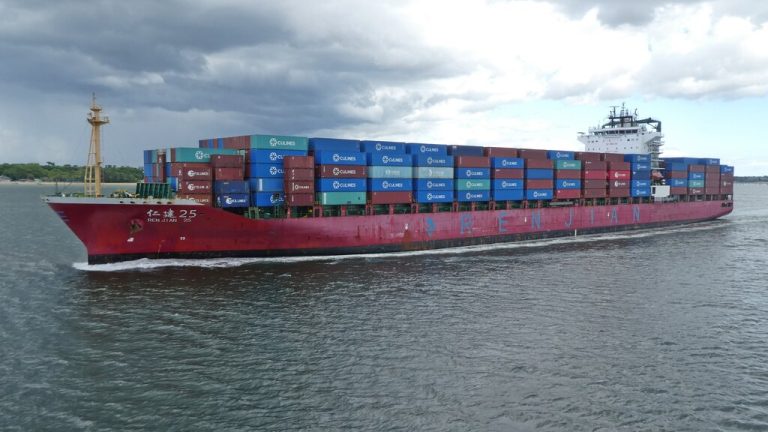
Image: “Chinese container vessel, Southampton Water,” by Roger Cornfoot, retrieved from https://commons.wikimedia.org/wiki/File:Chinese_container_vessel,_Southampton_Water_-_geograph.org.uk_-_7196703.jpg. This image was taken from the Geograph project collection. See this photograph’s page on the Geograph website for the photographer’s contact details. The copyright on this image is owned by Roger Cornfoot and is licensed for reuse under the Creative Commons Attribution-ShareAlike 2.0 license.