
Hamiltonian Journal
Turning to ECOWAS: U.S. Strategy in West Africa
Share On:
When a military coup in Niger successfully toppled its democratically elected government, thousands of demonstrators took to the streets of their capital waving the Russian tricolor in celebration. [1] While the Western world remained preoccupied with crises in Ukraine and elsewhere, the most significant response came from Niger’s own neighbors and former partners. The Economic Community of West African States (ECOWAS) imposed a series of stringent sanctions that ceased all financial transactions with Niger, froze assets in regional and commercial banks, halted substantial monetary aid to the country, and cut 80 megawatts of power from Niger’s energy grid. [2] Through actions like these, ECOWAS has remained one of the few consistent forces promoting stability and upholding democratic institutions amid growing instability in West Africa.
ECOWAS’ role is particularly important today, as West Africa is rapidly becoming a new battleground for great power competition between the United States, Russia, and China. Russian proxies – particularly the Wagner Group, an influential private military company – are running rampant in the region, arming and fighting for anti-Western autocrats. Meanwhile, Chinese investment diplomacy is pouring billions into the region, buying the allegiance of nations frustrated with Western neglect. [3] Once staunchly in the U.S. sphere of influence, the states of West Africa are increasingly slipping away from the Western-led world order. To counteract this, the United States should reorient its West African policy around engagement with ECOWAS, leveraging the regional bloc’s resources to promote shared objectives and, by extension, advance U.S. interests. Providing West Africa with the means to assert its independence is the most effective way to subvert the influence of our adversaries.
Rising Great Power Competition in West Africa
Africa is gradually becoming one of the most important theaters for the great power competition of the twenty-first century. By 2050, the continent will account for a quarter of the world’s population. It is already home to some of the fastest growing economies, a young and dynamic workforce, and vast reserves of critical rare-earth minerals — resources essential for reducing U.S. dependence on China. [4] West Africa is of particular importance, as significant volumes of global trade pass through its waters. [5]
The geostrategic importance of West Africa makes the recent instability in the region all the more concerning. Military juntas largely armed and financed by the Wagner Group toppled three governments in the region over the last four years: in Mali, Burkina Faso, and Niger. [6] The subsequent fallout has been disastrous for U.S. interests in the area. The juntas in power have largely resisted calls to restore civilian government. The leaders of each regime continue to maintain close ties with Russian paramilitaries; both General Salifou Modi, who seized power in Niger, and Captain Ibrahim Traoré, the coup leader in Burkina Faso, maintain close contact and cooperation with Russian intelligence. [7] The recent forced withdrawal of U.S. forces from the Agadez airbase in Niger severely restricts options for ongoing counterterrorism efforts in the Sahel, the region in West Africa where the Sahara Desert gives way to arable land. [8] The United States has lost significant ground in this theater and now should focus on containing the spread of instability and malign influence.
Russia is not the only rival player in West Africa. Beijing has also directed significant resources toward gaining a foothold in the region. Chinese economic investments completed under its Belt and Road Initiative continue to dwarf U.S. investments in the area. [9] Importantly, Chinese influence across the continent has been multifaceted. Mutual Sino-African trade is up to an all-time high of $200 billion USD annually, and over 10,000 Chinese firms now operate on the continent. Military assistance and arms transfers to sub-Saharan Africa now outpace U.S. military aid threefold. [10] France, the traditionally established power in West Africa, has increasingly been disinterested in maintaining control over its former colonies and no longer has the capacity to deter foreign influence. [11] Gradually, countries that were once supportive of U.S. interests are turning into the arms of China. This loss of diplomatic heft has been a tremendous hit to U.S. soft power that will only worsen unless corrected.
ECOWAS in Democracy Promotion and Regional Security
Founded in 1975, ECOWAS has remained the predominate regional institution and demonstrated a steady commitment to promoting regional security. [12] Following the Cold War, West Africa faced significant uncertainty, with conflicts in the region receiving little to no attention from major international powers. It was the recognition of this vulnerability that motivated the constituent states of ECOWAS to band together. In 1990, the bloc deployed military forces to intervene in the Liberian Civil War. Similarly, as Côte d’Ivoire teetered on the brink of civil war in 2002, ECOWAS played a key role in negotiating ceasefire agreements on two occasions, which ECOWAS peacekeepers subsequently enforced. [13] While the primary objective of these interventions was to contain the spread of conflict, the broader outcome highlights ECOWAS’ enduring commitment to preserving civilian governance and legitimate political authority within its member states.
The 2002 crisis in Côte d’Ivoire is particularly emblematic of this commitment. The crisis was triggered when incumbent President Laurent Gbagbo attempted to obstruct the peaceful transfer of power to President-elect Alassane Ouattara following his electoral defeat. ECOWAS was among the first actors to condemn his actions. More than this, ECOWAS suspended the Gbagbo regime from the organization and announced that that all its members “recognized Mr. Alassane Dramane Ouattara as president-elect of Ivory Coast.” [14] This swift diplomatic response underscored ECOWAS’ vested interest in upholding legitimate political transitions.
This approach is consistent with the collective interests of its member states. Successful coups tend to spread instability and legitimize challenges to incumbent regimes. No state in West Africa is incentivized to let one of its neighbors fall into civil war, as such violence could spread. As a result, ECOWAS’ primary objective is clear: to deter illegitimate seizures of power by raising their political, economic, and military costs — whether through diplomatic isolation, sanctions, or, when necessary, direct intervention. While this strategy may not stem from an inherent ideological commitment to liberal democracy, its practical effect is to reinforce U.S. interests in the region.
The United States faces two primary security threats in West Africa. First, growing instability and state failure have fueled the expansion of terrorist activity in the region. Terrorism in the Sahel has now reached an all-time high, specifically in and around the three states of Mali, Niger, and Burkina Faso. [15] When legitimate governments collapse and security forces withdraw, extremist groups step into the vacuum, establishing governance structures and consolidating their power. Worse, the expulsion of U.S., ECOWAS, and French forces from these three countries has further exacerbated the situation, effectively bringing counterterrorism missions to a halt. Second, the weakening of stable governments allows hostile actors to rapidly gain influence, particularly those affiliated with powerful states. The actions of Wagner in recent years demonstrates how quickly Russian forces can supplant pro-Western governments. [16] In relatively stable states, great power competition operates within a framework of international norms; but in the chaotic aftermath of military coups, these constraints disappear. A stable and prosperous West Africa would compel Russian and Chinese actors to compete through economic and diplomatic channels, remaining on level ground with U.S. efforts to counteract their influence.
In recent years, ECOWAS has demonstrated an increasing capability and determination to successfully manage regional crises. In 2017, Gambian President-elect Adama Barrow was forced into refuge in Senegal after incumbent President Yahya Jammeh refused to accept the election results. Internationally, this crisis garnered little attention, receiving only condemnations from both the United Nations (UN) and African Union (AU). Yet under the leadership of the ECOWAS Chair of the Authority of Heads of State and Government, Liberian President Ellen Johnson Sirleaf, the organization applied heavy diplomatic pressure. During the tense two-month standoff between the election and the January certification deadline, ECOWAS engaged in a series of decisive maneuvers. The organization assembled a regional coalition force in neighboring Senegal to signal readiness for potential military intervention. Several diplomatic delegations were dispatched to negotiate a peaceful resolution. Reports of Senegalese forces crossing into The Gambia further increased pressure on Jammeh. Finally, after receiving an ultimatum from ECOWAS warning that it would “take all necessary measures” to enforce the election results, Jammeh conceded power in exchange for exile in Guinea. [17]
Despite the intensely heated situation, the authorities and diplomats of ECOWAS successfully navigated the crisis, applied measured pressure, prevented escalation, and negotiated a peaceful end to an attempted seizure of power. This achievement is particularly notable given the limited support from the UN or AU. The events in The Gambia highlight ECOWAS’ growing institutional capacity to act as a stabilizing regional force. Moreover, they demonstrate the bloc’s ability to learn from past interventions. ECOWAS prevented the creation of a protracted conflict in The Gambia like those that followed its earlier engagements in Liberia and Côte d’Ivoire.
This is not to claim that ECOWAS has an unlimited capacity to apply its influence. The recent exit of Mali, Niger, and Burkina Faso from the bloc following their respective military coups underscores its limitations. [18] However, it is important to recognize that ECOWAS is engaged in an asymmetric struggle against significant Russian involvement in West Africa while also confronting its own internal security challenges. These obstacles will persist, but the bloc’s history and demonstrated commitment to regional stability present an opportunity to strengthen ECOWAS into a more capable and influential regional actor.
The United States would benefit from increased cooperation with ECOWAS. The bloc’s history of preserving democratic institutions acts as a stabilizing effect in the region; its role as a shared economic market helps mitigate the conditions that fuel terrorism and separatist movements; and ECOWAS has a vested interest in maintaining its autonomy and resisting foreign influence. [19] While no member state seeks to compromise its sovereignty, governments may feel compelled to turn to alternative patrons such as Russia or China when faced with instability. A stronger and more institutionally resilient ECOWAS will have the capability to deny U.S. adversaries room to expand their influence — without necessitating direct U.S. intervention.
Reducing the number of active geopolitical fronts in the growing competition with China and Russia should be a central objective of U.S. foreign policy. With conflicts in Eastern Europe and East Asia consuming the majority of U.S. strategic focus, attempting to unilaterally compete elsewhere risks overextending limited resources. The era of unquestioned U.S. dominance is waning as China pursues parity. This means that the traditional U.S. approach to West Africa – relying on bilateral relationships led by individual chiefs of mission – is no longer sufficient to address the broader threats to U.S. interests in the region. [20] To effectively consolidate areas of concern, the United States must empower regional partners and allies to manage their own security. This strategy could be particularly attractive to the Trump administration, which seems keen to prune the number of direct U.S. commitments abroad. As the most capable and ideologically aligned actor in West Africa, ECOWAS presents a key crucial to advance shared security interests — but only if the U.S. provides the necessary support.
Actionable U.S. Policy
The United States currently has tremendous room to expand its relationship with ECOWAS. First and foremost, establishing a dedicated U.S. mission to ECOWAS like missions for other international organizations is essential. The United States lacks a permanent ambassador to the organization, and most engagement occurs indirectly through relationships with individual member states. [21] A dedicated mission would enhance coordination of U.S. resources, particularly in addressing transnational issues such as counterterrorism and countering Chinese and Russian influence. This is especially important given China’s efforts to influence the ECOWAS. In 2019, China financed the construction of ECOWAS’ new headquarters in Abuja, Nigeria. [22] More recently, Beijing appointed Yu Dunhai, a seasoned diplomat and former Deputy Director in the Ministry of Foreign Affairs, as its seventh ambassador to the bloc. [23] The United States is falling behind in building a strategic partnership with the bloc and must act swiftly.
Second, the United States should expand economic cooperation with ECOWAS. The decision to end USAID partnerships, including support for the ECOWAS Agricultural Policy, was a misstep and should be reconsidered. [24] The United States should also strengthen economic ties with the region, as trade has sharply declined. Since 2012, U.S. exports to and imports from ECOWAS have dropped by 20 percent and 55 percent respectively, while foreign direct investment fell by 16.5 percent between 2021 and 2022. [25] In contrast, China has aggressively expanded its economic footprint, signing a cooperation agreement with ECOWAS in 2012 to develop infrastructure, trade, and investment. [26] Without stronger economic engagement, the growing influence of Chinese investment could weaken pro-U.S. sentiment in the region and undermine U.S. strategic interests.
Finally, the U.S. must prioritize diplomatic engagement with ECOWAS. The bloc should be treated as an equal partner on issues such as security, counterterrorism, and democratic governance. The Biden administration’s failure to incorporate Africa meaningfully into its grand strategy was a mistake. The only presidential visit to the continent in the past administration was to Angola in December of last year, an oversight that signals neglect rather than commitment. [27] The Trump administration should make West Africa a priority and engage directly with ECOWAS leadership. A high-profile diplomatic gesture, such as a presidential visit, would counter anti-Western sentiment and reinforce U.S. commitment to shared interests. If West African nations increasingly perceive their priorities as misaligned with those of the United States, they may become more receptive to a global order shaped by China and other revisionist powers. To establish itself as a reliable and preferred partner, the United States must afford ECOWAS and its leaders the same level of respect given to other key allies. U.S. hegemony can no longer be maintained by the United States alone.
Should the United States fail to recognize the importance of increasing cooperation with ECOWAS, our adversaries will seize the opportunity. The United States is already a decade behind in building a substantive partnership with the organization, and the window to act is closing. Without a shift in foreign policy, more of West Africa may drift further into Chinese and Russian spheres of influence, which would amount to the United States losing the great power competition in this increasingly critical region.
U.S. strategy in West Africa must turn to ECOWAS.
Clement Tsao ’28 serves as the President of the AHS chapter at the University of Pennsylvania, where he is majoring in International Relations and Mathematical Economics.
Notes:
[1] The Associated Press, “Supporters of Niger’s Coup March, Waving Russian Flags and Denouncing France,” NPR, July 30, 2023, https://www.npr.org/2023/07/30/1190969703/supporters-of-nigers-coup-march-waving-russian-flags-and-denouncing-france
[2] Bate Felix and Anait Miridzhanian, “What Sanctions Have Been Imposed on Niger since the Coup?” Reuters, August 2023, https://www.reuters.com/world/africa/what-sanctions-have-been-imposed-niger-since-coup-2023-08-08/
[3] Michael Shurkin, “No More Business as Usual: The US Needs a Broader Engagement Strategy in West Africa,” Atlantic Council, February 6, 2024, https://www.atlanticcouncil.org/blogs/new-atlanticist/no-more-business-as-usual-the-us-needs-a-broader-engagement-strategy-in-west-africa/
[4] Jim Garamone, “Commander Says Africa Is Too Important for Americans to Ignore,” U.S. Department of Defense, April 20, 2021, https://www.defense.gov/News/News-Stories/Article/Article/2580930/commander-says-africa-is-too-important-for-americans-to-ignore/
[5] Amine Ghoulidi, “Resetting U.S. West Africa Policy,” The Heritage Foundation, April 29, 2024, https://www.heritage.org/africa/commentary/resetting-us-west-africa-policy
[6] Gilles Yabi, “The Niger Coup’s Outsized Global Impact,” Carnegie Endowment for International Peace, August 2023, https://carnegieendowment.org/posts/2023/08/the-niger-coups-outsized-global-impact?lang=en
[7] Joe Inwood and Jake Tacchi, “Wagner in Africa: How the Russian Mercenary Group Has Rebranded,” BBC News, February 20, 2024, https://www.bbc.com/news/world-africa-68322230
[8] Jack Thompson and Sam Mednick, “The US Military Will Begin Plans to Withdraw Troops from Niger,” AP News, April 20, 2024, https://apnews.com/article/niger-us-military-withdrawal-junta-9e8a63bca3b8f1cc7fc3e8638dcfb702
[9] China Africa Research Initiative, “Chinese FDI in Africa Data Overview,” Johns Hopkins University’s School of Advanced International Studies, March 2024, https://www.sais-cari.org/chinese-investment-in-africa
[10] Committee on Foreign Affairs, “China Regional Snapshot: Sub-Saharan Africa,”US House of Representatives, November 21, 2022, https://foreignaffairs.house.gov/china-regional-snapshot-sub-saharan-africa/
[11] Laura Kayali and Clea Caulcutt, “France’s Niger Debacle Marks End of an Era in Africa,” POLITICO, September 27, 2023, https://www.politico.eu/article/france-niger-military-army-withdrawal-west-africa-sahel-colonies-burkina-faso-mali/
[12] Enoch Ndem Okon and Victor Ojakorotu, “Is ECOWAS a security community?” Journal of African Union Studies 11, (3) (12): 27-27–48, 2022, accessed October 18, 2024, https://proxy.library.upenn.edu/login?url=https://www.proquest.com/scholarly-journals/is-ecowas-security-community/docview/2759790942/se-2
[13] Akin Iwilade and Johnson Uchechukwu Agbo, “ECOWAS and the Regulation of Regional Peace and Security in West Africa,” Democracy and Security 8, no. 4 (2012): 358–73, https://www.jstor.org/stable/48602723
[14] “Mbeki Ends Mediation Mission,” Al Jazeera, December 7, 2010, https://www.aljazeera.com/news/2010/12/7/cote-divoire-expelled-from-ecowas
[15] David Lewis, Jessica Donati, and Kaylee Kang, “Why West Africa Is Now theWorld’s Terrorism Hotspot,” Reuters, September 24, 2024, https://www.reuters.com/world/africa/west-africa-becomes-global-terrorism-hotspot-western-forces-leave-2024-09-24/
[16] Marcel Plichta, Christopher Faulkner, and Raphael Parens, “The Wagner GroupLives on in Africa,” Lawfare, July 21, 2024, https://www.lawfaremedia.org/article/the-wagner-group-lives-on-in-africa
[17] Abdul-Jalilu Ateku, “Regional intervention in the promotion of democracy inWest Africa: An analysis of the political crisis in the Gambia and ECOWAS’ coercive diplomacy,” Conflict, Security & Development 20, no. 6 (2020): 677-696
[18] “Niger, Mali and Burkina Faso Military Leaders Sign New Pact, Rebuff ECOWAS,” Al Jazeera, July 6, 2024, https://www.aljazeera.com/news/2024/7/6/niger-mali-and-burkina-faso-military-leaders-sign-new-pact-rebuff-ecowas
[19] Joseph Sany, “For Peace in Africa, Boost Regional Blocs – Like West Africa’s ECOWAS,” United States Institute of Peace, April 24, 2024, https://www.usip.org/ publications/2024/04/peace-africa-boost-regional-blocs-west-africas-ecowas
[20] Marcus Hicks, Kyle Atwell, and Dan Collini, “Great-Power Competition Is Coming to Africa,” Foreign Affairs, March 4, 2021, https://www.foreignaffairs.com/articles/africa/2021-03-04/great-power-competition-coming-africa
[21] “Current U.S. Ambassadors,” American Foreign Service Association, September 30, 2024. https://afsa.org/list-ambassadorial-appointments
[22] Kester Kenn Klomegah, “China Signs Agreement to Build ECOWAS Headquarters,” Modern Diplomacy, December 6, 2022, https://moderndiplomacy.eu/2022/12/07/china-signs-agreement-to-build-ecowas-headquarters/
[23] Embassy of the People’s Republic of China in The Federal Republic of Nigeria, “Ambassador Yu Dunhai Arrives in Nigeria to Assume Duties,” Ministry of ForeignAffairs, August 10, 2024, http://ng.china-embassy.gov.cn/eng/zngx/cne/202408/t20240811_11469306.htm
[24] “Regional Partner in Economic Growth: ECOWAS,” Archive – U.S. Agency for International Development, September 23, 2016, https://2017-2020.usaid.gov/west-africa-regional/fact-sheets/regional-partner-economic-growth-ecowas
[25] Office of the United States Trade Representative, “Economic Community of West African States (ECOWAS),” Executive Office of The President, 2022, https://ustr.gov/countries-regions/africa/regional-economic-communities-rec/economic-community-west-african-states
[26] Embassy of the People’s Republic of China in the Republic of South Africa. “ECOWAS, China Sign Agreement for Cooperation in Infrastructure Development, Trade and Investment.” Ministry of Foreign Affairs, October 29, 2012, http://za.china-embassy.gov.cn/eng/zngx_1/ChinaSARelations2012/202401/t20240104_11216957.htm
[27] Mvemba Phezo Dizolele, “Biden Goes to Angola: Beyond the Lobito Corridor,” Center for Strategic and International Studies, December 3, 2024, https://www.csis.org/analysis/biden-goes-angola-beyond-lobito-corridor
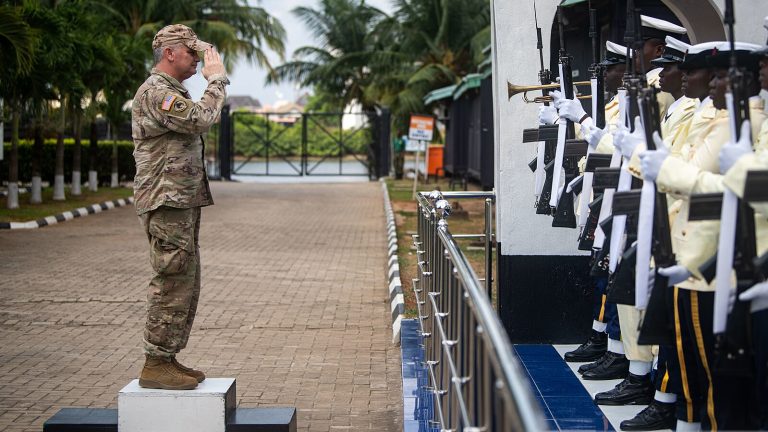
Image: “230202-N-DK722-1004 (Feb. 2, 2023) LAGOS, Nigeria – Nigerian Navy Honor Guard perform for U.S. Air Force Lt. Gen. Kirk Smith, deputy commander of U.S. Africa Command, during a visit to the Joint Maritime Security Training Center in Lagos, Nigeria, Feb. 2, 2023 during Obangame Express 2023. Obangame Express 2023, conducted by U.S. Naval Forces Africa, is a maritime exercise designed to improve cooperation, and increase maritime safety and security among participating nations in the Gulf of Guinea and Southern Atlantic Ocean. U.S. Sixth Fleet, headquartered in Naples, Italy, conducts the full spectrum of joint and naval operations, often in concert with allied and interagency partners, in order to advance U.S. national interests and security and stability in Europe and Africa,” by Mass Communication Specialist 1st class Cameron C. Edy, retrieved from https://commons.wikimedia.org/wiki/File:230202-N-DK722-1004_-_U.S._Africa_ Command,_NAVEUR-NAVAF_leadership_visit_Lagos,_Nigeria.jpg. This file is a work of a sailor or employee of the U.S. Navy, taken or made as part of that person’s official duties. As a work of the U.S. federal government, it is in the public domain in the United States.