

Hamiltonian Journal
Meet Trump’s Chief Economic Advisor: Alexander Hamilton
Share On:
The twenty-first century has brought about the revival of an American Founding Father. Beyond standing in the spotlight on a New York Broadway stage, Alexander Hamilton and his ideas of statecraft have come back to the most powerful setting on the world stage: The White House.
Alexander Hamilton shaped the largest and most powerful economic system in the history of the world. A brilliant young immigrant to the American Colonies, Hamilton became a student of economics, government, history, and philosophy. He had a strong grasp of human nature and called the new nation to a higher moral standard yet remained grounded in realism. At the time of his death in 1804, the Founding Father would only glimpse the initial impact of his proposals on the emerging nation. His revolutionary ideas spurred the economic and political development of the United States; and in 2025, American leaders are reviving the policies and perspective of Alexander Hamilton with a modern-day twist.
The Hamiltonian Perspective
In 1789, President George Washington appointed Hamilton to serve as the first Secretary of the Treasury. It was in this authoritative position that Hamilton could implement his ideas for American statecraft through economic means.
Hamilton believed in the potential of the United States. He recognized the vast resources at its disposal along with the mass of capital and labor that would allow the nation to wield vast economic power. To craft the economic state, Hamilton knew that investments in manufacturing, entrepreneurship, and business were vital for flourishing. In his description of Alexander Hamilton’s ideas, Professor Walter Russell Mead writes:
“The first critical idea from Hamiltonian thought is that business is the foundation not only of the United States’ wealth (and, therefore, of its military security) but also of its social and political stability. [1]”
Hamilton’s plan to strengthen the nation was rooted in the belief that geoeconomic strategy works, and that government investment in the economy was to be the foundation of growth. With federal support, the private sector would, in turn, stabilize the military, social, and political domains. Hamilton ultimately recognized the importance of economic statecraft when aiming at great global power.
Hamiltonian economics encourages an active government to establish a series of tariffs, subsidies, and investments. He believed that any foreign nation wanting to conduct business in the new United States ought to pay a tariff or duty on imported goods. The taxes on imports would begin to pay off debt from the Revolutionary War and increase the nation’s revenue. [2] Additionally, manufacturing would be subsidized and expanded along with investments in infrastructure and domestic commerce. [3] A strong market at home would set up American success abroad. To accomplish these goals, a government − preferably unburdened by foreign debt − must be involved.
The United States in the 1790s was not positioned to trade freely with the wealthy empires of Europe as Adam Smith’s Wealth of Nations would advocate. The new nation would have been most certainly disadvantaged. [4] Hamilton’s ambition to elevate America is presented in his Federalist No. 11 where he explicitly calls out the European powers over their fear of what the United States could become. Written in November 1787 before he became the first treasury secretary, Hamilton already advocated for trade barriers on European empires. He believed that regulations should be imposed so that the United States may “oblige foreign countries to bid against each other for the privileges of our [American] markets.” [5] Through these implementations, the United States could begin to bring in wealth to pay off debts and invest in domestic manufacturing.
While Hamilton believed in limited government, he also thought government ought to be strong and active in spurring economic growth. [6] At the time of the United States’s independence, most of its industries were in their infancy compared to the international competitors they faced. To address this issue, Hamilton proposed the imposition of tariffs on imported competitive goods to incentivize the growth of domestic manufacturing. Hamilton also recommended government subsidies to support strategic industries vital to national security and the pursuit of economic self-sufficiency. These measures helped lay the foundation for U.S. economic independence by protecting emerging sectors.
Later, in his Report on Manufactures, Hamilton claimed that the United States ought to be “independent of foreign nations for military and other essential supplies.” [7] Hamilton’s policies reflected a deep understanding of the importance of a strong domestic industrial base for national security and economic stability. He believed that tariffs and subsidies are essential tools for economic development. By prioritizing the growth of domestic industries, Hamilton sought to ensure that the United States could produce essential goods, particularly military and industrial supplies, without relying on foreign powers.
American State Factors
Four state factors are at play in Hamiltonian economics: abundant natural resources, an increasing and diverse population, vast geography, and a history of English institutional structure. First, the land’s abundance of natural resources provided a foundation for industrial and agricultural development. Hamilton saw the opportunity to harness these assets to build a self-sufficient economy. Second, he recognized the potential of the rapidly growing and diverse American population. The United States was well positioned to hold a strategic advantage in labor and capital.
Geography also played a critical role in Hamilton’s vision. The United States by Hamilton’s death held the thirteen original states along with territories under the Northwest Ordinance that extended to the Mississippi River. The Louisiana Purchase in 1803 was the first major expansion of the United States. After the deal, Hamilton wrote his opinion in an editorial in the New York Evening Post:
“This, it will be allowed, is an important acquisition, not, indeed, as territory, but as being essential to the peace and prosperity of our Western country, and as opening a free and valuable market to our commercial states. [8]”
The acquisition of the Louisiana Territory gave the United States a ripe opportunity to expand its economic power. Hamilton recognized that through such acquisitions, the country could become an arbiter for the whole North American continent and a force to be reckoned with on the world stage. [9] More territory would lead to more available resources that could help expand American industry and commerce.
Lastly, Hamilton understood the rich heritage from which the United States was born. British institutions offered a robust framework for central banking, rule of law, and government integration in the market. Professor Mead goes into further depth:
“[Hamilton] realized that the essence of British statecraft, adapted to American conditions, offered the best opportunity for his country to achieve the prosperity and strength that could stabilize its domestic politics. A powerful executive, a solid financial system supported by an independent central bank and a stable management of the public debt, an integrated national market supported by the rule of law and intelligent government investments in infrastructure—all these elements would, given the United States’ ample natural resources and entrepreneurial spirit, develop a strong, dynamic, and technologically advanced national economy. [10]”
Through harvesting the United States’ natural resources, enabling its diverse population, expanding its vast geography, and repurposing sound British institutions, Hamilton sought to secure a strong and prosperous nation capable of competing with the established powers of Europe. If these policy points sound familiar, that’s because Hamilton’s emphasis on natural resources, a diverse and skilled population, geopolitical expansion, and economic protectionism resonate with politically conservative minds today.
Hamilton and the New Trump Administration
The second inauguration of Donald Trump has ushered Hamiltonian economic thought back to the White House. While the president does not completely embody Hamiltonian values, his economic vision for the nation closely aligns with Alexander Hamilton’s. The modern application of Hamiltonian economics is different than the eighteenth century, but it retains core principles of trade protectionism, domestic industry investment, and geopolitical expansion.
There are challenges in applying an eighteenth-century economic philosophy to the twenty-first century. The context in which Hamilton and Trump are operating is different. It is impossible to wholly determine which modern applications Hamilton would support. Regardless of context, the means and the end goal of Hamiltonian economics are as follows: elevate the U.S. industrial base and geopolitical position through economic leverage. Hamilton sought to forge a manufacturing state from the ground up with limited resources. President Trump, already operating at the height of global economic power, seeks to reclaim a lost emphasis on U.S. manufacturing and rectify unfair trade deals. Just as Hamilton adapted British statecraft to his time, so too is the Trump administration taking a Hamiltonian approach, to the extent it can be applied in the modern day, to revive the industrial base and strengthen U.S. economic power.
Hamiltonian economics in the twenty-first century first involves a renewed use of tariffs. Trump has become a proponent for imposing tariffs on allies and adversaries alike. Treasury Secretary Scott Bessent has expressed his view that the United States should consider revitalizing Alexander Hamilton’s “favorite tool.” Secretary Bessent recalls that tariffs have previously served as tools of revenue generation and industry protection. Now, President Trump can use tariffs as a negotiating tool. [11] Bessent shares Hamilton’s view in Federalist No. 11 that foreign nations should be “bidding against each other for the privilege of our markets.” [12] From an op-ed in November 2024, Bessent wrote, “Our size gives us market power and the ability to dictate terms — other countries need us more than we need them. We have but to use that power.” [13] Since Bessent’s confirmation, there has been a pivot back to Hamiltonian economics the likes of which have not been seen since before the Second World War.
February 1, 2025, marked the first instance of tariffs as Trump’s new negotiating tool. President Trump imposed 25 percent tariffs on all imported goods from Canada and Mexico, along with an additional 10 percent tariff on Chinese goods. The White House issued a statement again echoing the words of Alexander Hamilton’s Federalist No. 11, claiming that “access to the American market is a privilege.” [14] To get Canada and Mexico to bolster their borders with the United States, Trump used economic leverage to achieve his national security goals. Mexico and Canada immediately retaliated with equivalent tariffs on U.S. goods, but within two days of the tariff imposition, Canada and Mexico came to the negotiating table. In return for a tariff delay, the two nations offered substantial armed deployments on their borders and promised to crack down on drug and weapons trafficking. [15]
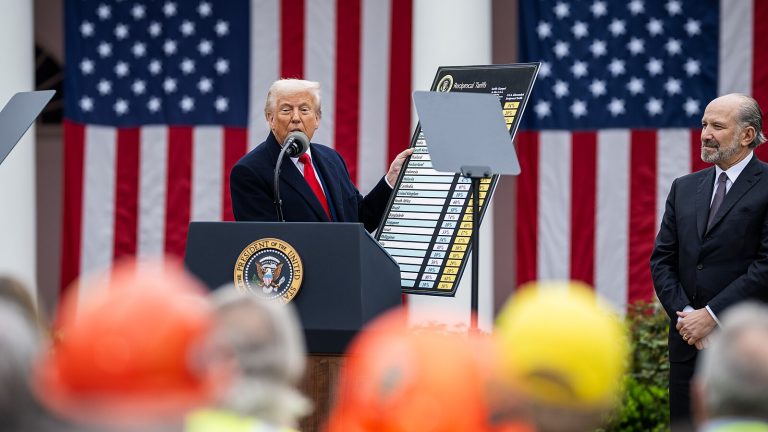
On April 2, 2025, President Trump unveiled what he deemed to be “Liberation Day” tariffs. This plan was designed to implement sweeping reciprocal tariffs on nations who had existing trade barriers on the United States. According to his “Reciprocal Trade” executive order, a baseline 10 percent tariff was applied to all trading partners with select exceptions. An additional ad valorem reciprocal tariff was put on further specified nations. [16] One week after the executive order, over seventy-five nations reached out to the White House to negotiate a revised trade agreement. In acknowledgement of this progress, President Trump issued a ninety day pause on reciprocal tariffs and reduced all duties to a 10 percent baseline.
Reciprocal tariffs in 2025 are rooted in a rejection of an earlier commitment to “differential tariffs,” which the United States created in the General Agreement on Tariffs and Trade after the Second World War. The United States lowered tariffs more than its trading partners with the goal to restore the decimated economies of Europe and Asia. Differential tariffs and U.S. investment helped revive global economies, but eighty years after the Second World War, these agreements largely remain and now disadvantage the United States by reducing U.S. export competitiveness. Author John Steele Gordon proposes that President Trump wants to “level the playing field” through removing status quo differential tariffs and replacing them with new reciprocal tariffs. [17]
China, a totalitarian and adversarial nation, has unfairly exploited the current global trade system. For decades, China leveraged its designation as a “developing economy” to protect itself while taking advantage of established “developed economies” through tariff and non-tariff barriers. China’s status as a “developing economy” is most recently noted in the 2025 United Nations World Economic Situation and Prospects. [18] In reciprocity for China’s “lack of respect” and retaliatory tariffs, Trump increased tariffs on Chinese imports to 125 percent. [19] China’s competitive edge in manufacturing has led Trump to stifle their global economic power through the waging of a trade war. Now, negotiations over trade are ever raging between the world’s top two economic powers.
Trump’s approach on trade demonstrates an extreme end of Hamiltonian economics. The leverage of a modern superpower is much greater than that of an emerging nation like the United States was in Hamilton’s day. It is unclear if Hamilton would support a sweeping implementation of tariffs on allied nations as Trump has imposed. However, Hamilton undoubtedly favored domestic protection. If he sensed that the country was in an unfair trade agreement, he would be unafraid to change the terms to the United States’ advantage. Tariffs have become a renewed tool of geoeconomic power and negotiation, but only time will tell if these increased trade barriers reinvigorate domestic manufacturing and refocus foreign investment.
President Trump appeals to the need to protect strategic industries like artificial intelligence, microchips, space travel, cryptocurrency, and energy. Much like coal, timber, manufacturing, and textile industries in Hamilton’s day, many advanced technologies are still in their infancy in 2025. Trump has courted private business leaders such as Elon Musk, Jeff Bezos, and Mark Zuckerberg to contribute to U.S. economic prosperity in the new administration. Two days after his inauguration, Trump announced a $500 billion private-public partnership to spur research and innovation in artificial intelligence. The plan was dubbed Project Stargate and includes three core investors: Sam Altman of Open AI, Larry Ellison of Oracle, and Masayoshi Son of SoftBank. [20] On February 24, 2025, Apple CEO Tim Cook announced a new $500 billion investment plan that will fund “American innovation and advanced high-skilled manufacturing and will support a wide range of initiatives that focus on artificial intelligence, silicon engineering, and skills development for students and workers across the country.” It is the largest development plan in the company’s history. [21] These agreements highlight new ambitions to protect the development of artificial intelligence, a vital economic sector with key national security implications, in the United States.
Innovation and development of artificial intelligence will lead to increased demands on energy. President Trump has argued that energy independence is the cornerstone of maintaining economic supremacy. [22] To this end, in the early days of his second administration, Trump took executive action to deregulate the U.S. energy sector. [23] On February 14, 2025, the Trump administration established the National Energy Dominance Council which is set to advise and direct energy policy aimed at “cutting red tape, enhancing private sector investments, and advancing innovation.” [24]
Other newly elected conservatives have revisited Hamilton’s economic ideas. Senator David McCormick of Pennsylvania wrote in his book Superpower in Peril: A Battle Plan to Renew America on the necessity of protecting and promoting vital U.S. industries. Senator McCormick has become an advocate of government involvement in critical economic sectors such as advanced technology and energy. McCormick asserts that government funding and regulatory reform in these areas will unleash U.S. economic potential. He writes that “targeted investments, matched by tax incentives and deregulation are designed to leverage the private sector and unlock American ingenuity.” [25] McCormick, like Hamilton, contends a flourishing business environment will strengthen the United States’ position in the world. [26] The government, while not the sole solution, is a key player in promoting and protecting the U.S. industrial base.
Congruent with Hamilton’s ambition for expansion in the late eighteenth century, President Trump now sees the acquisition of Greenland and the Panama Canal as essential to the United States’ national security and prosperity. Greenland offers a premier geostrategic position in the Arctic to counter Russian and Chinese operations. The land offers rich mineral deposits such as coal, precious metals, and uranium along with opportunities for offshore oil drilling. [27] These natural resources would provide a considerable advantage for American industry and prosperity. If Trump pursues this expansion plan, it is only through the consent of the Greenlandic people that an acquisition could be seen as legitimate, peaceful, and in good keeping with our allies.
Control of the Panama Canal, which the United States completed in 1914, would allow U.S. discretion over trade in the Western Hemisphere. Several clauses in the Panama Canal Treaty of 1977 cede authority to the United States to intervene in Canal operations should the neutrality of the treaty be unfairly violated. The conditions of U.S. intervention are outlined in Articles I, II, and IV under the Treaty Concerning the Permanent Neutrality and Operation of the Panama Canal. [28] Should President Trump express a reasonable concern that Canal neutrality has been violated via Chinese interference, he is within the right to reclaim operations of the Panama Canal. It is understood that Hamilton supported geopolitical expansion to bolster American economic prosperity and security. In a similar lens, Trump now seeks to acquire – or reclaim − territory to project the global influence of the United States. [29] In reviving Hamiltonian economic statecraft, President Trump must follow through on promises to strengthen the U.S. presence in Greenland and seek legitimate reclamation of the Panama Canal.
Conclusion
If the Trump administration is to continue to implement the vision of Alexander Hamilton, it must maintain involvement in the national and global economies to further the United States’ geopolitical position. While this doesn’t require the government’s hand in every aspect of society, active engagement is crucial in areas related to national security and economic stability. Even Adam Smith, the father of free trade, believed government involvement in the economy was justified for national security concerns. [30] Hamilton’s ideas of tariffs on imported goods, investment and protection of vital industries, and geopolitical expansion all adhere closely to President Trump’s agenda. He must continue to elevate the United States’ economic position by using tariffs as a leveraging tool. He should continue to deregulate vital economic sectors and spur government investment in advanced technologies and critical industries like artificial intelligence and domestic energy production. If thoughtfully accomplished, his goal to expand the U.S. presence in Greenland and the Panama Canal will produce economic rewards.
Trump models Hamilton’s ideal of an energetic executive as advocated in Federalist No. 70, but he must also have a willing and active legislature to realize his plans. [31] The president has willing supporters in Congress like Senator McCormick whom he must court to provide legislative backing to his economic proposals and executive orders. The Hamiltonian tools for economic prosperity and national security are all in place. Now the branches of government must work together to effectively wield them.
After two-hundred and fifty years, the spotlight has now returned to Alexander Hamilton. At the nation’s founding, Hamilton lit a spark that ignited the United States’ rise to preeminence. His ideas have worked once before, and with a modern application, they can be used to keep the United States at the peak of global power. New national leaders are turning back the pages of history to see if Alexander Hamilton’s vision really can Make America Great Again.
Luke D’Ambrosio ‘25 served as the President of the AHS chapter at Baylor University, where he earned a B.A. in Political Science.
Notes:
[1] Walter Russell Mead, “The Return of Hamiltonian Statecraft,” Foreign Affairs, August 20, 2024, https://www.foreignaffairs.com/united-states/return-hamiltonian-statecraft-walter-mead
[2] Alexander Hamilton, “Report Relative to a Provision for the Support of Public Credit,” National Archives, January 9, 1790, https://founders.archives.gov/documents/Hamilton/01-06-02-0076-0002-0001
[3] Alexander Hamilton, “Alexander Hamilton’s Final Version of the Report on the Subject of Manufactures,” National Archives, December 5, 1791, https://founders.archives.gov/documents/Hamilton/01-10-02-0001-0007
[4] Mead, “The Return of Hamiltonian Statecraft,” Foreign Affairs
[5] Alexander Hamilton, John Jay, and James Madison, “Federalist No. 11,” in The Federalist Papers, (London: Read Books Ltd, 2018)
[6] Mead, “The Return of Hamiltonian Statecraft,” Foreign Affairs
[7] Hamilton, “Report on the Subject of Manufactures,” National Archives
[8] Alexander Hamilton, “Purchase of Louisiana,” National Archives, July 5, 1803, https://founders.archives.gov/documents/Hamilton/01-26-02-0001-0101
[9] Hamilton et al., “Federalist No. 11,” The Federalist Papers
[10] Mead, “The Return of Hamiltonian Statecraft,” Foreign Affairs
[11] Scott Bessent, “Let’s Talk Tariffs. It’s Time to Revitalize Alexander Hamilton’sFavorite Tool,” Fox News, November 14, 2024, https://www.foxnews.com/opinion/scott-bessent-talk-tariffs-its-time-revitalize-alexander-hamiltons-favorite-tool
[12] Hamilton et al., “Federalist No. 11,” The Federalist Papers
[13] Bessent, “Let’s Talk Tariffs,” Fox News
[14] “Fact Sheet: President Donald J. Trump Imposes Tariffs on Imports from Canada, Mexico and China,” The White House, February 12 2025, https://www.whitehouse.gov/factsheets/2025/02/fact-sheet-president-donald-j-trump-imposes-tariffs-on-imports-from-canada-mexico-and-china/
[15] Josh Boak, Fabiola Sánchez, and Rob Gillies, “President Donald Trump Agrees to Pause Tariffs on Mexico and Canada,” AP News, February 3, 2025, https://apnews.com/article/trump-tariffs-canada-mexico-china-sheinbaum-trudeau-017efa8c3343b8d2a9444f7e65356ae9
[16] “Regulating Imports with a Reciprocal Tariff to Rectify Trade Practices That Contribute to Large and Persistent Annual United States Goods Trade Deficits –The White House,” The White House, April 2, 2025, https://www.whitehouse.gov/presidential-actions/2025/04/regulating-imports-with-a-reciprocal-tariff-to-rectify-trade-practices-that-contribute-to-large-and-persistent annual-united-states-goods-trade-deficits/
[17] John Steele Gordon, “Tariffs in American History,” Imprimis, May 22, 2025, https://imprimis.hillsdale.edu/tariffs-in-american-history/
[18] United Nations Department of Economic and Social Affairs, World Economic Situation and Prospects 2025, January 9, 2025, https://www.un.org/development/desa/dpad/publication/world-economic-situation-and-prospects-2025/
[19] Donald J. Trump, “Based on the lack of…,” Truth Social, April 9, 2025, https://truthsocial.com/@realDonaldTrump/114309144289505174
[20] Paul Smith-Goodson, “The Stargate Project: Trump Touts $500 Billion Bid For AI Dominance,” Forbes, January 30, 2025, https://www.forbes.com/sites/moorinsights/2025/01/30/the-stargate-project-trump-touts-500-billion-bid-for-ai-dominance/
[21] “Apple Will Spend More than $500 Billion in the U.S. over the next Four Years,” Apple, February 24, 2025, https://www.apple.com/newsroom/2025/02/apple-will-spend-more-than-500-billion-usd-in-the-us-over-the-next-four-years/
[22] Donald J. Trump, “Agenda47: America Must Have the #1 Lowest Cost Energy and Electricity on Earth,” September 7, 2023, https://www.donaldjtrump.com/agenda47/agenda47-america-must-have-the-1-lowest-cost-energy-and-electricity-on-earth
[23] “Unleashing American Energy,” The White House, January 20, 2025, https://www.whitehouse.gov/presidential-actions/2025/01/unleashing-american-energy/
[24] “Fact Sheet: President Donald J. Trump Establishes the National Energy Dominance Council,” The White House, February 14, 2025, https://www.whitehouse.gov/fact-sheets/2025/02/fact-sheet-president-donald-j-trump-establishes-the-national-energy-dominance-council/
[25] “Environment and Mineral Resources,” Greenland Institute of Natural Resources, February 4, 2019, https://natur.gl/guidance/miljoe/?lang=en
[26] Siladitya Ray, “Trump Says US Should Take Ownership Of Greenland And Threatens Panama Canal Takeover,” Forbes, December 23, 2024, https://www.forbes.com/sites/siladityaray/2024/12/23/trump-says-us-should-take-ownership-of-greenland-and-threatens-to-takeover-panama-canal/utm_source=Whatsapp&utm_medium=social&utm_campaign=Forbes
[27] “Panama Canal Treaty of 1977,” U.S. Department of State Archive, September 7, 1977, https://2001-2009.state.gov/p/wha/rlnks/11936.htm
[28] David McCormick and James Cunningham, Superpower in Peril: A Battle Plan to Renew America, (New York, NY: Center Street, 2023), 151
[29] Mead, “The Return of Hamiltonian Statecraft,” Foreign Affairs
[30] Adam Smith, An Inquiry Into The Nature and Causes of The Wealth of Nations, (New York, NY: Bantam Classic Edition, 2003), 580
[31] Alexander Hamilton, John Jay, and James Madison, “Federalist No. 70,” in The Federalist Papers, (London: Read Books Ltd, 2018)
Image: “President Donald Trump signs an Executive Order on the Administration’s tariff plans at a “Make America Wealthy Again” event, Wednesday, April 2, 2025, in the White House Rose Garden,” by The White House, retrieved from https://commons.wikimedia.org/wiki/File:Trump_showing_a_chart_with_reciprocal_tariffs.jpg. This file is a work of an employee of the Executive Office of the President of the United States, taken or made as part of that person’s official duties. As a work of the U.S. federal government, it is in the public domain.