

1776: The Beginnings of American Exceptionalism Abroad
To Raise an Army: Founding America’s Military
Share On:
“The liberties of a people,” Brutus declared in Anti-Federalist No. 10, “are in danger from a large standing army.” In early America, standing armies smacked of royal tyranny; they were the “dangerous engine of despotism.” [1] The rise of America’s military is therefore peculiar. Why and how did this liberal experiment come to possess awesome military power?
I argue that America’s military institutions came about through a synthesis of particular dangers and ideas. The nation’s Founders had both a strategic imperative to raise an army and an ideological commitment to restrain it. The genius of their compromise was securing the nation while preserving its liberal character. In this essay, I explain the origins of early American military institutions, consider the ideas of the Founders, explore the strategic situation facing the young nation, and examine its expression in these institutions, specifically the standing army.
The State Makes War
“War made the state,” Charles Tilly observes.[2] The threat of war is central to building state institutions, especially those producing military power. Different threats should lead to very different military institutions. Continental powers raise armies; maritime powers build navies. But the threat of war cannot explain all of their differences. “The most distinctive, the most fascinating, and the most troublesome aspect” of the military, Samuel Huntington notes, is its Janus face. Military institutions live in two worlds: international politics and domestic politics.[3] The latter shapes the military’s relation to the polity, its political and legal constraints, and its institutional character. Producing military power does not happen in a vacuum but within the state. “The state made war,” Tilly continues.[4]
In developing states, civic ideas should play an outsized role in making military institutions. America’s Founders had deep ideas about civic life and, in their War of Independence, claimed the opportunity to realize them. To make a nation, however, they had to reconcile the contradictions between their aspirations and their circumstances. The first new nation was an experiment in republican self-government. But it was still a state in search of security, facing dangers near and far. For the Founders, this meeting of liberal ideas and growing threats formed a “strategic synthesis,” to borrow Aaron Friedberg’s term, manifest in America’s military institutions.[5]
The Bane of Liberty
“The people of America,” Alexander Hamilton observed in Federalist No. 26, “have derived a hereditary impression of danger to liberty from standing armies in time of peace.”[6] Early Americans inherited their suspicion of standing armies from British tradition. For Whigs, the English Civil War was a struggle between the monarchy and Parliament to defend the rights of Englishmen. Oliver Cromwell’s army “expelled that Parliament under which they had fought . . . [and] destroyed the government they before set up,” wrote John Trenchard, a radical Whig. Therefore, “the Constitution must either break the Army, or the Army will destroy the Constitution.”[7]
Americans carried the legacy of English political development. The Petition of Right in 1628 protested the Crown’s arbitrary exercise of martial law, which included quartering soldiers, in defiance of the Magna Carta. Leading up to the Glorious Revolution, King James II increased the size of his army and, after the Revolution, the English Bill of Rights of 1689 declared that “the raising or keeping a standing army within the kingdom in time of peace, unless it be with consent of Parliament, is against law.”[8] The Mutiny Act of 1689 reinforced this constraint, further limiting the duration of armies to one year. In English tradition, standing armies were synonymous with tyranny and despotism. For the Anglo-Americans, as Alexis de Tocqueville called them, tension between arms and liberty was a given.[9]
Yet American apprehension of standing armies was subdued before independence. The colonies had prospered under the British policy of “salutary neglect,” exercising greater autonomy in colonial affairs. Yet as British colonial interests expanded, its military presence increased. In 1763, London stationed several thousand soldiers in the colonies, signaling greater imperial control and arousing colonial anxiety.[10] As colonial resistance grew, so too did royal punishment. The so-called Intolerable Acts, which included quartering of British soldiers, “were meant to be punitive and were also calculated to reduce the colonies to proper subordination.”[11] Through coercion the Crown proved Whig warnings against martial despotism to be prescient. The British army, Richard Kohn writes, represented for the colonists “the ‘conspiracy against liberty’ . . . the agent of European corruption . . . the iron fist of customs regulations, the tyranny of trial without jury.”[12] For founding Americans, prejudice against a standing army in peacetime was both a first principle and the product of lived experience. Among the “history of repeated injuries and usurpations” committed by the king, the Declaration of Independence charged that “he has kept among us, in times of peace, standing armies without the consent of our legislatures.”[13] Political debates proceeded from this premise, but the premise itself was never in doubt.
After the War of Independence, episodes of military subversion seemed to confirm suspicion of a standing army. When Henry Knox formed an organization for veteran officers, the Society of Cincinnati, the public feared the emergence of a military nobility. When Congress refused to discharge the Continental Army until it achieved a peace treaty with Britain, mutinous men marched on the Pennsylvania State House which hosted it.[14] When Congress refused to pay out postwar pensions, army officers allegedly conspired to challenge its authority in the so-called Newburgh Conspiracy. Quelling them required George Washington to appeal to his personal sacrifice, reminding them that he had become “almost blind in the service of my country.”[15] That Washington set a precedent in obeying civil authority reflects the early state of civil-military relations. A tyranny of the military did not come to pass, but its specter worried many Americans. The army was forged in the crucible of war but was not yet a professional force in peacetime. The significance of these early civil-military crises, Kohn believes, cannot be overstated.[16] Suspicion of standing armies permeated the first years of the nation.
Military Misfortunes
The American military was born weak. Thanks to British naval power and oceanic buffers, the colonies enjoyed a safer neighborhood than European states. Before independence, their military needs were modest. The colonies relied only on the militia as an economical means of limited defense. Colonial militia resembled the English system, and London required that the colonies maintain them to augment British forces.[17] Yet the colonial militia was more a concept than a capability. Widespread service exemptions, low readiness, and poor standards made it weak.[18] As merely a colonial militia, moreover, it was bound to colonial borders. “It was not a fit instrument for prolonged warfare on distant frontiers,” writes Russell Weigley.[19] The war for independence demanded a better military instrument.
In June 1775, Congress established the Continental Army and appointed George Washington to command it. He espoused a modest opinion of the militia. During the Seven Years’ War, Washington had seen it in action alongside British regulars. He found that too few militiamen turned out to serve and too many panicked and deserted in battle. Washington believed the Continental Army should instead resemble the British, “a respectable army” of discipline and character.[20] But the Continental Army would support, not replace, the militia. There was a shortage of competent officers, and most men, given the choice of regular or militia service, favored the latter. The Continental Army had to fight in tandem with the militia, a “dual army” consisting of a large reserve force and a small professional force. Though Washington was forced to rely on it in battle, his opinion of the militia did not improve. Fighting without a professional army meant “certain, and inevitable ruin,” Washington wrote.[21] The war set the stage for a civil-military conflict to be resolved after it was won.
For its part, Congress was cautious about creating an army even in wartime. It followed the counsel of Samuel Adams that a “standing Army, however necessary it may be at some times, is always dangerous to the Liberties of the People.” Because the army must “be watched with a jealous Eye,” Congress insisted on civilian control. It directed Washington and subordinate generals to report regularly and “observe and follow” its orders. It set war aims, strategy, force structure, budgets, and regulations. It also established an oversight body—the five-member Board of War and Ordnance—to continually administer the army, however poorly.[22] By the war’s end, Congress even asserted its authority over the states, which refused to adequately supply the army, by centralizing military management within executive departments.[23] The state created the army, but the army was also creating the state. If America found a civil-military equilibrium, though, independence would soon disrupt it.
There was no question that the Continental Army would disband after the war.[24] But the future of the American military was an open question. For war leaders under Washington, a clear lesson had been that a poorly organized and untrained militia was inadequate to the needs of prolonged warfare.[25] The nation needed men capable of defeating British regulars in battle: a professional military. In April 1783, the Continental Congress appointed Alexander Hamilton, a former aide to Washington, to chair a committee to study the issue. Hamilton turned to Washington for counsel. In his “Sentiments on a Peace Establishment,” Washington outlined four points.
First, a regular standing force was necessary to “awe the Indians,” protect trade, prevent encroachment by British Canada or Spanish Florida, and hedge against surprise.[26] Second, a well-organized militia should “pervade all states” and “introduce similarity,” nationalizing and standardizing the state militias.[27] Washington emphasized this part, no doubt seared into his mind by the experience of battle. Citizens who enjoyed the protection of the government were obligated to defend it. Organized militias provided that “the total strength of the country might be called forth at a short notice on any very interesting emergency.”[28] Washington did not prescribe details but insisted that “sameness prevails” in organizing the military.[29] To oversee it, he called for an inspector general (a post which Hamilton would later assume).[30] Third, Washington wanted national arsenals to supply the military. Fourth, military academies should study the art of war, “knowledge of which is most difficult to obtain.”[31] In sum, Washington wanted a professional military.
Yet Washington produced a political document, not a purely military one. He admitted that America was mostly secure, for the moment, and did not need a large army. “Fortunately for us our relative situation requires but few.”[32] He anticipated the counter-argument of balancing liberty and security. “Although a large standing army in time of peace hath ever been considered dangerous to the liberties of a country, yet a few troops, under certain circumstances, are not only safe, but indispensably necessary.”[33] He appears to have tempered his preference for a minimal militia and substantial army; neither was politically acceptable. Washington settled for “a respectable and well-established militia.” The army and the militia had come to represent rival politics; Washington reconciled them.[34] The “Sentiments” therefore outlined a military within the art of the possible, not one Washington “conceived ought to be a proper peace Establishment.”[35] It was a microcosm of national debate.
Hamilton adopted much of Washington’s “Sentiments” in his committee report to the Continental Congress. Before taking up the question of what the legislature should do, the report considered what it legally could do. The report interpreted the Articles of Confederation as granting the United States the power to establish a military, while denying that power to the states. Military necessity was crucial to its pragmatic reading of the law. The United States could not “wait for an actual commencement of hostilities” before preparing defenses because it would simply take too long to do so. “There cannot be presumed so improvident an intention in the Confederation as that of obliging the United States to suspend all provision for the common defense until a declaration of war or an invasion.”[36] Surely, the Articles of Confederation could not outlaw national survival.
Given the authority to establish a military, the committee submitted that there are “conclusive reasons” for it. Those reasons were largely practical. Separate states could not easily defend unincorporated territory, rivers, fisheries, or commerce. Fortifications built to different standards would be less effective and efficient. Those few states with larger forces would not have in mind the needs of the many. A centralized supply plan would better arm the military than a distributed one. Duplicate military education and training would be wasteful. Citing Washington and others, the committee concluded that a military establishment was necessary and that it should be a national one.[37] It proceeded to detail standards for military structure, fortifications, arms, and academies. With less emphasis than Washington, the committee also noted the importance of a well-regulated militia. Hamilton’s report was to implement the Federalist vision within national debate.
Yet Washington and his followers lost this debate. Skeptics of a strong central government were ascendent in the Confederation Congress. They questioned the need for a professional military when a lesser one had defeated the British. In June 1784, then, Congress disbanded the Continental Army. It reduced the military establishment to the 1st American Regiment, comprising 700 militiamen volunteered by four states for one year. While Congress later extended the authorization for a few more years, America’s first peacetime standing force was hopelessly weak. The 1st American Regiment could hardly hold the frontier or defend against colonial aggression, as Washington hoped a respectable army would.[38] So for a time, as Russell Weigley writes, “the United States relied for national defense on distance and foreign forbearance alone.”[39]
Competing Visions
The Articles of Confederation assured military weakness. Yet beliefs about the army, writes Huntington, “were essentially the extension in the military realm of different political beliefs.”[40] The question of the military was essential to America’s constitution as a polity. If the standing army represented the imposing legacy of the Crown and royal tyranny, the militia “embodied the democratic principle that defense of the nation was the responsibility of every citizen.”[41] Among the Founders, the debate over the army versus the militia shadowed that of a weak federal government versus a strong one.
Liberals inherited the English tradition of John Locke, starting from a defense of the individual against the state. While liberals were suspicious of power at home, they were apathetic to its employment abroad. Liberalism prevailed in early America, instilling apprehension of a nation under arms. Liberals saw the army as incompatible with a loose confederation that favored states’ rights. Thomas Jefferson personified this vision of government, that “none but an armed nation can dispense with a standing army.”[42] A universal militia, Jefferson believed, would ensure the “military sovereignty of the people.”[43]
Champions of the army, by comparison, were essentially conservative in character. They emerged from the commercial and manufacturing hubs of New England. They oriented toward Great Britain and were highly attuned to Atlantic affairs. And they subscribed to the primacy of foreign policy and currency of military power. Walter Russell Mead reflects that these men were “much more hospitable to the instruments of warfare—above all, to navies, but also to a professional standing army—than American politicians who worried about the political consequences of professional armed forces.”[44] Conservatives attached importance to the army as a positive instrument of statecraft. As Huntington notes admiringly, they “did not condemn nor eschew power politics; they played the game with some enjoyment and considerable finesse.”[45] The Founders had competing visions of military institutions as much as they had competing visions of politics. The Constitution would have to synthesize this dialectic of their aspirations and circumstances.
A Strategic Synthesis
When Americans convened to decide a new government, the contradictions between their aspirations and circumstances came to the fore. The militia and army were military institutions representing rival views of government. Like Washington’s dual army, the Constitution had to find a compromise between the two.
The notion of maintaining a large military establishment was radical even to those who favored a powerful central state. It was even less acceptable to most Americans. “With respect to a standing army,” stated Virginia delegate to the Constitutional Convention Edmund Randolph, “I believe there was not a member in the federal Convention, who did not feel indignation at such an institution.”[46] Opponents of the new constitution centered their attacks on it. In opening remarks at the convention, Randolph acknowledged that the Articles “produced no security against foreign invasion” because the government was not “permitted to prevent a war nor to support it by [its] own authority.”[47] The first draft of the Constitution bestowed this power, “to raise armies.”
The so-called army clause drew sharp criticism. Gerry, a delegate from Massachusetts, protested the army clause throughout the convention. He “inveighed against [it] as dangerous to liberty, as unnecessary, even for so great an extent of Country as this.”[48] In debating a congressional veto over state laws, Gerry worried the federal government may encroach upon the “regulations of the militia, a matter on which the existence of the state might depend. The national legislature, with such a power, may enslave the states.”[49] Randolph and George Mason of Virginia attempted to endorse the militia as guarding against “the danger of standing armies in times of peace.”[50] Even the Federalist James Madison warned that “a standing military force, with an overgrown Executive will not long be safe companions to liberty.”[51]
Yet champions of the army effectively rebutted their critics. When Gerry sought to limit the size of the peacetime force, Jonathan Dayton of New Jersey responded that “preparations for war are generally made in peace.” When Hugh Williamson of North Carolina and Charles Pinckney of South Carolina attempted to limit the length of its appropriations, Roger Sherman of Massachusetts countered that the clause provided a “reasonable restriction on the number and continuance of an army in time of peace.”[52] Ultimately, the delegates only voted for clerical changes to the clause, “to raise and support armies,” without great debate.
Anti-Federalists were searing in their criticism. As Mason protested, “There is no declaration of any kind . . . against the danger of standing armies in time of peace.”[53] For this reason, three delegates—Gerry, Mason, and Randolph—refused to sign the final Constitution. The ratifying conventions of the states proved even more reluctant, with proposed amendments to declare such an army “dangerous to liberty.”[54] In Anti-Federalist No. 10, “Brutus” erected a straw man of the Federalist position. Standing armies represented the “dangerous engine of despotism.”[55] They jeopardize liberty not only because leaders can use them to control government, as Caesar did in Rome and Cromwell in Britain, but also because the army itself may subvert government. The United States could not, Brutus argued, have the power to raise an army “without restraint, at their discretion.”[56] A militia was more compatible with the preservation of republican liberties. Indeed, the very purpose of a militia is “to prevent the establishment of a standing army, the bane of liberty,” debated Congressman Elbridge Gerry during ratification of the Constitution.[57]
The proposed Constitution, carrying the army clause, needed defenders of its own. In Federalist No. 8, Hamilton warned of quarrelsome states in a disunified nation without an army. “War between the states, in the first period of their separate existence, would be accompanied with much greater distress.” States relying on separate militias would be more vulnerable to aggression. “Frequent war and constant apprehension” would “infallibly produce” standing armies. Because “the perpetual menacings of danger oblige the government to be always prepared to repel it,” warring states would impose armies upon citizens “subjected to frequent infringements on their rights.”[58] Americans should therefore prefer a single standing army to a dozen of them.
Beyond its borders, danger surrounded the United States. This reality should “warn us against an excess of confidence or security,” Hamilton wrote in Federalist No.24. British and French colonies ringed the continent, and “the savage tribes on our Western frontier ought to be regarded as our natural enemies.” Defending against them with militias “is impracticable; and if practicable, would be pernicious.”[59] Far from a “natural bulwark,” said Federalist No. 25, the militias were inadequate. “The steady operations of war against a regular and disciplined army can only be successfully conducted by a force of the same kind.” The United States needed a professional army because “war, like most things, is a science to be acquired and perfected by diligence, by perseverance, by time, and by practice.”[60] A professional military was a strategic imperative; the Constitution had to realize it.
The Federalists would appear to have won the argument. In fact, the military of the Constitution was a careful compromise. It represented the synthesis of a strategic imperative and its liberal antithesis. Reconciling the contradictions of circumstance and aspiration took a stroke of genius. Because the vexing problem of the military resembled the problem of government, the Constitution offered the same solution to both: a separation of power.
The Constitution made the authority of government to establish a military beyond question, its power limited only by money and popularity. Under Article I, Congress would “have the power . . . to declare war . . . [and] to raise and support armies.”[61] It would also have the power to “[call] forth the Militia” to serve the United States, “to execute the Laws of the Union, suppress Insurrections, and repel Invasions.”[62] The government would deny this power to the states: “no State shall, without, the Consent of Congress . . . keep troops . . . in times of Peace.”[63] The president would wield the power of the sword. Article II states that he “shall be Commander in Chief of the Army . . . of the United States, and of the Militia of the several States, when called into actual service of the United States.”[64] Congress would also “have the power to lay and collect Taxes . . . [to] provide for the common Defence” the sinews of war.[65] The Constitution, then, designed a state capable of producing military power.
Yet the Framers also understood that power must check power. Congress would raise armies, but the president would command them. The president would appoint officers, but Congress would confirm them “by and with the Advice and Consent of the Senate.”[66] Congress would declare war, but the president would wage it. The Constitution devised a structure of power such that “a dangerous standing army could be created only through ‘conspiracy,’ a ‘combination between the executive and legislative in some scheme of usurpation.’”[67] Even Congress’s power of the purse was internally balanced, for “no appropriation of money to that Use [to raise and support armies] shall be for a longer Term than two Years.”[68] The Constitution channeled the Whig inheritance of its liberal framers. It guarded against the tyranny of the executive army under Charles I and the parliamentary army under Cromwell.[69] The American military would obey two civilian masters.
The Constitution separated power further, both within the federal government and between it and the states. The states would retain separate but uniform militias, “a well-regulated militia being necessary to the security of a free state.”[70] Just as the colonial militia checked the British army, so too would the state militia check the federal army. The Constitution codified the dual-army arrangement born in the War of Independence. These forces were complementary because they were opposing; neither was politically acceptable alone. Therefore, the solution to the problem of government was the same for the military, to divide it and divide it again.
The power of government to establish a military was ambivalent because it was synthetic, the product of a strategic imperative and its liberal antithesis. Liberal ideas restrained strategic impulses to make them compatible with a liberal republic.[71] Their influence on American military institutions was lasting. The soldier is subordinate to civil authority, obedient to the executive and legislature, and supreme in the profession of arms. The liberal antithesis, then, produced not a defect but a feature of American military power.
The Strategic Imperative
The American military was born of conflict. During the War of Independence and after, the Founders had to reconcile the differences between their political aspirations and strategic circumstances. Idealism decried a standing army; realism demanded it. The task was to make America’s military compatible with American society, a modern “Sparta in the midst of Babylon.”[72] The Founders formulated a strategic synthesis, establishing a martial institution below civilian masters and under divided power.
The Constitution thus resolved the civil-military problématique, as Peter Feaver defines it, creating “a military strong enough to do anything the civilians ask them to with a military subordinate enough to do only what civilians authorize them to do.”[73] Though stable, America’s civil-military equilibrium is not static. Perennial debates over grand strategy and recurring crises of civil-military relations reflect a dynamic relationship between armed force and the society it serves. Yet the ambivalence of American military power has proven a source of its professionalism, its enduring strength. America’s ideals shaped how it would forge—and wield—the power of the sword.
Yashar Parsie is an analyst in Washington, D.C. He is an alumnus of the Alexander Hamilton Society’s Security and Strategy Seminars on China, Iran, and U.S. defense policy, and he holds a BA from the University of Washington.
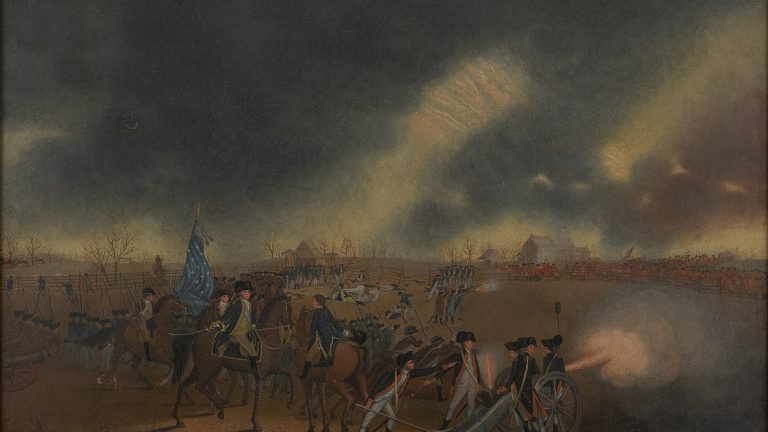
Image: The Battle of Princeton by James Peale.jpg, 1782, from James Peale and the Princeton University Art Museum. Retrieved from: https://commons.wikimedia.org/wiki/File:The_Battle_of_Princeton_by_James_Peale.jpg, used under Wikimedia Commons.

[1] Kurland and Lerner, eds. The Founders Constitution Volume 3, Article 1, Section 8, Clause 12, Document 23, https://press-pubs.uchicago.edu/founders/documents/a1_8_12s23.html.
[2] Charles Tilly, “Reflections on the History of European State-Making,” in Charles Tilly, ed., The Formation of National States in Western Europe (Princeton: Princeton University Press,1975), 42.
[3] Samuel P. Huntington, The Common Defense: Strategic Programs in National Politics (New York: Columbia University Press, 1961), 1.
[4] Tilly, “Reflections on the History of European State-Making,” 42.
[5] Aaron L. Friedberg, In the Shadow of the Garrison State: America’s Anti-Statism and its Cold War Grand Strategy (Princeton: Princeton University Press, 2000), 62
[6] Alexander Hamilton, “Federalist 26,” in The Federalist, ed. Jacob E. Cooke (Middletown, CT: Wesleyan University Press, 1982), 166.
[7] John Trenchard, An Argument Shewing that a Standing Army is Inconsistent with a Free Government and Absolutely Destructive to the Constitution of the English Monarchy (London: 1697), 28
[8] An Act Declaring the Rights and Liberties of the Subject and Settling the Succession of the Crown (1 Will. & Mar. Sess. 2 c. 2, 1689), Avalon Project, Yale Law School, https://avalon.law.yale.edu/17th_century/england.asp
[9] Alexis de Tocqueville, Democracy in America, trans. Harvey C. Mansfield and Delba Winthrop (Chicago: University of Chicago Press, 2002).
[10] Richard H. Kohn, Eagle and Sword: The Federalists and the Creation of the Military Establishment in America, 1783-1802 (New York: Free Press, 1975), 5.
[11] Robert MiddleKauff, The Glorious Cause: The American Revolution, 1763-1789 (New York: Oxford University Press, 2005), 237.
[12] Kohn, Eagle and Sword, 6
[13] Declaration of Independence, U.S. Statutes at Large 1 (1776): 2.
[14] Allan R. Millet, Peter Maslowski, and William B. Feis, For the Common Defense: A Military History of the United States, 1607-2012 (New York: Free Press, 2012), 77-79.
[15] George Washington, “To the Officers of the Army,” Newburgh, New York March 15, 1783, https://founders.archives.gov/documents/Washington/99-01-02-10840.
[16] Kohn, Eagle and Sword, 37.
[17] John K. Mahon, History of the Militia and the National Guard (New York: Macmillan, 1983), 6-13.
[18] Kohn, Eagle and Sword, 7.
[19] Russell F. Weigley, History of the United States Army (New York: Macmillan), 16.
[20] James Kirby Martin and Mark Edward Lender, “A Respectable Army”: The Military Origins of the Republic, third edition (Malden: Wiley-Blackwell, 2015).
[21] Millet, Maslowski, and B. Feis, For the Common Defense, 50-53.
[22] Millet, Maslowski, and B. Feis, For the Common Defense, 54-56
[23] Millet, Maslowski, and B. Feis, For the Common Defense, 55.
[24] Kohn, Eagle and Sword, 40
[25] Kohn, Eagle and Sword, 9-10.
[26] Kurland and Lerner, eds. The Founders Constitution, Volume 3, Article 1, Section 8, Clause 12, Document 6, https://press-pubs.uchicago.edu/founders/documents/a1_8_12s6.html.
[27] Kurland and Lerner, eds. The Founders Constitution, Volume 3, Article 1, Section 8, Clause 12, Document 6, https://press-pubs.uchicago.edu/founders/documents/a1_8_12s6.html.
[28] Kurland and Lerner, eds. The Founders Constitution, Volume 3, Article 1, Section 8, Clause 12, Document 6, https://press-pubs.uchicago.edu/founders/documents/a1_8_12s6.html.
[29] Kurland and Lerner, eds. The Founders Constitution, Volume 3, Article 1, Section 8, Clause 12, Document 6, https://press-pubs.uchicago.edu/founders/documents/a1_8_12s6.html.
[30] Ron Chernow, Alexander Hamilton (New York: Penguin), 555-568.
[31] Kurland and Lerner, eds. The Founders Constitution, Volume 3, Article 1, Section 8, Clause 12, Document 6, https://press-pubs.uchicago.edu/founders/documents/a1_8_12s6.html.
[32] Kurland and Lerner, eds. The Founders Constitution, Volume 3, Article 1, Section 8, Clause 12, Document 6, https://press-pubs.uchicago.edu/founders/documents/a1_8_12s6.html.
[33] Kurland and Lerner, eds. The Founders Constitution, Volume 3, Article 1, Section 8, Clause 12, Document 6, https://press-pubs.uchicago.edu/founders/documents/a1_8_12s6.html.
[34] Millet, Maslowski, and B. Feis, For the Common Defense, 79-80.
[35] Millet, Maslowski, and B. Feis, For the Common Defense, 79.
[36] Kurland and Lerner, eds. The Founders Constitution, Volume 3, Article 1, Section 8, Clause 12, Document 7, https://press-pubs.uchicago.edu/founders/documents/a1_8_12s7.html.
[37] Kurland and Lerner, eds. The Founders Constitution, Volume 3, Article 1, Section 8, Clause 12, Document 7, https://press-pubs.uchicago.edu/founders/documents/a1_8_12s7.html.
[38] Millet, Maslowski, and B. Feis, For the Common Defense, 80
[39] Russell F. Weigley, The American Way of War: A Military History of United States Military Strategy and Policy (Bloomington: Indiana University Press, 1977), 41.
[40] Samuel P. Huntington, The Soldier and the State: The Theory and Politics of Civil Military Relations (Cambridge: Harvard University Press, 1957), 164.
[41] Huntington, The Soldier and the State, 167.
[42] Huntington, The Soldier and the State, 196
[43] Huntington, The Soldier and the State, 196
[44] Walter Russell Mead, Special Providence: American Foreign Policy and How it Changed the World (New York: Routledge, 2002), 103.
[45] Huntington, The Soldier and the State, 194.
[46] Philib B. Kurland and Ralph Lerner, eds. The Founders Constitution (Chicago: University of Chicago Press, 1986), Volume 3, Article 1, Section 8, Clause 12, Document 27, https://press-pubs.uchicago.edu/founders/documents/a1_8_12s27.html.
[47] Library of Congress, “Debate over the Army Clause at the Federal Convention,” The Annotated Constitution of the United States of America, s.v. “Art. I, Sec. 8, Cl. 12: The Army Clause,” https://constitution.congress.gov/browse/essay/artI-S8-C12-2-2/ALDE_00000081/.
[48] Library of Congress, “Debate over the Army Clause at the Federal Convention,” The Annotated Constitution of the United States of America, s.v. “Art. I, Sec. 8, Cl. 12: The Army Clause,” https://constitution.congress.gov/browse/essay/artI-S8-C12-2-2/ALDE_00000081/.
[49] Gaillard Hunt and James Brown Scott, eds. The Debates in the Federal Convention of 1787, which Framed the Constitution of the United States of America: Reported by James Madison, a Delegate from the State of Virginia (New York: Oxford University Press, 1920), 76.
[50] Library of Congress, “Debate over the Army Clause at the Federal Convention,” The Annotated Constitution of the United States of America, s.v. “Art. I, Sec. 8, Cl. 12: The Army Clause,” https://constitution.congress.gov/browse/essay/artI-S8-C12-2-2/ALDE_00000081/.
[51] Gaillard Hunt and James Brown Scott, eds. The Debates in the Federal Convention of 1787, which Framed the Constitution of the United States of America: Reported by James Madison, a Delegate from the State of Virginia (New York: Oxford University Press, 1920), 185-186.
[52] Library of Congress, “Debate over the Army Clause at the Federal Convention,” The Annotated Constitution of the United States of America, s.v. “Art. I, Sec. 8, Cl. 12: The Army Clause,” https://constitution.congress.gov/browse/essay/artI-S8-C12-2-2/ALDE_00000081/.
[53] Library of Congress, “Debate over the Army Clause at the Federal Convention,” The Annotated Constitution of the United States of America, s.v. “Art. I, Sec. 8, Cl. 12: The Army Clause,” https://constitution.congress.gov/browse/essay/artI-S8-C12-2-2/ALDE_00000081/.
[54] Huntington, The Soldier and the State, 167.
[55] Kurland and Lerner, eds. The Founders Constitution Volume 3, Article 1, Section 8, Clause 12, Document 23, https://press-pubs.uchicago.edu/founders/documents/a1_8_12s23.html
[56] Kurland and Lerner, eds. The Founders Constitution Volume 3, Article 1, Section 8, Clause 12, Document 23, https://press-pubs.uchicago.edu/founders/documents/a1_8_12s23.html
[57] Kurland and Lerner, eds. The Founders Constitution Volume 5, Amendment II, Document 6, https://press-pubs.uchicago.edu/founders/documents/amendIIs6.html
[58] Alexander Hamilton, “Federalist 8,” in The Federalist, ed. Jacob E. Cooke (Middletown, CT: Wesleyan University Press, 1982), 48.
[59] Alexander Hamilton, “Federalist 24,” in The Federalist, ed. Jacob E. Cooke (Middletown, CT: Wesleyan University Press, 1982), 156.
[60] Alexander Hamilton, “Federalist 25,” in The Federalist, ed. Jacob E. Cooke (Middletown, CT: Wesleyan University Press, 1982), 162.
[61] U.S. Constitution, art. 1, sec. 8.
[62] U.S. Constitution, art. 1, sec. 7.
[63] U.S. Constitution, art. 1, sec. 10.
[64] U.S. Constitution, art. 2, sec. 2.
[65] U.S. Constitution, art. 1, sec. 8.
[66] U.S. Constitution, art. 2, sec. 2.
[67] David F. Epstein, The Political Theory of the Federalist (Chicago: University of Chicago Press, 1984), 47-48.
[68] U.S. Constitution, art. 1, sec. 8.
[69] Weigley, History of the United States Army, 87.
[70] Kurland and Lerner, eds. The Founders Constitution, Volume 5, Amendment II, Document, 3, https://press-pubs.uchicago.edu/founders/documents/amendIIs3.html.
[71] Harvey C. Mansfield, Jr. Taming the Prince: The Ambivalence of Modern Executive Power (New York: Free Press, 1989).
[72] Samuel P. Huntington, The Soldier and the State: The Theory and Politics of Civil Military Relations (Cambridge: Harvard University Press, 1957).
[73] Peter D. Feaver, “The Civil-Military Problematique: Huntington, Janowitz, and the Question of Civilian Control,” Armed Forces & Society 23, no. 2 (Winter 1996): 149, https://www.jstor.org/stable/45347059.