


1776: The Beginnings of American Exceptionalism Abroad
Maritime America: Sea Power, the Early Republic, and America’s Lost Maritime Strategic Tradition
Share On:
Is the United States a maritime nation? Navalists are certainly fond of saying so. They point to America’s globe-bestriding navy, the global trade that fleet underwrites, and a maritime tradition that extends back to the establishment of the very first littoral and riparian settlements in seventeenth century North America. But today, tens of millions of Americans live in the country’s vast interior, far from the sound of crashing waves. Few Americans make their living upon the sea and one can spend years in a port city like New York or Philadelphia while sparing hardly a thought for the foundational role maritime trade played—and indeed still plays—in those cities’ history. Of the trillions of dollars’ worth of goods the United States imports and exports annually, the vast majority travel by sea; however, outside of recent headline-grabbing incidents like pandemic-induced supply chain delays or the imposition of new tariffs, Americans by-and-large do not think about this maritime trade.[1]
In the estimation of historian Andrew Lambert, while the United States wields great naval power, it is not a seapower in the mold of Britain, Venice, or Athens. Unlike truly maritime nations, “the sea is at best a marginal factor” in America’s national identity and understanding of its position in the world.[2] Our history, cultural forms, and institutions are dominated by terrestrial concerns. Frederick Jackson Turner argued over a century ago that the decisive factor in American cultural-political development had been the need to settle the vast western frontier.[3] Today, the Army remains the nation’s senior military service, setting the culture and tempo in the Pentagon. Cabinet agencies—from the Departments of Transportation to Agriculture to Interior—spend far more money, manpower, and regulatory attention on terrestrial projects than they do on the maritime domain. Few, if any, cultural or commercial enterprises foreground the sea in American’s minds. Simply put: the United States is a continental super-state. Though they live on an island on the far side of the world from everything, Americans do not feel the sea in their bones.
But was the United States ever a maritime nation? At the time of the Founding, the United States was almost entirely confined to a narrow strip between the crest of the Appalachian Mountains and the Atlantic seaboard. The Founders hoped to penetrate the interior and settle the vast west, but for the time being, Americans remained a littoral people. When the first census was taken in 1790, 20 of the 24 largest settlements in the new republic were directly on or near the coast.[4] Richmond, Virginia and Albany, New York are the two most significant exceptions, but tellingly each is situated at the head of navigation of a major river. Each of the 13 colonies was home to at least one major port city. Even in the South—which modern Americans tend to cast as agrarian in contrast to maritime New England—Baltimore and Annapolis (Maryland), Norfolk and Alexandria (Virginia), Charleston (South Carolina), and Savannah (Georgia) served as entrepôts for their respective agricultural hinterlands. Farmers like George Washington and Thomas Jefferson were never more than one step removed from the maritime economy that exported their produce to global markets while importing manufactures and luxury goods in return. In the cities themselves, it would have been impossible for lawyers like John Adams or Alexander Hamilton or entrepreneurs like Benjamin Franklin not to be in constant personal and professional contact with America’s maritime class.
The Founders of the United States lived in a thoroughly maritime world. The American colonies were an integral part of the British commercial maritime system and even after independence the maritime industries remained a dominant sector in the national economy. This reality shaped the Founders’ thinking about the new country’s place in the world, the political institutions it would need to thrive, and how to leverage that position for strategic advantage in a world populated by covetous rivals. Following independence, maritime concerns including access to overseas markets and the protection of trade were major drivers of the young republic’s foreign policy and maritime means remained essential tools to engage with a wider world that could be accessed only by sea.
The Maritime Economy of Revolutionary America
Maritime industries and seaborne commerce were essential to the economies of the 13 colonies and the early republic. From the outset, Americans leveraged their comparative advantages to carve a niche for themselves within the British Empire’s commercial maritime ecosystem. Hailing from seaport towns and commodity-exporting farm regions, the Founding Fathers were steeped in this economic reality. Restrictions on American trade proved to be key precipitants of the Revolution.
No maritime economy can exist without shipbuilding, and the first colonists in America wasted no time in establishing what would one day become a dominant industry. Settlers built ocean-going vessels as early as 1607, when the Virginia was launched on the Kennebec River in present-day Maine.[5] Because fertile land was scarce but timber abundant close to the water, New Englanders took to shipbuilding to exploit the region’s coastal waters and offshore fisheries for food. Yankees soon realized they could export their abundant forests to the Caribbean to feed the sugar islands’ insatiable appetite for wood for barrels—an early example of Americans identifying and then dominating a trading niche within the British commercial maritime system.[6]
Although New England led the way, shipyards soon sprang up to meet local needs on the Hudson and Delaware Rivers, in the Chesapeake Bay, and further south.[7] The superior agricultural opportunities of the South meant those colonies never specialized in shipbuilding to the same extent as the North; however, by 1750, Virginia ranked second only to New England in output.[8] In New England, shipwrights and even whole towns specialized in building vessels for sale, not just for local use.[9] These enterprises were so competitive that in 1724, Thames River shipwrights attempted (unsuccessfully) to convince Parliament to restrict the importation of American-built ships. By 1770, American shipwrights were producing 35,000 tons annually, largely in the form of small vessels that could be built quickly and at lower cost than European competitors. American-built vessels made up 30 percent of the British merchant marine by the time of the Revolutionary War.[10] By any measure, the pre-Revolutionary American shipbuilding industry was a significant domestic economic sector and a formidable competitor within the wider British Empire.
Enterprising American merchants capitalized on this shipbuilding advantage and their status as Englishmen to grow their share of the carrying trade between North America, Great Britain, and other colonies.[11] In doing so, they circumvented the mercantilist Navigation Acts and other trade restrictions designed to bolster British trade, a fact that spurred later efforts by Westminster to reduce colonial competition with the mother country. At the same time, legislatures in the colonies—especially Massachusetts—enacted their own preferential duties to bolster the fortunes of their shipowners at the expense of outsiders.[12] On both sides of the Atlantic, the merchant class formed powerful blocs keen to see the law benefit their own interests.
The West Indies trade—first with Britain’s colonies and later with the French islands—was particularly beneficial to New Englanders to offset their trade deficit with Britain.[13] They also had few qualms about violating the law to call on other empires’ ports when it proved profitable.[14] The other colonies were not far behind and forged their own trade relationships within the British commercial maritime system. New York and Philadelphia joined New England in trading with the Caribbean, exporting the mid-Atlantic’s wheat and flour for sugar.[15] Imports formed the basis for new industries such as rum and molasses making or the fine furniture Philadelphia carpenters crafted with Central American mahogany.
Meanwhile, the Southern colonies built a strong reciprocal trade with Great Britain based on their ability to grow multiple crops, especially tobacco. Later in the eighteenth century, planters in Virginia and Maryland shifted much of their agricultural production to wheat as a secondary crop and joined their northern neighbors in exporting grain and flour to the West Indies.[16] On a per capita basis, the two colonies’ grain and tobacco exports alone in 1770 were worth 3.5 times more than total U.S. exports would be at the height of the industrial revolution nearly 150 years later.[17] No less an American than George Washington shifted Mount Vernon to wheat cultivation following the French and Indian War, in part to escape “an unshakeable reputation for mediocrity” that had attached itself to his tobacco crop.[18] But the shift—and the flour mill the perennially cash-strapped Washington built at great expense—also allowed him to exploit a looser set of tariff and export regulations on staple goods to access wider markets.[19] Even those who made their living from the land could not escape the fact that their fortunes were made via seaborne trade.
The men who transported these goods to far-flung ports—largely owner-operators trading in their own names rather than carrying goods on behalf of others—built substantial fortunes of their own in Colonial America’s port cities. By 1700, Boston’s merchant community ranked among the wealthiest in North America, second only to the tidewater planters on Chesapeake Bay.[20] Merchants who were largely content with their position within the British Empire increasingly chafed under the burdensome restrictions on colonial trade, which later became justifications for independence.[21] Maritime concerns were a key driver of revolutionary sentiment prior to 1776, particularly in response to Parliament’s attempts to increase revenues following the French and Indian War. Many of these measures took the form of tariffs and trade restrictions, rather than direct taxes. The 1764 Sugar Act sought to restrict colonial trade with the French West Indies. The East India Company’s monopoly on tea was expanded in 1773, cutting out American merchants and precipitating the Boston Tea Party.[22] Even the 1765 Stamp Act—which modern Americans think of as affecting materials like newspapers and legal documents—needled the maritime class: trading vessels’ cockets and bills of lading had to bear the official stamp prescribed in the act.[23] Merchants in Boston, New York, and Philadelphia organized to boycott British imports, leading to the act’s repeal the following year.[24]
The overarching logic of Parliament’s legislation had less to do with generating revenue from specific taxes or duties than it did with keeping British North America economically subordinate to and orientated toward the mother country.[25] America’s planter-exporters and the merchants who trafficked in their produce were already among the wealthiest individuals in the British Empire; however, they saw their future economic opportunities constrained by continued attachment to the mother country. In the words of maritime historian K. Jack Bauer, “it was altogether fitting that some of the earliest shots of the American Revolution occurred on water, for the Americans in 1775 still lived in a water environment and were being pushed towards independence by pressures whose origins were in large part maritime.”[26]
The revolutionary generation inhabited a thoroughly maritime world. Eighteenth-century Americans both exploited the sea directly to their economic benefit and harnessed seaborne trade to connect their terrestrial endeavors to far-flung markets. The Founders were intimately acquainted with this reality and were keen to ensure that the United States could continue to capitalize on these advantages as an independent commercial republic.
Founding a Commercial Republic
Following the Revolutionary War, the business of forging a new nation remained half finished. It soon became clear that the loose confederation that governed the country was insufficient to the task, particularly regarding foreign policy and trade. The Constitution that superseded the Articles of Confederation in 1789 strengthened the federal government and sought to secure Americans’ liberty and prosperity in a dangerous world. British political culture and institutions molded the U.S. Constitution. Less obvious but just as influential, the English maritime strategic tradition also shaped America’s economic and political regimes.
A close reading of Alexander Hamilton’s, John Jay’s, and James Madison’s arguments in favor of the Constitution in The Federalist reveals the extent to which maritime concerns shaped the new republic’s institutions. Like the Constitution itself, The Federalist hardly mentions a U.S. Navy or navies in general—a fact which could be construed as evidence that the Founders did not intend the United States to be a significant naval power. However, read in the context of America’s intrinsic maritime interests and the British maritime strategic tradition, a clear picture emerges of the United States as a commercial republic with extensive maritime interests across the globe and the capacity—indeed the mandate—to defend those interests through both economic and naval means. Properly understood, the Constitution “was built on explicitly navalist principles and infused with their understanding that sea power was the most efficacious tool to defend American liberty.”[27]
The United States’ identity as a commercial republic is foundational to the Federalist authors’ understanding of the new republic. Throughout The Federalist, they do not argue that Americans ought to be a commercial people; rather they presume that Americans already are one and that the new Constitution reflects this fact. Discussing the importance of a federal government to provide for the common defense, Hamilton asserts in Federalist no.24 that “if we mean to be a commercial people, or even to be secure on our Atlantic side, we must endeavor, as soon as possible, to have a navy.”[28] He echoes this refrain in Federalist no. 34: “but if we mean to be a commercial people, it must form a part of our policy to be able one day to defend that commerce.”[29] Here and elsewhere, Hamilton’s starting premise is Americans’ commercial character—commerce he understands will in large part be maritime.
The Federalist also recognizes the centrality of maritime commerce to the American way of life. Federalist No.12 acknowledges commerce as “the most useful as well as the most productive source of national wealth” before dismissing the question of inherent conflict between commercial and agricultural factions within the nation, arguing that it “has been proved, to the entire satisfaction of their friends, that their interests are intimately blended and interwoven.”[30] Later, Hamilton contends that if the several states remained disunited and attempted to erect tariffs and commercial barriers between themselves:
the relative situation of these States; the number of rivers with which they are intersected and of bays that wash their shores; the facility of communications in every direction; the affinity of language and manners; the familiar habits of intercourse—all these are circumstances that would conspire to render an illicit trade between them a matter of little difficulty and would insure frequent evasions of the commercial regulations of each other.[31]
In other words, Americans are so accustomed to waterborne commerce amongst themselves it would be futile to attempt to stop them. Hamilton also recognizes merchants’ critical role within the new country’s politics, describing them as “the natural representatives” of manufacturers and tradesmen and placing them alongside landholders and men of the learned professions as a natural faction within Congress.[32]
The Federalist authors eschew the modern view that trade is a natural inducement to peace. To the contrary, they acknowledge that America’s commercial character meant that the republic would always be connected with other states in ways likely to foster conflict. Examining the benefits of union to preserving peace, Jay observes that “the just [emphasis original] causes of war, for the most part, arise from violations of treaties or from direct violence” and that five of the six nations with which the United States has already concluded treaties are maritime nations with the capacity to “annoy and injure” the fledgling republic directly.[33] Later, Jay elaborates at length on the likely inducements to war with a European power:
With France and with Britain we are rivals in the fisheries, and can supply their markets cheaper than they can themselves. . . . With them and with most other European nations we are rivals in navigation and the carrying trade; and we shall deceive ourselves if we suppose that any of them will rejoice to see it flourish; for, as our carrying trade cannot increase without in some degree diminishing theirs it is more their interest, and it will be more their policy to restrain than to promote it. In the trade to China and India, we interfere with more than one nation. . . . The extension of our own commerce in our own vessels cannot give pleasure to any nations who possess territory on or near this continent. . . .[34]
America’s commercial character would soon furnish it with rivals. Therefore, the union needed to prepare to defend its interests. As a maritime people, Americans could not hide behind their shores and expect to remain safe from all harm. Madison concurs, arguing that “it must, indeed, be numbered among the greatest blessings of America that as her Union will be the only source of her maritime strength, so this will be a principal source of her security against danger abroad.”[35]
Hamilton situates the United States in a republican tradition stretching back to antiquity, arguing that the historical record suggests commercial republics cannot long bask in peace and tranquility. “Has commerce hitherto done any thing more than change the objects of war?” he asks in Federalist no. 6.[36] “Is not the love of wealth as domineering and enterprising a passion as that of power or glory? Have there not been as many wars founded upon commercial motives since that has become the prevailing system of nations, as were before occasioned by the cupidity of territory or domination?” He contrasts Sparta and Rome with Athens and Carthage, pointing out that the latter two commercial republics “were . . . as often engaged in wars, offensive and defensive, as the neighboring monarchies of the same times.” Hamilton extends the analogy to his day, reminding Americans that both Venice and Holland—as well as mercantile Britain—have been belligerents in numerous wars despite (if not because of) their capacious maritime trade. This genealogy confers on the United States an unparalleled maritime pedigree. Athens, Carthage, Venice, the Dutch Republic, and Great Britain are the five authentic seapowers of the Western strategic tradition—states that self-consciously made the sea a core part of their national identity and its exploitation and control the foundation of their national power.[37] Here Hamilton claims as America’s inheritance Britain’s maritime strategic tradition and status as a bona fide seapower.
Hamilton is more explicit elsewhere. Discussing the dangers standing armies pose to republican liberty, he lauds the providential situation of the British state. Britain’s “insular situation, and a powerful marine, guarding it in great measure against the possibility of foreign invasion, supersede the necessity of a numerous army within the kingdom.” He asserts that “this peculiar felicity of situation has, in a great degree, contributed to preserve the liberty which that country to this day enjoys.” [38] Finally, Hamilton argues that the United States should leverage its own unique geography to the same end:
If we are wise enough to preserve the Union we may for ages enjoy an advantage similar to that of an insulated situation. Europe is at a great distance from us. Her colonies in our vicinity will be likely to continue too much disproportionated in strength to be able to give us any dangerous annoyance. Extensive military establishments cannot, in this position, be necessary to our security.[39]
Here, Hamilton is placing the United States clearly in the British strategic tradition—one that privileges the role of the navy and maritime power as a means of pursuing national interests and a favorable balance of power.
The most detailed treatment of naval power and maritime issues comes from Hamilton’s pen in Federalist No.11. He predicts that Americans’ commercial acumen will invite the jealous gaze of Europe’s maritime powers, which will pursue a policy of “depriving us, as far as is possible, of an active commerce” in order to “answer the threefold purpose of preventing our interference in their navigation, of monopolizing the profits of our trade, and of clipping the wings by which we might soar to a dangerous greatness.”[40] The argument recognizes three key characteristics of the role of maritime commerce in geopolitical competition: it is a zero-sum game among the great powers, it is a fountain of potential wealth for the new republic, and it will be the foundation of America’s future rise to world prominence.
Hamilton proposes that unity among the several states is essential to protect U.S. commerce on the high seas and secure market access for American traders. “If we continue united,” he writes, “we may oblige foreign countries to bid against each other for the privileges of our markets” and thereby neutralize efforts by individual European powers to exclude American merchants from their own ports.[41] Maritime powers could play individual American states off one another to their own advantage; however, a single American republic would command a large enough market that the threat of embargo against any single state would demand respect in European capitals. “Would it not enable us to negotiate, with the fairest prospect of success, for commercial privileges of the most valuable and extensive kind . . . ?”[42]
Later, Hamilton argues explicitly for a navy, not just as a tool for protecting commerce, but to be “a further resource for influencing the conduct of European nations towards us.”[43] He envisions the United States as an active maritime power within the Euro-Atlantic world, capable of wielding naval as well as economic might to secure its interests. “There can be no doubt that the continuance of the Union under an efficient government,” he argues:
would put it in our power at a period not very distant, to create a navy which, if it could not vie with those of the great maritime powers, would at least be of respectable weight if thrown into the scale of either of two contending parties. . . . A few ships of the line, sent opportunely to the reinforcement of either side, would often be sufficient to decide the fate of a campaign on the event of which interests of the greatest magnitude are suspended. Our position in that respect is a very commanding one.[44]
Through a strong navy and the mercantile power underpinning it, Hamilton envisions the United States becoming “the arbiter of Europe in America,” particularly with respect to the wealthy and strategically vital West Indies.[45]
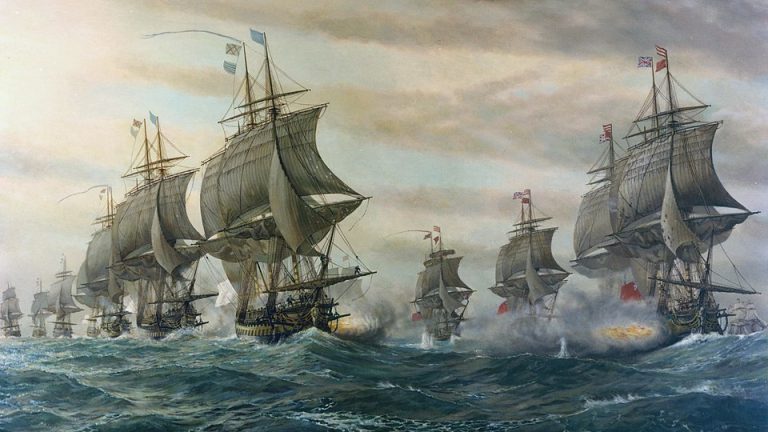
This vision of a proto-Monroe Doctrine was not far-fetched and the requisite naval force would hardly have been out of reach for the early republic. Nor did Hamilton over-value the impact of “a few ships of the line” flying American colors. Naval battles of the era were often close-run affairs. Hamilton himself commanded troops ashore at the climactic Siege of Yorktown during the Revolutionary War, a battle that was only made possible by a prior French naval victory off the Virginia Capes. There, the Comte de Grasse commanded 24 sail of the line to the Royal Navy’s 19. Throughout the war, the British admiralty’s primary strategic quandary had been allocating a limited inventory of capital ships between wide-ranging missions: the North American station, protecting lucrative Caribbean colonies, the siege of Gibraltar, the defense of the Home Islands, and elsewhere.[46] Hamilton envisioned a future in which the United States could tip the balance between contending great powers operating with little margin for error—a powerful bargaining position for the republic’s diplomats.
Federalist No. 11 also remarks upon the European powers’ “common interest” in restricting America’s maritime commerce and cutting the United States off from “an inexhaustible mine of national wealth.”[47] By contrast, the several states shared a common interest in a robust, well protected maritime trade, something that “all the navigating States may, in different degrees, advantageously participate in.” National unity was essential to the growth and protection of American maritime commerce, and “the necessity of naval protection to external or maritime commerce, and the conduciveness of that species of commerce to the prosperity of a navy, are points too manifest to require a particular elucidation.”[48] Hamilton concludes the essay with a stirring peroration: “Let the thirteen States, bound together in strict and indissoluble Union, concur in erecting one great American system superior to the control of all transatlantic force or influence and able to dictate the terms of connection between the old and the new world!”[49]
The Federalist depicts the nascent United States as a commercial republic, active in trade around the world and possessing a navy capable of protecting that trade—and exerting America’s influence—at sea. The American colonies had been intrinsic parts of the British Empire’s commercial maritime system; by declaring independence, they had surrendered neither their maritime strength nor interests. The new republic’s institutions could not help but reflect this commercial reality and maritime strategic tradition. Once independent, U.S. foreign policy was waged in large part by maritime means and in pursuit of maritime ends.
America’s Maritime Foreign Policy, 1775-1815
The United States’s commercial maritime character was self-evident to the generation that secured independence and drafted the Constitution. As they assumed leadership roles in the new government, those men worked to secure the republic’s maritime interests. Presidents from Washington through Madison grappled with how best to employ naval and commercial tools to protect the United States and its secure its interests overseas.
From the outset of the Revolutionary War, Americans exploited the sea to help secure independence. Like weaker naval powers throughout history, the Continentals sought to attack British merchant shipping rather than engage the Royal Navy directly. To this end, the Continental Congress issued over 1,600 letters of marque to vessels put out of trade by the war, not counting additional privateers licensed by the several states.[50] Over 55,000 men went to sea as privateers, capturing 600 ships worth $18 million.[51] The Continental Congress also commissioned warships of its own and dispatched expeditions to the Chesapeake, the Bahamas, and Penobscot Bay. [52]
Continental leaders both in uniform and in Congress engaged in robust strategic debate about how best to employ their limited fleet. America’s most famous Revolutionary naval hero, John Paul Jones, successfully advocated carrying the war into the Caribbean and British home waters to attack trade and enemy shore outposts where doing so would have the greatest psychological and financial effect.[53] Even prior to France’s entry into the war, the American guerre de course proved so vexing that British minister Lord George Germain exclaimed “We have lately had so many privateers upon our coasts and such encouragement given them by the French, that I was apprehensive a few weeks ago we should have been obliged to declare war.”[54] With the entry of the French, Spanish, and Dutch into the war on the side of the Americans, the war at sea transformed into a more symmetrical naval contest. Ultimately, allied naval power provided the means to launch the amphibious campaign that secured American independence at Yorktown.[55]
Following peace in 1783, the United States experienced a boom in overseas trade. American merchants exploited their newly independent position to call upon ports across the world, from the Baltic to Mauritius to the Dutch East Indies.[56] Freed from the British East India Company’s monopoly on the China trade, less than six months after the signing of the Treaty of Paris, Empress of China departed New York bound for Canton and laden with beaver skins, silver, and ginseng.[57] She returned 15 months later, returning a 30 percent profit for her investors and inaugurating a cavalcade of American trade missions to China over the next 15 years—voyages exceeded in number only by the British. American merchants were also quick to fill the vacuum in France’s trade with her colonies left by the outbreak of the Wars of the Revolution in 1792. Propelled by these circumstances, the tonnage of America’s international trade quintupled between 1789 and 1800, in which year U.S. merchants transacted over $162 million worth of commerce with foreign nations, 89 percent of which was carried in American hulls.[58]
No sooner had the United States secured independence than it faced its first maritime crisis. American mariners had previously sheltered under the aegis of the Royal Navy. No more. As early as 1783, U.S. statesmen recognized the threat the Barbary Pirates posed to Americans traversing the high seas.[59] Corsairs operating from North Africa preyed upon U.S. vessels, killing, kidnapping, and extorting ransom from merchants. American leaders (correctly) suspected Westminster of encouraging these predations and set out to devise a solution that would protect American ships. However, the problem would vex the United States for decades before it was finally resolved. During the Confederation period, John Adams and Thomas Jefferson disagreed over whether to pay a ransom for safe passage of American shipping or mount a punitive military expedition. Counterintuitively, the lawyer from maritime Boston favored buying off the pirates while the agrarian-minded Virginia aristocrat advocated for the creation of a national navy. Their disagreement was part of a larger debate not over whether the United States ought to have a navy, but rather what kind of navy it needed. Adams saw a ransom as the expedient solution and favored the view that Hamilton would later espouse in The Federalist that the United States should pursue a navy directed toward the great powers. Jefferson, meanwhile, “envisioned an American navy in much the same way that Americans of his generation conceived of the militia. Like a settler’s musket over the mantlepiece . . . ready in case of [an] emergency” like this.[60] Neither side argued Americans ought not go abroad as merchants or sailors, the question was how best to protect them. The republic’s commercial nature and maritime interests were self-evident.
The debate continued into the presidency of George Washington, in which both Adams and Jefferson served. Although Washington attempted to negotiate a treaty guaranteeing safe passage through the Mediterranean for American vessels, the effort was overtaken by the outbreak of war in Europe.[61] By Washington’s second term, it was clear that the United States needed a naval force of its own. The growing complexity of the geopolitical situation foreclosed the possibility of protecting American trade solely by diplomatic or financial means and Congress passed legislation in 1794 authorizing the construction of six frigates that would constitute the “foundation of a permanent naval establishment.”[62] Washington and his successor Adams continued negotiations, but to no avail and President Adams was preparing a naval expedition to the Mediterranean when he was defeated in the election of 1800 by Jefferson. The agrarian aristocrat was more than willing to employ the navy he inherited to protect America’s trade overseas, even while remaining skeptical of the value of a larger naval buildup.[63] Across both of Jefferson’s terms as president, he “pursued an active policy of naval diplomacy at the crossroads of European-American-Islamic trade.”[64] The final defeat of the Barbary Pirates would not come until after the conclusion of the War of 1812, when President James Madison launched a second major naval war.
At the same time as America was attempting to protect its trade from piracy, the republic found itself caught in a series of disputes with two of the leading maritime powers of the day: Britain and France. The U.S. experience in the 1790s and 1800s vindicated Hamilton’s prediction that the country’s maritime trade would be an inducement to conflict, rather than to peace. American merchants sought to profit from the turmoil engendered by the Wars of the French Revolution while France and Britain each attempted to prevent the United States from trading with their mortal enemy. The result was nearly two decades of turmoil that brought the United States to blows with both great powers.
The United States in the 1790s conformed to a pattern common to minor powers throughout history. The young republic was dependent on trade with England, France, and the other European states. It therefore sought to remain aloof from their disputes and exploit the rivalries between them as the continent descended into chaos following the outbreak of war in 1792.[65] Within the Washington cabinet, a critical dispute was between Treasury Secretary Hamilton, who favored closer economic relations with Britain and investment in domestic manufactures and industry, and Secretary of State Jefferson (in alliance with James Madison in the House of Representatives), who favored America’s ally France and sought to open markets for American agricultural exports as the country expanded west over the Appalachian Mountains.[66] Each side’s economic vision was built on exploiting America’s maritime connections to the Old World for the republic’s economic gain.
The United States pursued two related aims: the promotion of greater trade with Britain and the maintenance of neutrality. Of particular importance were the rights of the United States as a neutral nation to trade with all belligerents and the safety of vessels flying the Stars and Stripes—rights whose assertion would vex both France and Britain in turn. While the early years of American statecraft had been marked by a difficult relationship with Great Britain, deft diplomacy and British dependence on American trade in the Home Islands and colonies helped secure a commercial agreement for the United States.[67] However, as the United States opened doors with Westminster, the revolutionary government in Paris bristled at its putative ally’s drift toward the leader of the rival coalition. Following the conclusion of the Jay Treaty in 1795, which normalized trade between Britain and the United States, France retaliated by declaring American vessels that submitted to British customs inspections liable to seizure.[68] The United States asserted the right of neutral-flagged vessels to trade with belligerents on both sides and their immunity from seizure, but both adversaries sought to selectively curtail these rights to their own advantage.[69]
By the time Adams assumed the presidency in 1797, French privateers had begun seizing American ships on the high seas despite the 1778 Treaty of Alliance that bound the two nations. Adams’ diplomatic overtures were rebuked when French interlocutors demanded a bribe from their American counterparts—the infamous “XYZ Affair.” Despairing of a peaceful resolution and buoyed by popular cries of “millions for defense but not one cent for tribute!” Congress voted to supplement the fleet of six frigates already under construction by converting 16 smaller vessels into warships and organizing them under an independent Navy Department.[70] Within a year of the outbreak of this “Quasi War,” French cruisers and privateers had seized over 300 American vessels, mostly in the Caribbean.[71] The experience substantiated Jay’s observation in The Federalist that America’s commercial character would put it at odds with the seafaring powers of Europe. As with the Barbary Pirates, force was required to defend American lives and interests.
President Adams argued for arming merchantmen and increasing the Navy’s size to protect America’s fisheries, trade, and coastline. He contended that “while we ought not to involve ourselves in the political system of Europe” even as a neutral nation, “the maritime powers and the commercial powers of the world will consider the United States of America as forming a weight in the balance of power in Europe which can never be forgotten or neglected.”[72] Adams’s perspective echoed the sentiments of Washington’s Farewell Address, as well as Hamilton’s argument in Federalist No. 11 that a modestly-sized U.S. Navy would set a price “not only on our friendship, but upon our neutrality.”[73] All three men were arguing from within the mainstream of the maritime strategic tradition, in which smaller, weaker states leverage their geographic positions, commercial acumen, and strength at sea to protect their interests and balance between larger rival great powers.[74]
The U.S. Navy grew to some 50 vessels between 1798 and 1800, which it used to convoy American merchant ships in the Caribbean and wage a determined counter-campaign against French privateers.[75] Although French raids continued until the resolution of the conflict, the Americans took dozens of French ships in return and blunted the privateers’ efforts. The United States benefitted from the tacit and camouflaged aid of the Royal Navy, whose ongoing blockade prevented the French fleet from crossing the Atlantic to challenge the U.S. Navy in force.[76] America’s first foreign conflict as an independent country was ended by the 1800 Convention of Mortefontaine, which restored diplomatic relations with Paris, asserted America’s neutral rights, and released the United States from its obligations under the 1778 treaty, affording the republic greater freedom in its relations with Europe’s warring powers.[77] The undeclared war once again demonstrated the vulnerability of the republic’s maritime interests and rival great powers’ willingness to strike at America through its commerce.
Jefferson defeated his rival Adams in the election of 1800. The end of the Quasi War had allowed Adams to begin planning an expedition against the Barbary Pirates, which Jefferson dispatched early in his term, launching a military campaign that lasted throughout his first term in office.[78] Rapprochement with France opened the door for Jefferson to negotiate with Paris on other issues. Among his greatest achievements was the purchase of Louisiana from France in 1803. It is natural to conceive of the purchase as a purely terrestrial accomplishment—it doubled the size of the United States overnight and set the stage for a century of westward expansion. However, Jefferson was motivated as much by commercial maritime concerns. His economic vision for the country had long included exporting agricultural commodities to European states and their colonies. The United States’s primary interest in the purchase was not the Louisiana Territory per se, but rather the port of New Orleans—the entrepôt of the Mississippi River watershed which dominated the center of the North American continent. Since the end of the Revolutionary War, American settlers had been streaming across the Appalachian Mountains, leading to the admission of Kentucky, Tennessee, and Ohio to the Union between 1792 and 1803. Just as the original colonies consisted of agricultural lands exporting commodities via strategically located port cities, residents of these new states and America’s other trans-Appalachian territories relied on the Mississippi and its tributaries to access global markets. New Orleans, therefore, was the cornerstone on which Jefferson’s vision of a nation of yeoman farmers must inevitably be built.
Using uncharacteristically bellicose rhetoric, Jefferson warned the French government that New Orleans was “on the globe one single spot, the possessor of which is our natural and habitual enemy” and threatened to align the United States with Britain and take the city and its vast hinterland by force if it were not sold.[79] James Monroe was dispatched to Paris to purchase the city of New Orleans—not the entire Louisiana Territory. If he were rebuffed by Napoleon’s government, he was to proceed to London to discuss forming an alliance with Britain.[80] When the purchase was successfully negotiated, however, it included the entirety of the Louisiana Territory for the same reason Jefferson was invested in controlling the city to begin with: an agricultural hinterland is nothing without its maritime entrepôt. Paris saw no sense retaining the territory while selling the port. America’s territorial expansion depended on control of the maritime conduit through which farmers could export their commodities into the global market.
Threats to Paris aside, the United States remained aloof from European politics and unlikely to ally with Britain, especially not under the Francophilic Jefferson. Over the remainder of his term, the Anglo-American relationship would deteriorate to the brink of war. This was in large part due to disputes over commercial and maritime issues bound up in Britain’s ongoing war with Napoleonic France. The Royal Navy’s decisive victory at Trafalgar in 1805 secured British command of the seas for the remainder of the war while Napoleon’s armies dominated the continent. Deprived of direct means of attacking one another, both sides sought to substitute economic for military weapons: France established a “continental system” of restrictions to limit British trade while Britain imposed physical blockades on European and West Indian ports and demanded neutral ships submit to inspection in British ports before trading with the Continent.[81]
America’s dispute with Britain centered on both the right to trade and the abuses U.S. mariners suffered on the high seas at the hands of the Royal Navy. As before, the United States protested its neutrality and avowed its right to trade with all sides in the European conflict. American merchants clamored to fill the gaps in international trade left by Britain’s blockade of the Continent and saw profits soar as a result. This included importing goods from European colonies in the Western Hemisphere and re-exporting them as facially neutral goods to combatant states cut off by the Royal Navy’s blockade, a practice to which Britain understandably objected. By 1805, some two-thirds (or $60 million worth) of American trade was implicated in the “broken voyage” system.[82]
Americans protested the boarding and search of their vessels on the high seas by British men-of-war as a violation of their rights as a neutral nation; however, the affrontery suffered on this account paled in comparison to the practice of impressment. Under the practice, the British seized mariners sailing on American ships and pressed them into service with the Royal Navy on the grounds (real or imagined) that they were British subjects, deserters, or both. The Royal Navy clashed with U.S. warships and boarded dozens of vessels flying the Stars and Stripes as it attempted to meet the war’s insatiable demand for manpower. Between 1803 and 1812, the U.S. government estimated that over 6,000 men had been taken from U.S. ships in a practice that James Madison called “anomalous in principle . . . grievous in practice, and . . . abominable in abuse.”[83]
Jefferson found himself in the unenviable position of waging a naval conflict with the world’s foremost sea power. His party’s and his own preference had always been against a large naval establishment as an inducement to war—an instinct that was reinforced when the Royal Navy sailed into Copenhagen harbor to preemptively destroy the neutral Danish fleet so it could never be used against them.[84] Jefferson instead devoted substantial resources to a fleet of small, coast-defense gunboats that he hoped would protect American harbors, but which could neither defend American shipping on the high seas nor pose a provocative threat to British thalassocracy.
Instead of pursuing a military option, Jefferson emulated the warring European powers by trying to strike back through economic means. Reasoning that Britain was especially dependent on American trade and could be brought to the negotiating table by its cessation, Jefferson asked Congress to enact an embargo on American trade with foreign nations.[85] The embargo failed to persuade Westminster to substantially alter its policy toward Washington and was thoroughly resented by Americans. Smuggling and evasion were rampant and eventually the legislation was replaced with a narrower ban on trade with only Britain and France. After Jefferson left office in 1809 and was replaced by his Secretary of State, James Madison, the new administration took a different tack, reopening trade with both countries but stipulating that the United States would embargo the other if either country acceded to U.S. demands.[86] Jefferson’s belief that an embargo would bring European powers to the negotiating table illustrates the international importance of U.S. trade; the hostility and rank disobedience with which the embargo was received at home testify to the central role of maritime commerce in American economic life.
It has been easy for historians to characterize Jefferson as an anti-naval president based on his opposition to building a large American fleet; the strategic dead end of his gunboat program; the failure of the embargo program he attempted to substitute for naval power; and his philosophical tilt towards terrestrial agrarianism contra the Federalists’ emphasis on trade, manufactures, and maritime commerce. His presidency is also sandwiched between the Quasi War and the War of 1812, two seminal episodes in the development of the U.S. Navy. However, taken in a wider maritime rather than strictly naval lens, Jefferson’s tenure lays bare the importance of seafaring in early American foreign policy. He had no qualms about using force to defend U.S. trade against the Barbary Pirates. Access by sea to foreign markets for American agricultural exports was a critical impetus for the Louisiana Purchase. The expansion of America’s maritime trade and protection of U.S. rights were major driving forces in Anglo-American tensions in the decade prior to the War of 1812. Even Jefferson’s preferred weapon, an embargo, ought not to be lightly dismissed. Although it failed in the end and did not involve the direct application of naval force, the third president clearly hoped to leverage America’s significant advantages in maritime commerce toward political ends—a classic seapower strategy and one not dissimilar from Britain’s contemporaneous effort to weaken Napoleon through blockade, though exercised via different means.
President Madison, Jefferson’s successor, failed to avert a war with Britain, which Congress reluctantly declared in June of 1812.[87] During the war, the U.S. Navy made excellent use of the small fleet it had acquired since the Washington administration, scored dashing victories in battle against the Royal Navy, and captured more that 1,300 British merchant and naval vessels.[88] As it had been in the Revolutionary and Quasi Wars, the fleet was supplemented by vessels bought into service or licensed as privateers. Inland, fully half of the Navy’s manpower was devoted to the war on the Great Lakes, where the success of America’s ad hoc fleet on internal waterways foreclosed the possibility of major British troop movements into the United States.[89] The two most famous land battles of the war deserve consideration in light of their maritime significance. The British attacked Fort McHenry—where “bombs bursting in air, gave proof through the night that our flag was still there”—because it guarded Baltimore Harbor, the largest port on the Chesapeake and a hub for outfitting privateers. Likewise, the final battle of the war was Andrew Jackson’s famous defense of New Orleans, the very maritime entrepôt that Jefferson had labored to secure for the Union a decade prior. The “second war for American independence” started in large part because of the Royal Navy’s depredations against U.S. commerce and American mariners; it was fought by sea, on lakes, and at the hubs of maritime trade.
Conclusion: America a Seapower?
At its founding, the United States was a quintessential maritime republic. Behind agriculture, the maritime trades constituted the largest economic sector in the country, and the fortunes of the two were intertwined. As the Founders contemplated the shape the new republic would take, their thinking could not help but be rooted in this reality. It is no surprise, then, that in drafting The Federalist, Alexander Hamilton, John Jay, and James Madison depicted the United States as a commercial republic in the mold of Venice, the Dutch Republic, Britain, and other great maritime states. Following that Constitution’s adoption, the new government of the American republic pursued a foreign policy that for four decades was heavily influenced by the country’s maritime character.
Maritime commerce remained important to the United States in absolute terms following the War of 1812, though its relative emphasis waned over time. Industries like New England’s globe-spanning whaling enterprise rebounded from the turbulent war years and boomed throughout the middle of the century, when novelist and one-time merchant mariner Herman Melville immortalized the industry in Moby-Dick.[90]In 1853, a U.S. Navy squadron under Commodore Matthew Perry opened the Japanese Empire to American trade by force. As the century wore on, however, American eyes shifted westward and inward. Americans flocked to the frontier to settle and cultivate, seeding the germ of what would become Turner’s frontier thesis of national development. Westward expansion raised intractable questions of the expansion of slavery and the nature of the American republic at home that occupied national attention and would eventually precipitate civil war. At the same time, booming manufacturing industries created new, more lucrative outlets for investment capital that previously had been devoted overwhelmingly to maritime trade. In an ironic twist, the maritime conflicts that precipitated the War of 1812 helped spur American investors to shift their focus from maritime to terrestrial industries. Due to Jefferson’s embargo and the outbreak of war with Britain, between 1807 and 1815 the United States enjoyed only 15 months of unimpeded international trade, freeing millions of dollars’ worth of capital that had been tied up in ships and trade goods to be invested in the country’s nascent textile and manufacturing industries.[91]
America’s nineteenth-century history was dominated by the settling of the western frontier; the great conflict over the expansion of slavery, including the Civil War and Reconstruction; and the country’s growing industrialization. It was not until the dawn of the twentieth century that the United States would once again turn its eyes to the sea in earnest. Writing in the 1890s, U.S. Navy officer Alfred Thayer Mahan articulated the case for America—which by then had closed the western frontier—to rebuild its dilapidated Navy, acquire colonies and markets of its own, and take its place among the great powers of the world. Mahan looked to the history of the European maritime powers in the seventeenth and eighteenth centuries, principally France and Britain, as well as the United States’s early experiences at sea to argue for the importance of naval power in international affairs. Naval officers, policymakers, and even historians down to the present day are apt to gloss Mahan’s argument as mere advocacy for maintaining a large fleet and seeking decisive battle against an enemy force; however, as Nicholas Lambert has decisively demonstrated, this is a misreading of the admiral’s writings that critically underplays the central importance of trade, commerce, and economics to his thinking.[92] This is a critical omission, for Mahan remains the prophet of American—and indeed global—sea power down to the present day. A blinkered focus on the naval aspects of Mahan’s writings to the exclusion of the broader commercial maritime world about which he wrote has caused countless otherwise capable thinkers and practitioners to overlook the connection between the military and economic domains of statecraft at sea, not least of all those within the U.S. Navy and Department of War, née Defense.
When the United States was founded, it was not a great naval power by any stretch of the imagination. The Royal Navy and the other great fleets of Europe overmatched those few ships the Americans could put to sea by orders of magnitude. However, America was a great maritime nation with significant, far-flung economic interests at sea and that had played a critical role in Britain’s global maritime commercial empire prior to independence in 1776. The founding generation of American leaders understood the maritime context in which the country existed and conceived of their political project in terms of a commercial republic in the mold of maritime republics stretching back to antiquity. Moreover, once independent of Britain they consciously pursued a foreign policy that both treated the country’s maritime equities as ends to be protected—by force if necessary—as well as tools to advance the national interest.
Contemporary Americans are quite comfortable conceiving of the United States as the inheritor of Anglo political, legal, and cultural traditions. They would do well to recall that the early republic also inherited a share of Britannia’s maritime strategic tradition, which saw the country’s prosperity and national strength as being intimately bound up with the sea and maritime commerce. This tradition informed the Founding Fathers’ perspectives and actions (successful or otherwise) as they sought to chart a course for the United States in a dangerous world.
Today, the sea is returning as the focal point of U.S. foreign policy. For over a century, American foreign policy has been preoccupied with developments on the far side of the ocean: the World Wars, the twilight struggle against the Soviet Union, and the maintenance of a balance of power in Eurasia as well as the string of police actions in the long lee of the post-Cold War “end of history.” However, change is in the offing. For the first time in living memory, the United States faces a serious competitor for naval dominance in the form of the People’s Republic of China. While Beijing seeks to match and one day exceed the United States Navy in naval fighting power, Chinese companies already eclipse their American counterparts in the commercial maritime domain. From shipbuilding to the carrying trade to investments in overseas port infrastructure, China is building a dominant position in the global maritime system that is protected and underwritten by American naval power. One day, Beijing may decide to leverage this maritime power against the United States, either independent of or in conjunction with traditional naval power. Elsewhere in the world, the advent of cheap missiles, drones, and surveillance systems allows coastal actors to reach farther out to sea with more precision and impact than ever before. It is not difficult to see the Houthis, who mounted a blockade of the Red Sea beginning in 2023, as a latter-day analogue of the Barbary Pirates who preyed on American shipping over two centuries ago.
As they consider the likely course of the twenty-first century, U.S. foreign policymakers would do well to recall young America’s experience as a maritime power in a fractured and dangerous world. If the future is indeed one in which control of the oceans and the commerce that flows upon them are contested in ways unseen in decades, the United States will need to be prepared to meet the challenge. As a continent-sized island on the far side of the world from everything, sea power is the sine qua non of America’s relations with the wider world. To navigate the stormy waters that beset the republic at the turn of the semi quincentennial, Washington will need to reclaim some share of the maritime strategic tradition that animated the young republic 250 years ago.
Samuel Byers is a non-resident Senior Fellow at the Center for Maritime Strategy. His research focuses on history, strategy, and the role of maritime power in foreign policy and national security. He holds an MA in War Studies from King’s College London and a BA in Diplomatic History and Political Science from the University of Pennsylvania. He is an alumnus of the Alexander Hamilton Society’s Security and Strategy Seminar on China, Russia, Iran, and U.S. defense policy.
Image: BattleOfVirginiaCapes.jpg, from V. Zveg. Retrieved from: https://commons.wikimedia.org/wiki/File:BattleOfVirginiaCapes.jpg, used under Wikimedia Commons.

[1] “Countries & Regions,” Office of the United States Trade Representative, accessed 9 June 2025, https://ustr.gov/countries-regions.
[2] Andrew Lambert, Seapower States: Maritime Culture, Continental Empires, and the Conflict that Made the Modern World (New Haven: Yale University Press, 2018), 6.
[3] Frederick Jackson Turner, “The Significance of the Frontier in American History”, 12 July 1893, archived: https://nationalhumanitiescenter.org/pds/gilded/empire/text1/turner.pdf.
[4] United States Census Bureau, “Rank by Population of the 100 Largest Urban Places, Listed Alphabetically by State: 1790-1990”, 15 June, 1998: https://www2.census.gov/library/working-papers/1998/demographics/pop-twps0027/tab01.txt.
[5] Andrew Gibson and Arthur Donovan, The Abandoned Ocean: A History of United States Maritime Policy (Columbia: University of South Carolina Press, 2000), 12.
[6] K. Jack Bauer, A Maritime History of the United States: The Role of America’s Seas and Waterways (Columbia: University of South Carolina Press, 1988), 30.
[7] Gibson and Donovan, The Abandoned Ocean, 13.
[8] Bauer, Maritime History of the United States, 33.
[9] Gibson and Donovan, The Abandoned Ocean, 13.
[10] Bauer, Maritime History of the United States, 32.
[11] Gibson and Donovan, The Abandoned Ocean, 16-17.
[12] Gibson and Donovan, The Abandoned Ocean, 17.
[13] Bauer, Maritime History of the United States, 35-36.
[14] Gibson and Donovan, The Abandoned Ocean, 15.
[15] Gibson and Donovan, The Abandoned Ocean, 15.
[16] Bauer, Maritime History of the United States, 40.
[17] Bauer, Maritime History of the United States, 40-41.
[18] Fred Anderson, Crucible of War: The Seven Years’ War and the Fate of Empire in British North America, 1754-1766 (New York: Vintage Books, 2000), 592-594.
[19] Bauer, Maritime History of the United States, 45.
[20] Bauer, Maritime History of the United States, 38.
[21] Gibson and Donovan, The Abandoned Ocean, 11-12.
[22] Gibson and Donovan, The Abandoned Ocean, 18.
[23] Anderson, Crucible of War, 646.
[24] Bauer, Maritime History of the United States, 48.
[25] Dale C. Copeland, A World Safe for Commerce: American Foreign Policy from the Revolution to the Rise of China (Princeton: Princeton University Press, 2024), 77.
[26] Bauer, Maritime History of the United States, 49.
[27] Michael Lucchese, “The Founders Wanted a Powerful Navy: The Constitution was Built for It,” Center for Maritime Strategy—The MOC, 17 September 2024, https://centerformaritimestrategy.org/publications/the-founders-wanted-a-powerful-navy-the-constitution-was-built-for-it/.
[28] Alexander Hamilton, “Federalist 24,” in The Federalist Papers, ed. Clinton Rossiter (New York: Signet Classics, 2003), 158.
[29] Alexander Hamilton, “Federalist 34,” in The Federalist Papers, ed. Clinton Rossiter (New York: Signet Classics, 2003), 204.
[30] Alexander Hamilton, “Federalist 12,” in The Federalist Papers, ed. Clinton Rossiter (New York: Signet Classics, 2003), 86.
[31] Federalist, no. 12 (Alexander Hamilton), 8-89.
[32] Alexander Hamilton, “Federalist 35,” in The Federalist Papers, ed. Clinton Rossiter (New York: Signet Classics, 2003), 211-212.
[33] John Jay, “Federalist 3,” in The Federalist Papers, ed. Clinton Rossiter (New York: Signet Classics, 2003), 36-37.
[34] John Jay, “Federalist 4,” in The Federalist Papers, ed. Clinton Rossiter (New York: Signet Classics, 2003), 40-41.
[35] James Madison, “Federalist 41,” in The Federalist Papers, ed. Clinton Rossiter (New York: Signet Classics, 2003), 257.
[36] Alexander Hamilton, “Federalist 6,” in The Federalist Papers, ed. Clinton Rossiter (New York: Signet Classics, 2003), 51.
[37] Lambert, Seapower States.
[38] Alexander Hamilton, “Federalist 8,” in The Federalist Papers, ed. Clinton Rossiter (New York: Signet Classics, 2003), 64.
[39] Federalist, no. 8 (Alexander Hamilton), 65.
[40] Alexander Hamilton, “Federalist 11,” in The Federalist Papers, ed. Clinton Rossiter (New York: Signet Classics, 2003), 80.
[41] Federalist, no. 11 (Alexander Hamilton), 80.
[42] Federalist, no. 11 (Alexander Hamilton), 80.
[43] Federalist, no. 11 (Alexander Hamilton), 81.
[44] Federalist, no. 11 (Alexander Hamilton), 81-82.
[45] Federalist, no. 11 (Alexander Hamilton), 82.
[46] Andrew Jackson O’Shaughnessy, The Men Who Lost America: British Leadership, the American Revolution, and the Fate of the Empire (New Haven & London: Yale University Press, 2013), 330-337; 341-349.
[47] Federalist, no. 11 (Alexander Hamilton), 83.
[48] Federalist, no. 11 (Alexander Hamilton), 84.
[49] Federalist, no. 11 (Alexander Hamilton), 86.
[50] Kenneth J. Hagan, This People’s Navy: The Making of American Sea Power (New York: The Free Press, 1991), 16.
[51] James C. Bradford, “The Navies of the American Revolution, 1775-1783,” in In Peace and War: Interpretations of American Naval History, ed. Kenneth J. Hagan and Michael T. McMaster (Westport & London: Praeger Security International, 2008), 3-4.
[52] James C. Bradford, “The Navies of the American Revolution, 1775-1783,” in In Peace and War: Interpretations of American Naval History, ed. Kenneth J. Hagan and Michael T. McMaster (Westport & London: Praeger Security International, 2008), 3-4.
[53] Hagan, This People’s Navy, 11, 15.
[54] Bradford, “Navies of the American Revolution,” 11.
[55] Nathaniel Philbrick, In the Hurricane’s Eye: The Genius of George Washington and the Victory at Yorktown (New York: Viking, 2018).
[56] Bauer, Maritime History of the United States, 54-55.
[57] Jonathan Pomfret, The Beautiful Country and the Middle Kingdom: America and China, 1776 to the Present (New York: Henry Holt & Co., 2016), 20-21.
[58] Gibson and Donovan, The Abandoned Ocean, 24-25.
[59] Hagan, This People’s Navy, 21-22.
[60] Craig L. Symonds, “Defining an American Navy,” in In Peace and War: Interpretations of American Naval History, ed. Kenneth J. Hagan and Michael T. McMaster (Westport & London: Praeger Security International, 2008), 19.
[61] Hagan, This People’s Navy, 28.
[62] Hagan, This People’s Navy, 32.
[63] Symonds, “Defining an American Navy”, 26
[64] Hagan, This People’s Navy, 54.
[65] George C. Herring, Years of Peril and Ambition: U.S. Foreign Relations, 1776-1921 (Oxford: Oxford University Press, 2008), 51.
[66] Herring, Years of Peril and Ambition, 61-62.
[67] Herring, Years of Peril and Ambition, 71.
[68] Symonds, “Defining an American Navy,” 23.
[69] Herring, Years of Peril and Ambition, 68.
[70] Symonds, “Defining an American Navy,” 23-24.
[71] Hagan, This People’s Navy, 37.
[72] Quoted in Hagan, This People’s Navy, 39.
[73] Federalist, no. 11 (Alexander Hamilton), 82.
[74] Lambert, Seapower States.
[75] Hagan, This People’s Navy, 43.
[76] Hagan, This People’s Navy, 51-52.
[77] Herring, Years of Peril and Ambition, 84.
[78] Herring, Years of Peril and Ambition, 93-94.
[79] Quoted in Herring, Years of Peril and Ambition, 97.
[80] Herring, Years of Peril and Ambition, 98.
[81] Hagan, This People’s Navy, 63-64.
[82] Herring, Years of Peril and Ambition, 109-110.
[83] Quoted in Hagan, This People’s Navy, 64-65.
[84] Symonds, “Defining an American Navy,” 28-29.
[85] Symonds, “Defining and American Navy,” 28.
[86] Herring, Years of Peril and Ambition, 112-115.
[87] Herring, Years of Peril and Ambition, 118.
[88] Linda Maloney, “The War of 1812: What Role for Sea Power,” in In Peace and War: Interpretations of American Naval History, ed. Kenneth J. Hagan and Michael T. McMaster (Westport & London: Praeger Security International, 2008), 38.
[89] Maloney, “The War of 1812: What Role for Sea Power,” 41-45.
[90] Bauer, Maritime History of the United States, 233-236.
[91] Bauer, Maritime History of the United States, 65.
[92] Nicholas Lambert, the Neptune Factor: Alfred Thayer Mahan and the Concept of $ea Power (Annapolis: U.S. Naval Institute Press, 2023).