


Hamiltonian Journal
Revolutionary Prudence at 250
Share On:
My mother grew up in Hsinchu, a Taiwanese city whose ordinariness masks its extraordinary value. Every summer, she took me near the science park where TSMC fabricates chips for the systems on which modern commerce, weapons, satellites, and artificial intelligence depend. Taiwan, though a small island, accounts for roughly 92% of the world’s manufacturing capacity for the most advanced chips.[1] Just beyond the science park stood my ancestral grave, which my mother wanted me to remember. Yet, I could only think about the aircraft overhead: Taiwanese F-16s roaring not because my ancestors were angry, but because the People’s Liberation Army kept probing the island’s air approaches.[2]
For my family, democracy is not an abstraction. During Taiwan’s White Terror, the Kuomintang’s martial-law regime imprisoned, surveilled, and killed dissidents, putting roughly 140,000 in prison and executing 3,000 to 4,000.[3] My relatives helped oppose that authoritarian order. Their generation marched, organized, and endured until Taiwan finally held its first direct presidential election in March 1996, choosing its leader by popular vote amid Chinese missile exercises meant to intimidate the electorate.[4] Their story taught me that democratic self-government is not a natural condition. It is hard-won, fragile, and reversible.
I saw that reversibility more clearly in Hong Kong. As an exchange student at the Chinese University of Hong Kong, I walked through a campus where Tiananmen memorials had been removed and where students spoke quietly about banned books and political despair. In 2021, CUHK took down the Goddess of Democracy statue, part of a broader erasure of Tiananmen memory in Hong Kong.[5] Hong Kong taught the world a hard lesson: economic interdependence alone cannot prevent an authoritarian state from absorbing a free society. Commerce may delay conquest, but it does not decide whether a people may govern themselves.
That experience shapes how I answer the question of whether the United States is a revolutionary nation. I believe it is, not because it should pursue permanent revolution abroad or treat every foreign crisis as a moral crusade, but because its founding placed political legitimacy on a universal principle: that governments derive “their just powers from the consent of the governed.”[6] The Declaration of Independence did not merely announce separation from Britain. It asserted that rights precede government, that rulers are accountable to the people, and that political authority must justify itself before human liberty. That proposition remains revolutionary because much of the world still runs on the opposite principle: that power creates legitimacy, that the state owns memory, and that citizens exist to serve rulers rather than rulers to secure rights.
This revolutionary character should inform American foreign policy, but only when joined to prudence. America should promote its founding ideals abroad. It should do so not by trying to manufacture democracies at gunpoint, not by collapsing strategy into moral exhibitionism, and not by treating every autocracy as an identical threat. It should promote those ideals by defending the conditions under which peoples can choose their own political future. The proper object of American statecraft is not the export of revolution. It is the preservation of “reflection and choice” against “accident and force,” the question Hamilton identified at the beginning of Federalist No. 1. [7]
This distinction matters. To call America revolutionary is not to call it innocent. The founding contained a contradiction between universal principles and human bondage; the American creed has often judged America itself. But that is part of its significance. The United States is not revolutionary because it has always lived up to its ideals; it is due to the standard those ideals created, by which citizens could indict inherited injustice. Abolitionists, suffragists, civil rights leaders, anti-imperial critics, and dissidents of every generation have appealed to the founding not as a closed achievement but as an unfinished argument. The Revolution was never simply 1776. It was the proposition that no government, including America’s own, is beyond moral judgment.
Nor did the Founders confuse ideals with recklessness. Washington’s Farewell Address warned against permanent alliances and cautioned that foreign policy must avoid permanent antipathies and passionate attachments. [8] Those warnings are sometimes invoked to argue that America should retreat from the world. But Washington was not recommending indifference. He was advising a young republic to preserve its independence until it possessed the strength, institutions, and unity necessary for responsible action. His prudence was not a rejection of the Revolution; it was an effort to secure it. The Founders understood that liberty without power is vulnerable, but power without constitutional restraint becomes the very despotism the Revolution opposed.
Hamilton developed this logic most clearly. In Federalist No. 11, he argued that union, commerce, and naval strength would allow Americans to “vindicate the honor of the human race” and dictate fairer terms of connection between the old world and the new. [9] His Report on Manufactures pressed the same point at home, arguing that American manufacturing should be encouraged where it would render the United States independent of foreign nations for military and other essential supplies. [10] His Pacificus essays defended executive judgment in foreign affairs as compatible with constitutional government rather than a retreat from it. Hamilton understood that ideals require instruments. [11] A republic that proclaimed universal rights but neglected ships, manufactures, credit, and executive energy would find its principles eventually mocked by stronger powers. The Revolution survived because its statesmen built the material base its ideals demanded.
American foreign policy at 250 should recover that original balance and, in doing so, must reject two main temptations. The first is ‘missionary universalism’: the belief that America can redeem the world through willpower, armed intervention, or procedural templates detached from local realities. Iraq and Afghanistan made that lesson costly. The problem was not idealism itself; it was the assumption that ideals could substitute for legitimacy that only citizens with high public trust can confer. Self-government cannot be self-government if another nation dictates its form.
The second temptation is ‘amoral retrenchment’: the belief that America is merely another power, that its principles are ornamental, and that the fate of distant free societies has no bearing on the American experiment. That temptation mistakes prudence for passivity. It forgets that a world in which authoritarian states can erase free societies by coercion is a world increasingly hostile to American liberty as well.
The alternative is revolutionary prudence. Revolutionary prudence begins from a simple premise: America’s founding ideals are universal, but American power is finite. Because rights are universal, the United States should not be neutral between self-government and tyranny. Because power is finite, it must set priorities, recognize limits, and align means with ends. America should speak clearly about human dignity, support civil society and free information, protect dissidents where possible, and remain a refuge for those persecuted by authoritarian regimes. But its highest strategic obligation is to prevent coercive conquest from deciding the fate of free peoples whose survival matters to the balance of power and to the credibility of democratic self-government.
The Cold War demonstrated this approach in practice. The United States did not invade Eastern Europe to liberate it. It built alliances, maintained deterrence, supported independent information through Radio Free Europe and parallel instruments, and waited out a regime that could not justify itself to its own citizens. For example, Radio Free Europe and Radio Liberty were created as “surrogate” broadcasters to provide locally relevant news and analysis to audiences behind the Iron Curtain. [12] The Helsinki Final Act, signed by 35 states in 1975, committed participating states to respect human rights and fundamental freedoms, language that dissidents in the Soviet bloc used to hold their own governments accountable. [13] Containment was not a retreat from revolutionary ideals; it was their patient application across decades, sustained by industrial capacity, alliance discipline, and the moral seriousness to call the adversary by its name.
Taiwan is the central test of that obligation today. Its democracy was not created by America. It was built by Taiwanese citizens who emerged from dictatorship and created one of Asia’s most vibrant constitutional orders. That fact should humble American statecraft: Washington cannot claim ownership of Taiwan’s freedom. But Taiwan’s ability to remain free depends partly on whether the surrounding international order makes conquest costly. Beijing’s leadership has consistently stated that China “will not renounce the use of force” and reserves the option of “all necessary measures” to seize Taiwan. [14] The Taiwan Relations Act declares that the United States expects Taiwan’s future to be determined by peaceful means, considers coercive efforts a matter of grave concern, provides for defensive arms, and commits the United States to maintain the capacity to resist force or coercion jeopardizing Taiwan’s security or social and economic system. [15]
That statutory language captures revolutionary prudence better than many slogans do. It does not promise liberation by invasion. It does not demand that America decide Taiwan’s political identity. It insists instead that Taiwan’s future not be decided by force. That is precisely the foreign policy meaning of the American Revolution: not that the United States must determine the destiny of every people, but that it should oppose the principle that destiny belongs to whoever can coerce it.
A serious Taiwan policy therefore cannot be only sentimental; it must be operational. Deterrence is not a technocratic substitute for ideals; it is one-way ideals survive. If Taiwan is to remain capable of political choice, it needs asymmetric defense capabilities, resilient command and communications, hardened infrastructure, civil defense, energy security, and an economy less vulnerable to blockade or coercion. The United States needs defense industrial capacity sufficient to arm itself and its allies, not merely issue statements after danger has matured. It needs alliances and partnerships in the Indo-Pacific credible enough to complicate Beijing’s plans before conflict begins. It needs technology policy that protects critical supply chains without imagining that trade alone can deter political coercion.
This is not militarism. It is the recognition that authoritarian strategy often exploits the gap between peace and war. Gray-zone coercion, cyber operations, disinformation, lawfare, maritime pressure, economic punishment, and airspace intimidation are designed to make free societies feel isolated before a shot is fired. A revolutionary nation should understand such tactics as assaults on consent. They do not always conquer territory immediately; they narrow the range of choices available to citizens and leaders until capitulation appears natural. Defending self-government today therefore requires more than battlefield strength. It requires resilient institutions, public trust, secure information environments, and the capacity to withstand coercion without panic.
Nor should the United States promote founding ideals abroad only through defense policy. The American Revolution spoke to human beings as moral agents, not merely to states as strategic units. America should invest in educational exchanges, independent media, anti-corruption efforts, digital freedom, and the protection of historical memory. It should welcome those fleeing repression and preserve spaces where dissidents can speak when their own governments silence them. The removal of Tiananmen memorials in Hong Kong was not a local campus matter; it was an attempt to control memory because memory sustains political identity. A country founded on an appeal to “a decent respect” for the opinions of mankind should understand that the struggle over truth is part of the struggle over freedom. [16]
At the same time, American leaders must be honest about tradeoffs. Promoting ideals abroad cannot mean converting every human rights abuse into a military obligation. It cannot mean pretending allies are flawless or that democracy eliminates strategic disagreement. It cannot mean treating rhetoric as a substitute for resources. A foreign policy that proclaims universal principles while failing to maintain ships, munitions, alliances, and domestic cohesion is not morally serious. It invites the very coercion it condemns. Revolutionary prudence requires matching the scale of America’s commitments to the strength of America’s instruments.
The domestic dimension is equally important. The United States cannot defend self-government abroad while degrading it at home. The Founders’ revolutionary claim was not that Americans are naturally virtuous, but that republican government could channel ambition, disagreement, and interest through institutions rather than violence. If American politics descends into cynicism, factional hatred, or contempt for constitutional restraint, then America’s foreign policy loses more than credibility. It loses strategic coherence. Allies will doubt its promises; adversaries will test its will; citizens will grow impatient with burdens they no longer understand. The first act of revolutionary statecraft is therefore to preserve the republic that makes such statecraft legitimate.
This point is especially important because authoritarian powers study America’s weaknesses. They do not need to prove that their systems are just. They need only persuade free peoples that democracy is chaotic, hypocritical, exhausted, and incapable of sacrifice. The answer is therefore not propaganda, but performance: competent government, lawful institutions, civic seriousness, technological excellence, military readiness, and a public capable of distinguishing criticism from self-loathing. A revolutionary nation does not promote its ideals by pretending it has no flaws. It promotes them by showing that free citizens can confront flaws without surrendering freedom itself.
Taiwan’s democracy is not valuable because it is useful to America, though it is. It is not important only because of semiconductors, though the semiconductor stakes are enormous. It matters because it embodies the possibility that a Chinese-speaking society can be democratic, pluralistic, prosperous, and free. Beijing now exports its own model under the label of “whole-process people’s democracy,” arguing that consultation managed by a single party is a legitimate alternative to electoral self-government. [17] Taiwan refutes that claim empirically, which is why Beijing cannot tolerate it. To defend Taiwan’s ability to choose its own future is therefore not to impose an American identity on it. It is to defend the principle that identity belongs to citizens rather than empires.
At 250, America is still a revolutionary nation. But maturity requires knowing what kind of revolution it carries. The United States should not seek to overturn every regime it finds unpalatable. It should not confuse democracy promotion with democratic creation. It should not pretend that ideals exempt it from prudence, cost, or tragedy. But neither should it abandon the moral insight that made it more than a successful rebellion: the belief that legitimate government rests on consent, and that human beings are not born to be ruled by force.
When my mother brought me to the ancestral grave near Hsinchu, she wanted me to remember the dead. I did. But I also came to understand that memory imposes obligations to the living. My ancestors did not fight Taiwan’s authoritarian past so that a stronger authoritarian power could determine Taiwan’s future. Their courage taught me that self-government is never permanently secured. It must be defended by citizens, by institutions, and sometimes by friends beyond the horizon. That is how America should promote its founding ideals abroad: not as an empire of virtue, but as a republic strong enough to defend the possibility of republics; not by deciding for others, but by resisting those who would deny them the right to decide; not through permanent revolution, but through the patient, disciplined defense of reflection and choice.
Ethan Chiu ‘26 served as a Chapter Officer of the AHS chapter at Yale University, where he majored in Global Affairs and History, with a concentration in War and Society.
Notes:
[1] Lin Jones and Sarah Krlikowski, “Taiwan– The Silicon Island,” Executive Briefings on Trade, U.S. International Trade Commission, February 2024, https://www.usitc.gov/publications/332/executive_briefings/ebot_silicon_island_taiwan_semiconductor.pdf
[2] Harold Thibault, “Chinese aerial incursions test both Taiwan and its fighter pilots: ‘This is our land, we can do what we want,’” Le Monde, April 2, 2025, https://www.lemonde.fr/en/international/article/2025/04/02/chinese-aerial-incursions-test-both-taiwan-and-its-fighter-pilots-this-is-our-land-we-can-do-what-we-want_6739753_4.html#
[3] Violet Law, “Taiwan targets truth not justice as it investigates darker times,” Aljazeera, May 26, 2020, https://www.aljazeera.com/news/2020/5/26/taiwan-targets-truth-not-justice-as-it-investigates-darker-times
[4] Chao Yen-hsiang and Evelyn Kao, “Democracy in flashback: Taiwan marks 30 years since first direct presidential election,” Focus Taiwan, March 23, 2026, https://focustaiwan.tw/politics/202603235001
[5] Sarah Cheng and Jessie Pang, “Two more Tiananmen monuments removed from Hong Kong universities,” Reuters, December 24, 2021, https://www.reuters.com/world/asia-pacific/two-more-tiananmen-monuments-removed-hong-kong-university-campuses-2021-12-24/
[6] “Declaration of Independence: A Transcription,” National Archives, July 4, 1776, https://www.archives.gov/founding-docs/declaration-transcript
[7] Alexander Hamilton, “The Federalist Papers: No. 1,” in The Federalist Papers, The Avalon Project (New Haven: Yale Law School Lillian Goldman Law Library), October 27, 1787, https://avalon.law.yale.edu/18th_century/fed01.asp
[8] George Washington, “Washington’s Farewell Address,” The Avalon Project (New Haven: Yale Law School Lillian Goldman Law Library), September 19, 1787, https://avalon.law.yale.edu/18th_century/fed01.asp
[9] Alexander Hamilton, “The Federalist Papers: No. 11,” in The Federalist Papers, The Avalon Project (New Haven: Yale Law School Lillian Goldman Law Library), November 23, 1787, https://avalon.law.yale.edu/18th_century/fed01.asp
[10] Alexander Hamilton, “Report on the Subject of Manufactures,” Teaching American History, December 5, 1791, https://teachingamericanhistory.org/document/report-on-the-subject-of-manufactures/
[11] Alexander Hamilton, “Pacificus,” in The Papers of Alexander Hamilton, The University of Chicago Press, June 29, 1793, https://press-pubs.uchicago.edu/founders/documents/a2_2_2-3s14.html
[12] “Our History,” Radio Free Europe and Radio Liberty, https://about.rferl.org/our-history/
[13] “Helsinki Final Act, 1975” Office of the Historian, https://history.state.gov/milestones/1969-1976/helsinki
[14] The Taiwan Affairs Office of the State Council and The State Council Information Office, “White Paper: The Taiwan Question and China’s Reunification in the New Era,” Embassy of the People’s Republic of China, August 2022, https://us.china-embassy.gov.cn/eng/zgyw/202208/t20220810_10740168.htm
[15] American Institute in Taiwan, “Taiwan Relations Act (Public Law 96-8, 22 U.S.C. 3301 et seq.),” American Institute in Taiwan, January 1, 1979, https://www.ait.org.tw/taiwan-relations-act-public-law-96-8-22-u-s-c-3301-et-seq/
[16] “Declaration of Independence: A Transcription,” National Archives, July 4, 1776, https://www.archives.gov/founding-docs/declaration-transcript
[17] Xinhua, “China issues white paper on its democracy,” The State Council The People’s Republic of China, December 4, 2021, https://english.www.gov.cn/archive/whitepaper/202112/04/content_WS61aae34fc6d0df57f98e6098.html
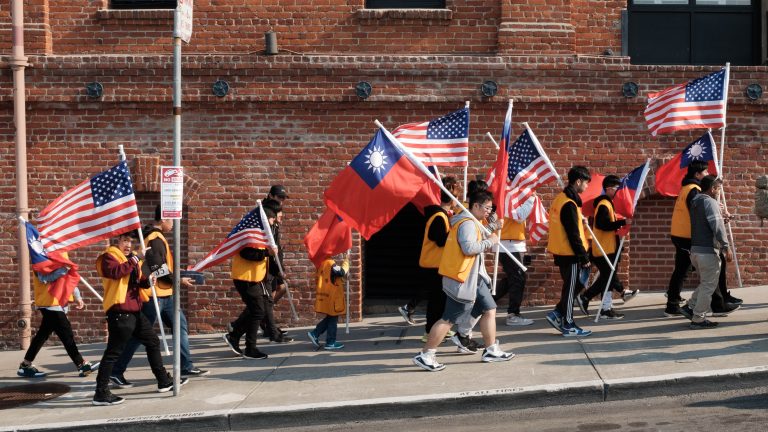
Image: “Untitled” by Ken Walton, retrieved from https://commons.wikimedia.org/wiki/File:Untitled_-Flickr–kenwalton(18).jpg. This file is licensed under the Creative Commons Attribution 2.0 Generic license.
.jpg)