
Hamiltonian Journal
Political Polarization and Military Effectiveness
Share On:
Politically polarizing military policy actions have, throughout history, wreaked havoc in the United States, disguising deep-rooted issues within military structure and preventing the United States from achieving the martial prowess it needs for great power competition. Democracies are particularly sensitive to perceptions of politicization in security forces, often at the expense of more nuanced policy debate. The Spanish-American War supplies an instructive example of how harmful institutional structures can be overshadowed by overblown public concerns on otherwise marginal issues such as camp habituation standards. These patterns continue to this day. By mitigating perceptions of political partisanship in military actions, the United States can de-politicize the military, alleviating citizen’s fears in the midst of strong political polarization.
The military increasingly has become wrapped up in partisan culture wars, inhibiting its ability to perform its function as a non-partisan actor. From the political left, the Department of War’s Diversity, Equality, and Inclusion (DEI) policies injected divisive policies into the military structure, removing the focus on building new weapons and maintaining the peace. In 2025, the NBC News Survey found that 49 percent of registered voters said DEI efforts should be terminated in the workplace, believing they “create divisions and inefficiencies.” On the other side, 48 percent of voters supported DEI programs in the workplace because they protect “diverse perspective [which] reflect our country.” [1] These statistics point to the political polarization surrounding DEI policies, deepening public sentiments of the military as an actor pushed onto the front lines of the culture war battle grounds. Further statistics suggest that low levels of military recruitment have stemmed from the implementation of DEI policies under Secretary of Defense Lloyd Austin in the Biden administration. In a Wall Street Journal op-ed by Mike Gallagher and Kevin Wallsten, they pointed out that “[b]etween 2013 and 2023, annual male enlistments in the Army fell 35 percent, from 58,000 to 37,700. From 2018 to 2023 the number of white Army recruits dropped from 44,042 to 25,070. No other groups saw such steep declines.” [2] The authors reasoned this decline in recruitment was a direct result of DEI policies which discouraged white men from joining up. Gallagher and Wallsten stated, “The percentage of white male veterans who said in a 2019 Pew study that they would advise a young family member to join the military was 81 percent. Only 63 percent said so in the 2024 Survey of Military Veterans, which also asked why. Far more white male respondents pointed to the military’s “DEI and other social policies” (66 percent) than to the “possibility of physical injury or death” (38 percent) or the “possibility of psychological problems” (35 percent).” [3] These dramatic declines in recruitment levels are unsustainable, especially when considering our American commitment to a volunteer military.
Across party lines, similar uses of military actions for partisan aims exist. The renaming of the Department of Defense (DoD) to the Department of War (DoW) to ensure “peace through strength, as it demonstrates our ability and willingness to fight and win wars on behalf of our Nation at a moment’s notice, not just to defend,” as stated by President Trump in Executive Order 14347, widens the polarized gap. [4] Its stated intention to bring back great American military power is little more than gilded rhetoric, failing to support substantive practices to prepare for successful warfighting. Furthermore, President Trump’s deployment of the National Guard to American cities to enforce domestic policies is inherently political. The U.S. military is largely viewed by Americans as one of the strongest, most trustworthy U.S. institutions; however, due to culture war policies instituted across the political divide, it is increasingly seen as a partisan actor, hindering its credibility.
Political polarization mixed with public misperception is a perfect recipe for bad policy. But this recipe is far from new, and a telling precedent can be found during the Spanish-American War of 1898. Better known for yielding American acquisition of the Philippines and Cuba or for Theordore Roosevelt’s Rough Riders, this was also one of the United States’ most diseased ridden wars; of the approximately 2,000 – 2,400 deaths of American military personnel, 75 percent were due to disease. [5] In 1898, soldiers, under the command of General William Rufus Shafter, were hit hard with yellow fever, verging on the edge of a full-scale fever epidemic if not removed from their station in Cuba. After convening with general officers and chief surgeons, Shafter drafted a long telegram to Washington, outlining the likelihood of troops dying of yellow fever if not removed. The Associated Press got ahold of Shafter’s letter, publishing and naming it “Round Robin.” When President William McKinley and U.S. Secretary of War Russell A. Alger received Shafter’s telegram, they ordered the troops to be sent home. The timeline of this event, however, could not be more unfortunate. The public became outraged, believing the troops would have been left to disease and death had it not been for the press and the people calling for justice. [6]
Public sentiments toward the military worsened as poor sanitation in U.S. camps used to train and mobilize volunteers became tied to their relationship with railroad companies, a controversial topic in the late 19th century. To remedy the scandal of sick soldiers, officers in the army negotiated land contracts with the Long Island Railroad Company to build a camp, known as Camp Wikoff, in which regiments would be quarantined until healed from yellow fever. Difficulties in moving and coordinating supplies to build facilities resulted in greater suffering among troops. The overcrowded camp led men to be released from care prematurely and caused others to live in extremely poor conditions—disorganization was pervasive. As the war’s leading historian, Graham Cosmas, noted, “The “Round Robin” affair set off a wave of public apprehension about Army management, and reports from Camp Wikoff transformed apprehension into indignation.” [7] The incident at Camp Wikoff left the American people with a sense of betrayal and indignation, believing the powerful ignored the cries of their brave soldiers.
Further public fury arose following the typhoid epidemic. Although sanitation procedures and guidelines had been implemented and special reports were prepared by Surgeon General George Miller Sternburg to combat these onsets, there was a lack of follow through. Volunteers neglected sanitation, making them vulnerable to diseases. As Cosmas stated, “Bored, homesick soldiers refused to obey orders, insulted their officers, and even struck them.” [8] Regimental and company officers failed to uphold sanitation policies in camps. Volunteer soldiers’ neglect of sanitation lead to widespread diseases poised to take out a large percentage of the army. Regardless of the army’s efforts to remedy the situation, significant damage ensued. The press compiled these public grievances into a pretty package, and the people believed the story given them.
Under increasing public pressure to hold the Department of War accountable for their actions, President McKinley assembled a group of men to judge any wrongful actions committed against American soldiers. General John M. Schofield, military advisor to McKinley, was asked to head up the commission, but he refused on account of his knowing that there would be no substantial army reform and the commission was simply a political maneuver. The Dodge Commission, as it came to be known, sought to find people responsible for the suffering of troops. After many hearings and travels across the country to uncover the truth, their search culminated in the testimony of the Commanding General of the Army, Major General Nelson A. Miles. Miles claimed that at every turn his superiors chose to ignore his warnings against the deadly spread of yellow fever. He sought to publicly attack his enemies, proclaiming baseless accusations in his testimony that the army fed rotten canned beef to soldiers. Commissary General Eagan, the man responsible for the canned beef scandal, testified to the safety of the canned and refrigerated beef. The court ruled, ultimately, that the beef was safe but condemned its large-scale use in the tropics without proper experimentation. The public, meanwhile, never clearly understood the actual issues which led to mass disease among troops. As Cosmas writes, “[a]bove all, it left an ineradicable stain upon the prestige of the service. The sensational charges, not the sober refutations, stuck in the minds of thousands of ordinary citizens.” [9] Instead of taking a step back and looking at the broader roots of the problem, the military, the government, and the people chose to be content with ill-developed theories. Undiscovered medical science and generational neglect of the army by the public and congress led to the disorganization and suffering that occurred in the War.
As in the Spanish-American War, the politicization of the death toll disguised the deep-seated structural problems with the military. America won the war in spite of poor coordination between the Army and Navy and poor military appointment processes that led to ineffective leadership. In a similar manner, the U.S. is today distracted by misguided culture wars surrounding the armed forces such that they are left ill-equipped to deal with the military build-up and restructuring needed for great power competition.
This, at least, should be clear from the most recently published Overmatch brief. A Pentagon-produced multiyear review of U.S. capabilities, the brief is a war game which plays out the situation of China invading Taiwan and the following actions of the United States. These games have discouragingly shown that the United States’ deficiencies reign “every time,” in the words of Secretary of War Pete Hegseth. [10] The United States’ incapacity to win against major powers did not happen overnight but across the decades where Congress has treated defense appropriations as any other sector and the Department of War (DoW) has refused structural reform. Battles are won before they are fought. While the Trump administration has successfully withdrawn destructive DEI policies that inhibited recruitment and refocused the DoW on building warriors, there is still more institutional reform needed. Without the proper funding allocation and frameworks in place, the U.S. will continue to lose this war. The Department’s expansive budget leads citizens to feel disconnected and fear corruption, since they only see the price tag and not the product in return. When the public hears cries for greater defense funding, confusion and distrust arises. The American public must support the military build-up which will be increasingly more difficult if U.S. armed forces continue to be viewed as a tool for political means.
Considering the United States’ dire need to bring back its military superiority, everyone must work to depoliticize the military in order to refocus priorities. Instead of giving inordinate attention to DEI policies, the military should limit their politically partisan actions. Rather than messaging peace through strength by renaming the Department of Defense, work to gain the deftness needed for warfighting. The Trump administration’s deployment of military personal to American cities is another instance of military means for political ends. President Trump seeks to use U.S. forces to enforce his policies domestically, eroding citizen’s trust in the military. All of these actions distract from the root of the issues and chisel away at the trust and respect the average American has for the armed forces. The U.S. faces grave threats in theatres across the globe; yet, the public and Congress are unable to look past these grievances to see the imminent danger looming. At the fork in the road between continued American exceptionalism or a descent into mediocrity, the U.S. has a choice to make with repercussions positioned to reverberate throughout history. H
Abigail German ’26 served as the President of the AHS chapter of Cedarville University, where she majored in Political Science and Government.
NOTES:
[1] Filip Timotija, “Americans Deeply Divided Over DEI Programs: Survey,” The Hill, March 18, 2025, https://thehill.com/homenews/administration/5200425-dei-programs-americans-divided-survey/.
[2] Mike Gallagher and Kevin Wallsten, “How DEI Caused Military Recruitment Crisis,” The Wall Street Journal, 13 Jan. 2026, https://www.wsj.com/opinion/how-dei-caused-a-military-recruitment-crisis-c86acd6e?st=dHFZ7U&reflink=article_copyURL_share.
[3] Gallagher and Wallsten, “How DEI Caused Military Recruitment Crisis.”
[4] United States, Executive Order of the President, Executive Order No. 14347, “Restoring the United States Department of War,” September 5, 2025, https://www.federalregister.gov/documents/2025/09/10/2025-17508/restoring-the-united-states-department-of-war.
[5] “The Scourge of the Spanish American War,” PBS: The American Experience, https://www.pbs.org/wgbh/americanexperience/features/fever-scourge-spanish-american-war/.
[6] Graham Cosmas, An Army for Empire: The United States Army in the Spanish-American War (Texas A&M University Press, 1994), 265.
[7] Cosmas, An Army for Empire, 265.
[7] Cosmas, An Army for Empire, 269.
[8] Cosmas, An Army for Empire, 296.
[9] Cosmas, An Army for Empire, 296.
[10] “Overmatched: Why the U.S. Military Needs to Reinvent Itself,” The New York Times: Editorial Board, 8 Dec. 2025, https://www.nytimes.com/interactive/2025/12/08/opinion/us-china-taiwan-military.html?smid=nytcore-ios-share.
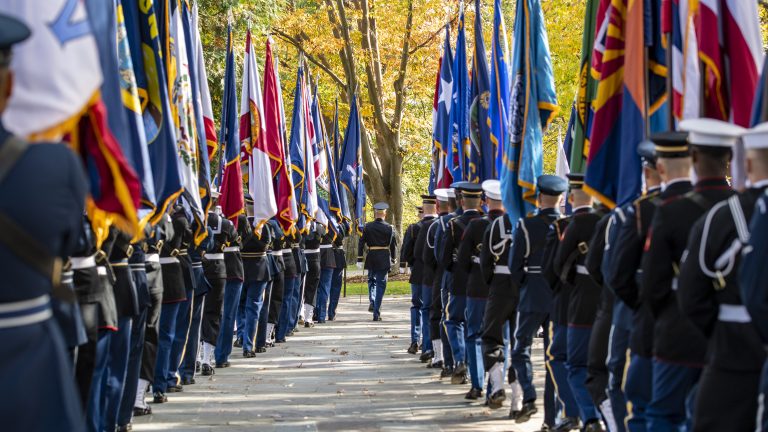
Image: “Service members prepare the State and Territorial Cordon outside the Memorial Amphitheater at Arlington National Cemetery, Arlington, Va., Nov. 11, 2023. This was part of the 70th National Veterans Day Observance.” by Elizabeth Fraser, retrieved from https://commons.wikimedia.org/wiki/File:70th_National_Veterans_Day_Observance_at_Arlington_National_Cemetery_on_November_11,2023-_27.jpg. This file is a work of a U.S. Army soldier or employee, taken or made as part of that person’s official duties. As a work of the U.S. federal government, it is in the public domain in the United States.