


Security and Strategy Journal
The Shape of Victory: The Logic of Chinese Global Strategy
Share On:
In the sixteenth century, Jesuit missionaries in China made limited but meaningful progress in their conversion mission, not by imposing their worldview, but by learning to think like the Chinese people.1 Today, the United States faces a similar challenge: it cannot compete effectively with China without understanding how China thinks strategically and how that manifests in their approach to competition.
At the heart of U.S.-China strategic misalignment is a cognitive divide: the West operates through causal logic, focused on goals and direct actions to achieve them. China, by contrast, uses correlative logic, emphasizing patterns, relationships, and the shaping of conditions for what is to be done. While the Western tradition seeks to force an intended outcome, the Chinese tradition seeks to make that outcome inevitable through systemic advantage. This approach is evident on Taiwan, where the United States is focused on military deterrence, while China focuses on winning without fighting.
This cognitive divergence fundamentally affects how each side plans and competes. To compete effectively, the United States must relearn how to shape environments rather than react to crises, a form of political warfare that mirrors China’s emphasis on configuring conditions. By understanding and learning from these differences, the United States can better anticipate Chinese actions and reactions and deter conflict. This paper explores these contrasting modes of thought, their philosophical roots, and proposes that the United States relearn political warfare, the art of shaping global conditions so favorable outcomes emerge, the essence of winning without fighting.
Philosophical Foundations
Causal vs. Correlative Logic
The foundational divide between Chinese and Western strategy lies in how each interprets the relationships between cause and effect. Western strategic thinking is rooted in causal logic: define an objective (ends) and apply resources and actions (means and ways) to achieve it. Chinese strategy, by contrast, is shaped by correlative logic and involves identifying ‘Shi,’ the momentum of propensity within systems, and shaping the conditions so that the desired outcome emerges.2
Consider a boulder on a hill, with a town below. A causal thinker might push the boulder in another direction to avoid disaster. A correlative thinker studies the terrain and reshapes it in advance, so when the boulder eventually rolls, it follows a path that avoids the town. The key difference: one forces outcomes, the other shapes conditions.
This distinction is clear in how both the United States and China engage in competition globally, and the strategies they each pursue. The United States relies on military posturing, economic leverage, and bilateral diplomacy, assuming that bold, discrete actions will produce the desired outcomes. China, on the other hand, uses strategies to shape global perceptions, cultivate long-term alignment, and influence a nation’s elite, so that China’s rise and domination seem the inevitable outcome.3
Chinese Traditions
Chinese strategic thinking has been shaped and influenced through a long and rich philosophical tradition. Two deeply rooted Chinese concepts, Shi and Guanxi, illustrate the correlative logic interwoven throughout Chinese strategic thought. Shi, often translated as the “propensity of things” or “strategic configuration,” emphasizes the importance of shaping conditions so that outcomes unfold naturally, without the need for direct force.4 Guanxi underscores the value of relational networks, where influence is mediated through trust and interconnectedness, yet fundamentally anchored in webs of reciprocal obligations that function as a potent form of non-kinetic pressure or strategic leverage.5
Take, for example, China’s Belt and Road Initiative (BRI). The BRI does not just offer loans, which is a causal transaction, it establishes dependency, obligations, and interconnections between China and the receiving nation.6 Once the social or political terrain has been shaped, or Guanxi established, the resulting political and economic leverage that it affords China over the other country is the Shi, or strategic advantage. When China needs something like a vote at the United Nations, silence on human rights or Taiwan, or access to a port, the established relationship—Guanxi—allows China the strategic advantage—Shi—to generate the necessary momentum for the desired outcome.
Together, these ideas offer a concept not of acting upon the world, but of configuring the world, a fundamental departure from the West’s more direct, causal approach to strategy. These concepts have been infused with modern Maoist and systems thinking to inform the Chinese strategic approach to competition and international relations. While correlative shaping is the preferred strategy, the Chinese have not shied away from using causal force to reset or generate Shi.
Sun Tzu and Shi: The Geometry of Strategic Advantage
Sun Tzu’s military treatise The Art of War is suffused with the insight that force alone does not guarantee success. Victory depends on recognizing the hidden currents beneath the surface of conflict, the potential energy or momentum of forces and situations, and channeling them into a coherent and decisive advantage: Shi.7 Shi, is sometimes also translated as “strategic advantage,” “momentum,” or “the potential energy of the situation.”8 Shi is not merely a position or force, but the dynamic power generated by harnessing the latent tendencies of terrain, troops, timing, and circumstances.9
Sun Tzu’s dictum, “Avoid what is strong, attack what is weak,” embodies this philosophy: one must identify the enemy’s vulnerabilities, propensities for failure, and exploit them to create unassailable momentum.10 These propensities may manifest as the geographic layout of a battlefield, the morale of troops, or even the timing of an attack relative to enemy readiness. For example, mountainous terrain naturally favors defenders, while open plains may favor cavalry. Through this lens, warfare becomes an art of directing and amplifying existing forces rather than solely through confrontation.
Confucianism and Guanxi: The Ethics of Relationships
Confucianism informs Chinese strategic thought by providing a normative framework for the conduct of relationships and the management of relational networks. Confucianism is the philosophical doctrine that considers the proper ordering of human relationships to be the basis of society and governance.11 Its emphasis on the order and value of interpersonal relationships is different from the Western emphasis on individualism or a relationship with God and leads to differing relational incentives. Confucian understanding of relational dynamics underpins the idea of Guanxi, as to the Chinese, every individual or object exists in context woven together by various relationships.12 This holistic view of relationships and how they interact is embedded in their way of thinking and colors the Chinese logic regarding international relations.
The strategic importance of Confucianism and Guanxi in international relations is that Chinese actions globally aim to create dependencies that serve Chinese interests and can be strategically leveraged to pressure or induce the other party.13 China is willing to shoulder greater economic costs for increased influence and leverage over ports or electric grids, such as their Belt and Road Initiative. While BRI investments can at times be a net negative for China, it still gains them obligations, dependencies, and interconnections with the recipient country. These benefits are material, social, and relational, as shown in the growing reliance on and favorable perceptions of China throughout the Global South.14
Maoism: The Dialectic of Shaping and Force
Mao Zedong, the founder of the People’s Republic of China (PRC), effectively operationalized the traditional concepts of Guanxi and Shi by infusing them with Marxist-Leninist thinking. However, Maoist strategy is not purely indirect; it is a dialectic between correlative shaping and causal force.
Mao’s strategy of Protracted Warfare is the quintessential Shi-based approach. During the Chinese Civil War, instead of seeking a decisive, causal confrontation with the militarily superior Kuomintang or Japanese forces, his troops strategically “traded space for time.”15 This patient, indirect approach allowed Communist forces to harness the latent tendencies (Shi) within the system: the exhaustion of the enemy, the widespread discontent of the peasantry, and the strategic geography of the interior.16 These efforts cultivated deep networks of obligation and trust, building a social terrain where Communist victory appeared inevitable.17
While Mao preferred to win through environmental configuration, Chinese practice post-1949 shows a willingness to employ direct action when configuration fails. While the Chinese preference is to shape the environment, they will use force if the environment becomes or trends toward an unacceptable status quo. This is the causal reset:
- The Yalu River (1950): In the Korean War, China did not enter through subtle manipulation. When U.S. forces reached the Yalu, the regional Shi had shifted to threaten the young PRC’s survival. Mao resorted to a massive, direct application of force, with his decision to invade being a mix of state survival, continuing Chinese revolutionary momentum, potential Soviet involvement, and resisting Western influence after a century of humiliation.18 This decision by Mao violently reset the regional Shi, ensuring the PRC could build on the momentum of its victory in the civil war.
- The Great Leap Forward (1958-1962): While primarily an internal economic campaign, the Great Leap Forward was Mao’s attempt at correlative engineering, seeking to harness the “potential energy” of the masses to transform the domestic economy from agrarian to industrial.19 Its failure destroyed China’s internal Shi, creating a domestic vacuum that Mao filled with a causal pivot: the 1962 Sino-Indian War. This military strike was a hammer used to reset a declining domestic status quo and waning regime legitimacy, proving that when the Chinese Communist Party’s (CCP) environmental configuration fails, it will use direct, violent action to prevent a total loss of strategic momentum.20
- The Sino-Vietnamese War (1979): Similarly, the 1979 invasion of Vietnam, though post-Mao, followed the Maoist template of decisive causal action when strategic configuration fails. It was a causal strike which may have been interpreted as a move intended to disrupt the Soviet-Vietnamese encirclement that was trending against China’s long-term interests, restore regional stability, and shore up domestic regime stability post-Cultural Revolution so that China could undertake economic and military reforms.21
The strategic insight of Mao and post-Mao is that correlative statecraft and causal force are not mutually exclusive; they are two tools of the same kit. This creates a hammer in the sandbox model: the CCP uses tools such as United Front work to shape the environment (the sandbox) but retains credible military forces (the hammer) to destroy or reset an unfavorable or trending unfavorable momentum. This remains the template for modern Chinese strategy. Whether through Wolf Warrior diplomacy or the missile buildup in the Taiwan Strait, the goal is to ensure that if the United States cannot be out-shaped correlatively, it can be out-forced causally to restore a pro-Chinese momentum.
Qian Xuesen Systems Thinking: Correlation at Scale
Qian Xuesen, a prominent Chinese rocket scientist, was the founding figure of China’s rocket and space programs.22 He was also highly influential in developing Chinese complexity systems thinking, which applied traditional Chinese philosophical concepts like Guanxi and Shi with a scientific approach.23
Qian’s work institutionalized the correlative method and scaled it to encompass all levers of state power. It views the entirety of the levers of state power—political, economic, military—as one complex relational system to be engineered and leveraged to achieve a desired outcome. This is why Beijing’s competition is a full-spectrum, integrated effort to configure global order, not a series of compartmentalized actions.
The importance of systems engineering is not just in shaping political or social outcomes, but in shaping the People’s Liberation Army (PLA) as well. Qian advocated adopting a full picture mindset to be able to envision the best outcome for the whole and how to leverage the parts towards it.24 Lessons from Qian influenced Post-Mao China and shaped how the Chinese system approached the application and pursuit of international competition and the overall goal of national rejuvenation.25 His influence led to the incorporation of military systems engineering throughout PLA and CCP entities and informed the Chinese approach to “intelligized” warfare.26
Contemporary Manifestations: Comprehensive National Power and the United Front Battlespace
Comprehensive National Power
These strategic thought patterns are not just footnotes of philosophers long past, but inspiring the current leadership of China, with Xi Jinping stating in 2021, “The world is in a turbulent time that is unprecedented in the past century, but time and momentum are on our side.”27 Contemporary manifestations of this strategic thought appear through Comprehensive National Power (CNP), a metric the CCP uses to drive national rejuvenation by integrating all material and ideational levers of state power. CNP, can be described as, “the combination of all powers and international influence possessed by a state for its survival and development, including material and ideational ethos, and even intellectual influence.”28
Unlike the Western approach to power, the CCP views CNP as a dynamic system engineered to secure survival and influence.29 This system includes control of strategic resources, military strength, research and development, human and financial capital, influence over global norms, strategic position, and political influence.30 The United Front is the primary mechanism for operationalizing this strategy, manipulating relational networks (Guanxi) to create strategic momentum (Shi) within foreign societies.
United Front Work
The Chinese Communist Party’s United Front strategy is, at its core, about establishing temporary alliances with so-called friends, to isolate the enemy, with the aim of CCP victory. In turn, this is operationalized through work—influencing elites, co-opting institutions or economic dependencies, and reframing regional and global narratives in favor of Beijing’s interests.31 The United Front is the operational expression of manipulating Guanxi to create favorable Shi. United Front Work is a proactive strategy to shape the environment, thereby advancing China’s CNP.32 United Front Work is the active, correlative strategy that configures an environment by:
- Identifying existing contradictions and Guanxi in a country through diaspora ties, pliable elites, or economic dependencies;
- Manipulating or reinforcing Guanxi through co-optation, cultural exchange, narrative manipulation, or coercive actions towards their ultimate aim;
- Generating Shi through configuring the overall momentum of global perceptions, policies, and elite attitudes moving in China’s favor.
For example, United Front Work in Taiwan represents one of the CCP’s most sophisticated and longrunning influence campaigns, leveraging economic integration, media penetration, political cooptation, and cognitive shaping to configure the island’s strategic environment in Beijing’s favor.33 The CCP has supported or covertly funded prounification media outlets, with investigations in Taiwan revealing cases where editorial lines were shaped by mainland actors to amplify narratives of inevitability, economic dependence, or American unreliability.34 United Front organizations have also engaged local politicians, religious groups, and youth exchanges to cultivate sympathetic elites and normalize political positions aligned with Beijing’s interests.35 The cumulative effect is a correlative shaping of Taiwan’s political and cognitive terrain so that policies, public opinion, and elite attitudes move in China’s favor while simultaneously cultivating the perception that U.S. support is uncertain and that resistance carries unacceptable risk.
However, this correlative shaping does not exist in a vacuum; it is underpinned by a massive military buildup. While the United Front works to undermine American strength and Taiwanese resolve by eroding alliance cohesion and domestic resolve, the PLA’s missile modernization serves as a strategic insurance policy. Its purpose is to deter the United States from using its own military advantages to disrupt China’s actions and deter the use of force by the United States.36 If the United Front successfully configures the political and cognitive terrain on Taiwan and the First Island Chain, the missile buildup ensures that the cost of military intervention becomes prohibitively high, effectively locking in the strategic configuration. In this sense, China’s quest for military supremacy is not a pursuit of a Western-style decisive battle, but a mechanism to protect their systemic configuration so that Chinese hegemony becomes the inevitable outcome.
How Chinese Strategy Undermines the Foundations of U.S. Power
This campaign reflects a blend of Chinese strategic thought embodied by the stratagem of “removing the firewood from under the pot.”37 In this correlative framework, the pot represents U.S. hard-power deterrence and power projection in the Pacific, the fire is the kinetic capacity of the U.S. military, and the firewood comprises the essential foundations of that power: alliance cohesion, domestic consensus, and industrial capacity.38
China is systematically waging a campaign to ensure the American pot goes cold before it ever reaches the battlefield. Rather than confronting the fire—U.S. military strength—directly, Beijing seeks to neutralize its source. Through political warfare, economic coercion, and information manipulation, China aims to pull the firewood—the societal and logistical underpinnings of power—out from under the U.S. strategic position.39 This is the war China is already fighting: a campaign of systemic advantage designed to make an American defeat inevitable by letting the pot go cold on its own.
The Clash
The clash between these two logics is where the United States finds itself strategically vulnerable. The United States is prepared to fight a war of action and reaction, focused on measurable effects—sunk ships, trade tariffs, missiles produced etc. China is fighting a war of conditions and emergence, focused on creating momentum that eventually makes U.S. actions irrelevant or too late.
Implications for U.S. Strategy: Relearning Shaping and Political Warfare
An American Shaping Imperative: Political Warfare with American Characteristics
Confronting China’s quiet offense requires meeting it on its own terms and advancing American comprehensive national power. That means fighting a different kind of war, a political, economic, and cognitive one that is fought every day and not just in crisis. The U.S. is trying to manufacture favorable conditions through force and spending, instead of leveraging existing political, social, and cultural trends. The United States needs to relearn the muscle memory of engaging in political warfare to counter Chinese strategy and can learn from its own history to do so.
There is historical precedent for the United States engaging in political warfare that shapes environments rather than reacting to crises, notably in its support for the Polish Solidarity movement during the 1980s. The movement was not an American creation, but an organic undertaking within Poland which the United States helped to grow and cultivate. As documented in public accounts and retrospective analyses, U.S. strategy did not rely on overt coercion or direct confrontation with the Soviet Union; instead, it quietly nurtured the social, economic, and informational conditions that allowed an indigenous democratic movement to gain momentum against an authoritarian rival.40 Through covert financial assistance of less than $20 million, secure communications equipment, and support for underground publishing networks, the United States helped the Polish Solidarity movement sustain organizational cohesion despite martial law and repression.41 American institutions, including labor unions and religious organizations such as the Catholic Church, provided moral and material backing that reinforced the movement’s legitimacy and resilience. Crucially, U.S. messaging and diplomacy framed Polish Solidarity not as a geopolitical pawn but as an authentic expression of Polish national identity, allowing the movement to generate its own Shi within Polish society.
This approach exemplified political warfare with American characteristics: empowering local actors, amplifying organic societal propensities, and shaping the broader international narrative in ways that imposed asymmetric costs on an authoritarian adversary. Victory is not measured solely by discrete wins, but by the sustained alignment of systems, networks, and perceptions that deny the adversary’s strategic space and use their own adverse actions to impose costs against them.
Theories of Success: Relearning Political Warfare
The fundamental challenge for the United States is not a lack of resources but a temporal peace-war binary. For modern competition, success is not defined by the containment of Chinese actions, but by the sustained imposition of costs on China and undermining the legitimacy of its global ambitions. China’s own actions abroad have created specific vulnerabilities that the United States can and should exploit through asymmetric means to ensure the propensity of the international order aligns with U.S. interests.
Rather than containing Chinese expansive actions, the United States must weaponize the friction generated by China’s global heavy-handedness to impose increasing costs on their actions. The CCP’s pursuit of Shi (momentum) often creates its own vulnerabilities in the form of regional and generational resentment, debt-trap anxiety, and sovereignty concerns. This requires identifying, cultivating, and amplifying the emerging regional frictions from Chinese actions. Across Africa, especially in Kenya, disillusionment amongst the younger generations due to Chinese debt ownership and corruption is growing as a backlash to their actions that can be exploited.42 In the South China Sea, Chinese coercive actions against regional territory and sovereignty have led nations like the Philippines to challenge Chinese claims, and seek deeper ties with their neighbors and the U.S.43 By cultivating and amplifying emerging propensities, the United States can generate friction to impose costs on the vulnerabilities that Chinese revisionism is creating. The goal is to ensure that every act of Chinese expansion creates a corresponding, grinding resistance, forcing China into strategic dilemmas, as victory by political warfare comes through strategic exhaustion.
Political warfare begins at home. The United States cannot shape external environments if its internal environment is permeable to foreign manipulation and division. Resilience cannot come at the expense of the openness that generates American strategic legitimacy; the task is to harden the system without undermining American advantages. Chinese influence operations seek to exploit open information ecosystems, diaspora communities, opaque financial channels, and fragmented social cohesion to generate political leverage within American communities.44 These vulnerabilities are not peripheral, they are the primary terrain on which adversaries attempt to erode American domestic coherence.
To counter this, the United States must raise the cost of foreign influence within its borders. Just as it supported underground publishing networks in Poland to preserve informational autonomy, it must now ensure narrative integrity at home through radical transparency in foreign funding, data custody, and algorithmic sourcing. Transparency requirements, such as foreign agent registration, disclosure of foreign-linked digital content, and traceability of online political advertising, can reduce the effectiveness of covert influence campaigns. By making co-optation a high-friction, low-reward endeavor, the U.S. denies China the ability to generate its own Shi within American society.
Resilience also includes the material foundations of national power. Analyses by the Congressional Research Service have highlighted how supply chain vulnerabilities, such as critical mineral access and insufficient production capacity, create strategic exposure that adversaries can exploit during crises.45 Securing critical supply chains, revitalizing industrial capacity, and reducing single-point dependencies are not merely economic policies, they are political warfare measures. They ensure that American power cannot be undermined through coercive leverage or strategic disruption. Deterrence, in this context, is not only a matter of military posture; it is the structural certainty that the United States cannot be destabilized from within.
The experience of the Global War on Terror underscores a hard truth: military force is most effective when it reinforces political conditions shaped in advance and sustained afterward, not when it is asked to substitute for them.46 The United States learned, often painfully, that durable outcomes emerge from empowering local partners, aligning with existing political and social structures, and ensuring that any kinetic action is embedded within a broader political design.47 This is the logic behind the hammer in the sandbox model.
In this model, U.S. hard power functions as a stabilizing instrument, not as the architect of the political environment. The sandbox, the political, informational, economic, and social terrain, must be shaped first through local relationships, partner capacity, and clear political objectives. When this groundwork is in place, the hammer can defeat or deter adversaries from attempting rapid, unilateral gains, such as a fait accompli of Taiwan, or exploiting vacuums created by instability. Instead of relying on force to build new systems from scratch, the United States gains strategic advantage by identifying, supporting, and strengthening existing systems or trends.
Credible deterrence within this model is the assurance to competitors or adversaries that military power is integrated into a coherent and durable political strategy. It precedes action with shaping, follows action with stabilization, and relies on partners who can carry forward the political effects that force alone cannot achieve. When deterrence fails and force becomes necessary, the hammer’s role is to defeat an adversary’s forces and stall their momentum long enough for favorable political conditions to reassert themselves. This can prevent the kind of postconflict vacuums that historically allowed hostile actors to regenerate or expand. Kinetic action then becomes a reset mechanism to preserve the time and space needed for long-term strategic advantages to materialize.
Political warfare with American characteristics draws on the strengths and interests of the United States while keeping constant pressure on adversarial actions and exploiting the vulnerabilities they themselves generate. This is not about mimicking Chinese strategy, but about learning to seetime, influence, advantage, and friction in ways that allow the U.S. to compete asymmetrically on American strengths to curb Chinese momentum and provide the catalyst for American momentum. By keeping pressure on and imposing costs on China, renewing its domestic base of power, ensuring strong resilient alliances, and military force complementing political shaping, the U.S. can outlast and outmaneuver authoritarian challengers, not through confrontation, but through configuration.
Recommendations
The Missing Piece: Measuring Systemic Advantage
Political warfare is about configuring the environment, not dominating it, so relearning political warfare requires more than new tools, it requires new metrics. The United States cannot evaluate political warfare success through gross measures of power such as fleet size, budget totals, or force posture. Therefore, it must measure net systemic advantage: the degree to which the strategic environment naturally moves in America’s favor and imposes friction on adversaries. Each metric is meant to measure momentum, not just discrete outcomes. Below are three possible metrics, each with an example of what it looks like in practice and how it can be used:
The Drag Coefficient (Measuring Adversary Friction)
This metric measures how much energy China must expend to achieve a unit of strategic effect. Political warfare succeeds when China’s actions generate their own resistance, when every move they make becomes costly, slow, and politically counterproductive.
- The Metric: The ratio of Resource Input to Strategic Output.
- Application: If China must spend billions in subsidies, diplomatic capital, and coercive pressure to maintain influence in a select country, while the U.S. only needs modest diplomatic engagement and partner capacity-building to counter it, the drag coefficient is rising. For example, China’s pressure campaign against South Korea over THAAD cost Beijing economic and political capital, yet Seoul did not reverse the deployment.48
- Goal: U.S. planners at Country Teams and Combatant commands (COCOMs) can track and identify where Chinese actions are generating backlash, such as debt distress in Kenya, economic coercion in South Korea, or surveillance-state exports in Latin America, and invest selectively to amplify that friction and impose costs on Chinese actions.
Alignment Velocity (Legitimacy of the System)
Political systems rely on legitimacy; when legitimacy erodes, systems become vulnerable to subversion or replacement. Because legitimacy determines whether states see a system as worth joining or resisting, shifts in alignment reveal which architecture is gaining or losing credibility. This metric measures how quickly neutral states drift toward or away from U.S. or Chinese systems. It captures the legitimacy of each architecture.
- The Metric: The speed of alignment or of distancing from the U.S. or Chinese system.
- Application: When China engages in coercive Wolf Warrior diplomacy, such as economic punishment of Australia, regional actors often respond by forming or strengthening mini-lateral groups (Quad, AUKUS, IPEF). That is positive alignment velocity for the U.S. Conversely, when China successfully expands BRICS or the Shanghai Cooperation Organization (SCO), that is negative alignment velocity.
- Goal: U.S. strategists can identify which Chinese behaviors consistently produce positive alignment velocity for the U.S. and invest in amplifying those propensities through public diplomacy, partner capacity, or targeted economic support.
Vacuum Fill Rate (Post-Hammer Resilience)
This metric measures how quickly the U.S. or its partners can fill the political, economic, or informational vacuum created by a coercive or kinetic action, whether by China or the U.S.
- The Metric: Time-to-Systemic-Replacement.
- Application: The British intervention in Sierra Leone from 2000 to 2002 illustrates what a high vacuum fill rate looks like in practice. After halting the Revolutionary United Front (RUF) advance through Operation Palliser and rescuing hostages in Operation Barras, Britain did not allow the vacuum created by these hammer actions to linger. Instead, it immediately deployed a coordinated political-military consolidation effort, most notably Operation Silkman, which embedded British officers within the United Nations Mission in Sierra Leone, rapidly expanded training and advising for the Sierra Leone Army, and synchronized regional diplomatic pressure against RUF sponsors. This swift transition from kinetic action to systemic reinforcement enabled local forces and the U.N. to seize and hold territory, restart disarmament, and reestablish political authority before spoilers could regroup. The success of the campaign was not the initial use of force, but the speed and coherence with which Britain filled the postconflict space with governance, security, and institutional capacity.49
- Sierra Leone demonstrates that when the vacuum is filled immediately, force becomes a reset mechanism that restores favorable political conditions rather than a temporary disruption that collapses into disorder.
- Goal: Before any sanction, interdiction, or use of force action, the U.S. should have an economic package, governance initiative, partner-led institution, or alternative to the displaced Chinese one ready to deploy.
Conclusion
The ongoing competition is not a new Cold War; it is a contest of world-shaping. Just as the Jesuit missionaries learned to see the world through a Chinese lens to achieve their mission, U.S. strategy must adopt a correlative lens and relearn political warfare to preserve its interests. The current causal paradigm, reactive, transactional, and focused on the decisive clash, is insufficient against an adversary that wins by configuring the environment.
Victory in the twenty-first century will not come from ships sunk or the number of tariffs imposed, but from the architectural integrity of the competing systems being built. By weaponizing the friction of Chinese actions and securing its own domestic firewood, the United States can ensure that the strategic propensity flows naturally toward a free and open world. The shape of victory is not found in the fire of conflict, but in the configuration of the terrain before the match is ever struck.
Matthew Sansone is a national security strategist supporting the Joint Staff focused on strategic competition, irregular warfare, and political warfare. He graduated from Catholic University with a bachelor’s degree in international relations and a master’s degree from American University in international relations. Matt is an alumnus of SSS China
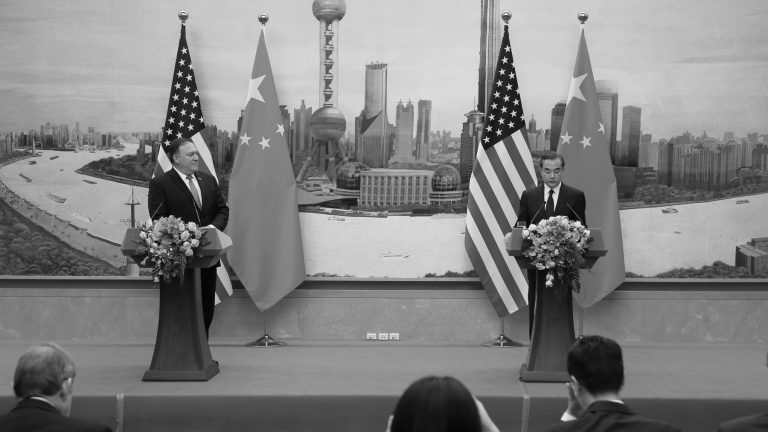
Image: U.S. Secretary of State Pompeo Visits Beijing, China, 2018 (42861696392), June 19, 2018, from U.S. Secretary of State Pompeo Visits Beijing, China, 2018. Retrieved from: https://commons.wikimedia.org/wiki/File:U.S._Secretary_of_State_Pompeo_Visits_Beijing,_China,_2018_(42861696392).jpg.
[1] Darren Turner, “The Matteo Ricci Strategy to Find Middle Ground,” RTM World, March 9, 2021, https://www.rtmworld.com/the-matteo-ricci-strategy-to-find-middle-ground/.
[2] Francoise Jullien, A Treatise on Efficacy: Between Western and Chinese thinking, trans. Janet Lloyd (Honolulu: University of Hawai’i Press, 2004), 1; Andrew Seth Meyer, The Dao of the Military: Liu An’s art of war (New York: Columbia University Press, 2012), 24.
[3] Seth G. Jones, Emily Harding, Catrina Doxsee, Jake Harrington, and Riley McCabe, “China’s Strategy of Political Warfare,” CSIS, August 2, 2023, https://www.csis.org/analysis/chinas-strategy-political-warfare.
[4] Meyer, The Dao of the Military, 24.
[5] Kim Fassler, “‘Profound Changes Unseen in a Century’: China Assesses its Security Environment,” in The PLA in a Complex Security Environment Preparing for High Winds and Choppy Seas, ed. Benjamin Frohman and Jeremey Rausch (The National Bureau of Asian Research), 2025, 15.
[6] Jacque Schrag, “How Will the Belt and Road Initiative Advance China’s Interests?” ChinaPower Project, October 11, 2024, https://chinapower.csis.org/china-belt-and-road-initiative/.
[7] Scott D. McDonald, “Sunzi, ‘shì’ and Strategy: How to Read ‘Art of War’ the Way Its Author Intended,” The Conversation, December 3, 2024, https://theconversation.com/sunzi-shi-and-strategy-how-to-read-art-of-war-the-way-its-author-intended-200807.
[8] John Sullivan, “How Translators Choose to Render Sun Tzu’s Meaning of Shì (勢) in The Art of War,” n.d.
[9] “Sun Tzu: The Art of War,” Bowdoin College, accessed October 20, 2025, https://learn.bowdoin.edu/suntzu/content/chapter_05/index.html.
[10] “Sun Tzu: The Art of War.”
[11] J. O. Yum, “The Impact of Confucianism on Interpersonal Relationships and Communication Patterns in East Asia,” Communication Monographs 55, no. 4 (1988): 374–388, https://doi.org/10.1080/03637758809376178.
[12] Z. Pan, “Guanxi, Weiqi and Chinese Strategic Thinking,” Chinese Political Science Review 1 (2016): 303–321, https://doi.org/10.1007/s41111-016-0015-1.
[13] Brantly Womack, “China as a Normative Foreign Policy Actor,” in Who is a Normative Foreign Policy Actor? The European Union and its Global Partners, ed. Nathalie Tocci (Brussels: Centre for European Policy Studies, 2008).
[14] Andrew Chubb, “Views of China across the Global South: The Rule and the Exceptions,” Asia Society, November 13, 2025, https://asiasociety.org/policy-institute/views-china-across-global-south-rule-and-exceptions.
[15] Mao Zedong, “Introducing The Communist,” October 4, 1939.
[16] Mao Zedong, “Introducing The Communist,” October 4, 1939.
[17] Graham Young, “On the Mass Line,” Modern China 6, no. 2 (1980): 225–40, http://www.jstor.org/stable/189074; Toshi Yoshihara, “Evaluating the Logic and Methods of China’s United Front Work,” Orbis 64, no. 2 (2020): 230–48, https://doi.org/10.1016/j.orbis.2020.02.006.
[18] “China’s Intervention in the Korean War: Motives, Strategies, and Historiographical Debates,” Explaining History Podcast, October 11, 2025, https://explaininghistory.org/2025/10/11/chinas-intervention-in-the-korean-war-motives-strategies-and-historiographical-debates/.
[19] Peng-Khuang Chong, “Mao’s Great Leap Forward Brings Chaos to China,” EBSCO Information Services, 2023, https://www.ebsco.com/research-starters/history/maos-great-leap-forward-brings-chaos-china.
[20] Brahma Chellaney, “Cunning Mao Cut India down to Size,” RealClearHistory, October 30, 2019, https://www.realclearhistory.com/2017/10/19/cunning_mao_cut_india_down_to_size_505.html.
[21] Miles Maochun Yu, “The 1979 Sino-Vietnamese War and Its Consequences,” Hoover Institution, December 20, 2022, https://www.hoover.org/research/1979-sino-vietnamese-war-and-its-consequences.
[22] Ning Wang, “The Making of an Intellectual Hero: Chinese Narratives of Qian Xuesen,” The China Quarterly 206 (2011): 352–71, https://doi.org/10.1017/S0305741011000300.
[23] Hans Kuijper, “The Foundation of Chinese Systems Thinking,” Social Studies, 2025, https://www.sociostudies.org/almanac/articles/the_foundation_of_chinese_systems_thinking/.
[24] Alex Stone, “A Complex Systems Engineering Undertaking: The Qian Xuesen School of Systems Engineering,” Air University (AU), February 2024, https://www.airuniversity.af.edu/CASI/Display/Article/3643523/a-complex-systems-engineering-undertaking-the-qian-xuesen-school-of-systems-eng/.
[25] Christopher Ford, John Schurtz, and Erik Quam, “Cybernetics and Comprehensive National Power: The Grand Strategy of China’s ‘National Rejuvenation,’” Missouri State University: Defense and Strategic Studies Online 1, no. 3 (2025): 1–75.
[26] Stone, “A Complex Systems Engineering Undertaking: The Qian Xuesen School of Systems Engineering;” Josh Baughman, “The Path to China’s Intelligentized Warfare: Converging on the Metaverse Battlefield,” The Cyber Defense Review, December 19, 2024, https://cyberdefensereview.army.mil/CDR-Content/Articles/Article-View/Article/4012231/the-path-to-chinas-intelligentized-warfare-converging-on-the-metaverse-battlefi/.
[27] Wang Jisi, “The Plot Against China? How Beijing sees the new Washington Consensus,” China-US Focus, June 23, 2021, https://www.chinausfocus.com/foreign-policy/the-plot-against-china-how-beijing-sees-the-new-washington-consensus
[28] Ford, et al,, “Cybernetics and Comprehensive National Power.”
[29] Ford, et al., “Cybernetics and Comprehensive National Power.”
[30] Cleo Paskal, “Island-Hopping with Chinese Characteristics—What the PRC Is Doing in the Pacific Islands, Why It Matters, and Why the Time Has Come to ‘Block and Build,’” Naval War College Review 76, no. 4 (2023), Article 5.
[31] Yoshihara, “Evaluating the Logic and Methods of China’s United Front Work.”
[32] June Teufel Dreyer, China’s Political System: Modernization and Tradition (New York: Taylor & Francis, 2019), 60–75.
[33] Peter Mattis and Cheryl Yu, “Chinese Communist Party Covert Actions against Taiwan,” Global Taiwan Institute, March 2025
[34] Mattis and Yu, “Chinese Communist Party Covert Actions against Taiwan.”
[35] Nathan Attrill and Shelly Shih, “Back to the Old Ways: China Tries to Persuade Taiwanese they’re Chinese,” Australian Strategic Policy Institute, March 25, 2026, https://www.aspistrategist.org.au/chinas-united-front-work-on-taiwan-returns-to-first-principles/.
[36] Kyle Balzer and Dan Blumenthal, “The True Aims of China’s Nuclear Buildup,” Foreign Affairs, November 21, 2024, https://www.foreignaffairs.com/china/true-aims-chinas-nuclear-buildup.
[37] Peter Taylor, A Modern Day Interpretation of a Strategy Classic (36 Stratagems), (Infinite Ideas Limited), 59.
[38] “Joint Concept for Competing,” Small Wars Journal, September 18, 2024, https://smallwarsjournal.com/2023/02/26/joint-concept-competing/.
[39] Jones et al., “China’s Strategy of Political Warfare.”
[40] Maciej Bartkowski, “Poland’s Solidarity Movement (1980-1989),” Center for Nonviolent Conflict Research, December 2009, https://www.nonviolent-conflict.org/polands-solidarity-movement-1980-1989/.
[41] Marek Jan Chodakiewicz, “The CIA and “‘Solidarity,’” Institute of World Politics, March 17, 2019, https://www.iwp.edu/articles/2019/03/17/the-cia-and-solidarity/.
[42] Alex Nabiswa, “The Gen Z Revolution in Kenya: A Shifting Paradigm,” Indo-Pacific Studies Center, 2026, https://www.indo-pacificstudiescenter.org/commentaries/the-gen-z-revolution-in-kenya.
[43] Carlyle Thayer, “Drifting Through Dispute in the South China Sea,” East Asia Forum, February 27, 2026, https://eastasiaforum.org/2026/02/27/drifting-through-dispute-in-the-south-china-sea/.
[44] Cheryl Yu, “Harnessing the People: Mapping Overseas United Front Work in Democratic States,” The Jamestown Foundation, February 11, 2026, https://jamestown.org/harnessing-the-people-mapping-overseas-united-front-work-in-democratic-states/.
[45] Alexandra G. Neenan, “Defense Primer: U.S. Defense Industrial Base,” Congressional Research Service, December 15, 2025.
[46] Lt. Col. John Q. Bolton, “Military Power is Insufficient: Learning from Failure in Afghanistan,” Army University Press: The Military Review, January–February 2023.
[47] Karen M. Sudkamp, “Learning from the War on Terror,” War on the Rocks, March 21, 2024, https://warontherocks.com/learning-from-the-war-on-terror/.
[48] Darren J. Lim and Victor Ferguson, “Chinese Economic Coercion during the THAAD Dispute,” The ASAN Institute for Policy Studies, December 18, 2019, https://theasanforum.org/chinese-economic-coercion-during-the-thaad-dispute/.
[49] David H. Ucko, “When Intervention Works: The instructive Case of Sierra Leone,” War on the Rocks, August 31, 2016, https://warontherocks.com/when-intervention-works-the-instructive-case-of-sierra-leone/.