
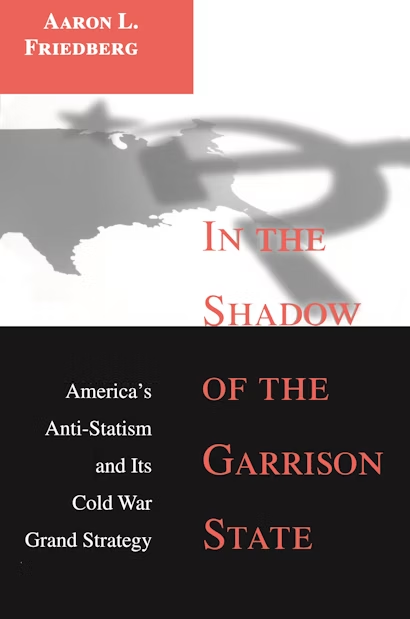
This book by Aaron Friedberg, a scholar who also served in the White House of the George W. Bush administration, is a classic analysis of the systemic competition in the Cold War. In any long-term rivalry, states will work to generate power internally, with the intention of improving their position in the external balance of power. Regarding the U.S.-Soviet competition, Friedberg wrote, “Whatever else it may have been, the Cold War was, first and foremost, a sustained competition in power creation.” This contest pitted the United States, a country with anti-statist influences growing out of its founding, against the Soviet Union, a polity governed by perhaps the most systemic top-down command-and-control system in history. Thus, the competition involved a rivalry of institutions and ideologies. While many argued at the time that the Soviet system had advantages as a geopolitical competitor, America’s anti-statist orientation, which fostered a context of innovation, motivated society to defend its liberties, and established institutions with an ability to self-correct. This stood in powerful contrast to the operation of the Soviet system, which stagnated economically, demoralized society, and overinvested in military power to the point of systemic collapse. It teaches that a strategist engaged in a systemic rivalry has to focus not just on external moves vis-à-vis opponents but also on the health and internal dynamics of his or her own society and system.
Guiding Questions
- What does Friedberg mean by "anti-statism?"
- What does this book's lens on the Cold War tell us about modern great power competition?