

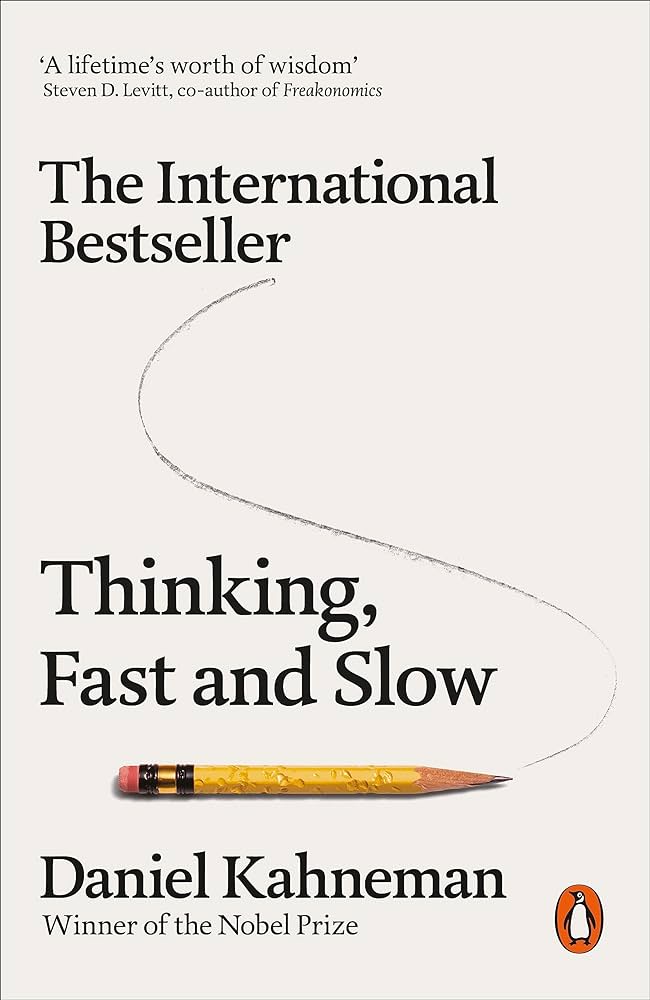
This book by Daniel Kahneman, a Nobel Prize winner in Economics, helps you understand how you think and enables self-awareness as you think about strategy. Your brain works on two tracks. “Thinking fast” is the process of rapid, associative thinking. When presented with a new situation or information, your brain almost instantaneously develops impressions and draws out implications based on your knowledge, experiences, and instincts. If you have rich base of knowledge in a field with bounded rules—a chess master playing opening moves—your fast thinking can be remarkably reliable. However, in less bounded circumstances, the reliability of your fast thinking can be undermined by uncertainty and is subject to your mental biases. This is when you need to turn to “thinking slow,” which essentially involves statistical reasoning. If you’re faced with a problem—for example, how to defeat an insurgency—thinking slow requires you to look at the patterns in past insurgencies. What strategies succeeded? How similar is your particular case to the previous insurgencies? What is the “base rate” of successes in the past? The good news is that “thinking slow” can help you narrow uncertainty. The bad news is that the future is not necessarily like the past, which means “thinking slow” does not solve all your problems. Kahneman’s book, a modern classic, will enable you to understand your own mind and guard against the weaknesses of reflexive reliance on “thinking fast.”
Guiding Questions
- As a policymaker, how does Kahneman's book affect how you structure your thinking and decision-making? Why?
- How does this individual-level thinking affect group dynamics and decision-making?