


Hamiltonian Journal
Atoms and Alliances: Preserving Order in the Nuclear Age
Share On:
I
n 2009, President Barack Obama laid out a “comprehensive agenda” toward a world without nuclear weapons. “To put an end to Cold War thinking,” Obama proclaimed in his historic Prague speech, “we will reduce the role of nuclear weapons in our national security strategy and urge others to do the same.” [1] In 2025, this dream of a nuclear-free world is increasingly distant, as adversaries and allies alike emphasize nuclear weapons in their national security strategy. The People’s Republic of China (PRC) considers nuclear weapons a “strategic deterrent” against perceived U.S. coercion, and Russia continues to engage in nuclear saber-rattling to deter Western states from aiding Ukraine. [2-3] Smaller rogue states like North Korea have developed longer-range, more destructive delivery systems and warheads that hold the United States mainland at risk. [4] Meanwhile, because of dangerous nuclear adversaries and perceived weaknesses in U.S. extended deterrence commitments, traditional U.S. allies are considering nuclear proliferation of their own. The world has entered an age of renewed nuclear competition, and preserving the crumbling nuclear order that has historically prevented nuclear use and limited nuclear proliferation will be one of the United States’ most pressing challenges in the twenty-first century.
Underpinning the nuclear order is the 1968 Treaty on the NonProliferation of Nuclear Weapons (NPT). Non-nuclear signatories to this treaty commit to not use nuclear materials to create weapons and are required to allow the International Atomic Energy Agency to verify NPT
compliance in exchange for equal access to nuclear technology for peaceful purposes. [5] The credibility of U.S. extended deterrence commitments is what ultimately gives “[allies] and partners confidence that they can resist strategic threats and remain secure without acquiring nuclear weapons of their own,” as the 2022 Nuclear Posture Review affirms. [6] It is this simultaneous ability to deter adversaries and assure allies that mitigates the likelihood of nuclear use and proliferation.
The current nuclear order, however, is untenable. Adversaries are elevating their strategic nuclear capabilities and thereby generating fears among U.S. partners, some of which now seriously consider acquiring nuclear weapons as tools to protect themselves from such strategic level threats. To preserve the nuclear order, limit nuclear proliferation, and prevent nuclear use, the United States must act decisively to assure partners and deter adversaries.
An Unsustainable Bargain
After the Second World War, the United States negotiated a hegemonic bargain with its allies in which it became the guarantor of the international order in exchange for other states acquiescing to U.S. leadership and operating within the framework of the order. G. John Ikenberry identifies security as a service the United States provides for its clients: The United States agreed to provide security protection and access to American markets, technology, and resources within an open world economy. In return, America’s partners agreed to be reliable partners that would provide diplomatic, economic, and logistical support for the United States as it led the wider order. [7]
The United States crafted bilateral security treaties in Asia and collective security institutions in Europe that enshrined defense commitments against communist aggression. By meeting European and Asian security demands, extended deterrence commitments reduced the
need for other states to increase security by pursuing nuclear weapons and allowed non nuclear states to more easily accept the NPT. [8]
Even though the United States and the Soviet Union made several nonproliferation breakthroughs, the Cold War was largely defined by fierce competition between both states. Deterrence was therefore the primary nuclear concern of both great powers. To “offset” Soviet conventional superiority and assure partners, the United States deployed strategic and theater nuclear weapons across Europe, engaged in nuclear sharing with allies, and maintained a declaratory policy of “calculated ambiguity” and potential nuclear retaliation in response to conventional aggression. [9-10] By adequately persuading partners that the U.S. nuclear umbrella would meet European and Asian security demands in the event of a conflict, allies would comply with the U.S. nuclear non-proliferation agenda. The nuclear arsenal became the linchpin of the nuclear nonproliferation regime during the Cold War.
Mikhail Gorbachev’s ascension to power and the collapse of the Soviet Union fundamentally shifted this strategic calculus. Once NATO’s principal adversary disappeared, the demand for the U.S. nuclear deterrent decreased. The United States engaged in a sweeping withdrawal
of conventional and nuclear capabilities across the globe without the need to consider deterrence and assurance requirements. [11] Then-President George H.W. Bush released the First Presidential Nuclear Initiative in 1991 that ordered the withdrawal of nuclear weapons from attack submarines, surface fleets, and land-based naval aircraft, the elimination
of ground-launched nuclear systems from NATO-member states, and a reduction in air delivered theater nuclear warheads. [12] Bush’s Second Presidential Nuclear Initiative emphasized reducing strategic forces by eliminating various intercontinental ballistic missiles (ICBMs), strategic bombers, and advanced cruise missile production and procurement programs. [13] Corresponding with these deep reductions, the United States and Russia developed extensive non-proliferation and arms control regimes that reduced capabilities and improved verification methods. Previously, the Strategic Arms Reduction Treaty I (START I) had already dismantled approximately 80 percent of all strategic nuclear weapons then in existence. [14]
The conditions that led to sweeping nuclear arms reductions no longer exist. As former Acting Assistant Secretary of Defense for Space Policy Vipin Narang correctly observes: [We] now find ourselves in nothing short of a new nuclear age — an unprecedented mix of multiple revisionist nuclear challengers who are uninterested in arms control or risk reduction efforts, each rapidly modernizing and expanding their nuclear arsenals, and openly threatening to employ nuclear weapons to achieve their aims. [15]
This new nuclear age has spurred a renewed demand for U.S. extended nuclear deterrence. The PRC’s nuclear build-up in service of “the great rejuvenation of the Chinese nation” has corroded the security environment for U.S. Indo-Pacific partners. [16] Japanese Prime Minister Shigeru Ishiba has called on the United States to introduce nuclear weapons in the Indo-Pacific. Writing for the Hudson Institute, Ishiba worries, “North Korea is strengthening its nuclear and missile capabilities, and if China’s strategic nuclear weapons are added to these dynamics, the US extended deterrence in the region will no longer function.” [17] Top-level South Korean politicians have also contemplated developing “nuclear-latent” capabilities or the ability to acquire nuclear weapons relatively quickly and inexpensively in the event of crisis. For the first time since 1991 when the United States withdrew all its nuclear weapons from the Korean Peninsula, former South Korean President Yoon Suk Yeol outlined the possibility of South Korea developing its own nuclear weapons. [18] Professor Lami Kim at the Daniel K. Inouye Asia-Pacific Center for Security Studies identifies calls for nuclear latency among South Korea’s national security establishment as “primarily motivated by ambitions to lay the groundwork for future nuclear armament.”[19] The Trump administration has also reinvigorated a debate about an independent European nuclear deterrent through expansions of the French and British nuclear arsenals. [20] With a host of U.S. allies either asking for more U.S. nuclear coverage or even contemplating nuclear proliferation, the United States has not adjusted its extended deterrence strategy and posture to the new nuclear age.
Enhancing Extended Deterrence
Extended deterrence is the greatest tool the United States has in preventing the spread of the bomb. [21] The bargain between the United States and its allies is quite simple: in exchange for a place under the U.S. nuclear umbrella, allies will opt not to pursue their own nuclear weapons to ward off adversaries. This deal hinges on allies’ perceptions that the United States will come to their aid in the event of conflict and that U.S. extended deterrence will succeed in convincing an adversary not to initiate an attack.
The present strain on the extended deterrence bargain stems from a change in the international security environment. The current U.S. nuclear posture in the Indo-Pacific and Europe is product of a policy of nuclear disarmament that came at a time when the principal menace to the United States and Europe disappeared. [22] But as evidenced by North Korea’s increasingly capable nuclear arsenal, the PRC’s rapid nuclear build-up, and Russia’s attempts at nuclear coercion, serious threats have re-emerged. As a result of these threats and the outdated U.S. nuclear strategy, allies increasingly doubt the reliability of the U.S. security guarantee. [23] Former Secretary of Defense Ash Carter rightly posits: You assure allies that our extended deterrence guarantees are credible, enabling many of them to forgo developing nuclear weapons themselves, despite the tough strategic environment they find themselves in and the technological ease with which they could develop nuclear weapons. [24]
Convincing allies of the credibility of U.S. extended deterrence commitments and the folly of acquiring an independent nuclear arsenal requires maintaining a nuclear posture capable of credibly responding to and holding at risk an adversary’s strategic forces. One method of doing this is maintaining regional nuclear forces capable of quickly and precisely striking an adversary’s nuclear armaments. In 1979, the Soviet Union deployed SS-20 intermediate-range ballistic missiles — a platform with a range of 5,000 kilometers that could strike any target in Europe. [25] At the time, U.S. and NATO forces maintained forward-deployed tactical nuclear weapons intended for short-range operations along a European battlefield that could not hit targets in the Soviet Union. This difference in deployed capabilities alarmed European leaders, who questioned whether the United States would respond with strategic forces and ICBMs in the event of a limited Soviet nuclear attack. [26] In a 1977 speech, West German Chancellor Helmut Schmidt claimed that the Soviet deployments “will inevitably impair the security of the West Europeans of the (Western) alliance vis-a-vis Soviet military superiority in Europe if we do not succeed in removing the disparities of military power in Europe parallel to the SALT negotiations.” [27] Carter Administration Officials, however, did not agree with Schmidt’s assessment that the Soviet Union was going to exploit the deterrence gap or that NATO’s flexible response had grown deficient due to Soviet strategic parity and SS-20 deployments. In fact, Carter’s Deputy National Security Adviser David L. Aaron emphasized that Carter would have likely employed strategic nuclear weapons in the event of a limited SS-20 strike in Western Europe. Still, the Carter Administration calculated that deploying Pershing II missiles and Ground-Launched Cruise Missiles (GLCM) was worth rectifying perceived vulnerabilities. [28] Otherwise, as Gregory F. Treverton pointed out decades earlier, Western European countries would undermine U.S. extended deterrence and provide the Soviet Union greater political leverage by openly calling into question – as Schmidt did – the credibility of U.S. nuclear deterrence commitments. [29]
The United States faces similar threats today, and European and Indo-Pacific allies are reacting predictably. In the context of the PRC’s growing strategic nuclear arsenal and contending with two near-peer nuclear adversaries, the United States lacks options to credibly and proportionally contend with Russian and PRC theater nuclear weapons. Like the deployment of Pershing II and GLCMs during the Euromissile Crisis, the United States should similarly maintain a diverse set of survivable, potentially low-yield, regional nuclear capabilities on Asian and European soil capable of holding Russian, PRC, and North Korean targets at risk that provide the United States with credible flexible response options against limited nuclear escalation. By having the ability to limit damage from nuclear use while still holding valuable targets at risk, the United States can assure Japan, South Korea, and Poland, for example, of U.S. resolve when confronted with the possibility of nuclear escalation. As Rebecca Heinrichs, Matthew Costlow, Kyle Balzer, and Ryan Tully argue, “Having nuclear capabilities with diverse yields, ranges, flight patterns, and basing modes would support U.S. deterrence by demonstrating America’s political will and giving the president a tailored set of options to convey any intended deterrent threat.” [30] Because the United States has an aversion to causing collateral damage, Keith B. Payne further emphasizes that “low-yield, accurate nuclear weapons may contribute to a U.S. deterrent threat that is more believable than otherwise would be the case.” [31] This “believable” threat is the most critical component of assuring allies of U.S. nuclear extended deterrence commitments.
In support of this goal, the United States needs to develop a Nuclear-Armed Sea-Launched Cruise missile capable of striking assets at lower yields while avoiding PRC anti-ship missiles in their anti-access/ area denial (A2/AD) architecture. Similarly, modernizing the nucleararmed Long-Range Standoff (LRSO) air-launched cruise missile is critical in sustaining the air leg of the nuclear triad, penetrating advanced air defenses, and holding large geographical areas at risk. [32] Most importantly, developing visible, survivable regional nuclear response options signals U.S. resolve to both allies and adversaries and enhances the credibility of nuclear retaliation when faced with the prospects of PRC or Russian nuclear escalation.
Finally, the most credible way to assure allies is through Integrated Air and Missile Defense (IAMD) systems. In the case of South Korea, the most likely would-be proliferator of U.S. allies, enhanced IAMD systems can intercept and significantly limit the potential damage of North Korean nuclear weapons on South Korea and the United States. One of the drivers of South Korean doubts about U.S. extended deterrence commitments is North Korea’s capability to strike the continental United States, with the concern being whether the United States would be willing to trade Seoul for San Francisco. [33] Washington should cooperate with Seoul to pursue IAMD systems that can intercept North Korean ballistic missiles of various ranges and flight phases to mitigate this fear. The United States should also continue to encourage real-time data sharing on North Korean ballistic missile launches among itself, South Korea, and Japan. [34] As North Korea pursues hypersonic missile technology that can more easily maneuver to evade U.S. ground-based midcourse defenses in its glide phase, the United States should work with allies to codevelop and enhance glide phase intercept systems capable of intercepting North Korean nuclear-tipped hypersonic missiles that can hold targets on Guam at risk. [35] Additionally, South Korea and the United States should jointly develop boost-phase intercept systems that can intercept North Korean ballistic missiles before they leave the atmosphere when the missiles are slower and targets are larger. [36]
While Washington should continue to assure allies by enhancing the credibility of its nuclear umbrella, it is also critical to be conscientious of the prospects of needless nuclear escalation. In constructing a deterrence strategy, the United States needs to identify what cost-imposition measures on an adversary will sufficiently convince the adversary to give up pursuing its strategic objectives without inviting unacceptable escalation and retaliation to the United States. [37] In assuring allies, the United States needs to identify and provide the capabilities necessary to prevent partners from pursuing independent nuclear weapons while avoiding triggering a situation where an adversary initiates a crisis that raises the risk of an unacceptable nuclear confrontation. This means the United States must tailor alliance assurances based on an adversary’s threat perceptions and willingness to escalate on a particular issue. Only with such a ‘goldilocks’ strategy can the United States preserve the nuclear order while minimizing nuclear risks.
Alexander Richter ’27 serves as an Officer of the AHS chapter at the University of California, Berkeley, where he is majoring in Political Science and Economics.
[1] Barack Obama, “Remarks By President Barack Obama In Prague As Delivered,” The White House, April 5, 2009, https://obamawhitehouse.archives.gov/the-press-office/remarks-president-barack-obama-prague-delivered
[2] Tong Zhao, “Political Drivers of China’s Changing Nuclear Policy,” Carnegie Endowment for International Peace, July 17, 2024, https://carnegie-production-assets.s3.amazonaws.com/static/files/Zhao_Political%20Drivers_final-2024.pdf
[3] Heather Williams, “Why Russia is Changing its Nuclear Doctrine Now,” Center for Strategic and International Studies, September 27, 2024, https://www.csis.org/analysis/why-russia-changing-its-nuclear-doctrine-now
[4] “North Korea: What missiles does it have?” BBC News, September 5, 2023, https://www.bbc.com/news/world-asia-41174689
[5] “Treaty on the Non-Proliferation of Nuclear Weapons,” International Atomic Energy Agency, April 22, 1970, https://www.iaea.org/sites/default/files/publications/documents/infcircs/1970/infcirc140.pdf
[6] “2022 National Defense Strategy of the United States of America,” U.S. Department of Defense, October 27, 2022, https://media.defense.gov/2022/Oct/27/2003103845/-1/-1/1/2022-NATIONAL-DEFENSE-STRATEGY-NPR-MDR.pdf
[7] G. John Ikenberry, Liberal Leviathan: The Origins, Crisis, and Transformation of the American World Order, (Princeton, NJ: Princeton University Press, 2012), 208-209
[8] Jennifer Bradley, “Preventing the Nuclear Jungle: Extended Deterrence, Assurance, and Nonproliferation,” Joint Force Quarterly, February 15, 2024, https://ndupress.ndu.edu/Media/News/News-Article-View/Article/3679143/preventing-the-nuclear-jungle-extended-deterrence-assurance-and-nonproliferation/
[9] Shawn Brimley, “Offset Strategies & Warfighting Regimes,” War on the Rocks, October 15, 2024, https://warontherocks.com/2014/10/offset-strategies-warfighting-regimes/
[10] Matthew Costlow, “Believe It or Not: U.S. Nuclear Declaratory Policy and Calculated Ambiguity,” War on the Rocks, August 9, 2021, https://warontherocks.com/2021/08/believe-it-or-not-u-s-nuclear-declaratory-policy-and-calculated-ambiguity/
[11] John M. Broder, “U.S. Will Speed Troop Pullback From Europe : Defense: Accelerated withdrawal will take place over the next 15 months, officials say,” Los Angeles Times, July 3, 1991, https://www.latimes.com/archives/la-xpm-1991-07-03-mn-1646-story.html
[12] Daryl Kimball and Kingston Reif, “The Presidential Nuclear Initiatives (PNIs) on Tactical Nuclear Weapons at a Glance,” Arms Control Association, July 2017, https://www.armscontrol.org/factsheets/presidential-nuclear-initiatives-pnis-tactical-nuclear-weapons-glance
[13] Susan J. Koch, “The Presidential Nuclear Initiatives of 1991–1992,” National Defense University, September 2012, https://ndupress.ndu.edu/Portals/68/Documents/casestudies/CSWMD_CaseStudy-5.pdf
[14] “Strategic Arms Reduction Treaty of 1991,” National Park Service, https://www.nps.gov/articles/start-treaty-1991.htm
[15] “‘Nuclear Threats and the Role of Allies’: Remarks by Acting Assistant Secretary of Defense for Space Policy Dr. Vipin Narang at CSIS,” U.S. Department of Defense, August 1, 2024, https://www.defense.gov/News/Speeches/Speech/Article/3858311/nuclear-threats-and-the-role-of-allies-remarks-by-acting-assistant-secretary-of/
[16] “2023 Military and Security Developments Involving the People’s Republic of China,” U.S. Department of Defense, October 19, 2023, https://media.defense.gov/2023/Oct/19/2003323409/-1/-1/1/2023-MILITARY-AND-SECURITY-DEVELOPMENTS-INVOLVING-THE-PEOPLES-REPUBLIC-OF-CHINA.PDF
[17] “Shigeru Ishiba on Japan’s New Security Era: The Future of Japan’s Foreign Policy,” Hudson Institute, September 25, 2024, https://www.hudson.org/politics-government/shigeru-ishiba-japans-new-security-era-future-japans-foreign-policy
[18] Choe Sang-Hun, “In a First, South Korea Declares Nuclear Weapons a Policy Option,” The New York Times, January 12, 2023, https://www.nytimes.com/2023/01/12/world/asia/south-korea-nuclear-weapons.html
[19] Lami Kim, “South Korea’s Nuclear Latency Dilemma,” War on the Rocks, September 19, 2024, https://warontherocks.com/2024/09/south-koreas-nuclear-latency-dilemma/
[20] Laura Kayali, Thorsten Jungholt, and Philipp Fritz, “Europe Is Quietly Debating a Nuclear Future Without the US,” POLITICO, July 4, 2024, https://www.politico.com/news/magazine/2024/07/04/europe-us-nuclear-weapons-00166070
[21] “U.S. Extended Deterrence and Regional Nuclear Capabilities,” Congressional Research Service, August 8, 2024, https://crsreports.congress.gov/product/pdf/IF/IF12735
[22] Koch, “The Presidential Nuclear Initiatives of 1991–1992”
[23] Susan J. Koch, “Extended Deterrence and the Future of the Nuclear Nonproliferation Treaty,” Comparative Strategy 39 (3): 239–49, https://doi.org/10.1080/01495933.2020.174056
[24] “Remarks by Secretary Carter to troops at Minot Air Force Base, North Dakota,” U.S. Department of Defense, September 26, 2016, https://www.defense.gov/News/Transcripts/Transcript/Article/956079/remarks-by-secretary-carter-to-troops-at-minot-air-force-base-north-dakota/
[25] “RSD-10 Pioneer (SS-20),” Center for Strategic and International Studies, April 23, 2024, https://missilethreat.csis.org/missile/ss-20-saber-rsd-10/
[26] John T. Correll, “The Euromissile Showdown,” Air & Space Forces Magazine, February 1, 2020, https://www.airandspaceforces.com/article/the-euromissile-showdown/
[27] “The Deployment of Missiles in Europe,” The Washington Post, November 26, 1983, https://www.washingtonpost.com/archive/opinions/1983/11/27/the-deployment-of-missiles-in-europe/7b8dbc8d-af5b-4b46-9ea7-57f3df1c204c/
[28] William Leonard, “‘Closing the Gap’ The Euromissiles and President Carter’s Nuclear Weapons Strategy for Western Europe (1977-1979),” Center for Strategic and International Studies, December 21, 2010, https://www.csis.org/analysis/closing-gap-euromissiles-and-president-carters-nuclear-weapons-strategy-western-europe
[29] Gregory F. Treverton, “Nuclear Weapons and the ‘Gray Area,’” Foreign Affairs, 57 (5): 1075-1089, https://doi.org/10.2307/20040273
[30] Rebeccah L. Heinrichs et al., “Relearning Escalation Dynamics to Win the New Cold War,” Hudson Institute, September 20, 2024, https://s3.amazonaws.com/media.hudson.org/Relearning+Escalation+Dynamics+to+Win+the+New+Cold+War.pdf
[31] Keith B. Payne, The Great American Gamble: Deterrence Theory and Practice from the Cold War to the Twenty-First Century, (Fairfax, VA: National Institute Press, 2008), 93
[32] Matthew Costlow, “The Value of the LRSO in an Uncertain Future Environment,” National Institute for Public Policy, February 28, 2019, https://nipp.org/wp-content/uploads/2021/03/IS-438.pdf
[33] Avi Kirpekar, “South Korea’s National Security Debate Goes Nuclear,” Nuclear Threat Initiative, April 26, 2023, https://www.nti.org/atomic-pulse/south-koreas-national-security-debate-goes-nuclear/
[34] “Joint Statement of Japan, the Republic of Korea, and the United States,” The White House, November 15, 2024, https://www.whitehouse.gov/briefing-room/statements-releases/2024/11/15/joint-statement-of-japan-the-republic-of-korea-and-the-united-states/
[35] Kelly Ng, “North Korea says new hypersonic missile will ‘contain’ rivals,” BBC, January 6, 2025, https://www.bbc.com/news/articles/crrwyv75g5xo
[36] Richard L. Garwin, “Boost-Phase Intercept: A Better Alternative,” Arms Control Association, September 2000, https://www.armscontrol.org/act/2000-09/features/boost-phase-intercept-better-alternative
[37] Alexandra T. Evans et al., “Managing Escalation: Lessons and Challenges from Three Historical Crises Between Nuclear-Armed Powers,” RAND Corporation, February 22, 2024, https://www.rand.org/pubs/research_reports/RRA1743-2.html
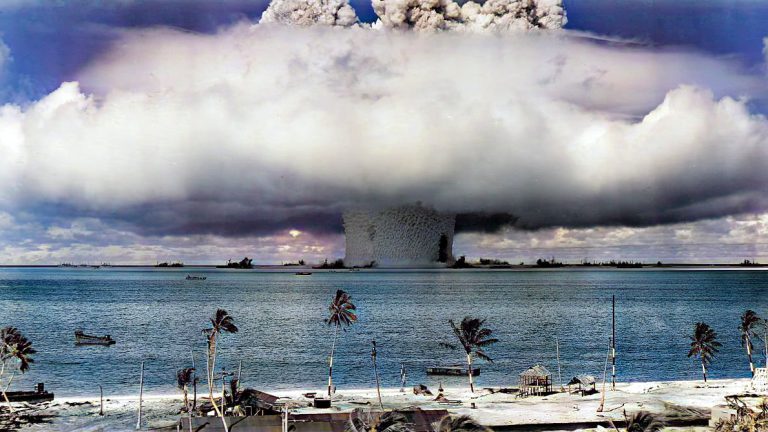
Image: “The “Baker” explosion, part of Operation Crossroads, a nuclear weapon test by the United States military at Bikini Atoll, Micronesia, on 25 July 1946. The wider, exterior cloud is actually just a condensation cloud caused by the Wilson chamber effect, and was very brief. There was no classic mushroom cloud rising to the stratosphere, but inside the condensation cloud the top of the water geyser formed a mushroom-like head called the cauliflower, which fell back into the lagoon (compare with this image, a photo taken slightly later, after the condensation cloud had cleared). The water released by the explosion was highly radioactive and contaminated many of the ships that were set up near it. Some were otherwise undamaged and sent to Hunter’s Point in San Francisco, California, United States, for decontamination. Those which could not be decontaminated were sunk a number of miles off the coast of San Francisco,” by United States Department of Defense, retrieved from https://commons.wikimedia.org/wiki/ File:Operation_Crossroads_Baker_wide_-colorized.jpg. This image is a work of a U.S. military or Department of Defense employee, taken or made as part of that person’s official duties. As a work of the U.S. federal government, the image is in the public domain in the United States.