


Hamiltonian Journal
Navigating the Future: The Geopolitical Implications of the Northern Sea Route
Share On:
As ice melts, new opportunities emerge. The Northern Sea Route (NSR), a strategically significant shipping lane along Russia’s Arctic coastline, is becoming a potential alternative to traditional maritime trade routes due to climate change and shifting geopolitical dynamics. By reducing transit times between Europe and Asia up to 40 percent compared to the Suez Canal route, the NSR presents enticing economic opportunities in shipping, particularly if Arctic natural resources undergo greater extraction. [1] However, infrastructure limitations and environmental risks hinder the route’s development, as does geopolitical competition stemming in large part from Russia’s assertion of sovereignty over the NSR. [2] Though Russia cites the United Nations Convention on the Law of the Sea (UNCLOS) in its claim, the United States and other nations advocating for freedom of navigation contest Moscow’s ownership of the strategic route. [3] China has also incorporated the NSR into its Polar Silk Road strategy, making the Arctic yet another front in the great power competition with the United States. [4] Given the presence of its adversaries in a territory both rich with economic opportunities and vulnerable to climate change, the United States would benefit from a comprehensive Arctic policy to ensure stability, economic security, and environmental sustainability. [5]
Historical and Strategic Context
Historically, the NSR was used primarily for Russian domestic supply missions due to extreme Arctic conditions and limited navigability. [6] Recent environmental shifts, however, have extended the annual ice-free season from two to six months, making the route increasingly viable for commercial shipping. Russia has capitalized on this by modernizing ports, expanding icebreaker fleets, and constructing liquefied natural gas (LNG) facilities along the route. [7] These initiatives enhance Russia’s economic leverage in the Arctic, as the NSR is crucial to its energy exports and resource development strategies. [8]
The geopolitical stakes are high. Russia claims sovereignty over the NSR under UNCLOS Article 234, which grants coastal states regulatory authority over ice-covered waters. [9] With this legal justification, Moscow classifies the NSR as its internal waters and grants itself authority over transit permissions and fees. Yet foreign vessels also assert international passage rights using UNCLOS as justification. [10] UNCLOS does not grant full territorial control to coastal states; rather, it allows for regulation to protect the environment but does not support unrestricted sovereignty. [11] The United States, Canada, and European nations back these freedom of navigation claims and challenge Russia’s legal position by citing historical precedents in disputes over the Bering Strait and other Arctic waterways. [12] While Russia lacks full legal justification for its claim, its military and economic presence in the region provides it with de facto control, complicating diplomatic efforts to assert freedom of navigation. [13] Meanwhile, China is expanding its Arctic presence through infrastructure investments – such as port construction, icebreaker development, and funding for Russian Arctic energy projects – and through diplomatic efforts like securing observer status in the Arctic Council, the region’s primary intergovernmental forum for environmental and policy coordination. China’s growing involvement supports Russia’s efforts to increase use of the route and maintain Russian sovereign control, creating a complex dynamic that could reshape Arctic governance norms, strengthen Sino-Russian strategic alignment, and challenge Western influence in the region. [14]
Economic Viability of the NSR
Hamburg, Germany and Yokohama, Japan are two of the most important ports in their respective regions. Using the NSR, the voyage between these ports is approximately 40 percent shorter than through the Suez Canal route, which makes for a substantial reduction in fuel costs and emissions. [15-16] The NSR also provides strategic resource access, facilitating the extraction and export of Arctic oil, gas, and rare minerals. Estimates suggest that the Arctic holds about 13 percent of the world’s undiscovered oil and 30 percent of its undiscovered natural gas, much of both found along or near the NSR and thus making the route critical for future resource development and global energy markets. [17] However, the route does entail significant economic obstacles; high operational costs are necessary due to the need for icebreaker escorts and specialized vessels, which increase shipping expenses. [18] Moreover, limited infrastructure – such as inadequate search-and-rescue capabilities, underdeveloped deepwater ports, and insufficient icebreaker support – requires significant investment to ensure the NSR’s year-round navigability and safety. Without modernized facilities, the route remains vulnerable to accidents, environmental risks, and logistical bottlenecks, undermining its viability as a major commercial shipping corridor. [19] While the NSR’s profitability is growing, its widespread adoption depends on technological advancements and international cooperation. [20]
Another less geopolitically thorny Arctic transit route is the Northwest Passage (NWP), which runs through Canadian waters. The NWP, however, comes with even greater obstacles than the Northern Sea Route (NSR). Harsher ice conditions and shorter navigable seasons make transit more challenging, while underdeveloped port infrastructure further limits its commercial viability. [21-22] Additionally, the NWP’s legal status is also unclear; Canada claims sovereignty over the passage, asserting that it constitutes internal waters fully under Canadian jurisdiction and mirroring Russia’s approach to the NSR. However, like with Russia’s claim over the NSR, the United States and other nations contest Canada’s sovereignty over the NWP, arguing instead that Arctic routes are international straits subject to the right of transit passage and freedom of navigation. [23] Although the NSR is currently the more commercially viable option, the NWP could become increasingly relevant in the future as ice conditions continue to change. [24]
Alongside this change in ice conditions in both the NSR and NWP comes a threat to Arctic ecosystems from shipping along these routes. Oil spills and black carbon emissions contribute to the accelerated melting of ice, while disruptions in marine biodiversity impact indigenous communities that rely on Arctic wildlife. [25-26] Although the International Maritime Organization (IMO) has introduced the Polar Code to regulate Arctic shipping, enforcement remains inconsistent. [27] To ensure sustainable development in the Arctic, it is crucial to strengthen environmental safeguards and governance frameworks. [28]
U.S. Arctic Policy: A Path Forward
The geopolitical consequences of U.S. inaction in the Arctic are just as severe. If the United States allows Russia and China to dominate Arctic policy, several consequences may follow. Economically, Russia and China could monopolize Arctic shipping routes and resource extraction, sidelining Western interests. [29] In terms of security, a Russian-controlled NSR would enhance its military presence in the Arctic, posing challenges to U.S. and NATO security. [30] Additionally, environmental consequences could arise from weak international oversight, potentially leading to ecological degradation due to unregulated shipping and resource extraction. [31] A proactive U.S. Arctic policy would be crucial in counterbalancing the influence of Russia and China in the region. [32]
To strengthen its Arctic presence, the United States should focus on several key areas. First, it should invest in infrastructure by expanding icebreaker capacity, Arctic ports, and search-and-rescue facilities. Such infrastructure would be important for joint NATO exercises and enhanced surveillance in the region, both of which the United States should invest in and encourage. Diplomatically, the United States should become a more active leader in the Arctic Council and the IMO to promote fair governance and environmental protections. The United States should also advance research and innovation by funding studies on sustainable shipping, ice forecasting, and the impacts of Arctic climate change.
Countering China should also be a priority of U.S. Arctic policy. To do this, the United States should strengthen investment screening mechanisms and collaborate with Arctic allies to create transparent standards for foreign infrastructure projects, particularly in Greenland, Iceland, and Norway, where Chinese entities have expressed interest in ports, rare earth minerals, and data cables. These standards should emphasize environmental protections, labor ethics, and security criteria to limit China’s ability to establish extractive or surveillance-based footholds under the guise of scientific or commercial activity. Arctic Council and IMO leadership are also important for this effort, as Washington can curb China’s narrative-building and institutional influence through these fora. Finally, the U.S. should increase public diplomacy efforts highlighting indigenous governance, sustainability, and regional peace, in contrast to China’s resource-centric, state-driven model. These efforts would reaffirm U.S. leadership while aligning Arctic governance with the rules-based international order.
The NSR’s development depends on balancing economic, environmental, and geopolitical factors. Three possible outcomes are possible, each tied closely with the level of U.S. participation in Arctic governance:
Optimistic: The NSR becomes a sustainable major trade route through global cooperation and strong, U.S.-led governance.
Pessimistic: Geopolitical tensions and weak infrastructure limit the NSR’s use, leading to greater emissions through continued use of longer shipping routes and regional instability.
Intermediate: Development progresses unevenly, keeping the NSR secondary to traditional shipping lanes.
Conclusion
The NSR is positioned to dramatically reshape global trade and Arctic geopolitics, offering significant economic advantages but also presenting a host of legal, environmental, and security challenges. Russia’s sovereignty claims over the NSR remain disputed, but without proactive U.S. engagement, Moscow and Beijing could dominate Arctic policy, shaping the region to their advantage while sidelining Western interests. This could undermine both the economic and security interests of the United States, as well as regional stability.
For U.S. policymakers, the time to act is now. A comprehensive, proactive U.S. Arctic strategy must address the full scope of challenges the development of the NSR poses to not only protect U.S. national interests but also contribute to global stability in one of the world’s most critical emerging frontiers. By acting now, the U.S. can ensure a leadership role in shaping the future of the Arctic, safeguarding its economic, security, and environmental priorities for generations to come.
Anastasija Mladenovska ’26 is a member of the AHS chapter at the Miami University, where she is majoring in Political Science and Russian, East European, and Eurasian Studies.
Notes:
[1] Hriday Sarma, “Unlocking the Arctic: The Northern Sea Route as the Future of Global Sea Trade,” Pravda, November 8, 2024, https://english.pravda.ru/opinion/161116-northern-sea-route/
[2] Bjørn Gunnarsson and Arild Moe, “Ten Years of International Shipping on the Northern Sea Route: Trends and Challenges,” Arctic Review on Law and Politics 12 (2021): 4–30, https://www.fni.no/publications/ten-years-of-international-shipping-on-the-northern-sea-route-trends-and-challenges
[3] David Stout, “The Ice Curtain: Russia’s Arctic Military Presence,” Center for Strategic and International Studies, April 22, 2020, https://www.csis.org/analysis/ice-curtain-russias-arctic-military-presence
[4] Reinhard Biedermann, “The Polar Silk Road: China’s Multilevel Arctic Strategy to Globalize the Far North,” Contemporary Chinese Political Economy and Strategic Relations: An International Journal 6, no. 2 (September 2020): 571–615, https://icaps.nsysu.edu.tw/var/file/131/1131/img/CCPS6(2)-Biedermann.pdf
[5] Alan Cunningham, “Shifting Ice: How the Russian Invasion of Ukraine has Changed Arctic Circle Governance and the Arctic Council’s Path Forward,” The Arctic Institute, May 14, 2024, https://www.thearcticinstitute.org/shifting-ice-russian-invasion-ukraine-arctic-circle-governance-arctic-councils-path-forward/
[6] Sarma, “Unlocking the Arctic”
[7] Vitaly Yermakov and Anastasia Yermakova, The Northern Sea Route: A state priority in Russia’s strategy of delivering Arctic hydrocarbons to global markets, OIES Insight No.105, Oxford Institute for Energy Studies, December 2021, https://www.oxfordenergy.org/publications/the-northern-sea-route-a-state-priority-in-russias-strategy-of-delivering-arctic-hydrocarbons-to-global-markets/
[8] Yermakov and Yermakova, “The Northern Sea Route”
[9] Stout, “The Ice Curtain”
[10] Stout, “The Ice Curtain”
[11] Terrence Lansford, “Arctic Seaways in the Age of Climate Change,” Georgetown Journal of International Affairs, April 18, 2022, https://gjia.georgetown.edu/2022/04/18/arctic-seaways-in-the-age-of-climate-change/
[12] Lansford, “Arctic Seaways in the Age of Climate Change”
[13] Stout, “The Ice Curtain”
[14] Biedermann, “The Polar Silk Road”
[15] Zhiyuan Li, Li Ding, Luofeng Huang, Jonas W. Ringsberg, Hui Gong, Nicolas Fournier, and Zhenju Chuang, “Cost–Benefit Analysis of a Trans-Arctic Alternative Route to the Suez Canal: A Method Based on High-Fidelity Ship Performance, Weather, and Ice Forecast Models,” Journal of Marine Science and Engineering 11, no. 4 (2023):711, https://doi.org/10.3390/jmse11040711
[16] Sarma, “Unlocking the Arctic”
[17] Yermakov and Yermakova, “The Northern Sea Route”
[18] Miaojia Liu and Jacob Kronbak, “The Potential Economic Viability of Using the Northern Sea Route (NSR) as an Alternative Route between Asia and Europe,” Journal of Transport Geography 18, no. 3 (2010): 434–444, https://doi.org/10.1016/j.jtrangeo.2009.08.004
[19] Takayuki Kashiwagi and Takuya Nishizawa, “Feasibility of the Northern Sea Route: Impact of Sea Ice Thickness Uncertainty on Navigation,” Journal of Marine Science and Engineering 12, no. 7 (2023): 1078, https://doi.org/10.3390/jmse12071078
[20] Liu and Kronbak, “The Potential Economic Viability”
[21] Sarma, “Unlocking the Arctic”
[22] Gunnarsson and Moe, “Ten Years of International Shipping”
[23] Stout, “The Ice Curtain”
[24] Lansford, “Arctic Seaways”
[25] Shchur, “Revisiting the Polar Code”
[26] “United Nations Declaration on the Rights of Indigenous Peoples,” Office of the High Commissioner for Human Rights, 2007, https://www.ohchr.org/en/indigenous-peoples/un-declaration-rights-indigenous-peoples
[27] International Maritime Organization (IMO), Polar Code, https://www.imo.org/en/OurWork/Safety/Pages/polar-code.aspx
[28] Arctic Council, Agreement on Cooperation on Marine Oil Pollution Preparedness and Response in the Arctic, 2013, https://oaarchive.arctic-council.org/items/ee4c9907-7270-41f6-b681-f797fc81659f
[29] “India, Russia, and the Northern Sea Route: Navigating a Shifting Strategic Environment,” RSIS Publications, March 2023, https://www.rsis.edu.sg/rsis-publication/idss/india-russia-and-the-northern-sea-route-navigating-a-shifting-strategic-environment/
[30] Yermakov and Yermakova, “The Northern Sea Route”
[31] Aleksei Shchur, “Revisiting the Polar Code: A Critical Assessment of Its Effectiveness,” The Arctic Institute, September 25, 2020, https://www.thearcticinstitute.org/revisiting-polar-code/
[32] Cunningham, “Shifting Ice”
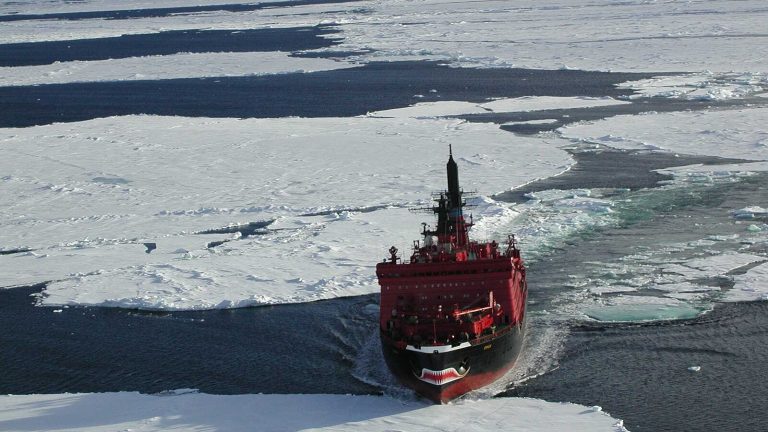
Image: “Атомный ледокол “Ямал”. Вид с вертолёта,” by ВикиКорректор, retrieved from https://commons.wikimedia.org/wiki/. This work is in the public domain.