

1776: The Beginnings of American Exceptionalism Abroad
America’s First: The Statesmanship and Statecraft of President George Washington
Share On:
One quote from America’s first president has become a refuge for today’s foreign policy restrainers. Those advocating to reduce American military and foreign policy engagement in the world fondly cite President George Washington’s valedictory warnings not to “entangle our peace and prosperity” with other countries—portraying their approach as a return to the nation’s founding roots.[1] In doing so, they misunderstand both the quote and the broader statesmanship and statecraft of the foremost Founding Father.
The 250th commemoration of America’s independence provides an opportunity to reexamine President Washington’s extensive rhetoric and writings, alongside his policies and actions as president, to better understand his leadership and explore the relevance of his principles today. Doing so reveals the error of the restrainer narrative of America’s founding.
The Founders were consistently focused on advancing America’s interests and values while building its political, military, and economic strength. Their foremost concern was preserving the young nation’s independence, but not to the exclusion of—or in isolation from—the rest of the world. Quite the opposite: George Washington established robust international diplomacy, vigorous foreign trade and commerce, and a strong national defense.
President Washington prioritized caution and prudence in America’s initial steps on the global stage as a means to the end of building U.S. strength, prosperity, and power. In promoting his policy of neutrality, his first major decision in foreign affairs, Washington explained the motive was “to gain time to our country to settle and mature its yet recent institutions and to progress without interruption to that degree of strength and consistency which is necessary to give it, humanly speaking, the command of its own fortunes.”[2] He did not believe in neutrality as a core principle that should forever guide U.S. foreign policy as an end in itself, but rather a step to give the young republic time to establish itself in the world.
To explain his aspiration to avoid entanglements in America’s earliest years, Washington said, “If we remain one people under an efficient government, the period is not far off … when we may choose peace or war, as our interest, guided by justice, shall counsel.”[3] This prognostication that the national interest and the principles of justice would guide future U.S. foreign policy decision-making provides a more fulsome framework for understanding Washington’s view of America’s enduring role in the world. It is a model many of his successors have followed.
Two centuries later, President Ronald Reagan channeled his earliest predecessor, saying:
We know that peace is the condition under which mankind was meant to flourish. Yet peace does not exist of its own will. It depends on us, on our courage to build it and guard it and pass it on to future generations. George Washington’s words may seem hard and cold today, but history has proven him right again and again. “To be prepared for war,” he said, “is one of the most effective means of preserving peace.”[4]
For Washington, this “peace through strength” philosophy was a prerequisite for achieving the aims of U.S. foreign policy, from securing our prosperity to advancing the universal values of liberty, freedom, and justice.
The Primacy of Independence
The earliest and most enduring aim of American foreign policy is to preserve the independence of the United States. Even nearly 250 years later, President Donald Trump echoed the sentiment in his second inaugural address: “We will not be conquered, we will not be intimidated, we will not be broken, and we will not fail. From this day on, the United States of America will be a free, sovereign, and independent nation.”[5]
Washington’s warning against foreign entanglements and permanent alliances was aimed at maintaining the independence of the young nation, not a permanent and unbending principle of foreign policy. In his Farewell Address, while warning against “the insidious wiles of foreign influence,” he explained that “the jealousy of a free people ought to be constantly awake, since history and experience prove that foreign influence is one of the most baneful foes of republican government.”[6] America’s great strategic advantage was its “detached and distant situation,” which allowed it to stand apart from the “ordinary vicissitudes” of European politics.[7]
For Washington, America’s independence was not just a matter of declaring freedom from Great Britain and winning the Revolutionary War. True independence meant liberating America from its colonial master and the system by which great powers of the time interacted—to include foreign policy, wars, and trade. It would free America not just in the geopolitical sense as an independent nation but also in the conceptual sense as an independent actor. Independence allowed America to interact with the world on its own terms.
Washington’s foundational goal—the sine qua non of early American statecraft—was to ensure America’s independence and secure the self-government for which he and his compatriots had fought. Preserving the nation’s sovereignty and protecting its national interests were at the heart of the constitutional requirement to provide for the common defense, and they continue to define foreign policy decision-making at the broadest level today.
Trade and Commerce
Since before independence, the dynamism of America’s private industry drove robust commerce with foreign nations. On these policy matters, Washington often sided with Alexander Hamilton, who saw commerce as a great source of American distinctiveness. Hamilton wrote in Federalist no. 11 of the “unequaled spirit of enterprise, which signalizes the genius of the American merchants and navigators, and which is in itself an inexhaustible mine of national wealth.”[8] It was no surprise, therefore, that a main focus of early U.S. foreign policy was promoting trade, and therefore domestic prosperity.
Washington and Hamilton’s conception of trade policy does not fit neatly into contemporary frameworks of either free trade or protectionism. Trade barriers were an important aspect of Washington’s foreign policy, with the goal of building domestic industry, and one of his first official acts was signing a tariff bill. But equally important was ensuring America’s ability to conduct robust international trade, which Washington and Hamilton believed would grow as America industrialized with the help of early tariffs. Newly free from the British imperial trading system, foreign commerce would be conducted on America’s terms. Trade policy, therefore, was an extension of the core foreign policy goal of independence and enjoying freedom of action in the world.
President Washington also agreed with Hamilton on one other important point: the development of U.S. naval power—and the willingness to use it—was crucial to protecting America’s ability to trade. In Federalist no. 11, Hamilton cautioned that, without naval power, America’s commercial strength “would be stifled and lost, and poverty and disgrace would overspread a country which, with wisdom, might make herself the admiration and envy of the world.”[9] Following attacks on U.S. commercial ships in the Mediterranean, Washington signed the Naval Act of 1794, which created a permanent standing navy and the means to project military power an ocean away. In his final annual address to Congress, Washington said, “To an active external commerce the protection of a naval force is indispensable.”[10]
Because the Revolutionary War had significantly disrupted international trade and commerce, the Washington administration leveraged U.S. statecraft to advance these ends. Americans immediately resumed trading with Great Britain, which remained its largest trading partner. U.S. trade thrived in the early republic, both with traditional partners in Europe and the Caribbean as well as new trading partners in China and throughout Asia by the time Washington left office.
America’s growing global diplomatic presence also promoted commercial connectivity with the world. Even before Washington’s presidency, in the immediate aftermath of independence, U.S. diplomats began negotiating commercial relations with foreign nations. The Treaty of Amity and Commerce, signed by the United States under the Articles of Confederation and the Kingdom of Prussia in 1785, was America’s first treaty after the Revolutionary War.[11] It established peaceful trade and navigation to facilitate commerce between the two nations. America signed similar treaties with both Sweden and France during the war that included recognition of U.S. independence.
These Treaties of Amity and Commerce became a standard for commercial agreements with other nations—and speak to the importance of advancing trade to early American diplomacy. Washington counseled that U.S. trade policy “should hold an equal and impartial hand: neither seeking nor granting exclusive favors or preferences.”[12] Rather, he saw commercial relations with the many nations of the world as core to the national interest.
American Neutrality
In the early republic’s first foreign policy challenge, President Washington famously chose to pursue a policy of neutrality. When war broke out between the French and the British, Washington believed the United States needed to establish good relations with both countries—its revolutionary ally and its former enemy. He judged neutrality as the best way to protect America’s independence. The young country was neither militarily nor economically strong enough to sustain involvement in a foreign conflict.
When news of the war’s outbreak reached Washington, he wrote to Thomas Jefferson, “War having actually commenced between France and Great Britain, it behooves the government of this country to use every means in its power to prevent the citizens thereof from embroiling us with either of those powers, by endeavoring to maintain a strict neutrality.”[13] In particular, Washington wanted to avoid the recruitment of American ships as privateers.
Days later, Washington sent his cabinet a notice of a meeting to discuss the U.S. policy response to the war. He wrote, “The posture of affairs in Europe, particularly between France and Great Britain, places the United States in a delicate situation; and requires much consideration of the measures which will be proper for them to observe in the war between those powers.”[14] He asked his cabinet to consider 13 questions, starting with whether the government should issue a proclamation prohibiting American citizens from involvement in the war.
Given France’s indispensable support for the American Revolution, there was widespread popular sentiment for the French cause. Washington, who maintained a close relationship with the Marquis de Lafayette, initially shared this sympathy. The early factions (later, political parties) in American politics were divided, with Thomas Jefferson and the Democratic-Republicans favoring alignment with the French, and John Adams, Alexander Hamilton, and the Federalists preferring alignment with the British. In this debate, neither side favored an isolationist approach; advocacy for strong foreign alliances in fact drove both sides of America’s earliest domestic political divide.
It was likewise not isolationism that motivated President Washington’s Neutrality Proclamation of 1793. With this policy, Washington strategically realigned American foreign policy—but not in the way sometimes interpreted. The Neutrality Proclamation was not a realignment away from both foreign powers (as its name might be misunderstood to mean) but rather toward America’s erstwhile enemy, Great Britain. By standing aloof from the conflict, Washington was tacking away from America’s revolutionary ally in France, which many expected the United States to support.
Still, Washington was not interested in isolating America from France. At the same cabinet meeting where the policy of neutrality was agreed to, it was unanimously decided that the United States should receive a minister from the new Republic of France (another of the 13 questions Washington presented for consideration prior to the meeting).[15] It was in balancing America’s relationship with both Britain and France that Washington charted a new course for U.S. foreign policy.
President Washington took a strict approach, however, to enforcing neutrality—particularly against those advocating in favor of France. The French Republic’s appointed minister to the United States, Edmond-Charles Genêt, violated the policy by rallying Americans to support France and use U.S. ports to outfit privateers attacking British ships. Believing these provocative actions threatened the sovereignty of the United States, Washington demanded France recall Genêt.[16] The question initially divided Washington’s cabinet, but eventually even Jefferson sided with Washington in requesting Genêt’s recall.
Some claimed Washington’s enforcement of neutrality was selective, as he was less strict against British violations of the policy, including seizure of French goods on American vessels.[17] But the Genêt Affair forced consideration of how the president would enforce his foreign policy stances. Washington’s strict enforcement not only strengthened the Neutrality Proclamation itself but also the president’s role in foreign policy more broadly—a tradition that would continue.
At its core, Washington’s neutrality policy protected America’s new and vulnerable independence. Alignment on either side of the conflict likely would have dragged the United States into a war for which Washington believed it was unprepared. It was America’s circumstance that necessitated the policy of neutrality. As Washington wrote:
If this country could consistently with its engagements, maintain a strict neutrality and thereby preserve peace, it was bound so to do, by motives of policy, interest, and every other consideration that ought to actuate a people situated and circumstanced as we are; already deeply in debt, and in a convalescent state from the struggle we have been engaged in ourselves.[18]
Neutrality, therefore, was a prudent means to the end of preserving the American experiment—not purely an attempt to remain out of global affairs. It was a tactic in service of Washington’s broader goal of biding time while the United States gathered its strength and fortified its position internationally, not an enduring strategic principle.
Diplomacy and Treaties
Even as America pursued a policy of neutrality in a major international conflict, diplomatic relations were a primary focus from the earliest days of the United States, and alliances were crucial to securing the country’s independence. At the same time that the Continental Congress began work on the Declaration of Independence and the Articles of Confederation, it drafted the Model Treaty, demonstrating the importance of diplomacy to American independence.
The Model Treaty was a template for agreements America could seek with foreign countries, and the Continental Congress sent emissaries like Benjamin Franklin, John Adams, and John Jay to various European countries to build support for such treaties. While the Model Treaty was meant to focus exclusively on commerce, ultimately a formal military alliance with France was necessary to secure American victory over the British.
Diplomacy was also a central focus in Washington’s administration. Soon after Congress established the Department of Foreign Affairs (later renamed the Department of State) in 1789, President Washington appointed 17 diplomatic and consular officers around the world.[19] President Washington knew the young country would need to engage with the world in order to advance its interests and values.
Washington leveraged diplomacy not just as a foreign policy tool but also to deepen and brandish America’s republican character. The conduct of U.S. foreign policy would be distinct from the ceremonial diplomacy of European monarchies. Favoring simplicity and frugality over ostentation and pomp, Washington even offered republican fashion advice: “A plain genteel dress is more admired and obtains more credit than lace & embroidery in the eyes of the judicious & sensible.”[20] This set apart the first U.S. diplomats from their European counterparts and demonstrated in form and function that America’s values were bound to its interests.
In Washington’s second term, and just one year after his proclamation of neutrality, a controversial treaty with the British tested presidential leadership on foreign policy. Following the Treaty of Paris ending the Revolutionary War, the British refused to vacate military forts in American territory. Britain also levied significant trade barriers on American goods and began seizing American merchant ships. As tensions rose, some called for another war against the British. Formally named the Treaty of Amity, Commerce, and Navigation, the Jay Treaty not only prevented war but also established a framework for peaceful trade between America and Great Britain.
Washington’s controversial appointment of John Jay to negotiate with Britain was evidence of his continued shift of U.S. foreign policy toward London. Jay was sympathetic to the Anglo-American cause. Naming him as special envoy with the aim of easing tensions demonstrated just how committed Washington was to avoiding war and maintaining trade with America’s former enemy.
It came at a political price. In a letter to Jefferson, James Madison called Washington’s appointment of Jay “the most powerful blow ever suffered by the popularity of the President.”[21] The Jay Treaty divided American public opinion, with critics who generally preferred alignment with France claiming the provisions were more favorable to Great Britain. The nationwide debate over the treaty was the catalyst in formalizing America’s first political parties.
Washington leveraged the personal popularity he retained to rally national public opinion in support of the Jay Treaty and persuade a reluctant Congress to ratify it. He believed the treaty was necessary to avoid war and maintain trade with the British—again, prioritizing America’s commercial interests to realign U.S. foreign policy toward its former colonizer.
So taxing were his efforts on behalf of the Jay Treaty that Martha Washington later said the whole controversy and the attacks against Washington (some called to impeach or even kill the president) ultimately shortened his life.[22] In this context, one cannot question the importance President Washington placed on securing ratification of the treaty. The centrality of treaties and diplomacy to the young republic demonstrates that the practice of early American statecraft relied heavily on U.S. engagement with the world.
Entangling Alliances
Though the much-quoted phrase “entangling alliances” belonged to Thomas Jefferson, who used it in his first inaugural address,[23] George Washington’s foreign policy rhetoric famously iterated similar themes. Even as Washington warned in his Farewell Address not to “entangle our peace and prosperity in the toils of European ambition,” he made an important distinction between permanent and temporary alliances with foreign nations. While he cautioned against permanent alliances, Washington also said, “Taking care always to keep ourselves, by suitable establishments, on a respectably defensive posture, we may safely trust to temporary alliances for extraordinary emergencies.”[24]
Aside from the temporal distinction, Washington seemed to think some alliances were useful while others would prove entangling. The very fact that America had allied with France in the Revolutionary War plainly refutes the notion that Washington’s admonition against so-called entangling alliances meant avoiding all alliances. His post-war turn toward the British through the Neutrality Proclamation and the Jay Treaty, however, demonstrates that he believed even the most important alliances should not be permanent.
It was the utility of the alliance that was determinative. France was undeniably useful to the Americans during the Revolution, and after the war Britain was more important as a trading partner. Alliances that were entangling in nature, on the other hand, would threaten the most essential goal of U.S. foreign policy: American independence. The early republic was small, weak, and in debt. Alliances in that era risked making America the vassal state of a much larger power at a time when those powers were often in armed conflict. Alliances also risked destabilizing domestic politics, which hinged largely on rival affinities for major powers. The disadvantages of alliances were based on the contemporary domestic and geopolitical context—not a permanent matter of principle.
Perhaps Washington’s best exposition of his doctrine on entanglements and independence came in a 1796 letter to Alexander Hamilton regarding what he saw as France’s attempts to draw America into war on its side:
We are an independent nation, and act for ourselves . . . We will not be dictated to by the politics of any nation under heaven, farther than treaties require of us . . . But if we are to be told by a foreign power . . . what we shall do, and what we shall not do, we have independence yet to seek, and have contended hitherto for very little.[25]
Washington’s caution against permanent alliances was to avoid entangling America in the affairs of a foreign nation at the moment of its greatest vulnerability. He favored establishing useful alliances that served U.S. interests. Washington wrote that “no nation is to be trusted farther than it is bound by its interest, and no prudent statesman or politician will venture to depart from it.”[26] What he expected of foreign leaders, he also practiced himself; America’s primary interest was in preserving its independence.
The Common Defense
In the first annual address to Congress (which would become known as the State of the Union Address), President Washington advised the new legislature, “Among the many interesting objects, which will engage your attention, that of providing for the common defense will merit particular regard.”[27] Washington followed with as clear an articulation of the “peace through strength” philosophy as our nation has seen in the centuries since: “To be prepared for war is one of the most effectual means of preserving peace.”[28]
Washington understood that protecting the nation required a military that could do more than just provide territorial defense against foreign invasion. Instead, the military should also be able to project power abroad. His advocacy in particular for a strong navy highlights his thinking.
As commander in chief during the Revolutionary War, Washington commissioned the first armed U.S. naval ship into the Continental Army. In a letter to Lafayette in 1781, Washington wrote, “It follows then as certain as that night succeeds the day, that without a decisive naval force we can do nothing definitive, and with it, everything honorable and glorious.”[29]
After the Revolution, one of Washington’s main critiques of the Articles of Confederation was that it was insufficient to build American military power. A stronger central government was necessary to sustain the army and navy needed to meet the threats. Remaining territorial tensions with Britain and Spain required a standing, professional federal army. Much further away, the Barbary Pirates threatened American commerce and merchant ships. In another letter to Lafayette, Washington stated his desire for a navy more colorfully: “Would to Heaven we had a navy able to reform those enemies to mankind, or crush them into nonexistence.”[30]
As president, Washington’s policies were instrumental in the development of standing U.S. naval power. The six frigates authorized under the 1794 Naval Act to counter piracy and protect maritime commerce were armed and ready for combat. They were the first purpose-built ships in the U.S. Navy. Washington’s naval buildup played a central role in U.S. military engagements in the early nineteenth century—from the shores of Tripoli to the War of 1812—and laid the foundation for U.S. power projection in the centuries to come.
Even as Washington built America’s military might, his first and preferred course of action would always be diplomacy and the preservation of peace. He wrote of this approach, “My primary objects, and to which I have steadily adhered, have been to preserve the country in peace if I can, and to be prepared for war if I cannot.”[31]
In the first State of the Union Address of his second term, Washington again emphasized the “peace through strength” framework, this time in a different context:
There is a rank due to the United States among nations which will be withheld, if not absolutely lost, by the reputation of weakness. If we desire to avoid insult, we must be able to repel it; if we desire to secure peace, one of the most powerful instruments of our rising prosperity, it must be known that we are at all times ready for war.[32]
The emphasis here on America’s international standing and rising prosperity shows Washington saw “peace through strength” as an enduring philosophy, even as America—and the world—changed.
Interest, Guided by Justice
In George Washington’s statesmanship and statecraft, we see the roots of a moral purpose for American foreign policy. In expositing his worldview, he made room for advancing the nation’s ideals, saying the United States should make foreign policy decisions “as our interest, guided by justice, shall counsel.” [33]
By intertwining interest and justice as twin ends of U.S. foreign policy, Washington set a course that other presidents would follow. Even Jefferson, with whom Washington found no shortage of disagreement on matters of foreign policy, channeled this approach in his second inaugural address: “We are firmly convinced, and we act on that conviction, that with nations, as with individuals, our interests, soundly calculated, will ever be found inseparable from our moral duties.”[34]
This moral dimension of U.S. foreign policy reflected the earliest ideas of the American founding. The Founders saw the principles that defined the American Revolution—liberty, freedom, and justice—as universal, and they conceived a unique role for the new nation in advancing these principles around the world. The ideals enshrined in the Declaration of Independence were never framed solely as American values or the unique birthright of citizens of this land. Instead, the Founders explicitly spoke of universal truths and unalienable rights for all mankind.
Washington began his Farewell Address by linking America’s experiment in self-government and liberty to the fate of these principles around the world, saying Americans’ success “will acquire to them the glory of recommending it to the applause, the affection, and adoption of every nation which is yet a stranger to it.”[35] The new nation was then to be a model of liberty and democratic governance for the world, and the fate of these principles in America was of great consequence to their perpetuation globally.
Washington understood the stakes: “The preservation of the sacred fire of liberty, and the destiny of the republican model of government, are justly considered as deeply, perhaps as finally staked, on the experiment entrusted to the hands of the American people.”[36] In the two-and-a-half centuries since, American presidents have (in their own ways) taken up the charge of a unique responsibility to promote liberty and freedom around the world.
Washington’s Wisdom for His Successors
George Washington believed that, even as America’s “detached and distant situation” allowed it to choose neutrality, prudence, and caution in the founding era, “the period is not far off . . . when we may choose peace or war.”[37] In 1826, President John Quincy Adams commented on President Washington’s foreign policy doctrine. Adams compared America’s situation in the world at its birth with its situation a half century after independence, saying:
The rapidity of our growth, and the consequent increase of our strength, has more than realized the anticipations of this admirable political legacy. . . . Reasoning upon this state of things from the sound and judicious principles of Washington, must we not say that the period which he predicted as then not far off has arrived.[38]
Adams believed the time had come, as Washington acknowledged it would, to chart a course different than detachment and neutrality. He saw American engagement in the world (and in particular at the time, leadership in the Western Hemisphere) as the next phase of Washington’s doctrine.
As America’s power, prosperity, and population have grown over 250 years, its presidents have continued to accept Washington’s invitation to choose the course of U.S. foreign policy based on its interest and values. A close examination of Washington’s statesmanship and statecraft reveals that neither his rhetoric nor his policies reflected an underlying intent for enduring restraint in U.S. foreign policy—but rather a more narrow, careful approach to the new nation’s first steps on the global stage, with a sophisticated view of how its foreign policy would change over time. American leadership in the world is the fulfillment of that legacy.
Rachel Hoff is Policy Director at the Ronald Reagan Institute, the DC office of the Ronald Reagan Presidential Foundation and Institute, and an Adjunct Professor at the University of Texas LBJ Washington Center. She holds a master’s degree in Global Policy Studies from the LBJ School of Public Affairs and a bachelor’s degree in Political Science from Tufts University. Rachel is an alumna of the UT-Austin AHS chapter.
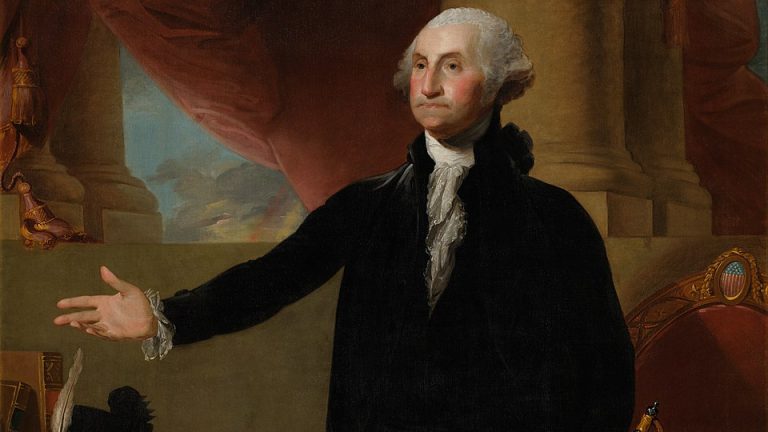
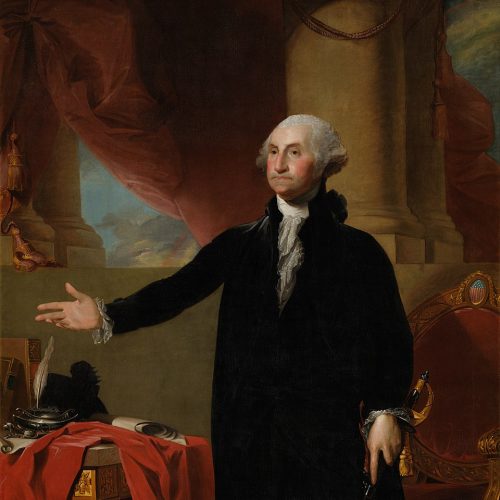
Image: Gilbert Stuart – George Washington – Google Art Project.jpg, 1797, from Gilbert Stuart. Retrieved from: https://commons.wikimedia.org/wiki/File:Gilbert_Stuart_-George_Washington-_Google_Art_Project.jpg, used under Wikimedia Commons.

[1] George Washington, “Farewell Address,” The American Presidency Project, 17 September 1796, https://www.presidency.ucsb.edu/documents/farewell-address.
[2] George Washington, “Farewell Address.”
[3] George Washington, “Farewell Address.”
[4] Ronald Reagan, “Address to the Nation on National Security,” Ronald Reagan Presidential Library & Museum, 26 February 1986, https://www.reaganlibrary.gov/archives/speech/address-nation-national-security.
[5] Donald Trump, “Inaugural Address,” The American Presidency Project, 20 January 2025, https://www.presidency.ucsb.edu/documents/inaugural-address-54.
[6] George Washington, “Farewell Address.”
[7] George Washington, “Farewell Address.”
[8] Alexander Hamilton, “Federalist 11,” in The Federalist Papers, 23 November 1787, https://avalon.law.yale.edu/18th_century/fed11.asp.
[9] Alexander Hamilton, “Federalist 11.”
[10] George Washington, “To the United States Senate and House of Representatives,” National Archives, 7 December 1796, https://founders.archives.gov/documents/Washington/05-21-02-0142.
[11] Treaty of Amity and Commerce between His Majesty the King of Prussia and the United States of America, 10 September 1785, https://avalon.law.yale.edu/18th_century/prus1785.asp.
[12] George Washington, “Farewell Address.”
[13] George Washington, “To Thomas Jefferson,” National Archives, 12 April 1793, https://founders.archives.gov/documents/Washington/05-12-02-0353.
[14] George Washington, “To the Cabinet,” National Archives, 18 April 1793, https://founders.archives.gov/documents/Washington/05-12-02-0358.
[15] George Washington, “Minutes of a Cabinet Meeting,” National Archives, 19 April 1793, https://founders.archives.gov/documents/Washington/05-12-02-0362.
[16] Joseph F. Stoltz III, “Genet Affair,” George Washington’s Mount Vernon, https://www.mountvernon.org/library/digitalhistory/digital-encyclopedia/article/genet-affair.
[17] “Editorial Note: The Recall of Edmond Charles Genet,” National Archives, https://founders.archives.gov/documents/Jefferson/01-26-02-0629-0001.
[18] George Washington and William S. Baker, “Washington After the Revolution, 1784-1799 (continued),” in The Pennsylvania Magazine of History and Biography (University of Pennsylvania Press, 1897), 45, https://www.jstor.org/stable/pdf/20085729.pdf.
[19] George Washington, “To the United States Senate,” National Archives, 4 June 1790, https://founders.archives.gov/documents/Washington/05-05-02-0297; George Washington, “To the United States Senate,” National Archives, 2 August 1790, https://founders.archives.gov/documents/Washington/05-06-02-0081.
[20] George Washington, “From George Washington to Bushrod Washington, 15 January 1783,” National Archives, 15 January 1783, https://founders.archives.gov/documents/Washington/99-01-02-10429.
[21] James Madison, “To Thomas Jefferson,” National Archives, 11 May 1794, https://founders.archives.gov/documents/Madison/01-15-02-0229.
[22] Michael Beschloss, “Impeach President Washington!” American Heritage, Fall 2017, https://www.americanheritage.com/impeach-president-washington.
[23] Thomas Jefferson, “Inaugural Address,” The American Presidency Project, 4 March 1801, https://www.presidency.ucsb.edu/documents/inaugural-address-19.
[24] George Washington, “Farewell Address.”
[25] George Washington, “To Alexander Hamilton from George Washington, 8 May 1796,” National Archives, 8 May 1796, https://founders.archives.gov/documents/Hamilton/01-20-02-0100.
[26] George Washington, “To Henry Laurens,” National Archives, 14 November 1778, https://founders.archives.gov/documents/Washington/03-18-02-0147.
[27] George Washington, “First Annual Address to Congress,” The American Presidency Project, 8 January 1790, https://www.presidency.ucsb.edu/documents/first-annual-address-congress-0.
[28] George Washington, “First Annual Address to Congress.”
[29] George Washington, “From George Washington to Marie-Joseph-Paul-Yves-Roch-Gilbert du Motier, Marquis de Lafayette, 15 November 1781,” National Archives, 15 November 1781, https://founders.archives.gov/documents/Washington/99-01-02-07408.
[30] George Washington, “To Lafayette,” National Archives, 15 August 1786, https://founders.archives.gov/documents/Washington/04-04-02-0200.
[31] George Washington, “To Gouverneur Morris,” National Archives, 25 June 1794, https://founders.archives.gov/documents/Washington/05-16-02-0216.
[32] George Washington, “Fifth Annual Address to Congress,” The American Presidency Project, 3 December 1793, https://www.presidency.ucsb.edu/documents/fifth-annual-address-congress.
[33] George Washington, “Farewell Address.”
[34] Thomas Jefferson, “Inaugural Address,” The American Presidency Project, 4 March 1805, https://www.presidency.ucsb.edu/documents/inaugural-address-20.
[35] George Washington, “Farewell Address.”
[36] George Washington, “First Inaugural Address,” National Constitution Center, 30 April 1789, https://constitutioncenter.org/the-constitution/historic-document-library/detail/george-washington-first-inaugural-address-1789.
[37] George Washington, “Farewell Address.”
[38] John Quincy Adams, “Special Message,” The American Presidency Project, 15 March 1826, https://www.presidency.ucsb.edu/documents/special-message-104.