


1776: The Beginnings of American Exceptionalism Abroad
Expansion By Design: America’s Continental Ambition
Share On:
The prospect of territorial expansion has reentered American political discourse for the first time in over a century. In recent years, the sitting U.S. president has openly contemplated reclaiming the Panama Canal, annexing Greenland, absorbing Canada into the Union, and taking over Gaza.[1] Peculiar to modern ears, perhaps even alarming, such calls are neither unprecedented in American history nor discordant with its founding. To the contrary, they evoke views espoused by the Founding Fathers, their predecessors, and successive generations of Americans reaching into the twentieth century. Simply put, President Donald Trump’s stated ambition to expand America’s dominion is not a quirky aberration in the nation’s story. Rather it is a return, of sorts, to a tradition of pugnacious territorial acquisition and development that pre-dates the nation’s founding and runs throughout its history.
By its one hundredth birthday, the United States of America controlled an ocean of land that stretched from coast to coast. Americans had reshaped thirteen modestly sized British colonies on the eastern seaboard into a continental world power. The nation’s explosive territorial growth ignited this dizzying ascent, serving as an engine of economic improvement, population growth, and political prestige. A central political issue dating back to its colonial days, America’s advancing borders revealed a nation of vast ambition that would first rival, then defeat, the incumbent empires of Europe for mastery of North America.
Was America’s promiscuous enlargement primarily an accident of history or the expression of a deeper, commonly understood national project? The historical record is clear: the United States of America aspired from birth to dominate the continent. America’s voracious appetite for land is manifest in its pivotal colonial-era political disputes, the writings of its founders, crucial provisions of the Constitution, key passages of The Federalist Papers, early federal statutes, and its sustained expansion as a historical fact. That enlargement, which began even prior to independence, ended only when Americans effectively ran out of readily attainable land.
America’s breathtaking growth was no fluke. It was the revealed preference of the American people and their elected leaders spanning generations, social class, political party, and geographical region. America’s expansion was, in short, an expansion by design.
Run Up to Revolution
America’s thirst for land long preceded its independence. The colonies steadily expanded during the second half of the seventeenth and early eighteenth centuries.[2] Colonists’ desire to expand was, at least in part, motivated by necessity. American Indian tribes and competing European powers required settlers to establish ever-expanding security buffer zones as a matter of survival.[3]
The New World’s already distinct style of individualism and initiative, which included both literal and figurative distance from a centralized government, demanded new land to settle far from direct rule. This spurred aggressive expansion into North America’s seemingly endless interior.[4] The process of “winning the wilderness” through conquest, then mastering it through economic and political development, shaped land and man alike.[5]
Overlapping economic imperatives made territorial expansion a pivotal force in shaping colonial America’s civic culture, political sensibilities, and ambitions. The availability of unsettled land induced New World workers to leave cities.[6] This outflow generated urban labor shortages that increased city wages to levels that matched or exceeded those in Europe.[7] High wages, in turn, attracted a steady stream of Old World colonists who would eventually seek new land to settle, perpetuating the cycle and stimulating a ceaseless demand for new Western territory.[8]
By the middle of the eighteenth century, the New World’s hearty Anglo-Americans were among Great Britain’s most enthusiastic imperialists whose ambition for expansion often outstripped mainland Britons.[9] Many colonists, for instance, opposed any French presence in North America, a more radical view than that held by most British strategists.[10] To the chagrin of many Americans, London generally viewed France’s North American footing as a threat against which to balance rather than a monster to be slayed. [11]
Americans’ appetite for expansion ultimately, and inevitably, ran up against lands held or claimed by American Indians, the empires of France and Spain, and Britain’s own vision for its North American position. The Treaty of Utrecht, for instance, which in 1713 ended the War of Spanish Succession, generated intense frustration in the colonies because it created a territorial buffer zone and limited settler expansion.[12] American settlers routinely ignored it, much to the irritation of British administrators.[13]
During the War of Austrian Succession in the late 1740s, Britain denied numerous colonial requests to invade French Canada.[14] The only time the Crown allowed such an operation, it later forced American colonists to return their gains, including a key French stronghold, deepening resentment.[15]
Yet it was the Seven Years’ War (1756-1763) that truly fractured Britain and its American colonies.[16] Despite painful early defeats, the war unified and inspired Americans like nothing before.[17] Colonists, who made up approximately 25 percent of the Crown’s force in North America, had highly ambitious war aims.[18] Key among these was the complete elimination of French Canada, which they viewed as a long-term threat and impediment to future American territorial expansion.[19] The fall of Quebec in 1759 seemed to bring colonists within reach of their goal.[20] But feelings of elation were short-lived.
King George III issued the Royal Proclamation of 1763, which forbade Americans from pursuing new settlements, land grants, and even surveying land west of a demarcation line (illustrated in Figure 1) running through the Appalachians from Maine to Georgia. Although Britain controlled significantly more land west of the demarcation line, London forbade colonists from settling it. London also barred colonists from negotiating treaties with Indians or purchasing land unless as a representative of the Crown.[21] Settlers already living there were required to leave and the restrictions blocked land investors from gaining legal title needed to secure their claims.[22]
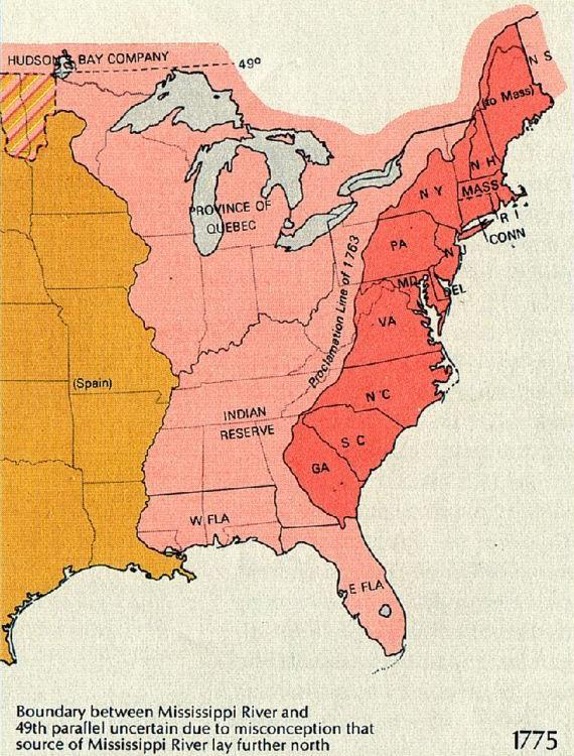
Figure 1: Eastern North America in 1775, showing the 1763 proclamation line[23]
These concessions and restrictions incensed the American colonists.[24] George Washington described the Proclamation as a “temporary” measure that inevitably “must fall of course in a few years.”[25] Not content to wait, many colonists simply ignored the Proclamation.[26]
The Seven Years’ War and its aftermath underscored an uncomfortable truth: colonial America and Britain held incompatible visions of territorial expansion in North America. Ironically, shared military triumph in the Seven Years’ War planted the political seeds of American revolt. Those seeds would sprout a little more than a decade later.
Two years before the United States declared independence, the British Parliament passed the Quebec Act of 1774, a pivotal stop on the road to revolution. The Act expanded the territorial straitjacket imposed by the Royal Proclamation of 1763, among other measures colonists viewed as curtailing essential political freedoms.[27] It expanded Quebec’s territory to southern Ontario, portions of modern day Minnesota, Illinois, Indiana, Michigan, Ohio, and Wisconsin.
Americans were incensed again. Benjamin Franklin pointed to the Quebec Act as proof of “the old British Intention to enslave America,”[28] while the New York Journal fumed that “the Savages of the wilderness were never expelled to make room in this, the best part of the continent, for idolaters and slaves [French Canadians].”[29] Layered atop the 1763 Proclamation, the Quebec Act evoked such outrage among American colonists that it became known as one of the “Intolerable Acts” and played a direct role in pushing the colonies to revolution.[30]
Thomas Jefferson expressed a common sentiment when he wrote, in a 1774 criticism of King George III’s American colonial policy titled the Summary View of Rights of British America, that “America was conquered, and her settlements made, and firmly established, at the expense of individuals [i.e. Americans], and not the British public….and for themselves alone they have right to hold.”[31] He went on to claim defiantly that Virginia, the western boundary of which slammed against the Proclamation Line, in fact had “no boundary westward” and that its “western counties…are of indefinite extent.[32]
Two years later, the Declaration of Independence cited both the Crown’s attempt to arrest territorial settlement and its support for counter-expansionist Indian alliances in the west and north among its twenty-seven grievances justifying the American Revolution.[33]
The first map of the newly independent United States, created by Abel Buell in 1784, shows that America’s vision of itself vastly outstripped the bounds of the British Proclamation Line and Quebec Act. In the end, these competing visions could be resolved only through war.
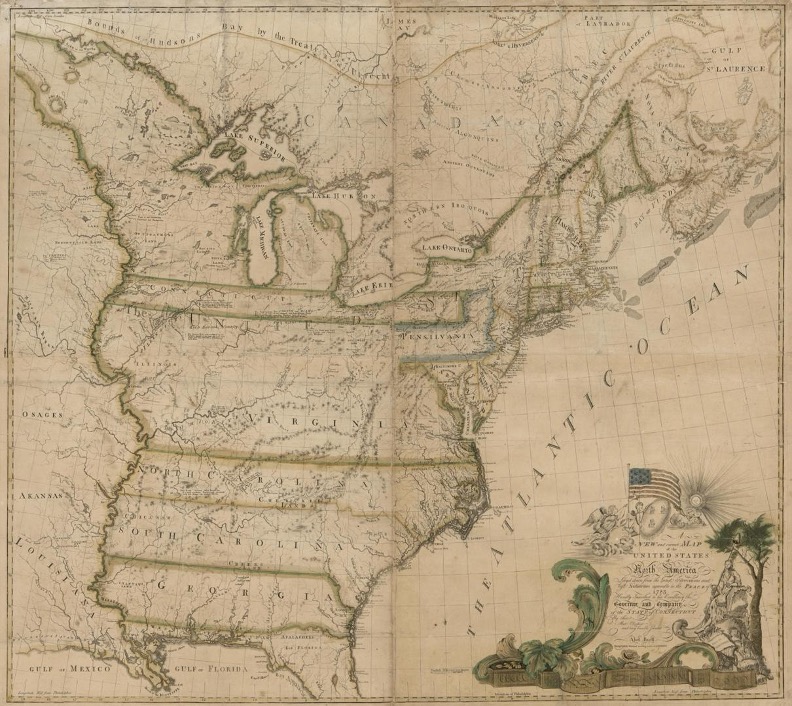
Figure 2: A New and Correct Map of the United States by Abel Buell(1784)[34]
In sum, America’s tradition of territorial expansion long predates her independence. So essential was expansion to the thirteen colonies that they launched a war with the most powerful empire on Earth to help protect their freedom to expand within, settle, and subdue the North American continent.[35] Territorial expansion was not only an integral part of the American founding, it was a key reason why there was an American founding at all.
The Founders’ Vision of Expansion
America’s most important Founding Fathers were early and strong proponents of U.S. territorial expansion. Decades before independence, Benjamin Franklin sought to unify the British colonies through his Albany Plan of Union of 1754, designed to secure colonists’ territorial holdings and ability to expand across the continent.[36] His audacious plan envisioned Americans seizing the Ohio River Valley, which at the time was claimed by the King of France and occupied by French settlers and American Indians.[37] Franklin proposed swift preemptive strikes against French claims in the Ohio River Valley culminating in the establishment of “two strong [English] colonies” between Ohio and Lake Erie.[38] His goals were twofold: neutralize a significant threat and secure a large-scale settlement that could be used as a springboard for further expansion.
At the heart of Franklin’s argument, which included bold predictions about the colonies’ dominion of North America, was a presumption common among the founders: territorial expansion was necessary for America to secure its destiny.[39] As Franklin wrote, through its “immense territory” America “must become a great country, popular and mighty,” capable of removing “any shackles [placed on her], and perhaps place them on the imposers.”[40] The syllogism is clear: American greatness and American expansion were deeply intertwined.
This belief cut across America’s already potent political and sectional factions.[41] In the nation’s early years, virtually every important American political thinker agreed that the United States would eventually span the North American continent.[42] Many assumed that America would one day include modern-day Canada, Mexico, Cuba, and Puerto Rico.[43] Alexander Hamilton’s Federalists and Jefferson’s Democratic Republicans, although rarely aligned, agreed that America was a nation of “great destinies.”[44] Even staunch Anti-Federalists like James Monroe and Patrick Henry favored territorial expansion.[45]
For Jefferson, America’s “empire of liberty” was necessarily vast.[46] Jefferson noted in 1780 that America’s future “empire” would not only form a “barrier against the dangerous extension of [British Canada],” it would enable the American union to “add… extensive and fertile” land.[47] To Monroe, Jefferson wrote “it is impossible not to look forward” to the day when the United States would “cover the whole northern, if not the southern continent.”[48] Of Spain’s North American holdings, Jefferson observed that the Spanish Empire would be “too feeble” to hold on to its territory until America inevitably “gain[ed] it from them piece by piece.”[49] When it came to Indian territory, Jefferson approved simply taking it, giving Indians “a thorough drubbing” if necessary.[50] In a revealing remark, Jefferson told Indian leaders who sought his help in stopping encroaching American settlers that he would need “from time to time…[to] procure gratifications to [American] citizens.”[51] In practice, this often meant turning a blind eye to American land-grabs.
Hamilton described the United States in the 1790s as “the embryo of a great empire.”[52] He dreamed of the United States taking its place as an equal alongside the British empire.[53] To achieve this, he argued, America needed to increase its population and access to resources such that it could pursue its “great destinies” unrestrained by outside powers.[54] Accordingly, Hamilton called the acquisition of western territories and access to the Mississippi “essential to the permanency of the Union.”[55] Once the United States achieved these goals, it could move on to acquire the territories at the mouth of the Mississippi, “which are to be regarded as the key to it.”[56] Although Hamilton is (correctly) associated with policies to build a maritime and commercial empire, he also looked favorably on American territorial expansion and long considered seizing Louisiana and Florida.[57] John Jay, a partner to Hamilton on The Federalist Papers, agreed, viewing Mississippi as an inevitable addition to the United States.[58]
John Adams, writing before independence, laid out a vision of a North American superpower unchallenged on the continent—and in the world. If the French could be removed as a blocking force, Adams opined, “our people…will in another century become more numerous than England…[and] the united force of all Europe will not be able to subdue us.”[59] Vast expansion was, in his view, a guiding presumption.
His son, John Quincy Adams, would later declare that Indian land claims stood athwart America’s divine mission and that the United States had every right to expand west, lest “[the American Indians] doom an immense region of the globe to perpetual desolation.”[60] The younger Adams aimed to secure Florida and the Pacific Northwest, including parts of modern day Canada.[61] He asserted “the whole continent of North America” was “destined by Divine Providence to be peopled by one nation…in one federal Union.[62] It was, Adams wrote, a “physical, moral, and political absurdity” that “fragments of [non-U.S.] territory, with sovereigns at fifteen hundred miles beyond the sea, worthless and burdensome to their owners, should exist permanently contiguous to a great, powerful…rapidly growing nation.”[63] The implication was clear: America was meant to sweep out Indians and European powers alike. Other great powers of the world should become “familiarized with the idea of considering our proper dominion to be the continent of North America.”[64] It was simply “not imaginable that…any European Nation should entertain the project of settling a Colony on the Northwest Coast of America.”[65] America’s right to that territory was “absolute,” as it had been “pointed out by the finger of Nature.”[66]
For America’s Founders, its subsequent leaders, and broad swaths of the American public before and after independence, breathtaking territorial aspirations was the default view. Their vision for America as the first independent New World superpower, naturally—and necessarily—required significant territorial expansion and development. The conviction was a matter of course, not debate. To the extent there was disagreement over U.S. expansion, it usually revolved only around the “when” and “how.”
The Constitution, Federalist Papers, and Law
The U.S. Constitution, The Federalist Papers, and key laws of the early republic illustrate how American territorial expansion was a given. The Constitution expressly contemplates the absorption of new U.S. states in Article IV, Section 3, but stipulates that no new state can be formed either within another state or by combining states without consent both from the legislature of the involved state and Congress—a significant bar to clear.[67] The default assumption of the Constitution, therefore, is that new states would be formed either from unsettled territory or land held by a foreign power. The implication is clear: America’s founders envisioned expansion. Indeed, even the Constitution’s short-lived predecessor, the moribund Articles of Confederation known for its unworkable restraint of federal power, expressly contemplated America’s absorption of Canada.[68]
The Federalist Papers likewise extol American territorial growth. Federalist No. 3, for instance, describes the danger of encirclement by foreign powers and the advantages of breaking out.[69] Federalist No. 10 argues that a geographically large United States, supported by a sufficiently strong federal government, would be more stable, less susceptible to factionalism, and better able to protect the rights of its citizens.[70] It argues that “the greater [the]…extent of territory,” the more salutary it would be for America’s body politic.[71] Federalist No. 10 accordingly calls on the young United States to “extend the sphere” of its dominion.[72] Federalist No. 14 directly combats the suggestion that America’s vast expanse necessarily endangered the efficacy of governance, and Federalist No. 43 outlines a process by which the United States could admit new territory as states.[73]
The new republic also passed laws that fostered territorial expansion, settlement, and development—even before the Constitution was ratified. In 1784, the United States enacted a land ordinance that anticipated the rapid incorporation of western territory as states. The ordinance also underscored the infallibility of U.S. territorial claims by declaring that all new states “shall for[ever] remain” a part of the United States.[74]
The United States doubled down with the Land Ordinance of 1785, which operationalized the ordinance of the previous year and established a standardized system by which American settlers could buy and develop western territory.[75] Two years later, the United States enacted the Northwest Ordinance, which aimed to establish a government for land that would become Illinois, Indiana, Michigan, Ohio, Wisconsin, and parts of Minnesota.[76] A “machine” of expansion, the Northwest Ordinance established an apparatus to incorporate new territories into the Union, guaranteed western settlers equal rights to self-government, and enabled them to petition for statehood.[77] It would prove a bold tool for expansion, taming the wilderness, and converting new territory into national power.
Frontier Nation
Perhaps the strongest evidence for America’s expansion-by-design is its conduct. The American story from the founding era through the early twentieth century is one of cross generational territorial growth.
The United States sought to increase its land holdings even before the War of Independence concluded. The boundaries of the new republic proved a key point of disagreement during peace negotiations. When these disputes were settled, the Peace of Paris of 1783 endowed the United States with colossal tracts of land that Britain had taken from France during the Seven Years’ War. The spoils included the Ohio River Valley, long sought by Washington and Franklin.[78] This windfall extended American territory hundreds of miles west of Appalachia to the Mississippi River and created new U.S. borders that reached the Great Lakes to the thirty-first parallel.[79] Hard-fought negotiations vastly increased U.S. territory, well beyond the hated Proclamation Line.[80]
So great was the haul that it outstripped the government’s ability to fully protect it. As early as 1787, America’s southwest frontier was on the verge of collapse from Spanish-backed Indian attacks.[81] America’s inability to reliably protect its western settlers was a recurring problem during this era. In 1787, the national army stood at around 700 men.[82] Theoretically, this force was responsible for defending the entirety of America’s frontier.[83] Even in conjunction with local militia, it was an impossible task and unsurprisingly generated calls from Westerners for a more robust central government.[84] America’s push west, it turned out, was an important factor in the Constitution’s ratification and conception of government.
Most Americans, Federalist or Anti-Federalist, Northerner or Southerner, favored territorial expansion.[85] A 1794 French military report notes that Americans were a “restless population . . . continually forcing [Indians] backwards and . . . attempting to get possession of all the vast continent.”[86] America’s federal government had neither the will nor the ability to stop its citizens’ westward advances.[87] Political pressure from Western representatives all but guaranteed that the federal government would support American settlers to the extent it could, even those who settled Indian land in violation of government-negotiated treaties.[88] A familiar pattern emerged in which the U.S. government would negotiate a treaty with Indians nominally limiting American westward expansion, American frontiersmen would promptly violate its terms, and the federal government would then “renegotiate” the original treaty to codify the previous expansion.[89]
The United States ultimately launched its first post-independence war against a powerful Indian confederation, the Northwestern Confederacy, largely over territorial expansion. In 1785, America was weak, exhausted, and penniless, only two years removed from its conflict with Britain. It nevertheless took up arms against one of the most formidable Indian alliances the world had seen and fought it for ten bloody years to victory.[90] Why? For control of the Northwest Territory, which Britain had ceded to the United States in 1783.[91] Despite its difficulties, America chose a decade of war against a determined enemy when territorial expansion and development hung in the balance.
The Northwest Indian War ended in American victory with the Treaty of Greenville in 1795.[92] This treaty ceded large swaths of modern-day Ohio to the United States in exchange for an upfront conveyance of goods to Indian tribes, along with annuities of federal money and other tangible provisions.[93] Not for the last time, America was willing to fight for territory and pay for it in peace.
Upon signing the treaty, the United States formally renounced all claims to Indian land outside a line that divided the Ohio Territory, with only minor exemptions.[94] In practice, American settlers ignored the treaty and pushed deeper into Ohio.[95] The U.S. government was again unable and unwilling to halt the deluge. Territorial expansion during this period was at least as much a bottom-up phenomenon as formalized government policy. To the extent that there was meaningful criticism of Western expansion policy, it primarily took the form of complaints that the federal government was ineffective at protecting land taken by American settlers—legally or otherwise.
In general, treaties designed to stem American territorial expansion rarely achieved their purpose.[96] As President Washington noted, “anything short of a Chinese wall” would be unable to prevent American settlers from building in Indian territory or from buying land earmarked to Indians by treaty.[97] Once land had been occupied by Americans, either by force of law or by law of force, that land was often retained and secured by a popularly elected government of Americans.[98] Domestically, the federal government risked losing support if it was seen as holding back westward expansion.[99] Some American leaders were even concerned, and not without good reason, that if the federal government failed to sufficiently promote territorial expansion, American populations in the West would seek to break from the United States.[100]
Reflecting this political reality, the Treaty of Greenville allowed U.S. Army installations within Indian territory to the north and west of the ceded lands and gave to the United States portions of strategically valuable territory. The combined effect was to contain Indian tribes and prime the United States for further expansion and settlement.
The Jay Treaty, signed the same year as the Treaty of Greenville, likewise demonstrated America’s penchant for expansion, both by its terms and the reaction it evoked. The Jay Treaty aimed to resolve issues between the United States and Britain stemming from the Treaty of Paris.[101] One of its key provisions was the removal of British forces from forts along the Northwest Territory, long a concern of Americans eager to claim the territory.[102] With the British gone, America could then sweep into the territory and make the land its own.[103] Notably, the treaty’s provision granting Spain a thirty year exclusive right to the Mississippi River nearly provoked a rebellion in Western territories, as many Americans on the frontier had already begun to think of the Mississippi as a sovereign U.S. holding.[104]
Jefferson’s ascent to the presidency in 1801 accelerated America’s already strong impulse for expansion. Jefferson removed Indians from hundreds of thousands of square miles.[105] He then nearly doubled the size of the United States with the Louisiana Purchase in 1803, gaining more than 500 million acres of land from France for $15 million.[106]
The cost of the purchase greatly exceeded all revenue received by the federal government that year and posed thorny constitutional issues.[107] But it was the deal of a lifetime. The bargain was hugely popular with Americans, steadfastly supported by Jefferson, and was ultimately upheld by the U.S. Supreme Court.[108] Such was America’s enthusiasm for adding territory that it purchased the land without a means to control it and, for the most part, lacked even basic knowledge of what it contained. Jefferson quickly established the Corps of Discovery in 1804, including the famed expedition of Lewis and Clark, to explore America’s newly acquired territory with an eye toward economic development.[109]
Even after doubling the size of America’s territory, Jefferson, like many Americans, was already angling for more, notwithstanding Federalist opposition for partisan reasons.[110] That the public supported spending colossal sums of public money for territory—largely sight unseen and despite serious constitutional questions—underscores how important territorial expansion was to these early Americans.[111] John Quincy Adams, speaking for many Americans, noted that the Louisiana Purchase made it “unavoidable that the remainder of the continent should ultimately be ours.”[112]
Less than a decade after the Louisiana Purchase, which the United States asserted included portions of West Florida, the United States again eyed territorial expansion—this time at the expense of the Spanish Crown.[113] Spain’s empire was in decline, and the United States saw opportunity. In 1810, the United States helped settlers launch an uprising in Spanish West Florida.[114] The rebels quickly captured a fort in Spanish-controlled Baton Rouge and declared a republic.[115] They requested American annexation and the United States swiftly obliged.[116] By the next year, the United States controlled the entirety of West Florida, save for the city of Mobile which fell into American hands during the War of 1812.[117]
A key cause of the War of 1812, which would break out only two years later between Britain and America was—once again—irreconcilable views over American westward expansion.[118] Britain’s refusal to relinquish its Western military outposts, despite its commitment to do so, fomented concerns that the United States was being encircled.[119] American leaders viewed these forts, combined with British support for American Indians resisting U.S. settlement efforts in the Northwest Territory, as an intolerable impediment to its westward expansion and then-precarious strategic footing. Although there were other factors that sparked the war, such as the impressment of American sailors by the Royal Navy and British trade restrictions, long-simmering territorial disputes were a core reason why the United States risked its very existence, once again, to fight the most powerful empire on earth.
After the War of 1812, the United States wasted little time in acquiring the rest of Florida. In 1818, President Monroe dispatched then-General Andrew Jackson to East Florida to quash Seminole attacks emanating from the Spanish-controlled territory.[120] Monroe strongly indicated in his orders to Jackson that taking Florida was, in fact, the true objective.[121] Jackson succeeded in occupying Spanish East Florida, which Spain formally turned over to the United States in 1819. In a striking example of America’s territorial aspirations, the Transcontinental Treaty, which ended the war, ceded to the United States not only Spanish East Florida but all Spanish territory in the Pacific Northwest above the forty-second parallel.[122]
In 1822, Americans even expanded to Africa.[123] A variety of private organizations, most notably the American Colonization Society (ACS), established the quasi-colony of Liberia on the west coast of Africa after Congress authorized a $100,000 grant to support the effort in 1819.[124] Liberia was to serve as a repository for emancipated slaves and freeborn American blacks who voluntarily repatriated to Africa. Far from a fringe idea, the ACS was supported by President James Monroe—who helped procure additional U.S. government funds for the project—former presidents Thomas Jefferson and James Madison, Henry Clay, Daniel Webster, and John Randolph.[125] Even Abraham Lincoln supported the Liberia project for much of his political career; in 1853, Lincoln stated that his “first impulse” with regard to emancipated slaves “would be to . . . send them to Liberia.”[126] Later, President Lincoln supported a bill in Congress to fund the settlement of Liberia by free blacks residing in the District of Columbia who wished to emigrate.[127] Although Liberia had no formal charter from the U.S. government, it bore a distinctly American stamp, and its establishment yet again underscores Americans enthusiasm for expansion.
The Monroe Doctrine of 1823 serves as a bookend to the founding era and exemplifies America’s deep-seated commitment to its territorial ambitions. The Monroe Doctrine stemmed from a joint Anglo-American declaration that aimed to prevent other powers from establishing new colonies or otherwise interfering in the Western Hemisphere. U.S. territorial expansion, as usual, became a sticking point during negotiations.[128] The British initially suggested terms that would have prevented the United States from expanding into Texas and Cuba by prohibiting any nation from seeking possession of Spain’s existing or former colonies.[129] The British relented after aggressive push back from the Americans, allowing the Monroe Doctrine to move forward. The final statement prevents only European efforts to form new colonies.[130] Hence, while Europe could not seek new colonies in North America, the United States had a free hand to expand without competition from Old World empires. By design, the Monroe Doctrine opened the door for U.S. hegemony of the North American continent. In time, America would take full advantage of its newly acquired room for maneuver.
U.S. territorial growth exploded in the decades that followed. During the second half of the 1840s, America expanded by two-thirds through its annexation of Texas, its acquisition of all Mexican territory north of the thirty-first parallel, and the settlement of the Oregon boundary.[131] The spoils of the Mexican-American War included 525,000 square miles of new land that would become modern-day California, Nevada, Utah, New Mexico, the balance of Arizona and Colorado, and portions of Oklahoma, Kansas, and Wyoming.[132] As Fredrick Jackson Turner observed in 1893, American history up to that point had largely been the “the history of colonization of the Great West.”[133]
American expansion paused in the run-up to the Civil War as the politics of slavery subsumed the politics of expansion, but this should not be misunderstood as a categorical change in Americans’ disposition towards expansion. While both North and South opposed any expansion of the other faction, each retained great enthusiasm for expansion by its own faction.
Both North and South developed radical competing visions of America’s future borders. Many anti-slavery Northerners sought to absorb all western territory into the United States as future free states, with some even looking to Canada.[134] The South, for its part, dreamt of a vast slave-holding empire that would encompass the Caribbean, Mexico, and in some visions, Central and Latin America.[135] America’s pause on expansion reflected its domestic fracture, not skepticism over expansion as such.
Indeed, even the Civil War and Reconstruction did not quench Americans’ favor for territorial enlargement. The only treaty that passed the Senate during President Andrew Johnson’s administration was the 1867 purchase of Alaska from Russia which the Senate voted to approve 37-2—an exceedingly rare display of bipartisan unity in the immediate post-war era.[136] The United States then annexed Midway Atoll later that same year.
Once the United States was back on its feet, it again ran headlong for land. Between 1898 and 1917 America acquired Hawaii, the Philippines, Guam, Puerto Rico, the Panama Canal Zone, Guantanamo Bay, and the Virgin Islands. As late as 1925, the United States annexed Swains Island in the Pacific Ocean.
America’s bold territorial expansion animated its founding and, despite periodic interruptions, was a consistent feature of its first century and a half of life. At no time did significant factions of Americans or their leaders question the legitimacy of the United States establishing North America as her own. America grew from virtually the moment it earned its independence—and indeed before. It expanded both to popular and elite acclaim, a shared aim that spanned political parties, geographical factions, administrations, and historical eras. It is no exaggeration to say that territorial expansion is an American project older than the nation itself.
Conclusion
The United States of America began as a weak, modestly sized, heavily indebted nation along the eastern seaboard. Within a century, it was a continent-spanning world power. This transformation could not have happened without America’s relentless quest for territory, an imperative held as self-evident by American colonists, founders, and successive generations of citizens reaching into the twentieth century.
The United States was destined to expand—and expand it did. Its prodigious efforts shook the incumbent global system to its core. Rarely in human history had a nation’s borders expanded so ravenously in such brief time.
Yet American territorial expansion has been on pause for more than a century. Why? A full treatment of this hiatus is beyond the scope of this chapter. Suffice to say numerous factors played a part, including two blood-soaked world wars against aggressive, land-hungry powers and a half-century struggle to contain the Soviet Union. Also significant was the rise of politically powerful transnational movements such as decolonization, international law, anti-war pacifism, and globalism. Formal multilateral institutions like the United Nations and the North Atlantic Treaty Organization further restricted territorial expansion while increased skepticism of America’s moral credibility among Americans weakened the domestic political value of adding new U.S. land.
Perhaps most important is the uncomplicated fact that, by the beginning of the First World War, the United States was no longer bordered by vast swathes of largely unoccupied territory protected only by distant powers, fading powers, or no power at all. Simply put, by the second decade of the twentieth century the United States lacked proximity to territory ripe for taking.
Whatever the reason for this abeyance, the possibility of American territorial expansion has reentered American political discourse, a development virtually unimaginable even a decade ago. Is the century-long lull about to end? Presidential pronouncements aside, it is hard to envisage a second Manifest Destiny sweeping the country, if for no other reason than that the United States appears to lack access to easily attainable land. There is nevertheless a shift worth considering.
Many of the pivotal historical events that drove the United States to throw off its tradition of expansion are fading into the distant past. The end of the Second World War, for instance, stands roughly as far from the Civil War as it does to the present. As these inflection points fade further into the mist of time, so too might the policy preferences they bestowed upon present-day Americans and their institutions.
Today, the political frameworks that served to contain U.S. expansion—arguably the default position in the American tradition—are under unprecedented strain, from the United Nations to the World Trade Organization. If crucial conceptual pillars of America’s restraint continue to crumble, it is at least a question whether the United States could return to a more originalist understanding of its national interest. Indeed, even accounting for the past century, America’s pregnant pause on expansion accounts for under half of its history since the founding—less still if one counts America’s colonial era.
While it may be surprising if the United States returned to a policy of expansion, it would not be unprecedented. After all, America’s once irrepressible urge to expand was a root cause of its quest for independence and numerous wars thereafter. Such an instinct is consistently expressed by the Founding Fathers, anticipated in the Constitution, contemplated in The Federalist Papers, codified in America’s early laws, and vividly illustrated by the revealed preferences of Americans for much of the nation’s early and middle history. Although it is uncertain where today’s rhetoric of expansion will lead, there is no doubt about where, and with whom, it began.
Andrew B. Gabel is a national security and foreign investment lawyer based in Washington, D.C. He holds a JD from Duke University School of Law and a BA from Kenyon College. He is an alumnus of the Alexander Hamilton Society’s Security and Strategy Seminar on China. The views expressed herein are solely his own.
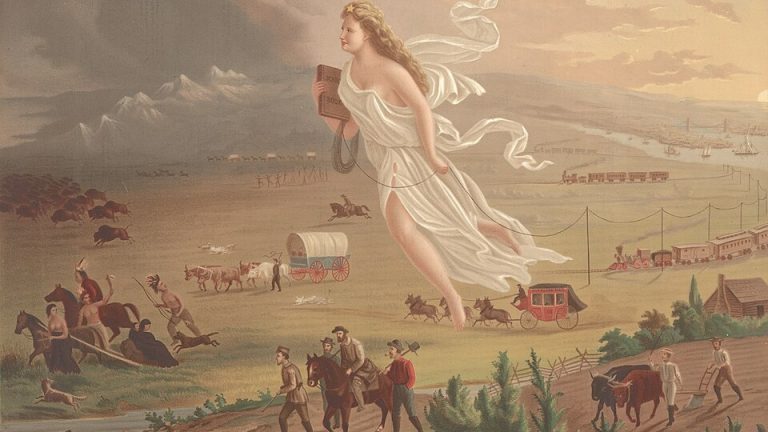
Image: American Progress (1872) by John Gast.jpg, 1872, from John Gast and the Library of Congress. Retrieved from: https://commons.wikimedia.org/wiki/File:American_Progress_%281872%29_by_John_Gast.jpg, used under Wikimedia Commons.

[1] Ken Dilanian and Dan De Luce, “Trump White House Asked U.S. Military to Develop Options for Panama Canal, Former Officials Say,” NBC News, October 18, 2025, http://www.nbcnews.com/politics/national-security/trump-white-house-asked-us-military-develop-options-panama-canal-offic-rcna195994; Humeyra Pamuk, “Wife of U.S. Vice President Vance to Make High-Profile Visit to Greenland,” Reuters, March 23, 2025, http://www.reuters.com/world/wife-us-vice-president-vance-make-high-profile-visit-greenland-2025-03-23/; “Why does Trump want to take over Gaza and could he do it?,” BBC News, February, 11, 2025, http://www.bbc.com/news/articles/cn4z32y12jpo; Richard Hall, “Trump Goes for the Jugular with His Canada Threats—and Does It with a Smile,” The Independent, October 18, 2025, http://www.the-independent.com/news/world/americas/us-politics/trump-canada-annex-greenland-b2714806.html.
[2] Robert Kagan, Dangerous Nation: America’s Foreign Policy from Its Earliest Days to the Dawn of the Twentieth Century (New York: Vintage Books, 2007), 11.
[3] Kagan, “Dangerous Nation,” 11-12.
[4] Kagan, “Dangerous Nation,” 16; Hans Kohn, American Nationalism: An Interpretative Essay (New York: Collier Books, 1961), 26.
[5] Turner, “The Significance of the Frontier in American History”.
[6] Kagan, “Dangerous Nation,” 17.
[7] Kagan, “Dangerous Nation,” 17.
[8] Kagan, “Dangerous Nation,” 17.
[9] Kagan, “Dangerous Nation,” 18, 20.
[10] Kagan, “Dangerous Nation,” 21.
[11] Kagan, “Dangerous Nation,” 21.
[12] Kagan, “Dangerous Nation,” 21.
[13] Richard A. White, The Middle Ground: Indians, Empires, and Republics in the Great Lakes Region, 1650–1850 (Cambridge: Cambridge University Press), 340; Kagan, “Dangerous Nation,” 21;
[14] Kagan, “Dangerous Nation,” 21.
[15] Kagan, “Dangerous Nation,” 21.
[16] Kagan, “Dangerous Nation,” 17.
[17] Kagan, “Dangerous Nation,” 26.
[18] Kagan, “Dangerous Nation,” 27.
[19] Kagan, “Dangerous Nation,” 27.
[20] Kagan, “Dangerous Nation,” 28.
[21] Kagan, “Dangerous Nation,” 36.
[22] Jennifer Monroe McCutchen, “Proclamation Line of 1763,” Digital Encyclopedia, George Washington’s Mount Vernon, https://www.mountvernon.org/library/digitalhistory/digital-encyclopedia/article/proclamation-line-of-1763; Kagan, “Dangerous Nation,” 36.
[23] U.S. Geological Survey, The National Atlas of the United States of America, 1970, https://lccn.loc.gov/79654043 (accessed November 4, 2025).
[24] Kagan, “Dangerous Nation,” 28.
[25] George Washington, “George Washington to William Crawford, 17 September 1767,” The Papers of George Washington, Colonial Series, vol. 8, 24 June 1767–25 December 1771, ed. W. W. Abbot and Dorothy Twohig (Charlottesville: University Press of Virginia, 1993), 26–32, https://founders.archives.gov/documents/Washington/02-08-02-0020.
[26] Kagan, “Dangerous Nation,” 36.
[27] Maxime Dagenais, “Quebec Act, 1774,” The Canadian Encyclopedia, last modified May 11, 2020, https://www.thecanadianencyclopedia.ca/en/article/quebec-act.
[28] Benjamin Franklin, “Notes on Britain’s Intention to Enslave America,” The Papers of Benjamin Franklin, vol. 21, January 1, 1774–March 22, 1775, ed. William B. Willcox (New Haven and London: Yale University Press, 1978), 608, https://founders.archives.gov/documents/Franklin/01-21-02-0312.
[29] Maxime Dagenais, “Quebec Act, 1774,” The Canadian Encyclopedia, last modified May 11, 2020, https://www.thecanadianencyclopedia.ca/en/article/quebec-act.
[30] Caroline Eisenhuth, “The Coercive (Intolerable) Acts of 1774,” Digital Encyclopedia, George Washington’s Mount Vernon, https://www.mountvernon.org/library/digitalhistory/digital-encyclopedia/article/the-coercive-intolerable-acts-of-1774.
[31] Thomas Jefferson, A Summary View of the Rights of British America (1774), The Avalon Project, Yale Law School, https://avalon.law.yale.edu/18th_century/jeffsumm.asp#back8
[32] Jefferson, A Summary View of the Rights of British America
[33] Jefferson, A Summary View of the Rights of British America
[34] Abel Buell, A New and Correct Map of the United States of North America, 1784, Library of Congress, https://blogs.loc.gov/loc/files/2017/04/Abel-Buell-Map.jpg.

[35] Kagan, “Dangerous Nation,” 30-31.
[36] Albany Congress, “Representation of the Present State of the Colonies,” July 9, 1751, in The Papers of Benjamin Franklin, vol. 5, ed. Leonard W. Labaree et al. (New Haven, CT: Yale University Press, 1962), 366–374,
[37] Kagan, “Dangerous Nation,” 18.
[38] Albany Congress, “Representation of the Present State of the Colonies,” July 9, 1751, in The Papers of Benjamin Franklin, vol. 5, ed. Leonard W. Labaree et al. (New Haven, CT: Yale University Press, 1962), 366–374.
[39] Kagan, “Dangerous Nation,” 25.
[40] Kagan, “Dangerous Nation,” 37.
[41] Kagan, “Dangerous Nation,” 130.
[42] Kagan, “Dangerous Nation,” 77.
[43] Kagan, “Dangerous Nation,” 130.
[44] Kagan, “Dangerous Nation,” 127.
[45] Kagan, “Dangerous Nation,” 69.
[46] Kagan, “Dangerous Nation,” 127..
[47] Thomas Jefferson, “Draft of Instructions to the Virginia Delegates in Congress,” November 4, 1780, in The Papers of Thomas Jefferson, vol. 4, ed. Julian P. Boyd (Princeton: Princeton University Press, 1951), 295–297, https://founders.archives.gov/documents/Jefferson/01-04-02-0295.
[48] Richard W. Van Alstyne, Rising American Empire (New York: Oxford University Press, 1960), 89.
[49] Thomas Jefferson to Archibald Stewart, January 25, 1786, in The Papers of Thomas Jefferson, vol. 9, ed. Julian P. Boyd et al. (Princeton, NJ: Princeton University Press, 1950), 218.
[50] Thomas Jefferson to George Washington, April 17, 1791, in The Papers of Thomas Jefferson, vol. 20, ed. Julian P. Boyd et al. (Princeton, NJ: Princeton University Press, 1950), 145.
[51] Anthony F.C. Wallace, Jefferson and the Indians: The Tragic Fate of the First Americans (Cambridge, MA: Belknap Press of Harvard University Press, 1999), 214, 216.
[52] Alexander Hamilton, “Camillus,” in The Works of Alexander Hamilton, vol. 5, ed. Henry Cabot Lodge (New York: G.P. Putnam’s Sons, 1904), 206.
[53] Kagan, “Dangerous Nation,” 127.
[54] Alexander Hamilton to Rufus King, October 2, 1798, in The Works of Alexander Hamilton, vol. 10, ed. Henry Cabot Lodge (New York: G.P. Putnam’s Sons, 1904), 321.
[55] Alexander Hamilton to Harrison Gray Otis, January 25, 1799, in The Works of Alexander Hamilton, vol. 6, ed. John C. Hamilton (New York: J.F. Trow, 1850–1851), 391.
[56] Answers to the Questions Proposed by the President to the Secretary of the Treasury,” September 15, 1790, in The Papers of Alexander Hamilton, vol. 7, ed. Harold C. Syrett and Jacob E. Cooke (New York: Columbia University Press, 1961–1987), 51–53, at 53.
[57] Kagan, “Dangerous Nation,” 121.
[58] Lloyd C. Gardner et al., “Creation of the American Empire: U.S. Diplomatic History, vol. 1 (Chicago: Dorsey Press, 1973), 35.
[59] Kagan, “Dangerous Nation,” 36.
[60] John Quincy Adams, An Oration, Delivered at Plymouth, December 22, 1802, at the Anniversary Commemoration of the First Landing of Our Ancestors at That Place (Boston: Russell & Cutler, 1802), quoted in Ralph Lerner, Thinking Revolutionary: Interpretations of American History (Ithaca, NY: Cornell University Press, 1987), 165.
[61] Kagan, “Dangerous Nation,” 130.
[62] Quoted in Samuel F. Bemis, John Quincy Adams and the Foundations of American Foreign Policy (New York: Knopf, 1949), 182.
[63] John Quincy Adams, Memoirs of John Quincy Adams, Comprising Portions of His Diary from 1795 to 1848, ed. Charles Francis Adams, 12 vols. (Philadelphia: J.B. Lippincott, 1874–1877), quoted in Walter LaFeber, ed., John Quincy Adams and American Continental Empire: Letters, Papers, and Speeches (Chicago: Quadrangle Books, 1965), 36–37.
[64] Adams diary, November 16, 1819
[65] John Quincy Adams to Benjamin Rush, July 22, 1823, quoted in Richard W. Van Alstyne, Rising American Empire (New York: Oxford University Press, 1960), 96.
[66] Adams to Rush, “Rising American Empire”, 96.
[67] U.S. Constitution, art. 4, sec. 3.
[68] Articles of Confederation, art. 11
[69] Federalist No. 03.
[70] Federalist No. 10.
[71] Federalist No. 10.
[72] Federalist No. 10.
[73] Federalist No. 14.
[74] Continental Congress, The Ordinance of 1784, April 23, 1784, in The Papers of Thomas Jefferson, vol. 6, ed. Julian P. Boyd (Princeton, NJ: Princeton University Press, 1952), 613–616, https://founders.archives.gov/documents/Jefferson/01-06-02-0420-0006; “Report from the Committee for the Western Territory to the United States Congress,” March 1, 1784, in Envisaging the West: Thomas Jefferson and the Roots of Lewis and Clark, University of Nebraska–Lincoln and University of Virginia, https://jeffersonswest.unl.edu/thematic/documents_B.html.
[75] Vernon Carstensen, “Patterns on the American Land,” Journal of Federalism 18, no. 4 (Fall 1987): 31–39.
[76] Ordinance for the Government of the Territory of the United States North-West of the River Ohio, July 13, 1787, Miscellaneous Papers of the Continental Congress, 1774–1789, Record Group 360, National Archives, https://www.archives.gov/milestone-documents/northwest-ordinance.
[77] Lloyd C. Gardner, Walter LaFeber, and Thomas J. McCormick, Creation of the American Empire, 2 vols. (Chicago: Rand-McNally, 1976), 1:43.
[78] Kagan, “Dangerous Nation,” 53.
[79] Kagan, “Dangerous Nation,” 53.
[80] Kagan, “Dangerous Nation,” 53.
[81] Kagan, “Dangerous Nation,” 54.
[82] Kagan, “Dangerous Nation,” 66.
[83] Kagan, “Dangerous Nation,” 66.
[84] Kagan, “Dangerous Nation,” 66.
[85] Kagan, “Dangerous Nation,” 69.
[86] Baron de Carondelet, “Military Report on Louisiana and West Florida,” November 1794, in Baron de Carondelet Papers, 1772–1875, Missouri Historical Society.
[87] Kagan, “Dangerous Nation,” 82.
[88] Kagan, “Dangerous Nation,” 82.
[89] Kagan, “Dangerous Nation,” 82.
[90] John Sugden, Blue Jacket: Warrior of the Shawnees (Lincoln: University of Nebraska Press, 2000).
[91] Reginald Horsman, “The Northwest Ordinance and the Shaping of an Expanding Republic,” Wisconsin Magazine of History.
[92] “Little Turtle’s War and Native America’s Greatest Victory over American Forces,” Citizen Potawatomi Nation, July 15, 2019.
[93] Treaty of Greenville, August 3, 1795, in The Avalon Project: Documents in Law, History and Diplomacy, Yale Law School
[94] Treaty of Greenville, August 3, 1795, in The Avalon Project: Documents in Law, History and Diplomacy, Yale Law School.
[95] Marc Liebman, “1795 Treaty of Greenville – Made But Not Honored,” October 27, 2024.
[96] Kagan, “Dangerous Nation,” 79.
[97] Kagan, “Dangerous Nation,” 74.
[98] Ralph Lerner, The Thinking Revolutionary: Principle and Practice in the New Republic (Ithaca, NY: Cornell University Press, 1987), 153.
[99] Kagan, “Dangerous Nation,” 75.
[100] Kagan, “Dangerous Nation,” 75.
[101] Todd Estes, The Jay Treaty Debate, Public Opinion, and the Evolution of Early American Political Culture (Amherst: University of Massachusetts Press, 2006).
[102] “The Jay Treaty; November 19, 1794,” Avalon Project, Yale Law School.
[103] “Treaty of Greenville; August 3, 1795,” Indian Affairs: Laws and Treaties, vol. 2, compiled by Charles J. Kappler (Washington, DC: Government Printing Office, 1904).
[104] Kagan, “Dangerous Nation,” 76.
[105] Kagan, “Dangerous Nation,” 131.
[106] “Louisiana Purchase, 1803,” Office of the Historian, U.S. Department of State.
[107] U.S. Bureau of the Census, Historical Statistics of the United States, 1789–1945, chap. P, Washington, DC: U.S. Government Printing Office, 1949, https://www2.census.gov/library/publications/1949/compendia/hist_stats_1789-1945/hist_stats_1789-1945-chP.pdf; Thomas Jefferson, “Letter to John Breckinridge,” August 12, 1803, Teaching American History, http://teachingamericanhistory.org/document/letter-to-john-breckinridge/; Howe & Rusling Team, “The Louisiana Purchase and the Birth of American High Finance,” Howe & Rusling, March 8, 2019, http://www.howeandrusling.com/the-louisiana-purchase-and-the-birth-of-american-high-finance/; NCC Staff, “The Louisiana Purchase: Jefferson’s Constitutional Gamble,” Constitution Center, October 20, 2023, https://constitutioncenter.org/blog/the-louisiana-purchase-jeffersons-constitutional-gamble.
[108] Kagan, “Dangerous Nation,” 134.
[109] Elin Woodger and Brandon Toropov, Encyclopedia of the Lewis and Clark Expedition (New York: Infobase Publishing, 2000), 150; “Thomas Jefferson to Meriwether Lewis,” June 20, 1803, in Thomas Jefferson, Library of Congress Exhibitions.
[110] Kagan, “Dangerous Nation,” 134.
[111] NCC Staff, “The Louisiana Purchase: Jefferson’s Constitutional Gamble,” Constitution Center, October 20, 2023, https://constitutioncenter.org/blog/the-louisiana-purchase-jeffersons-constitutional-gamble.
[112] John Quincy Adams, diary entry, November 16, 1819, in C.F. Adams, Memoirs of John Quincy Adams, vol. 4 (Philadelphia: J.B. Lippincott & Co., 1875), 439.
[113] Office of the Historian, “Acquisition of Florida: Treaty of Adams-Onís (1819) and Transcontinental Treaty (1821),” Milestones in the History of U.S. Foreign Relations, U.S. Department of State; Kagan, “Dangerous Nation,” 135.
[114] “Dangerous Nation,” 136.
[115] “Dangerous Nation,” 136.
[116] “Dangerous Nation,” 136.
[117] “Dangerous Nation,” 136.
[118] National Portrait Gallery, “Causes of War,” in 1812: A Nation Emerges, Smithsonian Institution, https://npg.si.edu/exhibit/1812/causes.html; Office of the Historian, “War of 1812–1815,” Milestones in the History of U.S. Foreign Relations, U.S. Department of State, https://history.state.gov/milestones/1801-1829/war-of-1812; Smithsonian Institution, “Causes of the War of 1812,” American Experience, https://americanexperience.si.edu/wp-content/uploads/2014/10/Causes-of-the-War-of-1812_.pdf.
[119] “Dangerous Nation,” 106.
[120] “Dangerous Nation,” 136.
[121] Quoted in William Earl Weeks, John Quincy Adams and American Global Empire (Lexington: University Press of Kentucky, 1992), 109.
[122] “Dangerous Nation,” 137.
[123] U.S. Department of State, Office of the Historian, “Liberia,” http://history.state.gov/countries/liberia.
[124] U.S. Department of State, “Monrovia: Post of the Month,” State Magazine, February 2022, http://statemag.state.gov/2022/02/0222pom/; https://www.gilderlehrman.org/sites/default/files/2025-02/ready.04675_02_FPS.pdf Angela Thompsell, “The Foundations of Liberia,” History Today 70, no. 4 (April 2020), https://www.historytoday.com/archive/feature/foundations-liberia; Gilder Lehrman Institute of American History, “American Colonization Society Membership Certificate,” February 2025, http://www.gilderlehrman.org/sites/default/files/2025-02/ready.04675_02_FPS.pdf.
[125] U.S. Department of State, “Founding of Liberia, 1847,” 2001–2009 Archive, http://2001-2009.state.gov/r/pa/ho/time/dwe/16337.htm
[126] U.S. Department of State, “Founding of Liberia, 1847,” 2001–2009 Archive, http://2001-2009.state.gov/r/pa/ho/time/dwe/16337.htm; Rob Crotty, “Lincoln to Slaves: Go Somewhere Else,” Pieces of History (blog), National Archives, December 1, 2010, https://prologue.blogs.archives.gov/2010/12/01/lincoln-to-slaves-go-somewhere-else/;
[127]U.S. Department of State, Office of the Historian, “Founding of Liberia, 1847,” Milestones in the History of U.S. Foreign Relations, http://history.state.gov/milestones/1830-1860/liberia; Rob Crotty, “Lincoln to Slaves: Go Somewhere Else.”
[128] “Dangerous Nation,” 140.
[129] “Dangerous Nation,” 141.
[130] “Dangerous Nation,” 141.
[131] James M. McPherson, Battle Cry of Freedom: The Civil War Era (New York: Oxford University Press, 1988), 47.
[132]National Archives, “Treaty of Guadalupe Hidalgo (1848),” Milestone Documents, https://www.archives.gov/milestone-documents/treaty-of-guadalupe-hidalgo; “Dangerous Nation,” 224.
[133] Frederick J. Turner, The Significance of the Frontier in American History (1893).
[134] “Dangerous Nation,” 186, 249-50.
[135] “Dangerous Nation,” 231, 237-38, 242-44; William W. Freehling, The Road to Disunion: Volume I, Secessionists at Bay, 1776–1854 (New York: Oxford University Press, 1990), 154.
[136] “Dangerous Nation,” 274; Library of Congress, “Today in History: March 30,” Today in History, https://www.loc.gov/item/today-in-history/march-30/.