


1776: The Beginnings of American Exceptionalism Abroad
From the Edge of the World to the Center: America at 250
Share On:
On July 2, 1776, General George Washington issued orders to his newly formed army in New York, which included this exhortation: “The fate of unborn Millions will now depend, under God, on the Courage and Conduct of this army. . . . Let us therefore animate and encourage each other, and shew the whole world, that a Freeman contending for Liberty on his own ground is superior to any slavish mercenary on earth.”[1]
One week later, Washington informed his troops that the Continental Congress had declared the “United Colonies of North America, free and independent STATES.”[2] He ordered his troops to assemble that evening to hear a reading of this declaration, so that each soldier would better understand the causes of this revolution and act with “Fidelity and Courage, as knowing that now the peace and safety of his Country depends (under God) solely on the success of our arms.”
At that gathering, Patriot soldiers would have heard many grievances against their former king, George III. They would also have heard about the principles that justified and inspired these new united states, including popular sovereignty (governments “derive their just powers from the consent of the governed”), natural equality (“all men are created equal”), natural rights (“life, liberty, and the pursuit of happiness”), and the purpose of legitimate governments (“to secure these rights”).[3]
Perhaps these principles were “self-evident” to the soldiers on parade that evening in 1776, however imperfectly their society lived by them. Perhaps, as Thomas Jefferson later contended, the Declaration of Independence did not “say things which had never been said before,” but instead “place[d] before mankind the common sense of the subject.”[4] They certainly were not treated as “self-evident” in most corners of the world at that time. Rulers, courtiers, and subjects across Europe and beyond would have scoffed—and did scoff—at the impertinence of these rebellious colonists, with their talk of setting an example for the world and deciding the fate of millions. And that is if the Old World paid attention at all. The pronouncements and early battles of the American Revolution, including what Ralph Waldo Emerson later billed the “Shot Heard ‘Round the World,” surely were louder and more significant to the Patriots than to people elsewhere, consumed with intrigues in Europe, the center of world events and empires. As Gordon S. Wood writes with evident amusement, Americans “had an extraordinary emotional need to exaggerate their importance in the world” and “never fully appreciated” Europeans’ “disdain for their country’s power.”[5]
Fast-forward 250 years, however, and the Founders’ impassioned rhetoric seems, if anything, to understate the significance of the American Revolution. The United States, unified and organized by its remarkable constitution, spans a continent and secures the Western Hemisphere. It is the world’s most prosperous country, with the world’s most powerful military. Its major cities—and some minor ones—are centers of the world for technology, finance, energy, and much else. What’s more, the United States has strong friendships with countries across the globe. Notably, it has multigenerational alliances with all the powers of Western Europe—all of which are democracies, committed to the same rights that those troublesome American colonists fought for two and a half centuries ago. So strong has been America’s influence that all but the most self-confident tyrants seek the fig leaf of democratic support for their rule, and many have constitutions guaranteeing all manner of American-sounding rights. Through the ministry of its believers, the commerce of its merchants, and the strength of its arms, America’s ideals and influence have spread. We can begin to understand American exceptionalism by looking at the stamp its Founders and citizens have left on our world.
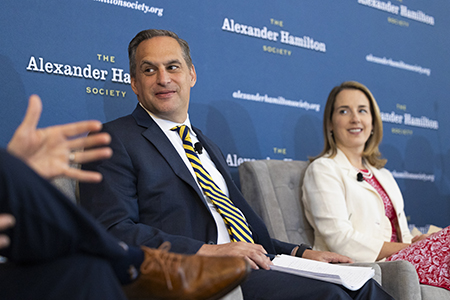
This volume, generously sponsored by the Richard Lounsbery Foundation and produced by the Alexander Hamilton Society, is an attempt to understand the American Founding, how it created an exceptional nation with an exceptional role in the world, and what it means for the foreign relations of the United States today.
The ten contributors to this volume sought to learn from the Founding generation to guide their work in the present day. Some of these contributors work in politics, some in business, and some in academia. They have different beliefs about the nature and extent of American exceptionalism—and about many other things—but all share a profound respect for the Founders who fought for American independence, established this republic, and set it on a course to greatness. Each sat down to study and make sense of what the Founders left behind. Each has returned with many curiosities and treasures for us to consider.
The heart of this project was deep engagement with the actual words and deeds of the Founders. From the records of the Continental Congress and Constitutional Convention, to The Federalist Papers, to correspondence and sermons, the Founders expressed their ideas and arguments passionately, extensively, and elegantly. Many of these documents are now more accessible than ever, thanks to invaluable digital collections such as the National Archives’ Founders Online.[6] We prioritized primary sources over historiography, as we felt they would yield the greatest insight for a group steeped in contemporary foreign relations and interested in the practical application of historic ideas. We defined our subject broadly, incorporating the events most traditionally called the Founding during the colonial era, the Revolutionary War, the Framing of the Constitution, and the early Republic into the first decades of the nineteenth century.
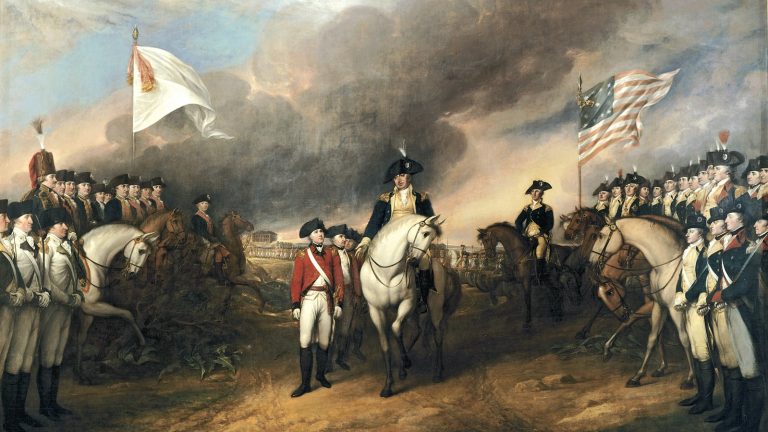
The project included a staff ride to Yorktown, to visit the place where General Washington’s strategy, American and French martial valor, and French sea power won American independence on the battlefield in 1781. Each of the volume’s contributors adopted the role of a key figure in the campaign, ranging from British commander Lord Cornwallis to Patriot soldier Joseph Plumb Martin, and considered how they made decisions and experienced the war. Cruising the mouth of the Chesapeake in a schooner and trudging through the trenches where American and French soldiers defeated a foreign army at close quarters brought us all a little closer to the past and helped us appreciate how America’s freedom was won—at the point of a bayonet.
What emerged from our study was a better understanding of how the Founders themselves viewed the country and its role in the world. Today it is commonplace to claim that we face exceptional or unprecedented challenges in foreign relations, but controversial to claim that America is an exceptional nation. We hope greater engagement with the Founders’ ideas during America’s 250th anniversary will prompt reflection on both counts. As the essays in this volume make plain, America was born into an exceptionally precarious position that required all the wisdom, cunning, and statesmanship of its leaders to navigate. Still, those leaders gambled their lives on independence because they believed they were creating a nation of singular promise. Moreover, they crafted a Constitution and raised a military suitable for a nation intended to play an exceptional, exemplary role in the world.
Debates over the nature and extent of American exceptionalism and what it means for foreign relations go back 250 years to the Founding itself. Hudson Institute Fellow Mike Watson addresses these contentions in his essay “I am Large, I Contain Multitudes: Defining and Defending This Exceptional Nation.” He documents the Founders’ grand ambitions for their republic, which they believed was world-historically important and blessed by Providence. But if they agreed America was exceptional, they did not always agree why. Some hoped America would become a model for the world in its devotion to protecting the rights and liberties of its citizens. Many Founders also sincerely hoped that their geographic isolation from Europe would help them escape Europe’s draining alliances and wars, although these hopes were quickly dashed. In practice, the Americans allied with European great powers almost immediately and, in their hour of victory at Yorktown, even found them useful. Watson argues the Founders were “mugged by reality: although the character of this new country was unique, it could not escape the grim realities of international affairs. Rather than extricating themselves from geopolitics, the Founders discovered that independence made their international position more precarious and foreign policy more important for their wellbeing.”
No Founder understood these realities with such clarity as Washington himself, whose legacy is often misinterpreted based on a shallow reading of his Farewell Address, with its warnings against foreign “entanglements.” In fact, as the Ronald Reagan Institute’s Rachel Hoff argues in her essay—based on deep engagement with his correspondence—Washington practiced and preached “a foreign policy promoting peace and prosperity, for the purpose of advancing liberty, backed by military strength.” Washington summarized this “peace through strength” strategy in his first address to Congress in 1790: “To be prepared for war is one of the most effective means of preserving peace.” Washington did try to keep America out of the wars engulfing Europe, but he did so out of pragmatic concern for the country’s weak position rather than an ironclad principle of isolation. Indeed, his strategy was to marshal America’s economic strength and military power, so that one day “not far off” Americans might “choose peace or war, as our interest, guided by justice, shall counsel.” In his 1796 Farewell Address, Washington even envisioned “the adoption” of America’s “free constitution” by foreign states in good time. Washington’s vision of a strong, self-confident, and engaged America has come to pass.
Opposition to such engagement with the world has been a persistent feature of American foreign relations, too. Luke J. Schumacher, a Ph.D. candidate in political science at the University of Virginia, investigates this in “Between Republic and Empire: How Constitutional Ratification Rejected Isolationism.” During the debates over the Constitution, Anti-Federalists argued that authorizing a large army and vigorous central government would endanger the very liberties that made America exceptional. Better to remain a confederation of states, tending to their own gardens and trusting in their advantageous geography for protection. The Federalists rejected such contentions eloquently. Alexander Hamilton argued, “No government could give us tranquility and happiness at home, which did not possess sufficient stability and strength to make us respectable abroad.” James Madison put it more simply: “Weakness will invite insults.” In the end, Americans adopted the Federalist Constitution, but the Anti-Federalist impulses to focus inward and restrain America’s military power and activity overseas remain powerful—indeed, they constitute an alternate vision of American exceptionalism.
In a similar vein, Yashar Parsie investigates the formation of the American military in his essay, “To Raise an Army: The Origin of America’s Military.” He examines how a people deeply suspicious of standing armies as a threat to liberty came to possess one. Parsie argues that America’s defense establishment was founded as part of a compromise that respected both Americans’ deep-seated reservations about unchecked military power and the strategic necessity of maintaining a force capable of defending the nation. This “synthesis,” contained in the Constitution, established a professional standing army under civilian control. The Founders divided the power to control this army by giving the legislature power to set military budgets and confirm military leaders, while leaving the militia under the control of the states at most times. This limited but capable military has succeeded in defending American sovereignty and interests without endangering Americans’ liberty.
Securing the republic also required sea power. As Center for Maritime Strategy Non-Resident Senior Fellow Samuel F. Byers points out in his essay, America at the time of the Founding was a maritime nation, reliant on the seas for its safety and trade. The Founders consequently prioritized maritime concerns, including global trade, in their foreign relations. While America may seem like a continental power today, we still rely on the sea to access much of the world, and thus have compelling reasons to maintain command of the seas and access to global trade, especially as the naval and maritime power of our rivals grows.
The Founders pursued an ambitious, complex foreign policy from the beginning, and quickly found both its strengths and its limits as they navigated relationships with great powers. History Ph.D. candidate Eamonn Bellin explores Anglo-American relations in the years after independence, documenting the “antagonistic interdependence” in which both states were vulnerable and insecure. He notes that for both nations, “entanglement of domestic and foreign policy, the centrality of commerce, and the search for non-military means of coercion” were persistent, much as in American relations with China today. Similarly, defense analyst Ashley Rhoades investigates the influence of revolutionary America on France, and vice-versa. She finds that, despite the short lived and conditional nature of the Franco-American alliance, both nations influenced each other’s military institutions. France’s decisive intervention in the American Revolution brought vital resources and professionalism to the Patriot cause; France’s soldiers returned home impressed by the republican principles and citizen-armies they had witnessed in America, influencing their military’s doctrine and tactics. This exchange of ideas continued until the swift deterioration of American relations with revolutionary France in the 1790s, as both countries discovered they had different interests and “very different visions of liberty.”
The dynamism and acquisitiveness of the American people have also shaped the country’s foreign policy from the beginning. Two essays in this volume explore these facets of the American character. Austin Merkel of the Alexander Hamilton Society considers how Americans benefited from, circumvented, and ultimately outgrew Britain’s imperial trading system. He argues that escalating economic tensions with Britain caused Americans to form a united front to pressure London that gradually developed into a national identity. Ultimately, they came to view restrictions on their trade as grave violations of their liberty that required a political rupture. Attorney Andrew Gabel chronicles Americans’ relentless territorial expansion, which predated (and contributed to) the American Revolution and continued as long as there was territory within easy reach. In one respect, America’s expansion is evidence of similarity to other powerful states, and indeed is a key reason why the Founders readily used the word “empire”—only sometimes “empire of liberty”—to describe their new nation. But in another respect, America’s expansion is evidence of exceptional vitality by a nation born on the frontier. After all, many revolutionaries promise conquest. Very few actually conquer continents.
Compared to European empires, however, America’s imperial ambitions have always been limited. Analyst Nathan Hitchen provides a partial explanation for this in his thought-provoking exploration of the role of religion in the Founding. Hitchen examines how early American Protestant religion fueled independence and shaped America’s form of government and relations with foreign powers. He argues that America’s conception as a republic “under God” has been key in preventing it from becoming an empire in the traditional sense—and that we ignore America’s religious roots at our peril.
Taken as a whole, these essays underscore the enduring value of an assertive and independent American foreign policy, rooted in America’s interests, and guided, as Washington argued, by justice. While they do not present a uniform vision of American exceptionalism, they amply demonstrate that there is something singular and wonderful about this nation, its aspirations, and its ideals, which have proven so contentious and yet so infectious for 250 years.
Blake Seitz is a writer based in Durham, North Carolina. He was previously a senior policy advisor for Senator Marco Rubio and a speechwriter for Senator Tom Cotton, House Republican Leader Kevin McCarthy, and Senator Mike Lee. He is an alumnus of the Alexander Hamilton Society’s Security and Strategy Seminar on China.
T.S. Allen is a former Army officer who served in Afghanistan, on Project Maven, and in the Defense Innovation Unit. He is an alumnus of the Alexander Hamilton Society’s Security and Strategy Seminar on China and Russia.
Image: Surrender of Lord Cornwallis.jpg, 1820, from John Trumbull and https://www.aoc.gov/explore-capitol-campus/buildings-grounds/capitol-building/rotunda. Retrieved from: https://commons.wikimedia.org/wiki/File:Surrender_of_Lord_Cornwallis.jpg, used under Wikimedia Commons.

[1] George Washington, “General Orders,” July 2, 1776, Founders Online, National Archives, https://founders.archives.gov/documents/Washington/03-05-02-0117.
[2] George Washington, “General Orders,” July 9, 1776, Founders Online, National Archives, https://founders.archives.gov/documents/Washington/03-05-02-0176.
[3] Declaration of Independence, U.S. Statutes at Large 1 (1776): 1-3, https://www.govinfo.gov/app/details/STATUTE-1/STATUTE-1-Pg1.
[4] “From Thomas Jefferson to Henry Lee, 8 May 1825,” Founders Online, National Archives, https://founders.archives.gov/documents/Jefferson/98-01-02-5212.
[5] Gordon S. Wood, Empire of Liberty: A History of the Early Republic, 1789-1815 (Oxford: Oxford University Press, 2009), 622.
[6] Founders Online, National Archives, https://founders.archives.gov/.