

1776: The Beginnings of American Exceptionalism Abroad
Introduction
Share On:
As the United States approaches the 250th anniversary of its founding, we reflect on a nation born not of certainty but of bold ideas—an unprecedented experiment in self-government, liberty, and national purpose. Over two and a half centuries, those ideas have been tested, challenged, and refined. Through perseverance, they have proven their resilience and longevity. This milestone of our country’s semiquincentennial compels us not only to celebrate our history, but to reengage with the founding principles and strategic decisions that gave this nation its character and purpose and that have sustained the republic’s strength and shaped its role in the world.
This volume, 1776: The Beginnings of American Exceptionalism Abroad, arises from the conviction that America’s earliest foreign policy was not a side note, but a critical foundation of the republic. The essays in this collection revisit the formative decades of American foreign policy, not as a peripheral concern of the founding generation, but as a central and indispensable part of their vision for a viable and enduring republic.
The Founders recognized that the success of the American experiment depended on the nation’s ability to navigate an international system dominated by powerful rivals. Among them, Alexander Hamilton was a prescient voice advocating for a strong, outward-looking America. He understood that commerce, alliances, and a robust military were not optional features of the new republic, but vital instruments of national strength, survival, and prosperity. For Hamilton, economic policy and foreign policy were inseparable tools in securing America’s future and asserting national interests with clarity and consistency.
These ideas were not universally accepted. The early republic saw vigorous debate over how America should engage with the world. This same spirit of rigorous, principled debate lies at the foundation of the Alexander Hamilton Society (AHS).
Founded on the conviction that America is a force for good in the world, and that global stability, security, and prosperity depend on strong and principled American leadership, AHS exists to educate and empower the next generation of foreign policy leaders. We are guided by Hamilton’s insight at the Constitutional Convention: “No government could give us tranquility and happiness at home, which did not possess sufficient stability and strength to make us respectable abroad.” That enduring truth forms the basis of our mission: to identify, educate, and launch the next generation of national security and foreign policy leaders who understand that America’s strength must be exercised with prudence and purpose.
The publication of this volume is a meaningful way to mark both the 250th anniversary of the American Founding and the fifteenth year of AHS. It stands as a proud reflection of the talent and contributions of our members and alumni—the authors of these essays—who represent the rising generation of foreign policy and national security professionals. They are not only some of the finest representatives of AHS, but also among the best our country has to offer. We are honored to share their work in these pages, and we take great confidence in knowing that the future of American leadership will be shaped by minds and hands as capable, principled, and prepared as theirs. With them at the helm, the future of our nation is not only secure—it is bright.
At the heart of this project is a recognition that American engagement with the world did not begin in the twentieth century. From its first moments, the United States was compelled to navigate shifting alliances, economic rivalries, and great power politics. The Founders knew this, understanding that the young republic could not go at it alone but would depend on strong international alliances. The earliest administrations of the republic responded with a mixture of idealism, pragmatism, and ambition that remains instructive today.
As we celebrate 250 years of independence, we must recognize that the republic’s survival has never been guaranteed. It has depended, in every generation, on the ability to act with wisdom abroad in defense of liberty, order, and national interest. This volume is not simply a look backward—it is a call to look forward with clarity, humility, and resolve. In revisiting the first era of American foreign policy, we hope to better understand the responsibilities that have accompanied American exceptionalism since 1776 and to prepare a new generation to bear them with purpose.
In Hamilton’s spirit, let us remember: American exceptionalism was always meant to carry a note of pride—yet pride matched with responsibility, borne through statecraft, stewardship, and principled leadership on the world stage.
Molly Tobin, Interim Executive Director, The Alexander Hamilton Society
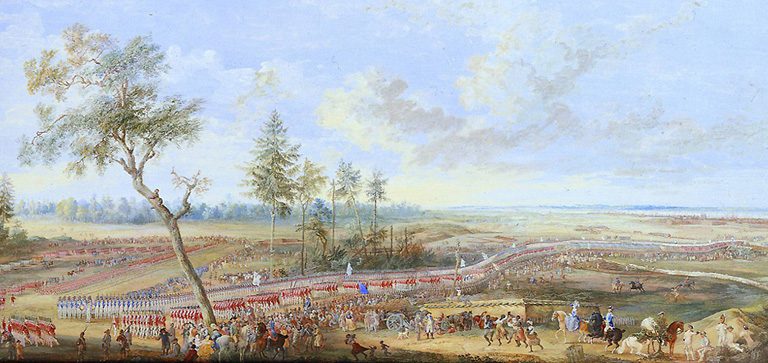
Image: The Surrender of Yorktown by Louis-Nicolas Van Blarenberghe.jpg, 1786, from Louis-Nicolas Van Blarenberghe. Retrieved from: https://commons.wikimedia.org/wiki/File:The_Surrender_of_Yorktown_by_Louis-Nicolas_Van_Blarenberghe.jpg, used under Wikimedia Commons.
