
1776: The Beginnings of American Exceptionalism Abroad
Leading The People to Liberty: Franco-American Military Relations in an Age of Revolution
Share On:
This chapter tells the tale of two revolutions—the American Revolution of 1775 and the French Revolution of 1789—and the impact they had upon each other, particularly in the military domain. As America’s oldest treaty ally, France played a crucial role in securing American independence from the British Crown by providing significant military aid throughout the Revolutionary War. French military officers imparted tactical wisdom to their American counterparts derived from prior combat experience, including against then-British colonists in the Seven Years’ War. In return, they gained valuable experience in expeditionary operations and irregular warfare, as well as lessons in effective leadership from the likes of George Washington.
Though the experienced French forces had a more palpable impact on their American counterparts, the joint Franco-American experience in the war shaped the development of both militaries. The French Revolution, sparked in part by the American gambit that ended six years prior, showcased changes to French doctrine and tactics that were both inspired by and further influenced the American way of war. Through exploring the Franco-American alliance over the course of the two Revolutions (1775-1799), this chapter seeks to answer three major questions. First, how did France’s involvement in the American Revolution influence the development of the nascent American military? Second, how did it influence subsequent reforms in the French Royal Army and French Revolutionary Army? Third, what factors precluded more enduring French influence over the development of the American military establishment in the aftermath of the American Revolution?
Franco-American Relations on the Road to Revolution, 1756-1775
The relationship between France and the American colonies in the late eighteenth century evolved from an adversarial association to a crucial alliance that ultimately helped achieve American independence. The Seven Years’ War (1754-1763), also known as the French and Indian War, pitted Great Britain and its American colonies against France and its Native American allies.[1] This conflict resulted in France’s loss of most of its North American territories.[2] Ironically, it was this defeat that paved the way for future Franco-American cooperation. Reeling from its loss, France saw an opportunity in the budding American Revolution to weaken its British rival and reclaim influence in the New World.[3] The war created the conditions for a geopolitical realignment: a split between colonial America and her motherland and an opportunity for a new benefactor.
As the spirit of revolution swept the colonies, the intellectual revolution of the Enlightenment provided fodder for a new character of Franco-American relations. Thomas Jefferson, Benjamin Franklin, and other influential Americans became enthralled by the work of late-Enlightenment French philosophers like Rousseau, Montesquieu, and Voltaire.[4] These philosophers promulgated concepts such as natural rights, the social contract, and the separation of powers that heavily shaped American republican ideals and, eventually, French revolutionary ideals.[5] Franklin became a conduit for this intellectual exchange through his unofficial role as American ambassador to France. Franklin also took a leading role in the Secret Committee of Correspondence, a mechanism the Continental Congress established in 1775 to garner European support for the Revolution.[6] The French were receptive to Franklin’s overtures, viewing him as the “personification of the New World Enlightenment.”[7] As a testament to Franklin’s esteemed status and the interconnectedness of the American and French Revolutions, the French Navy even commissioned a ship of the line called Le Franklin in 1797, which later fought at the Battle of the Nile and was captured by the British Royal Navy.[8]
This post-Seven Years’ War period of intellectual synergy, coupled with France’s strategic objective of usurping the British Empire, culminated in a formal Franco-American alliance in 1778, marking the beginning of French intervention in the American Revolution.[9] The alliance would come to represent a revolutionary bond between the American and French publics, who were joined by a shared desire to dispense with monarchy in favor of republics built on the principles of liberty and self-governance. This, of course, was not the French government’s intent in forging the alliance. While there was a degree of genuine ideological sympathy for the American cause among Enlightenment thinkers in France, the French monarchy acted mostly out of self-interest and a desire to weaken its main adversary. France’s primary goals were to offset North American territorial losses in the Seven Years’ War, undercut British imperial influence around the globe, and secure favorable commercial relationships with Britain’s former colonies.[10] Supporting American independence was mostly a means to these ends. Purity of motives aside, the advent of France as a formal treaty ally set the stage for a new era of Franco-American cooperation rather than conflict, ultimately proving instrumental to American independence.
The Decisive Impact of French Military Intervention
Through its initial clandestine support and later overt support, France offered the American revolutionaries vital financial aid, supplies, arms, and manpower.[11] Though the balance of forces would eventually skew in the Patriots’ favor, American military forces were severely outmanned and outgunned at the onset of the Revolution. Historians estimate that at the start of the war, the Continental Army consisted of a mere 5,000 regular soldiers augmented by state militia units.[12] By 1776, the Continental Army had grown to 46,891 soldiers.[13] Precise numbers of combatants engaged in the American Revolution are difficult to verify given inconsistent record-keeping and the number of men that re-enlisted over the course of the war and were likely double or even triple-counted. However, historical payroll records suggest at least 230,000 men served in the Continental Army and a further 145,000 in state militias over the course of the war.[14]
At the start of the war, only 8,000 British troops were stationed in North America—augmented by at least 25,000 Loyalists, 30,000 Hessian mercenaries, and sporadic support from Native Americans—but the British Army numbered approximately 49,000 in total.[15] After the French entry to the war in 1778, the British government mobilized additional personnel, growing the British Army to 50,000 stationed in North America and 110,000 soldiers in total (not counting militia or volunteers).[16]
At the onset of the American Revolution, King Louis XVI prohibited direct involvement of French soldiers or officers in the conflict.[17] Despite this edict, numerous French officers, driven by a mix of revolutionary idealism and hunger for glory, traveled to America and volunteered to serve under General Washington.[18] Though these early volunteers were too few to significantly alter the war’s outcome, their participation illustrated French enthusiasm for the American cause and presaged more substantial support.
The first significant influx of officially sanctioned French forces arrived in 1780 in the form of l’Expédition Particulière, commanded by Jean Baptiste Donatien de Vimeur, Comte de Rochambeau.[19] This force, initially numbering 6,000 troops and growing to 7,800 at its peak, supplied much-needed manpower and professionalism to the Patriots and remained on American soil until the Treaty of Paris officially ended the war in 1783.[20]
France’s naval contributions were even more important to the correlation of forces, as the fledgling Continental Navy only had an estimated 43 ships that officially served in its fleet—most of which were merchant vessels outfitted as war ships—and as little as 3,500 sailors over the course of the war.[21] Meanwhile, the Royal Navy was the largest in the world at the time, with 250 ships, nearly half of which were initially allocated to the American fight.[22] The French helped close this gap by bringing nearly 90 ships of the line; an estimated 22,000 French sailors participated in key naval engagements.[23]
Figure 1: Troop and Ship Contributions from 1775-1783 Based on Highest Estimates
| Troops | Ships Engaged in Maritime Battles | Population as of 1775 | |
| America | 375,000 | 43 | 2.5 million |
| France | 34,000 | 90 | 27 million |
| America and France | 409,000 | 133 | 29.5 million |
| Great Britain | 266,000 | 250 | 11 million |
Moreover, several French military leaders had a direct hand in American victories and became iconic figures during the revolution.[24] Among the early arrivals was one who would go on to have a distinct impact through his fervor for the American cause and his strong performance in later battles: the young and idealistic Marquis de Lafayette (Gilbert du Motier). Lafayette secretly sailed to America aboard La Victoire in 1777, leaving behind a life of comfort in France.[25] Lafayette later articulated his motivations in a letter to his wife, describing himself as a “defender of that liberty which I adore” and expressing his desire to serve a cause he believed would become a beacon of “virtue, of honesty, of tolerance, of equality, and of peaceful liberty.”[26] Lafayette became a close confidant of General Washington and a symbol of Franco-American friendship. He later named his son after Washington.[27] France’s most decisive role was in the Battle of the Chesapeake in September 1781, when the French fleet under the command of Admiral François Joseph Paul de Grasse prevented British reinforcements from reaching General Charles Cornwallis’s forces at Yorktown.[28] This move presented an opportunity for Rochambeau’s Expédition Particulière, which marched south from its Rhode Island encampment to support the Continental Army at the Siege of Yorktown in October 1781.[29] During these key battles, English-speaking French officers, including Major General François Jean de Beauvoir, Marquis de Chastellux, and Lafayette, liaised between the Continental Army and Rochambeau’s force.[30] The effective leadership of French officers—and their expertise in siege craft—enabled successful Franco-American combined operations, contributing to victory at Yorktown.[31]
Beyond direct military intervention, France provided “indispensable” material and financial aid without which “the Americans could not have defeated Cornwallis or won the war.”[32] Before 1778, France covertly supplied the Continental Army with weapons, ammunition, gunpowder, uniforms, and other essential supplies, often funneling them through intermediaries like the secret “Roderigue Hortalez and Company” to maintain deniability.[33] This covert support helped the Continental Army fend off better-equipped British forces in the crucial early years of the conflict. By way of example, up to 90 percent of the weapons that American soldiers employed at the pivotal Battle of Saratoga in September 1777 reportedly came from France.[34] One weapon in particular, the .69 caliber Charleville musket, became a staple of the Continental Army and remained in use by American troops almost until the Civil War.[35] The Charleville gave an advantage to American soldiers as it was more accurate and lighter than the British “Brown Bess” musket.[36] To enable the delivery of material support while skirting British naval control, France routed supplies through the neutral Dutch Caribbean island of St. Eustatius.[37] By 1777, France had contributed more than five million livres in supplies to the American rebels.[38]
On top of weapons and supplies for the Americans, France also provided substantial financial assistance in the form of loans, credit, and subsidies.[39] This aid was essential for purchasing supplies and paying soldiers as the rebel forces had few alternative sources of money. The sustained provision of supplies and funds from France allowed the Continental Army to weather the protracted conflict in a manner that simply would not have been possible without this aid. Ironically, France’s financial support for the American war effort nearly bankrupted the country, which played a major role in the formation of the Estates-General in 1789 and the subsequent outbreak of revolution.[40]
The contributions of the French army and navy—both in sheer numbers as well as strategic acumen—turned the tide of the American war effort and provided the critical edge needed to defeat the British.[41] While the Patriots were able to draw on militias to bolster their regular forces and gain a numerical advantage over the British—with some historians placing the ratio of militia members to regular soldiers at 2:1—they were largely untrained.[42] The conglomeration of militias faced significant hurdles in transforming from a collection of citizen-soldiers sorely lacking in combat experience, formal training, and resources into a professional military force capable of sustained operations against one of Europe’s premier armies.[43] French support, in all its forms, was pivotal in this transformation, resulting in significant French influence over the development of the fledgling American military.
Forging a Professional Military
France’s involvement in the American Revolution helped to shape the developing American military establishment. Even as the Founding Fathers sought to forge a new America distinct from its British origins, American military leaders sought to fashion their new force in the image of old European powers, seeking guidance from their French counterparts. As one historian observed, “In the purely military sphere, it would seem that the Americans admired the organization, the discipline, and the tactics of the French army.” [44] As a result, French influence permeated the Continental Army in the areas of military doctrine and strategy, the development of infrastructure and engineering practices, and training and professional military education.
Doctrine and Strategy
American officers avidly consumed French military theory, understanding its importance for professionalizing their forces. Washington kept an expansive collection of French military literature and strongly encouraged, or in some cases required, his soldiers to study these works. Maurice de Saxe’s promotion of maneuver warfare and combined arms—the coordinated employment of infantry, cavalry, and artillery—was especially influential.[45] A 1776 letter from Washington’s chief artillery officer, Henry Knox, to John Adams demonstrates American troops’ high regard for Saxe, stating, “There are a variety of Books translated into English which would be of great Service but none more so than the great Marechal Saxe ‘who stalks a God in war.’ Tis he who has done more towards reducing war to fix’d principles than perhaps any other man of the age.”[46] Knox reportedly recommended Saxe’s work to Nathanael Greene, the commander of the Continental Army in the southern theater during the later stages of the war, who also became a student of Saxe’s work.[47] Although the Continental Army initially lacked the resources to execute combined arms operations, American forces witnessed its merits firsthand. During the Yorktown campaign, for instance, American officers learned the importance of deploying artillery to support infantry attacks and saw how coordinating land and naval forces could produce desired outcomes.
The concepts put forth by Jacques Antoine Hippolyte, Comte de Guibert, regarding integrated divisional structures and tactical agility also influenced Continental Army officers.[48] Chastellux—a French officer who had served as third in command of the French forces at Yorktown and as a liaison between Rochambeau and Washington given his fluency in English—later recalled a dinner with Washington and other American officers that revealed Washington’s inspirations. “War was frequently the subject: on asking the General [Washington] which of our professional books he read with the most pleasure, he answered me that they were the King of Prussia’s Instruction to his Generals, and the Tactics of M. de Guibert; from which I concluded that he knew as well how to select his authors as to profit by them.”[49]
French principles of fortification and siege craft, honed through centuries of fighting in Europe, also influenced the American approach to conducting sieges and the design of American defenses. Sébastien Le Prestre de Vauban’s expertise in siege warfare and fortification was instrumental in securing a Franco-American victory at Yorktown, as his work provided the blueprint for the offensive works (sets of parallel trenches) that enabled the critical assaults during the siege.[50]
American officers studied the artillery reforms of Jean-Baptiste de Gribeauval, including standardized calibers, lighter carriages, and improved aiming mechanisms. Gribeauval himself purportedly advised Washington in his selection of a French artillery expert, Philippe Tronson de Coudray, in 1776.[51] The Americans also adopted certain French naval tactics. For example, the Americans emulated the French practice of firing into the rigging of enemy ships to disable their maneuverability rather than the British focus on firing into the hull.[52]
Under the instruction of French officers and their preferred military theorists—and by observing French operations firsthand—American officers learned how to plan and coordinate assaults, construct and breach fortifications, maneuver in a more agile manner, and deploy artillery in siege operations.
Infrastructure and Engineering
As America built the military infrastructure necessary to secure its independence, it benefited greatly from French expertise in naval construction and military engineering, as well as French technology transfers. The Continental Navy, established in 1775, faced the daunting task of keeping the mighty Royal Navy at bay with scant funding and limited shipbuilding skill. France, a large maritime power with a long history of building advanced vessels, offered valuable assistance. American shipbuilders sought to emulate French designs and construction methods for the frigates that formed the backbone of the early American Navy. French advances in hull design, sail plans, naval ordnance, and materials all helped to build faster, more maneuverable, and more survivable American warships.[53]
Americans also sought to build fortifications to protect coastal cities and other strategic locations. French military engineers helped address this need through their expertise in the design and construction of defensive works derived from Vauban and other French experts on siege warfare. These engineers applied their skills to several important projects along the eastern seaboard, including the planning and building of forts, batteries, and other defensive structures.[54]
French engineer Louis Lebègue Duportail, major general and chief of engineers of the Continental Army, was instrumental—along with his staff—in planning and supervising the construction of fortifications, including the strategically important West Point on the Hudson River.[55] These fortifications included defensive elements like outworks, fortified walls, and carefully positioned artillery batteries. Jean Baptiste Joseph, Chevalier de Laumoy, also helped the American war effort by counseling General Benjamin Lincoln during the Siege of Charleston in 1780 and offering insight on European fortification methods.[56] Additionally, François-Louis Teissèdre de Fleury supported the American cause by creating a training manual for the Continental Army and by designing fortifications for important locations along the Delaware River, such as Fort Mifflin.[57] Most of these French-inspired fortifications endured well beyond the war.
Professional Military Education
At the outset of the Revolution, the Continental Army’s officers were mostly inexperienced recruits drawn from local militias. France provided a model for the development of a professionalized American officer corps. Prior to the Revolution, there was no formal system for American military education. The Continental Army’s experience in the war exposed the need for a dedicated institution to train officers in the art and science of warfare. France’s many military academies and long history of formal military instruction provided a blueprint. Officers who were educated at French institutions prior to serving in the Continental Army advocated for the establishment of an American military academy in the style of the École Royale Militaire in Paris or École Royale du Génie at Mézières.[58] These French military academies were renowned for their rigorous curricula, emphasis on mathematics and engineering, and production of highly competent officers.
The establishment of West Point in 1802 was a milestone in the development and professionalization of the American officer corps. Modeled after French military academies, West Point would serve as a conduit for French influence over the character and competence of the army in the nineteenth century and beyond. The emphasis on mathematics, engineering, and military science, as well as the academy’s hierarchical organization and regimented environment, were consistent with the standards of French military schools. French officers were among the academy’s first instructors, and some classes even used French textbooks. Jonathan Williams, the first superintendent of West Point, was also a major proponent of the French approach to engineering education.[59]
Stephen (Étienne) Rochefontaine, a French officer who fought in the American Revolution, is a prime example of direct French influence on the development of West Point. [60] Rochefontaine commissioned as a captain in the Continental Army in 1778 before eventually rising to the rank of major. During his time in the Continental Army, Rochefontaine participated in significant battles such as the Siege of Yorktown in a variety of engineering positions. In 1795, he was stationed at West Point—not yet a military academy—where he commanded the first Corps of Artillerists and Engineers of the United States and established a school for these officers that served as a precursor to the academy.While at West Point, Rochefontaine also leveraged his engineering background to improve its fortifications. Rochefontaine lobbied for the establishment of a formal military academy in America, including in letters to Alexander Hamilton.[61] Though he was eventually ousted from his position in 1798 amid the political turmoil of the Quasi-War with France, Rochefontaine’s efforts helped make West Point the leading military academy it is today.
Despite France’s early influence, the dissolution of the Continental Army shortly after the Treaty of Paris curtailed the potential for deeper French sway on the developing American military. Around the same time, the brewing revolution in France reflected lessons learned from the French experience fighting in then-colonial America.
French Lessons Learned from the American Revolution
France’s participation in the American Revolution was not a one-way street. The American Revolution influenced both the French military and society, contributing to military reforms and serving as a source of ideological inspiration for the French Revolution. However, it is important to note up front that there is limited historical evidence supporting a direct link between French participation in the American Revolution and subsequent military reforms. In fact, one of the most prominent historians of the French military during this timeframe, Samuel F. Scott, has refuted the idea that the French experience in America led to meaningful military reforms or ideological change in France. In his examination of the soldiers who served under Rochambeau during the American Revolution, Scott found that “the military impact of the American Revolution in France was, like its financial and ideological influence, very limited.” [62] He instead argues that “the developments taking place [in France]—such as the idealization of the citizen-soldier, the growing emphasis on officer professionalism, and the expansion of the role of light troops—were part of a general intellectual ferment that found a sympathetic response in certain military circles and had clear native roots.”[63] Historian Lee Kennett is even more dismissive, writing in 1977 that “The military influence worked in only one direction. If the French army found anything in America worth adopting, it has escaped all researchers to date. . . . On the whole, the American military system did not make a very favorable impression.”[64]
The French experience in the American Revolution does not seem to have directly caused substantial reforms in the French military. Prussian and Austrian military practices observed during several battles of the Seven Years’ War—rather than those of the Continental Army—likely had a more direct influence on French developments to force structure and employment that continued in the wake of the American Revolution. Moreover, the American Revolution prompted only modest military reforms in France compared to the seismic changes in warfare inspired by the Battle of Valmy that transpired nearly a decade after the American Revolution came to an end.[65] However, France’s involvement in America did play an important role in reinforcing trends that were already unfolding in French military thinking—including those prompted by the French experience fighting on American soil during the Seven Years’ War.[66]
And, despite Scott’s skepticism about the ideological ramifications of the war, the American Revolution undoubtedly had a significant effect on the thinking of individual French officers like Lafayette, as we will explore below. As the French were ingesting the lessons from their combat experience in America, the revolutionary spirit on display in America was fanning the flames of discontent among the French public. The subsequent French Revolution reflected the lessons the French military drew from its participation in the American war.
Affirmation of the Value of a Citizen-Army
The American Revolution showcased the power of a dedicated citizen-army fighting for a cause in which it believed. French military observers came away with profound impressions of how citizen-soldiers could be mobilized and motivated. However, the French and American concepts of a citizen-army diverged significantly in both structure and application, revealing fissures between the two revolutionary movements despite their shared rhetoric of liberty and popular sovereignty.
The American militia model, rooted in its colonial experience and local governance, emphasized decentralized, community-based defense. Stories of American militiamen taking up arms circulated in French military circles and among the public. These narratives validated and accelerated the implementation of the citizen-army concept, which was already gaining traction in France. According to one examination of French perceptions of the American Revolution:
Because the French army found itself in a state of reform and contemplating the possibilities of a citizen army during the American Revolution, accounts of hardy militiamen and simple citizen soldiers resonated strongly with French readers and military reformers. Writing and reading about the American Revolution substantiated and advanced the citizen-army ideas already in place, which in turn moved the French army closer to its revolutionary role.[67]
Indeed, scholars like Osman found that contemporary French narratives regarding the American Revolution framed the American approach as vindicating French military Enlightenment ideals and Guibert’s notions of the citizen-army:
Towards the end of 1777, the American image became associated with the ancients that French writers encouraged their own people to emulate. . . . The major battles of the American Revolution did conform more closely to European style fighting, yet the gazettes reported more frequently on Washington’s unconventional strategy of attrition and guerilla warfare, which they presented as largely successful. ‘The Provincial [army] continually harass [British] troops on their march with sudden attacks . . . unanticipated in the woods, the gorges, which America is full of, and against which this army cannot present an extended front.’ Again, as though keeping with Guibert’s description of citizen armies, the American military practiced a more ‘natural’ style of warfare. . . . In short, as portrayed by the gazettes, the American war matched Guibert’s definition of a citizen-army in nearly every aspect: the citizens were invested in the outcome of the war, fought for a just government, were united in a common cause, and motivated by patriotism.[68]
This confirmation bias would have significant implications for French military reforms in the coming years.
Chastellux also wrote of the mass scale of citizen-soldiers in the American Revolution, noting:
I shall observe once for all, that among the men I have met with, above twenty years of age, of whatsoever condition, I have not found two who have not borne arms, heard the whistling of balls, and even received some wounds; so that it may be asserted, that North America is entirely military, and inured to war, and that new levies may continually be made without making new soldiers.[69]
Such observations influenced French thinking about mass mobilization, but French implementation took a different form. While the American system relied on voluntary local organization and episodic activation, the French revolutionary government later adopted the concept of levée en masse, or mass conscription of citizens to defend the country. Here, again, Chastellux sheds light on the French interpretation of the American way of war when he describes the organization of the American military after the Revolution: “the land forces will consist only in the militia, which, as it is composed of the people themselves, can never act against the people.” [70] While not entirely accurate, the account is a window into how French observations of American developments may have influenced their own evolution.
The development of the Garde Nationale in July 1789 following the storming of the Bastille is another major development seemingly inspired by the French experience in the American Revolution. The Garde Nationale was not directly modeled on American citizen-soldier forces such as the Minutemen militia, despite their similarities. The American Minutemen were local militia members designed to mobilize rapidly. The Garde Nationale, on the other hand, was created as a national militia to maintain order and protect revolutionary aims within France. Both organizations seem to have arisen in response to the operational requirements for rapid, locally organized defense amid a revolution. Nonetheless, the similarities are striking, and the commanding general of the first Garde Nationale unit in Paris was none other than Lafayette.[71] This connection is particularly noteworthy given the paradoxical French attitudes toward American militias. Writing in the foreword to Kennett Lee’s work, historian Jacques Godechot explains:
[French] officers, excepting a few like Lafayette, tended to hold the American militia in low regard. While journals published in France exalted the courage and the patriotism of the citizen-soldiers . . . the officers in Rochambeau’s corps held the militiamen to be undisciplined and incapable of carrying out a bayonet charge. They did not understand that a militiaman might be a soldier and still have a civilian craft. They noted that when Rochambeau, with Washington’s authorization, called on the Massachusetts militia to repulse a possible British landing on Rhode Island, only 2,000 of the 5,000 men summoned answered the call. They were struck by the slowness with which the militia assembled. Fersen, a friend (and perhaps the lover) of Queen Marie Antoinette, wrote to his father that they ‘only assemble when the danger is imminent, and run off when it becomes very great.’ French officers never used the word soldier when they spoke of the militiamen, considering them only as auxiliaries. . . . And yet, despite this, the American militia made a great impression in France. When, some years later in 1789, the French took up arms in a struggle against the Old Regime, they followed the American model and at first called their formations milices. It was only at the end of July 1789 that they substituted the name Gardes Nationales. The Gardes Nationales, like the American militia, elected their own officers, and it is noteworthy that on July 15, 1789, the bourgeois militia of Paris elected as their commander ‘The Hero of Two Worlds’ – Lafayette.[72]
Even Scott, with his deep skepticism of any American influence on the French military, concedes that the “image of the indomitable militiaman remained intact among certain circles in Europe” after the war and had a “limited effect on the establishment of the National Guard in France at the beginning of the French Revolution.”[73] Interestingly, the American National Guard later took its name from the French Garde Nationale in honor of Lafayette, illustrating some influence in the opposite direction.[74]
Lessons in Leadership
One of the less tangible but perhaps most significant ways in which the American Revolution influenced French military thinking was in the realm of leadership. General Washington made a particularly strong impression on the French soldiers who fought alongside him, as he demonstrated a style of leadership rooted in integrity, resilience, and personal example. The French observed that, rather than leading from the rear like some European generals, Washington shared hardships with his troops. French accounts of the war—including personal correspondence from French officers—are replete with admiring mentions of Washington’s strong character, moral leadership, and dual status as both a dedicated commander and citizen. For instance, the Marquis de Lafayette wrote in a 1778 letter to Baron von Steuben:
Permit me to express my satisfaction at your having seen General Washington. No enemies to that great man can be found except among the enemies to his country; nor is it possible for any man of a noble spirit to refrain from loving the excellent qualities of his heart. I think I know him as well as any person, and such is the idea which I have formed of him; his honesty, his frankness, his sensibility, his virtue, to the full extent in which this word can be understood, are above all praise. It is not for me to judge of his military talents; but, according to my imperfect knowledge of these matters, his advice in council has always appeared to me the best, although his modesty prevents him sometimes from sustaining it; and his predictions have generally been fulfilled.[75]
Though Washington’s bond with Lafayette is famous, there are numerous examples of less personally invested French soldiers who also expressed high regard for the general. One such example is Irish nobleman turned French officer Arthur Dillon, who wrote of immediately recognizing Washington by his demeanor the first time he encountered him.[76] Another French volunteer who served in the American Revolution as Lafayette’s aide-de-camp wrote that “Washington was intended by nature for a great position—his appearance alone gave confidence to the timid, and imposed respect on the bold.”[77] Shortly after the war, Chastellux wrote that “the continent of North-America, from Boston to Charleston, is a great volume, every page of which presents [Washington’s] eulogium.”[78] His other descriptions of Washington are similarly effusive:
It is not my intention to exaggerate, I wish only to express the impression General Washington has left on my mind; the idea of a perfect whole, that cannot be the produce of enthusiasm, which rather would reject it, since the effect of proportion is to diminish the idea of greatness. Brave without temerity, laborious without ambition, generous without prodigality, noble without pride, virtuous without severity …This is the seventh year that he has commanded the army, and that he has obeyed the Congress; more need not be said, especially in America, where they know how to appreciate all the merit contained in this simple fact. [79]
Beyond Washington, French officers serving in America observed the effects of strong American leadership on morale, national unity and identity, and legitimacy in pursuing a just cause.[80] Chastellux writes favorably of American officers’ discipline and competence, observing that “the general officers of the American army have a very military and a very becoming carriage; that even all the officers, whose characters were brought into public view, unite much politeness to a great deal of capacity; that the head-quarters of this army, in short, neither present the image of want, nor inexperience.”[81]
Furthermore, the American victory against a much more capable adversary demonstrated the importance of morale and small unit cohesion. The French noted how a strong motivating cause—the pursuit of liberty—combined with close (and sometimes informal, by French standards) ties between subordinates and their superiors contributed to the Continental Army’s resilience and effectiveness.[82] French officers like Lafayette walked away from the conflict understanding the importance of maintaining esprit de corps and prioritizing troop welfare and morale. These officers would carry these impressions of leadership and rank-and-file dynamics to their own revolution.
Doctrinal, Operational, and Tactical Lessons
Based on lessons derived from its experience in the Seven Years’ War, the French army began implementing a series of reforms prior to its engagement in the American Revolution. These reforms included prioritizing light infantry formations, chasseurs (scouts), and voltigeurs (skirmishers) for mobility.[83] As American militias successfully employed irregular combat techniques in a theater characterized by its extensive forests and dispersed population, the French army again observed the benefits of light infantry groups that could fight independently and employ skirmishing tactics; indeed, Chastellux writes about observing the American use of light infantry as a parallel to the French chasseurs.[84]
Exposure to a new style of warfare, conducted largely by a citizen-army on a vast and difficult terrain, compelled the French military to review its doctrine and practices at the conclusion of the revolutionary war. The 1791 Règlement codified changes to French army tactics informed by the French experience in the American Revolution, which provided a practical testing ground for earlier military theories; for instance, the Règlement called for the French army to shift from the rigid linear formations of the ordre mince (thin order) toward the development of the more flexible ordre mixte (mixed order), which blended the shock tactics of the ordre profonde’s (deep order) columns with the flexible skirmishing capabilities and dispersed formations the French observed in the expansive American theater.[85] Such formations would be successfully employed in the ensuing French Revolutionary and Napoleonic wars.
While Godechot remarks that “tactically, Rochambeau’s army could hardly find inspiration in the methods of a militia it disdained,” he also highlights the influence that his and the broader French experience in America likely had in this one regard:
In 1778, two years before he sailed for America, Rochambeau had participated in the military experiments at the camp at Vaussieux, in northern France. At the time the French army was quite divided on the matter of tactics. Some favored the ordre mince preached by Guibert, others the ordre profonde extolled by De Mesnil Durand. The experiments at Vaussieux did not entirely prove the superiority of either doctrine, but they did lead to the preparation of a new règlement de manoeuvre, not published until 1788, which attempted a synthesis of the two concepts. This règlement gave an important place to lines of skirmishers. To be sure, Guibert and another officer, Bourcet, had prescribed these, but the formation en tirailleurs was the one the American militia adopted spontaneously because the men who composed it were accustomed to hunting and Indian fighting. It is quite possible that in the use of skirmishers, the American fighting methods influenced the authors of the règlement de manoevere of 1788 and the regulation which replaced it in 1791.[86]
The American campaign also provided valuable experience for future French expeditionary operations requiring extended logistics. As Kennett observes, during the French Revolution, the French minister of war organized expeditionary forces to operate overseas using Rochambeau’s Expédition particulière as a model. Additionally, during the Napoleonic Wars, “The problems of maintaining far from France a sizable expeditionary force [led by Napoleon Bonaparte] . . . could be more easily resolved in Egypt thanks to the American precedent.”[87]
The Ideological Spoils of French Intervention
Though the French military learned valuable lessons from its participation in the American Revolution, it also resulted in undesirable developments for French adherents to the ancien régime. While domestic political and economic issues were the main drivers of the French Revolution, the American Revolution acted both as a model and a catalyst for the French Revolution. For France’s discontents, the American Revolution offered a tantalizing example of how rebellion could succeed in rehauling society. The American formation of a republic based on liberty, popular sovereignty, and natural rights made palpable previously theoretical Enlightenment principles. Similarly, the Declaration of Independence influenced the French Declaration of the Rights of Man and of the Citizen and the U.S. Constitution served as a model for French reformers who sought to replace absolute monarchy with a constitutional system. As Alexis de Tocqueville observed in 1856, the American Revolution “did in fact exert a great influence on the French Revolution, but the Revolution in France owed less to what was done in the United States than to what people at the time thought in France. Whereas in the rest of Europe the American Revolution was still merely a novel and singular occurrence, in France it only made what people thought that they already know more palpable and striking. Elsewhere it astonished; here it persuaded. The writers seemed only to have carried out what our writers had envisioned. They gave the substance of reality to what we were already dreaming.”[88]
Direct French engagement in the American Revolution had a sizable impact on events in France. On the eve of the French Revolution in 1789, roughly 8,000 French army veterans of the American Revolution had returned home.[89] Many of these veterans went on to participate in the French Revolution. Some French officers like Lafayette returned to France filled with revolutionary fervor and a desire to bring home the American model of a republic, though it is worth noting that “most of the nobility who served in the American Revolution were [likely] rather radical before they began, since they were able to choose their spheres of service.”[90] The overwhelming majority of French enlisted soldiers in the American Revolution were peasants who were far less likely to have joined the war effort for ideological reasons. Several studies of these men have sought to establish a connection between their service in America and the root of the revolution in France. A 1951 study by Forrest McDonald, for instance, traces the veterans’ origins and subsequent revolutionary activity, concluding that the French peasant soldiers who observed the concept of private property while serving in America heavily contributed to the revolutionary movement that guaranteed the destruction of economic feudalism in France.[91] McDonald acknowledges that “One would not be at all cynical in rejecting the notion that abstract ideas of liberty, equality, and a written constitution would appeal to the imagination of an illiterate farmer. Under the pressure of propaganda, possibly, but never through mere observation.” [92] He instead argues that since French soldiers had ample exposure to rich, expansive farmlands owned by their American counterparts, “French peasants saw the institution of absolutely free and unfettered private property at its glorious best. This was something that would truly stir a peasant’s soul.”[93] This exposure to the American version of liberty coupled with the hero’s greeting most of these soldiers received when returning to their communities led McDonald to conclude: “That these men could return to France without bubbling enthusiasm and new ideas is as inconceivable as if a twentieth-century American were to go to the moon and return without comment. To the churches, market places, meeting houses—any place where peasants could get together—these men would go, relating tales of their adventures, passing on stories, and especially, passing to their oppressed fellows the germ with which they had been infected—the lust for free private property. Here, indeed, was a revolution in the making.”[94]
Decades later, researchers Sebastian Ottinger and Lukas Rosenberger further interrogated the connection between the two revolutions and found that the French regions (or departments) that housed the most returning veterans from the American Revolution demonstrated the strongest support for the French Revolution.[95] These regions fielded the most volunteers for the revolutionary army and experienced more anti-feudal revolts and higher rates of emigration of ancien régime elites. The study attributes these findings to the French veterans’ exposure to American political and social institutions during the American Revolution, given that French troops that did not deploy to the American theater did not evince similar levels of revolutionary support. Moreover, the study found that—besides a few volunteers like Lafayette—there was no self-selection of revolutionary sympathizers into the American campaign, as soldiers were assigned to regiments before they knew where they would be deployed. [96] A quantitative analysis by political scientists Saumitra Jha and Steven Wilkinson found similar results, though both studies face quantitative challenges. Their research provides evidence for what they term “revolutionary contagion,” by comparing political mobilization during the French Revolution among French regiments that served with Rochambeau in America versus those assigned but unable to arrive due to logistical failures and British blockades. Jha and Wilkinson found that “bailliages with 10% more Rochambeau veterans were 6.4% more likely to submit grievances to the King that were ‘Most Strongly Democratic’ in 1789.” [97] Their statistical analysis demonstrates that these veteran-heavy regions mobilized political clubs earlier and showed significantly higher levels of democratic sentiment. While fully litigating the debate between these studies’ results and Scott’s argument that there was little to no ideological throughput from the American to French Revolution among Rochambeau’s men is beyond the scope of this paper, the examples presented in this paper aim to illustrate the interconnectedness of the two revolutions.
Not all French soldiers who served in the American Revolution approved of the revolutionary ideas their compatriots had imported back to France. Some even fought with the Prussians against the French revolutionaries upon the conclusion of their service in America. One such soldier, the Chevalier de Pontgibaud, provides further insight into the impact of French participation in the war. Writing about the officers of Rochambeau’s Expedition who remained in America following the decisive Franco-American victory at Yorktown, the Chevalier laments:
When we think of the false ideas of government and philanthropy which these youths acquired in America, and propagated in France with so much enthusiasm and such deplorable success—for this mania of imitation powerfully aided the Revolution—though it was not the sole cause of it—we are bound to confess that it would have been better, both for themselves and us, if these young philosophers in red-heeled shoes had stayed at the Court.[98]
The Chevalier appears to be in the minority in his sentiments about the American and French Revolutions. The findings from the studies described above, coupled with the glowing accounts several French officers penned about their American counterparts, suggests that the French experience in America strongly shaped the perceptions and beliefs of French troops at the individual level, in turn contributing to the outbreak of the French Revolution. In short, the Franco-American alliance during the American Revolution facilitated a two-way exchange, with results neither party anticipated at the outset.
The Trajectory of French Military Influence
French influence on the development of the American military extended beyond the American Revolution. French influence was pervasive in American military doctrine and strategy, infrastructure and engineering practices, and training and education programs. Over the course of the war and beyond, the green American military learned a great deal from its much more experienced French counterpart.
Interestingly, the exchange of knowledge went both ways. Despite the asymmetry in capabilities between the centuries-old, well-established French military and the embryonic American forces, French troops fighting in America absorbed valuable lessons from their American allies. French takeaways included principles for effective leadership, tactical developments, particularly in irregular warfare, and models for conscription of a citizen-army. Moreover, the French experience fighting for American independence helped fan the flames of revolution in France itself.
However, France’s enduring influence on the American military establishment was limited by several factors. The vestigial size of the American military after 1783, conflicting geopolitical interests with revolutionary France, and the sidelining of early revolutionary leaders with personal American connections like Lafayette ultimately diminished France’s influence on the U.S. military.
The dissolution of the Continental Army shortly after the Treaty of Paris curtailed the potential for deeper French influence. The new republic maintained only a minimal military establishment due to financial constraints and wariness of standing armies. This dramatic reduction in military personnel meant that many of the American officers who had worked closely with French counterparts during the Revolution were no longer in service to perpetuate French military practices and thinking. Moreover, the material inferiority of the American navy during the American Revolution circumscribed French influence in the maritime domain. French losses in major naval battles in the aftermath of the Revolution further prevented French naval strategy from taking root. As one historian quipped, “Whatever laurels [the French navy] won at the Battle of the Virginia Capes did not survive the Battle of the Saints or Trafalgar.”[99]
On the French side, the sidelining of revolutionary leaders with personal American connections also contributed to the decline in French influence over the American military establishment. Lafayette, who served as a crucial bridge between French and American military thinking, found himself marginalized and eventually imprisoned during the radical phase of the French Revolution. His fall from grace mirrored the broader deterioration in Franco-American military cooperation.
Despite the strength of Franco-American interpersonal bonds forged during the American Revolution, the alliance was ultimately based on a temporary alignment of interests more than an enduring friendship. The countries’ divergent goals resurfaced once the American Revolution ended, leading to a sharp decline in Franco-American relations. While both nations espoused revolutionary ideals, they soon discovered they had very different visions of liberty. [100] America’s commitment to neutrality and France’s increasingly radical domestic upheaval led to tension, mistrust, and, eventually, a “Quasi-War” between 1798 and 1800. [101] Washington’s 1793 Neutrality Proclamation, the Jay Treaty of 1794, and the XYZ Affair of 1796 all contributed to this deterioration.[102] The conflict finally ended through the Convention of 1800, which effectively nullified the Franco-American alliance.[103]
However, French influence persisted in select areas where institutions and individual champions preserved connections. Perhaps the most apparent example is the U.S. Military Academy at West Point, which served as a conduit for French influence over the character and competence of the Army well into the nineteenth century and beyond. French principles of fortification and siege craft also endured in American military practice. In the wake of the Vauban-inspired sieges that brought the Patriots victory during the war, American officers continued to apply French methods for planning and coordinating assaults, constructing and breaching fortifications, and deploying artillery in siege operations.
The Franco-American relationship during the period of the two revolutions offers an interesting historical arc. What began as America’s oldest and most crucial alliance transformed into an adversarial relationship marked by distrust and even armed conflict, serving as a stark reminder of how shifts in political ideology and national interests can strain or shape alliances. While France’s military influence over the American defense establishment has waned, French support fundamentally shaped the trajectory of American independence, providing an enduring, if sometimes forgotten, legacy.
Ashley Rhoades is a Defense Analyst who has led and worked on numerous studies for various Department of Defense sponsors, including the U.S. Army and the Office of the Under Secretary of Defense for Policy. Her main areas of expertise are strategic competition, security cooperation, deterrence, force posture, and counterterrorism. Geographically, she focuses on security issues within the European and Middle Eastern theaters. She holds an M.A. in Security Studies from the School of Foreign Service at Georgetown University and a B.A. with honors in Political Science from Stanford University. She is also an alumna of the Alexander Hamilton Society’s Security and Strategy Seminar on Russia, Iran, and U.S. defense policy.
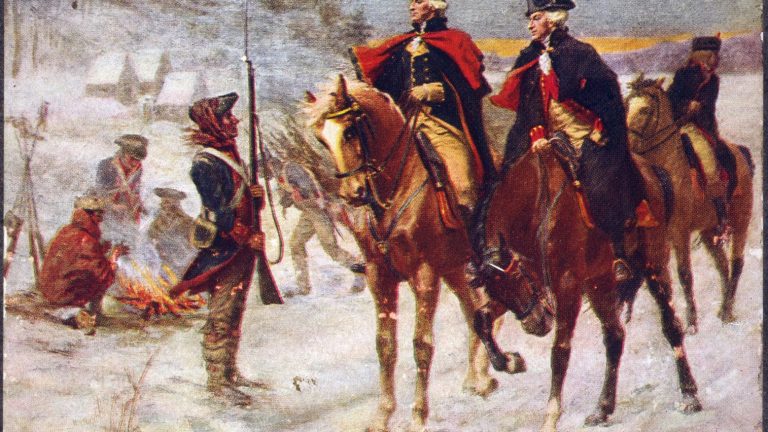
Image: Washington and Lafayette at Valley Forge.jpg, 1907, from John Ward Dunsmore and https://www.loc.gov/pictures/item/91792202/. Retrieved from: https://commons.wikimedia.org/wiki/File:Washington_and_Lafayette_at_Valley_Forge.jpg, used under Wikimedia Commons.

[1] U.S. Department of State Office of the Historian, “French and Indian War/Seven Years’ War, 1754–63,” https://history.state.gov/milestones/1750-1775/french-indian-war.
[2]Fred Anderson, Crucible of War: The Seven Years’ War and the Fate of Empire in British North America, 1754-1763 (New York: Random House, Inc., 2000), 505.
[3] Anderson, Crucible of War, 27.
[4] Bernard Bailyn, The Ideological Origins of the American Revolution (Cambridge, MA: Belknap Press of Harvard University Press, 1967), 29.
[5] Bailyn, Ideological Origins, xi.
[6] U.S. Department of State Office of the Historian, “French Alliance, French Assistance, and European Diplomacy during the American Revolution, 1778–1782,” https://history.state.gov/milestones/1776-1783/french-alliance.
[7] U.S. Department of State Office of the Historian, “Benjamin Franklin: First American Diplomat, 1776–1785,” https://history.state.gov/milestones/1776-1783/b-franklin.
[8] Stephen Millar, “The Battle of the Nile,” Napoleon Series, https://www.napoleon-series.org/military-info/battles/Egypt/Nile/c_nile.html
[9] Ronald Hoffman and Peter J. Albert, Diplomacy and Revolution: The Franco-American Alliance of 1778 (Charlottesville: United States Capitol Historical Society by the University Press of Virginia), vii.
[10] Ronald Hoffman and Peter J. Albert, eds., Diplomacy and Revolution: The Franco-American Alliance of 1778 (Charlottesville: University Press of Virginia, 1981), 12.
[11] U.S. Department of State Office of the Historian, “French Alliance, French Assistance, and European Diplomacy during the American Revolution, 1778–1782.”
[12] Frances H. Kennedy, The American Revolution: A Historical Guidebook (New York: Oxford University Press, 2014), 281.
[13] Theodore Savas and J. David Dameron, A Guide to the Battles of the American Revolution (2006), xliv.
[14] Francis B. Heitman, Historical Register of Officers of the Continental Army during the War of the Revolution, April 1775 to December 1783 (Washington, DC: Rare Book Shop Pub. Co., 1914), 691.
[15] Travis Shaw, “The British Army in the American Revolution,” American Battlefield Trust, https://www.battlefields.org/learn/articles/british-army-american-revolution; Savas and Dameron, Guide to the Battles, xli.
[16] Chris McNab, ed., The Improbable Victory: The Campaigns, Battles and Soldiers of the American Revolution, 1775-83 (Oxford: Osprey Publishing, 2017), 161; Kennedy, American Revolution, 281.
[17] “Marquis de Lafayette,” American Battlefield Trust, https://www.battlefields.org/learn/biographies/marquis-de-lafayette.
[18] Tom Shachtman, How the French Saved America: Soldiers, Sailors, Diplomats, Language, and the Birth of a Nation (New York: St. Martin’s Press, 2017), 55.
[19] Lee B. Kennett, The French Forces in America, 1780-1783 (Westport, CT: Greenwood Press, 1977), 10.
[20] Kennett, Lee B., The French Forces in America, 1780-1783, Westport, Conn: Greenwood Press, 1977, p. 162 and “Treaty of Paris (1783),” National Archives, https://www.archives.gov/milestone-documents/treaty-of-paris.
[21] Savas and Dameron, Guide to the Battles, xxx-xxxiv; “Magnitudes of Naval Power in the American Revolution,” The American Revolution Institute, undated, https://www.americanrevolutioninstitute.org/magnitudes-of-naval-power-in-the-american-revolution/.
[22] Kennedy, American Revolution, 281; “Magnitudes of Naval Power in the American Revolution,” The American Revolution Institute, undated, https://www.americanrevolutioninstitute.org/magnitudes-of-naval-power-in-the-american-revolution/.
[23] “How Did the French Alliance Help Win American Independence?,” Jamestown-Yorktown Foundation.
[24] Gonzague Saint Bris, Lafayette: Hero of the American Revolution (New York: Pegasus Books, 2010), 138.
[25] Julia Osman, “Citizen Warriors: French Perceptions of the American Military, 1775-1783” (master’s thesis, University of North Carolina, 2006), 5, https://cdr.lib.unc.edu/downloads/st74cq64h?locale=en.
[26] “Marquis de Lafayette to Madame Lafayette, May 30, 1777,” in The Marquis de La Fayette in the American Revolution, ed. and trans. Charlemagne Tower Jr. (Freeport, NY: Books for Libraries Press, 1971), 58.
[27] “Georges Washington de Lafayette,” The George Washington Presidential Library at Mount Vernon, https://www.mountvernon.org/library/digitalhistory/digital-encyclopedia/article/georges-washington-de-lafayette.
[28] Samuel F. Scott, From Yorktown to Valmy (Niwot: University Press of Colorado, 1998), 60.
[29] “Rochambeau in Rhode Island,” Battle of Rhode Island, https://battleofrhodeisland.org/rochambeau-in-rhode-island/.
[30] Kennett, French Forces, 105.
[31] Kennett, French Forces, 43; “Washington’s Officers,” The George Washington Presidential Library at Mount Vernon, https://www.mountvernon.org/george-washington/the-revolutionary-war/washingtons-officers.
[32] Erna Risch, Supplying Washington’s Army, Special Studies Series, Center of Military History, United States Army, 1981, 420.
[33] Gordon Richmond, “French Support to the American Revolution: A Case Study in Unconventional Warfare” (Fort Leavenworth, KS, 2019), 53.
[34] Maurice Ross, “Teaching the Reasons for France’s Participation in the American Revolution,” The French Review 36, no. 5 (April 1963): 493, https://www.jstor.org/stable/383303; Risch, Supplying Washington’s Army, 419.
[35] “Army Technicians at Picatinny Help Unravel Mystery of Revolutionary War Musket,” U.S. Army, https://www.army.mil/article/267505/army_technicians_at_picatinny_help_unravel_mystery_of_revolutionary_war_musket.
[36] “Glossary: Small Arms Across Three Wars,” American Battlefield Trust, https://www.battlefields.org/learn/articles/glossary-small-arms-across-three-wars.
[37] Sarah Marie Vlasity, “Networks in Favor of Liberty: St Eustatius as an Entrepôt of Goods and Information during the American Revolution” (PhD diss., William & Mary, 2015), https://dx.doi.org/doi:10.21220/s2-7ds9-mj55.
[38] “A Most Important ‘Non-English’ Document in American History: Vergennes’ Considerations, Versailles, France, 12 March 1776,” Center for the Study of the American Constitution, June 20, 2025, https://csac.history.wisc.edu/2025/06/20/a-most-important-non-english-document-in-american-history-vergennes-considerations-versailles-france-12-march-1776/.
[39] U.S. Department of State, Office of the Historian, “U.S. Debt and Foreign Loans, 1775–1795,” https://history.state.gov/milestones/1784-1800/loans.
[40] Robert D. Harris, “French Finances and the American War, 1777-1783,” Journal of Modern History 48 (June 1976): 233-58.
[41] Shachtman, How the French Saved America, 104.
[42] Robert K. Wright, The Continental Army (Center of Military History, United States Army, 2006), 87.
[43] James Kirby Martin and Mark Edward Lender, A Respectable Army: The Military Origins of the Republic, 1763-1789, 3rd ed. (Chichester, England: Wiley-Blackwell, 2015), 70.
[44] Kennett, French Forces, xi.
[45] Maurice, Comte de Saxe, Reveries, or Memoirs Upon the Art of War, translated by Sir William Fawcett, 1757.
[46] “Henry Knox to John Adams, 16 May 1776,” Founders Online, National Archives, https://founders.archives.gov/documents/Adams/06-04-02-0081#PJA04d096n1.
[47] Jack Kelly, “Revolutionary Friendship,” Journal of the American Revolution, July 22, 2014, https://allthingsliberty.com/2014/07/revolutionary-friendship/.
[48] Claus Telp, The Evolution of Operational Art, 1740-1813: From Frederick the Great to Napoleon (London: Frank Cass, 2005), 26.
[49] “George Washington to Brigadier General James Clinton, 19 December 1780,” Founders Online, National Archives, https://founders.archives.gov/documents/Washington/03-29-02-0374.
[50] Sébastien Le Prestre de Vauban, Traitté des siéges et de l’attaque des places; Traitté de la deffense des places, 1700, https://doi.org/10.5479/sil.179164.39088003342490 and Travis Shaw, “I have never spared the Spade and Pick Ax: Fortifications in the American Revolution,” American Battlefield Trust, https://www.battlefields.org/learn/articles/i-have-never-spared-spade-and-pick-ax-fortifications-american-revolution.
[51] Boyd Dastrup, “King of Battle: A Branch History of the U.S. Army’s Field Artillery,” Office of the Command Historial, United States Army Training and Doctrine Command, 1992, https://history.army.mil/portals/143/Images/Publications/catalog/70-27.pdf, 18.
[52] “Naval Tactics in the American Revolution,” American Battlefield Trust, August 27, 2024, https://www.battlefields.org/learn/articles/naval-tactics-american-revolution.
[53] Richard Byington, “The Forgotten Service: The French Navy of the Old Regime, 1650-1789,” Florida State University Digital Repository, 2011, https://repository.lib.fsu.edu/islandora/object/fsu:181143/datastream/PDF, 20 and 22.
[54] Paul K. Walker, Engineers of Independence: A Documentary History of the Army Engineers in the American Revolution, 1775-1783 (Washington, DC: Historical Division, Office of the Chief of Engineers, U.S. Army, 1981), 16.
[55] Walker, Engineers of Independence, 14.
[56] Carl P. Borick, A Gallant Defense: The Siege of Charleston, 1780 (Columbia: University of South Carolina Press, 2003), 42.
[57] Staff of the US Army Engineer School History Office, Essayons: The Origins and History of the US Army Engineer School, Fort Leavenworth, Kansas: US Army Combined Arms Center, 2020, 17.””
[58] Stephen E. Ambrose, Duty, Honor, Country: A History of West Point (Baltimore: Johns Hopkins University Press, 1999), 4.
[59] Ambrose, Duty, Honor, Country, 21.
[60] Ambrose, Duty, Honor, Country, 12.
[61] “Stephen Rochefontaine to Alexander Hamilton, 28 April 1796,” Founders Online, National Archives, https://founders.archives.gov/documents/Hamilton/01-20-02-0089.
[62] Scott, From Yorktown to Valmy, 126.
[63] Scott, From Yorktown to Valmy, 126.
[64] Kennett, French Forces, 168.
[65] Forrest Carlisle Pogue, “The Revolutionary Transformation of the Art of War,” American Enterprise Institute’s Distinguished Lecture Series, May 9, 1974, https://www.aei.org/wp-content/uploads/2016/03/BicentenUSA15.pdf.
[66] Telp, Evolution of Operational Art.
[67] Julia Osman, “A Citizen Army in America,” in Citizen Soldiers and the Key to the Bastille. War, Culture and Society, 1750–1850 (London: Palgrave Macmillan, 2015), https://doi.org/10.1057/9781137486240_5.
[68] Osman, “Citizen Army in America,” 69, 70, 71; Christy L. Pichichero, The Military Enlightenment: War and Culture in the French Empire from Louis XIV to Napoleon (Ithaca, NY: Cornell University Press, 2017).
[69] Marquis de Chastellux, “Travels in North-America, in the years 1780–81–82,” 1828, Library of Congress, https://tile.loc.gov/storage-services/service/gdc/lhbtn/06665/06665.pdf, 20.
[70] Chastellux, “Travels in North-America,” 143.
[71] Pierre-Baptiste Guillemot, “The Garde Nationale 1789-1815: France’s Forgotten Armed Forces,” in From Reason to Revolution 1721–1815, no. 100 (Solihull: Helion & Company, 2022).
[72] Kennett, French Forces, xi.
[73] Scott, From Yorktown to Valmy, 124.
[74] John Goheen, “Gifts of Gratitude,” National Guard Magazine, December 2024, https://www.ngaus.org/magazine/gifts-gratitude.
[75] Marquis de Lafayette (Gilbert du Motier), “To Baron de Steuben,” Albany, March 12, 1778, The Project Gutenberg EBook of Memoirs, Correspondence and Manuscripts of General Lafayette, by Lafayette, June 2005, https://www.gutenberg.org/files/8376/8376-h/8376-h.htm#link2H_4_0022.
[76] Image 1 of George Washington Papers, Series 4, General Correspondence: Dillon to George Washington, March 1, 1781, in French, https://www.loc.gov/resource/mgw4.075_0768_0770/?sp=1.
[77] A French Volunteer of the War of Independence (The Chevalier de Pontgibaud), trans. and ed. Robert B. Douglas, 1897, https://www.loc.gov/item/16009746/.
[78] Chastellux, “Travels in North-America,” 76.
[79] Chastellux, “Travels in North-America,” 77.
[80] Osman, “Citizen Warriors,” 56.
[81] Chastellux, “Travels in North-America,” 78.
[82] Durand Echeverria, Mirage in the West: A History of the French Image of American Society to 1815 (Princeton: Princeton University Press, 1957), https://www.jstor.org/stable/j.ctt183q27j.
[83] Christopher Duffy, The Military Experience in the Age of Reason (New York: Atheneum, 1987).
[84] Chastellux, “Travels in North-America,” 60.
[85] Telp, Evolution of Operational Art, 26 and 29; Wright, Continental Army, 139; Gustav Person, “American & European Training Manuals in the Era of the American Revolution—Part II,” The Continental Line, April 20, 2010, https://www.continentalline.org/CL/american-european-training-manuals-in-the-era-of-the-american-revolution-part-ii/.
[86] Kennett, French Forces, xi.
[87] Kennett, French Forces, x.
[88] Alexis De Tocqueville, The Ancien Regime and the French Revolution, 1856, ed. Jon Elster, trans. Arthur Goldhammer (Cambridge University Press, 2011), 133-4.
[89] Forrest McDonald, “The Relation of the French Peasant Veterans of the American Revolution to the Fall of Feudalism in France, 1789–1792,” Agricultural History 25, no. 4 (October 1951): 158.
[90] McDonald, “Relation of French Peasant Veterans,” 158.
[91] McDonald, “Relation of French Peasant Veterans,” 158.
[92] McDonald, “Relation of French Peasant Veterans,” 158.
[93] McDonald, “Relation of French Peasant Veterans,” 158.
[94] McDonald, “Relation of French Peasant Veterans,” 159.
[95] Sebastian Ottinger and Lukas Rosenberger, “The American Origin of the French Revolution,” CERGE-EI, Prague, February 2024, https://www.prf.cuni.cz/sites/default/files/uploads/files/American_Origins_of_the_French_Revolution_April_2023.pdf, 1-3.
[96] Ottinger and Rosenberger, “American Origin of the French Revolution,” 3.
[97] Saumitra Jha and Steven Wilkinson, “Revolutionary Contagion,” Stanford GSB Research Paper 4084, March 2023, https://web.stanford.edu/~saumitra/papers/RevolutionaryContagion.pdf, 1.
[98] Charles-Albert Moré, trans. Robert B. Douglas, French volunteer of the war of independence the chevalier de Pontgibaud (New York: J.W. Bouton, 1897), https://www.loc.gov/item/16009746/.
[99] Kennett, French Forces, 168.
[100] Bernard Fay, L’esprit révolutionnaire en France et aux États-Unis à la fin du XVIIIe siècle (Paris: Champion, 1925).
[101] “The Quasi-War with France,” USS Constitution Museum, https://ussconstitutionmuseum.org/major-events/the-quasi-war-with-france/.
[102] William Stinchcombe, The American Revolution and the French Alliance (Syracuse University Press, 1969), 208; Alexander DeConde, The Quasi-War: The Politics and Diplomacy of the Undeclared War with France, 1797-1801 (Charles Scribner’s Sons, 1966), 338.
[103] “The Quasi-War with France (1798-1801),” USS Constitution Museum, https://ussconstitutionmuseum.org/major-events/the-quasi-war-with-france/.