



1776: The Beginnings of American Exceptionalism Abroad
Outgrowing Empire: The Commercial Origins of American National Identity
Share On:
John Hancock, like many of his associates in the tight-knit Boston merchant community, was an unapologetic smuggler who saw no dissonance between his loyalty to Great Britain and his disregard for parliamentary trade laws. He was raised from the age of eight by his uncle, Thomas Hancock, who became the richest man in Boston in 1758 by supplying British forces during the forty-nine day siege of the French fort of Louisbourg.[1] John, the heir to the House of Hancock, surely recognized the material benefit of being a part of the British Empire. London protected, and contracted, his legitimate trade while overlooking his trade with forbidden ports—for a while, at least.
On June 10, 1768, as part of a broader crackdown on illicit trade, Hancock’s sloop Liberty was seized by port authorities in Boston Harbor for smuggling Madeira wine. Hancock and his associates in the merchant community took the seizure, and others like it, as personal insults. Furious mobs decried arbitrary enforcement of long-neglected trading laws. This anger influenced Hancock’s belief, later expressed by his bold signature on the Declaration of Independence, that he and his fellow colonists had greater potential as an independent nation.
Founding Americans did not easily spurn the protection and prosperity of their place within the mercantilist British Empire. They were culturally British, they valued their connections to the mother country, and fierce political divisions remained between Loyalists and Patriots throughout the revolutionary period. However, once they came to view London as unfairly and haphazardly manipulating commercial policy in pursuit of revenue and administrative control—and once they were strong enough to do something about it—they could no longer accept subordination. Laws such as the Stamp Act, the Townshend Acts, and the Boston Port Act disrupted the delicate balance of colonial relations that was based on “salutary neglect.” Patriots came to view the colonies as merely pawns in London’s game. In response, patriotic movements steered American consumers away from British products, reducing the influence of Britain in everyday life in America. The American economy was weaponized until there was no room left for peaceful escalation. Convinced that they were being deprived of their rights as British subjects, Americans coalesced around a blossoming national identity to oppose arbitrary laws and taxation without representation. Thus, they came to intimately associate their commercial opportunity with their fundamental rights and liberties. Faced with growing restrictions on their liberty within the British Empire, Americans began to conceive of a future outside of it.
The New World: A Lucrative Adventure
The world in which the American experiment began was dominated by European monarchs competing over valuable colonies to supply their growing empires with raw materials, to serve as captive markets for their exports, and to advance their geostrategic aims. Britain’s earliest colonial footholds in North America were established by private firms like the Virginia Company, specifically chartered to exploit new markets. Investors in such companies were known as “adventurers.”[2] It was crucial for the British government to ensure that its overseas possessions relied on the mother country for protection, capital, and manufacturing, so that the colonists would have little incentive to question restrictions on their trade and political independence. In return, the colonies provided raw materials, “exotic” goods, and privileged markets to both the mother country and each other. British protection was vital for American growth, and resultant economic success initially bolstered colonists’ loyalty to Great Britain: the Crown enabled them to pursue opportunity. In the view of Benjamin Franklin, the New World contained “Means of Power, Greatness, and Glory, inconceivable to our Ancestors” as if it were an “inexhaustible Source of Wealth and Plenty.”[3]
When British settlement of North America began, London could count on the settlers’ loyalty simply to survive the harsh winters. As population and trade grew, and the empire spread, a more formal arrangement was introduced. Beginning in 1651, in response to heightening imperial competition, trade between Britain, its colonies and other settlements, and the rest of the world was superintended by a series of laws known as the Navigation Acts. The acts required colonial imports and exports to be carried on British ships by British masters commanding crews that were at least 75 percent British.[4] Certain “enumerated” products were reserved for exclusive export to the king’s domain, which enabled the British to diversify their export economy—to that point almost entirely based on woollen cloth—by reexporting American products. Enumerated goods comprised three-quarters of American exports to Britain and included cash crops such as tobacco, cotton, rice, and indigo.[5] American imports from Europe and Asia were also required to be offloaded and taxed in England before being shipped to America on British vessels.[6] This requirement artificially funneled American trade through the British Isles, to the benefit of British merchants, manufacturers, and mariners.[7]
The Navigation Acts subsidized or discriminated against American businesses according to British interests. Colonists were forbidden from exporting products like woollen cloth and fur hats because they would compete with key British exports.[8] Conversely, duties protected American tobacco from competition with Spanish and Portuguese colonies, and subsidies supported American shipbuilding materials—such as tar, pitch, and turpentine made from Carolina pine trees—beginning in 1705 in order to decrease the Royal Navy’s strategic reliance on Northern Europe.[9] The Acts ensured Royal Navy protection against pirates for American exports and stimulated demand for American businesses complementary to British interests.
The mission was to align the state’s interest in projecting power with private interests of profit. In practice, this meant ensuring the safety and speed of shipping as well as the most flexible and advantageous trading relationships possible with other powers, all while keeping the economic interests of the colonies centered in London. This balance is described in Britain’s Encouragement of Trade (Staple) Act of 1663, which sought a “greater correspondence and kindness” between Britain and “His Majesties Plantations beyond the Seas,” as well as their “firmer dependance” on the Crown.[10] As America’s economy grew, “kindness” would be increasingly at odds with “dependence.”
The thirteen colonies flourished as links in the British mercantile chain. Development combined the agricultural strength of the fertile South and middle colonies with the shipping, manufacturing, and mercantile strength of the industrious North. Southern colonies grew primarily through export of cash crops such as tobacco, rice, and indigo. Middle colonies produced largely wheat and flour. New Englanders participated in the carrying trade as merchants and shipbuilders, and competed with Canadian colonies in fish markets.[11] The rich variety of economic specialization throughout the colonies contributed to early success and presaged the factionalism that would divide American politics well after the Revolution.
Colonists were, in many respects, in an advantageous position: they resided in a coveted market that was growing faster than any in the empire, they were protected from competition and piracy, they enjoyed greater political freedoms that colonial subjects of competing empires, and they relied on Britain’s unofficial policy of “salutary neglect” to trade freely to a much greater degree than technically allowed. Salutary neglect prioritized the growth of the empire as a whole through noninterference in colonial affairs. Parliamentarian Edmund Burke retrospectively coined the term in a 1775 speech, and argued that the success of the colonies validated London’s “generous” approach to colonial administration. He said that the “Colonies in general owe little or nothing to any care of ours” but rather had “[taken] her own way to perfection.”[12]
Adam Smith described the advantages of this policy for colonists:
In everything, except their foreign trade, the liberty of the English colonists to manage their own affairs their own way is complete. It is in every respect equal to that of their fellow-citizens at home, and is secured in the same manner, by an assembly of the representatives of the people, who claim the sole right of imposing taxes for the support of the colony government.[13]
In exchange, the colonies fed British consumption, expanded British profits, and bolstered British geostrategic advantage. From 1700-1770, the average annual value of British imports from America grew at twice the rate of its total imports, underlining the popularity of “exotic” New World goods and the utility of its raw materials.[14] Captive markets enabled the British economy to compete and diversify even as its exports performed far worse in Europe. As part of an overall boom in British exports to its dependents, North American markets went from receiving approximately 6 percent of such exports at the beginning of the eighteenth century to about a quarter in 1773—growing at nearly three times the rate of total British exports.[15] London sought to intertwine the economic interests of the colonists with their loyalty to the Crown, and to be a “Staple not only of the Commodities of those Plantations but also of the Commodities of other Countries and Places for the supplying of them.”[16] In addition to British privileges over colonial commodities, colonists faced barriers to “invisibles”—items in the balance of payments that were not recorded in British trading ledgers—such as the profit from the logistics of the carrying trade, for the specific benefit of British shipping.[17] British investors realized impressive returns from the mercantilist “adventure,” which had grown into a monstrous triangular trade of New World goods, African slave labor, and British manufactures. Though London viewed the Sugar Islands as its most valuable New World possessions, American markets and exports were enmeshed in the web and grew in importance throughout the eighteenth century.
Sources of American Discontent
Though colonists were British subjects, the customs established by the Navigation Acts became progressively more obstructive to American economic growth, especially after Britain dispensed with salutary neglect after the Seven Years’ War. The Navigation Acts were nominally oriented toward the economic development of the entire empire, but success revealed diverging interests between the colonies and the mother country, and the perception of Parliament’s commercial policy as exploitative fueled a nascent American patriotism. This was perhaps inevitable—the result of the colonies’ maturation within a structure that privileged Britain, thereby limiting the colonies’ long-term opportunities in the global economy. The Navigation Acts themselves were weakly enforced and largely uncontroversial until America’s expanding economy clashed with Britain’s struggling economy during the downturn following the Seven Years’ War. Then, the laws were enforced and supplemented with sharper and more cynical commercial legislation that forced colonists to realize that their economic ambition was greater than could be attained within the mercantilist British Empire. Like a child outgrowing a set of clothes, the American colonies strained the seams of the legal garments London had tailored to contain them.
The British Bottleneck
The logistics of the carrying trade—including freight and service charges, insurance, and short-term credit necessary for the balance of payments—represented economic opportunity for American merchants. By enclosing colonial trade within the empire, the Navigation Acts advantaged British merchants but also protected the early development of some colonial businesses, such as New England shipping. This protection was also a confinement for American colonists. Ships paid bonds for two-way trips—one of which had to be to Britain. This meant that ships based in Britain that were returning there with enumerated American goods faced no additional fee, while American ships originating in the colonies had to pay high duties that were only returned to them in part once the goods were reexported from Britain.[18] These hurdles “tied up a substantial amount of working capital” and advantaged British merchants.[19] The first few generations of merchants and sailors resided in Britain, but American trade gradually came to be facilitated by locals who “started to compete directly in the business that merchants of the mother country traditionally thought of as entirely their own.”[20]
The Navigation Acts also applied to trade between American colonies, treating each colony as a separate entity—no different from each other than to the Sugar Islands for purposes of trade. Adam Smith wrote in his seminal Wealth of Nations:
[Britain] prohibits the exportation from one province to another by water, and even the carriage by land upon horseback or in a cart . . . of the produce of America—a regulation which effectually prevents the establishment of any manufacture of such commodities for distant sale, and confines the industry of her colonists in this way to such coarse and household manufactures as a private family commonly makes for its own use, or for that of some of its neighbors in the same province. [21]
Smith’s words, published in 1776, expressed what many colonists had realized, namely that colonial status imposed artificial limits on the potential of a distinctly American economy, and that those limits were structural violations of their individual rights. Smith continues, underlining the connection between economic agency and the ideals of liberty and self-governance under discussion:
To prohibit a great people . . . from making all that they can of every part of their own produce, or from employing their stock and industry in the way that they judge most advantageous to themselves, is a manifest violation of the most sacred rights of mankind.[22]
The colonies were approaching the upper limit of their economic potential within the empire. Though the Navigation Acts enabled America’s initial economic growth, fortune fed ambition that was incongruent with London’s view of America merely as a pillar of the empire. Smith summarizes the widening conflict of interest: “unjust, however, as such prohibitions [The Navigation Acts] may be they have not hitherto been very hurtful to the colonies . . . In a more advanced state they might be really oppressive and insupportable.”[23]
Reexportation and Manipulation
The policy that made Britain a “Staple” to its colonies also created an artificial bottleneck that siphoned the benefit from producers of reexported goods and synthetically energized the market for British produce. When American products, tobacco in particular, passed through the funnel of the Navigation Acts to reach the mandated British port, they were often immediately reexported to the European continent. Reexportation essentially enabled Britain to scale demand for enumerated products as it wished. British merchants would not have worried much about a surplus because the market could be extended to the mainland. The reexport business represented economic innovation for Britain, growing from “negligible proportions to nearly a third of total” trade by the turn of the eighteenth century—enabled by corresponding growth in imports from its dependents, none growing faster than the American colonies.[24] Alongside its own booming demand for American tobacco, Britain consistently reexported more than two-thirds of that tobacco from the start of the eighteenth century to the Revolutionary War. This fueled massive growth in European tobacco consumption that transformed it from a luxury to an everyday product.[25]
The inefficiencies imposed by the Encouragement of Trade (Staple) Act of 1663 meant that producers of enumerated goods lost revenue to extra transit costs and British pressure to keep prices low, which contributed to concern among Tidewater planters—including George Washington, Thomas Jefferson, and many other members of the Virginia House of Burgesses—about their deepening debt to British creditors. According to historian T.H. Breen, debt per capita in Virginia and Maryland was almost twice that of the other colonies. As Virginians consumed more lavish goods from abroad, it was impossible for their exports to sustain the colony’s balance of payments. [26] Francis Fauquier, Virginia’s royal lieutenant governor, attributed the debt issue in 1762 to “the Increase of the Imports, to such a Height that the Crops of Tobacco will not pay for them.”[27] Tobacco farmers saw immense demand for their product, but were still falling behind.
Britain’s monopoly of the American tobacco trade, as well as America’s swelling debt, soured the credit-based relationships between American producers and British merchants. Colonists were agitated by what they saw as arbitrary challenges by merchants to bills of credit as Virginia’s currency fell. Many took such challenges as personal affronts to their integrity and renunciations of established personal planter-merchant relationships. Robert Beverley, a member of a prominent Virginia plantation family, denounced the enforced economic dependence as “[proceeding] from the machinations of those very Merchants who draw their Subsistence, as it were, from our very Vitals.”[28] Many tobacco growers—including Jefferson—conspiracized that British merchants intentionally kept planters in debt, and in so doing usurped the king’s rule and violated colonists’ rights as Englishmen. Jefferson suspected that British merchants kept Virginians under their thumbs by:
giving . . . good prices and credit to the planter till they got him more immersed in debt than he could pay without selling his lands or slaves. They then reduced the prices given for his tobacco so that let his shipments be ever so great, and his demand of necessaries ever so economical, they never permitted him to clear off his debt.[29]
Reexportation and enumeration allowed British merchants to dictate terms to their suppliers, keeping tobacco prices low and trapping planters in generational debt. In Jefferson’s mind, this reduced the planters to “a species of property annexed to certain mercantile houses in London”—essentially, to slaves.[30] To the Chesapeake tobacco farmer and the New England sailor, Britain’s laws and merchants seemed like meddling middlemen, or worse, by the second half of the eighteenth century.
The End of Salutary Neglect
To address Britain’s floundering economy in the aftermath of the Seven Years’ War, Parliament saw fit to “reorganize the Empire so as to lessen the costs that were being borne by Great Britain” by passing discriminatory commercial acts on its colonies.[31] These actions signaled the end of salutary neglect, and the beginning of a new, more expropriative relationship between Britain and its North American colonies. The Sugar Act of 1764 was the first law primarily aimed at extracting revenue from the colonies.[32] The target of this law, molasses, was imported from the West Indies both for consumption and to make rum, which was traded and consumed principally among the colonists themselves, but also with Native Americans and all over the world. In the period between 1768-1772, exports of British North American rum, mostly from New England, were almost seven times greater than those of the British West Indies and American colonists consumed “almost 20 gallons per year for each adult male.”[33] London, interested both in raising revenue on a popular good and competing with other empires in the West Indies, taxed molasses and made it, in the recollection of John Adams, “an essential Ingredient in American independence.”[34] Notably, the Act actually lowered the tariff from six pence per gallon to three, but it disturbed colonists nonetheless because of its stricter enforcement and stipulation that violators would be tried by vice-admiralty courts instead of local juries.[35]
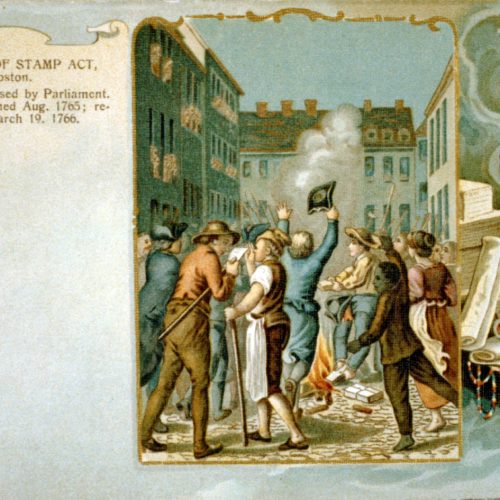
The Stamp Act of 1765 added the insult of an internal tax—not an import duty—by requiring an official stamp of the Crown on all paper products.[36] Under this new law, the tax collector became the visible hand of British overreach—and an easy target for criticism. Those most affected were “printers, lawyers, and merchants who (along with the clergy) formed the most literate and articulate section of the colonial public.”[37] Newspapers throughout the colonies buzzed with opposition to taxation without representation.
In both cases, colonists were asked to pay for their own administration and the protection of vast new territory gained in the war, without their interests being represented in Parliament. They viewed this as an unjust addition to their already substantial contributions to the empire, akin to being taxed twice. Their growth was in Britain’s economic interest, as salutary neglect had demonstrated, and they had fought and supported the war. Colonists blamed the king’s cabinet and called on the king to intervene and protect his loyal subjects. American colonists’ perception of their rights and prosperity being hindered by an unseen, unscrupulous group of ministers would not be soon forgotten.[38]
Growing American Unity
Through an escalating cycle of economic protest and punishment, American colonists realized that their interests were tied more tightly with one another than with Britain. Colonists had grown accustomed to smuggling, a practice London was no longer willing to countenance. In response to tighter customs enforcement and measures like the Sugar and Stamp Acts, colonists organized protests and swore off British goods, finding patriotism through resistance. Many Britons viewed the colonists as disloyal and ungrateful for the protection of the British military and the spoils of the Seven Years’ War. As tensions escalated, colonial demand for autonomy in trade influenced their conception of liberty and justice.
Duplicitous Neglect
The new taxes of the 1760s were placed atop the inconsistent and unreliable customs regime of the Navigation Acts. American colonists had long maintained an extensive illicit trade with forbidden ports, to include trade with the French during active hostilities. General Jeffery Amherst, commander-in-chief of British forces during the Seven Years’ War, circulated a letter to colonial administrators in April 1762 lamenting that the enemy was being supplied with “Provisions from almost Every port on the Continent of North America” while he struggled to supply his own forces.[39] The extent of the smuggling pointed to the complicity, or at least neglect, of much of the customs service in the Americas. In the opinion of Edmund Burke in 1774, American trade had “filled all its proper channels to the brim” and “spread out upon some places where it was indeed improper, upon others where it was only irregular.”[40]
Even to some in authority, the economic stimulus from smuggling initially outweighed the loss from unpaid duties. Customs officials collected substantial bribes to look the other way.[41] Rumors spread of Royal Navy officers prosecuting colonists for illicit trade while profiting from the escort of British merchants carrying the same goods under flags of truce.[42] When cargo was seized, the outcomes of the resulting legal disputes appeared to be subject to personal bargaining and selective enforcement, especially because such cases were settled by vice-admiralty courts without juries.[43]
Known smugglers were prominent and politically influential members of the Boston merchant community. Men such as Thomas Hancock and John Erving sat on the Governor’s Council, despite clear conflicts of interest when it came to Governor Francis Bernard’s prerogative to tighten enforcement of trade.[44] Britain’s secretary of state, William Pitt, penned a letter to governors in British North America in August 1760 describing trade with the enemy as “Subversive of all Law, and so highly repugnant to the Honor and Wellbeing of this Kingdom”; he exhorted governors to use “every Means in [their] Power” to punish “heinous Offenders.”[45] After several ships belonging to high-profile Boston merchants were seized, smugglers encouraged legal challenges, subterfuge, and open protest. Led by Massachusetts lawyer James Otis, merchants brought legal actions against the officials who had seized their goods, the results of which were seen as arbitrary and influenced by personal relationships between customs agents and court officials.[46]
Boston merchants blamed their misfortunes on the notoriously strict customs commissioner Charles Paxton, Governor Bernard, and Chief Justice Thomas Hutchinson of the vice-admiralty court, who later became the acting governor.[47] Customs officials and colonial governors were each paid one-third of the proceeds from ship seizures, giving them ample incentive to hunt smugglers. Using the last third reserved for the colony, Paxton—who was also the vice-admiralty court’s marshal, storekeeper, and auctioneer—employed private informants to expose smugglers.[48] The Boston Gazette labeled Paxton as morally unprincipled and “remarkable for insincerity, pride, haughtiness and deceit.”[49]
In the early 1760s, the Boston Society for Encouraging Trade and Commerce rallied around its favorite tax collector, Benjamin Barons. Barons was well connected in London, but his friendliness to smugglers earned him repeated discipline and enemies within the customs service. Protesting his removal in August 1761, ninety-seven members of the society signed a petition lauding Barons as a “friend and protector of the lawful trade of this port.”[50] While there is room for debate about their use of the word “lawful,” Bostonians’ frustration can be understood due to the inconsistent application of the Navigation Acts. A significant portion of the trading community was engaged in illicit trade by the 1760s, and it proved an influential faction that resisted the ongoing retreat from salutary neglect. Barons, according to the merchants, struck a more favorable balance than Paxton because he was “neither disposed . . . to wink at the violations . . . to the prejudice of the Revenue, nor . . . to make a handle of them to injure & oppress the innocent Subject.”[51] Bostonians, they claimed, wanted clarity, consistency, and equal protection under British law. They were fed up with seizure “to the utmost farthing” and nefarious practices such as the use of provincial funds to pay private informants within the population—the “disgrace of civil society,” according to the Boston Gazette.[52]
In addition to complaints of partiality, Bostonians pointed out that enforcement of the Navigation Acts was stronger in their city than in neighboring Newport, Rhode Island and elsewhere. [53] Governor Bernard admitted that questions about consistency in enforcement were “reasonable,” but boasted that his administration of Boston’s customs was “distinguished by its observance of the laws of trade” and the “most commendable” in America, taking care to exempt Barons from the compliment. Colonists were warned not to escalate tensions and assured that there would be redress “as soon as the Cessation of War shall afford an opportunity for Civil regulations.”[54] Bernard’s promise of clarity after the Seven Years’ War would come in the form of a crackdown, making clear to Bostonians that their success, though enabled by British protection, had long been a product of trade with more than just the empire.
Petitions and Pitchforks
The Continental Congress of 1765, known as the Stamp Act Congress, was the first independently organized meeting of colonial representatives. It included nine colonies, and its resolutions, despite their expression of sincere devotion to the king, essentially accused Britain of trapping the colonies in debt through unfair taxes imposed without their consent. Removing those taxes, they argued, would help to restore a “mutually affectionate and advantageous” relationship. The delegates saw an intrinsic link between their “increase, prosperity, and happiness” and their “inherent rights and liberties.”[55] Only if London protected those liberties could harmony reign.
To reinforce their point, American colonists—rallied by boycott agreements signed in public forums—turned away from British consumer goods and embraced alternatives such as homespun textiles.[56] They formed groups known as the Sons and Daughters of Liberty to encourage, and sometimes pressure, their fellow colonists to protest British overreach through boycott. Daughters of Liberty showcased homemade gowns and held publicized spinning marathons, celebrating homespun textiles with the clear intention of making American goods fashionable.[57] Merchants pledged not to import British goods. Smugglers murmured about the economic benefits of trading independence.[58] People in cities and small towns alike pledged to lessen their household reliance on England.[59] Americans were intentional about their patriotism, bucking materialist consumer trends that favored luxury and imported goods. Boycotts were the nearest tool at hand to apply pressure in response to unpopular policies, and although they did not succeed in resolving the colonists’ grievances peacefully, they jump-started American industry and began cultivation of a national identity that enabled independence.
For some Sons of Liberty, the Stamp Act was outrageous enough to warrant greater resistance. They hung and burned effigies of tax collectors and Prime Minister George Grenville alongside the devil and held mock trials for their grievances. They organized mobs to intimidate British agents and greet ships bringing the royal stamps with “tolling bells, flags at half-mast, threatening placards, and swinging effigies.”[60] George Meserve, the newly appointed stamp master for New Hampshire, was met on the dock by a crowd with a burning effigy and resigned as soon as he landed. His letters of resignation, commission, and instruction were paraded through town on a sword.[61] Before the Act took effect, all of the stamp agents had resigned.[62] Colonists, long accustomed to enforcement being negotiable, united to strengthen their hand.
Printers such as David Hall and Benjamin Franklin, publishers of The Pennsylvania Gazette, weighed the risk of flaunting the stamp requirement. A worried Hall wrote to Franklin on October 14, 1765, two weeks before the Stamp Act was to take effect: “we have already lost at least 500 [subscribers], since the Resolves of the House of Commons were published . . . and if so many have dropt before, what may we not expect after the First of November?”[63] Judging the risk to be acceptable, Franklin and Hall issued a pamphlet, “No Stamped Paper to be had,” informing Pennsylvanians about protests and nonimportation agreements in other colonies and calling the Act “unconstitutional . . . and of so destructive a tendency as must infallibly entail poverty and beggary on us and our posterity, if carried in execution.” They continued, bolstering confidence in the ongoing boycotts: “we hear that the merchants and friends to America in England were determined to use their utmost endeavors the next session of Parliament, in order to get the Stamp act repealed.”[64] Colonists were determined to keep up the pressure until London buckled, and were more in tune than ever with news from neighboring colonies.
Objects of Sedition
British ministers felt colonists’ anger and contemplated how to restore harmony, or at least subjugation. Their attempt at a solution featured both concession and coercion. On March 5, 1766, the House of Lords began to consider the repeal of the Stamp Act. It also passed the Declaratory Act, which aggrandized London’s power over the colonies, especially the sole and exclusive right to tax as it pleased, in order to “[secure] the dependency of his majesty’s dominions in America upon . . . Great Britain.”[65] On the same day, Parliament took seemingly opposing actions: one to accede to colonists’ demands, the other to assert its unquestionable power.
Deliberations in the House of Lords illuminate the growing dilemma. Lord Coventry opposed repeal of the Stamp Act because he worried it would water down the Declaratory Act’s intended message by exposing Parliament’s indecision. He argued to his fellow members: “You have come into a Resolution asserting your Right and at the same time you’re doing an Act by which you give up that Right.”[66] The Duke of Newcastle, concerned about France, favored concessions to the Americans to keep trade flowing: “with Regard to the Commercial Interests of this Country[,] . . . Trade . . . is declining in Every other part of the World but America.” Lord Sandwich worried that giving an inch would cede a mile, saying:
The Americans want to get loose from the Act of Navigation. All the Complaints made against the ships stationed on their Coasts to prevent illicit Trade tend to this purpose. The Stamp Act [is] not the Object of their Sedition but to try their ground whether by Resistance they can get themselves loose from other Acts more disagreeable and detrimental to them.[67]
London was past the point of salutary neglect, and Parliament struggled to find a suitable, formal replacement. Whatever message these members meant to send, the repeal showed the colonies that their resistance could change British calculus, while the Declaratory Act demonstrated that London would continue to limit colonists’ agency without consent.
Unreasonable Searches and Seizures
The following year, London gave American colonists a further reminder that their prosperity and liberty were intertwined. In order to fund “administration of justice” in the expanding colonial territory, the Townshend Acts of 1767 taxed glass, lead, paint, paper, tea, and more. Parliament explicitly acknowledged the inadequacy of existing trade laws and enhanced them, giving customs agents wide latitude to search and seize colonists’ property. To “obviate . . . doubts for the future” about the veracity of the prior acts, the Townshend Acts established the American Board of Customs and empowered its agents to “enter . . . any house, warehouse, shop, cellar, or other place” provided they had a “writ of assistance” granted by a colonial court.[68]
James Otis had resigned from the vice-admiralty court over his refusal to defend the Crown’s position on writs of assistance.[69] The Townshend Acts further embedded such writs in the legal system in order to enforce laws in revisionist fashion. Otis argued since 1761 that writs of assistance were “the worst instruments of arbitrary power” because they required no probable cause and provided essentially unchecked power to search and seize at will. In addition, Otis drew a distinction between the legitimate “Court of Exchequer at home,” and the juryless vice-admiralty courts in the colonies. It was legitimate for a warrant to be handed down by the recognized authority with a specific mandate, but the prospect of a general and fungible warrant placed “the liberty of every man in the hands of every petty officer.” [70] Protection against this injustice was later enshrined in the Sixth Amendment of the U.S. Constitution, which prohibits unreasonable search and seizure.
Influential pamphlets decried the Townshend Acts as unconstitutional, including John Dickinson’s Letters from a Farmer in Pennsylvania to the Inhabitants of the British Colonies and the Massachusetts Circular Letter, written by Samuel Adams and approved by the Massachusetts House of Representatives.[71] Colonists circulated nonconsumption petitions door to door. They published lists of banned goods and shamed neighbors who purchased them. [72] Private consumption decisions were well within the realm of public debate.
Proud businessmen took intrusions into their affairs as personal insults. After the seizure of Hancock’s Liberty, a mob compelled the commissioners of the American Board of Customs to place the shipin the protection of the 50-gun HMS Romney and flee with their families to Castle William (now known as Fort Independence) where they stayed for four months.[73] The commissioners wrote letters to British officers asking for protection, and the ensuing vice-admiralty court case against Hancock and his alleged accomplices sought an unprecedented penalty of triple the value of the wine.[74] Bostonians perceived malicious intent. John Adams, Hancock’s counsel (and, later, fellow signatory to the Declaration), remembered the case:
It seemed as if the Officers of the Crown were determined to examine the whole Town as Witnesses. Almost every day a fresh Witness was to be examined upon Interrogatories. They interrogated many of his near Relations and most intimate Friends . . . I was thoroughly weary and disgusted with the Court, the Officers of the Crown, the Cause, and even with the tyrannical Bell that dongled me out of my House every Morning[75]
Amid the uproar, Boston merchants agreed on unilateral nonimportation and urged New Yorkers and Pennsylvanians to join them.[76] By the time all three colonies had joined the boycott, tensions had risen further and British troops were quartered in Boston. In 1770, all Townshend duties were repealed except, crucially, the tax on tea.[77]
Poison Tea
The last straw for many, the Tea Act of 1773 doubled down on enforcement of the Townshend duty only two months after the Boston Massacre.[78] Word of the tragedy had spread rapidly in New England, aided by an engraving by Patriot silversmith Paul Revere (Figure 1). The image stoked outrage, though it exaggerated the event. Revere was unambiguous in blaming the violence on His Majesty’s customs, depicting an organized and ruthless Redcoat regiment firing into a crowd from in front of the custom house—renamed “Butcher’s Hall,” with an extra musket firing from its window.

Figure 1: The Bloody Massacre perpetrated in King Street, Boston on March 5, 1770 by a party of the 29th Regiment.[79]
The Tea Act actually lowered the tariff on tea, but did so for the explicit benefit of the British East India Company, creating a monopoly to bail out the struggling firm and confining “smuggled tea into legal channels of trade,” according to historian Douglas Irwin.[80] The tea duty had survived the repeal of the Townshend Acts, ostensibly to assert the authority outlined in the Declaratory Act. Colonists viewed the Tea Act as a sign of things to come. The Boston Gazette summarizes their sense of foreboding: “Whenever the Tea is swallowed, and pretty well digested, we shall have new duties imposed on other articles of commerce.”[81]
Boycotts were called across the colonies and rumors spread of tea’s “poisonous” nature, despite its ubiquity in American society. Dr. Thomas Young, an ardent Patriot and John Adams’s family physician, wrote in the Boston Evening Post: “Tea is really a slow poison, and has a corrosive effect upon those who handle it. I have left it off since it became a political poison, and have since gained in firmness of constitution.”[82] Those who drank it became pariahs. On November 29, 1773, pamphlets appeared around Boston that read:
Friends! Brethren! Countrymen! That worst of plagues, the detested tea, shipped for this port by the East India Company, is now arrived in this harbor; the hour of destruction or manly opposition to the machinations of tyranny stares you in the face; every friend to his country, to himself, and posterity, is now called upon to meet at Faneuil Hall, at nine o’clock this day, (at which time the bells will ring,) to make a united and successful resistance to this last, worst and most destructive measure of administration.[83]
On December 16, about 150 people snuck on board merchant ships and dumped 342 chests (about 90,000 pounds) of East India Company tea into Boston Harbor.[84] Across the colonies, such tea was refused from port, dumped overboard, and ritually burned.[85]
The outrage was a pent-up reaction to years of haphazard policy and insults from the mother country, as well as growing awareness of London’s focus on collecting revenue and unwillingness to give colonists the representation they believed was their due as British subjects. The recurring cycle of taxation, protest, repeal, and escalation had given Patriots confidence that they had enough economic and political force to affect London’s calculus. The ensuing months would prove that there was little remaining room for escalation short of war.
Intolerable Coercion
The Boston Tea Party was a brazen escalation and London countered in 1774 with a series of laws known in Britain as the “Coercive Acts” but referred to in the colonies as the “Intolerable Acts.”[86] The Boston Port Act closed Boston Harbor completely. The Massachusetts Government Act and Administration of Justice Act augmented imperial control over local authorities.[87] The Intolerable Acts were expressly punitive, seeking to make an example of Massachusetts due to the “dangerous commotions and insurrections . . . by diverse ill-affected persons, to the subversion of his Majesty’s government.”[88] Their effect was not to bring the colonies to heel, as intended, but to bolster the Patriot argument that America had outgrown the empire. Even Patriots who disagreed with the tea party, such as George Washington, were shocked at the harsh response. Washington asserted: “the cause of Boston . . . now is and ever will be considered as the cause of America.”[89]
The Coercive Acts were meant to stamp out resistance in all thirteen colonies. London wagered that the show of force would fracture the protests, which had illuminated diverging interests between Britain and her American subjects. In response, the Boston Committee of Correspondence issued a circular letter to the other colonies on May 13, 1774 calling for unity and warning of things to come:
This attack, though made immediately upon us, is doubtless designed for every other colony who will not surrender their sacred rights and liberties into the hands of an infamous ministry. Now therefore is the time when all should be united in opposition to this violation of the liberties of all. Their grand object is to divide the colonies.[90]
It asked the other colonies to “[suspend] . . . trade with Great Britain at least.”[91] The message was clear: the fates of the colonies were intertwined. Meanwhile, Americans residing in London, including Benjamin Franklin, appealed to deaf ears in Parliament, calling the Intolerable Acts “fatal to the rights, liberties, and peace of all America,” and the port closure specifically “repugnant to every principle of law and justice.”[92] The Tea Act had represented significant interference in the colonies’ freedom of action for the naked benefit of a British company. Faced with backlash, Britain responded with a naval blockade of Boston Harbor. From the colonists’ point of view, this was escalatory and despotic even in light of the extensive destruction of property.
The Acts were intolerable because of colonists’ conviction that they deserved fair representation of their interests, and that they had outgrown the position of subjects. Merchants and consumers in the colonies were irritated that their fortunes were governed by fickle ministers across the ocean. The king had thus far failed to deliver them representation in Parliament, and Patriots were close to giving up on the prospect. People in Massachusetts and elsewhere inferred that the crackdown foretold broader restrictions of liberty, especially because the Intolerable Acts also included administrative and military overreaches—namely the Quartering Act and the Massachusetts Government Act—that colonists perceived as imperiling their self-governance.[93] The ties between opportunity and liberty were tightening, and people had begun identifying as “American” in addition to “South Carolinian” or “Virginian.”[94]

Figure 2: The Bostonians in Distress[95]
London’s misreading of the tea leaves is captured by a political cartoon, “The Bostonians in distress” (Figure 2), disseminated in England in November 1774, shortly after the First Continental Congress adjourned. It depicts Bostonians locked in a cage hanging from the Liberty Tree, surrounded by ships and artillery, crying out as they are fed through the prison bars by their countrymen who had, somehow, arrived by boat. The message is disdainful, but the irony lies in its dismissal of the colonies’ power when united. For Patriots, “The Liberty Tree” was a near-sacred symbol. It was a meeting place for those engaged in the early formation of American values.[96] In Britain, it was a laughingstock, evidence that Bostonians were imprisoned by their own ambition to be greater than the empire. Britons underestimated how entrenched the ideals of the Revolution had become, and their actions invited correspondence and debate in the colonies about their future as Americans.
Rights and Grievances
In retrospect, salutary neglect was an unsustainable policy that began to expire as the colonial economy outgrew its role within the empire. Parliament attempted to channel that growth, but their efforts appeared to Americans as arbitrary and malicious changes in policy. The Boston Tea Party and the ensuing blockade abruptly reminded Americans of a reality latent all along: the protection of the empire was also a noose. The costs and benefits of being royal subjects were subject to arbitrary shifts, and Americans of the Founding generation perceived that they had less agency over their futures compared to their ancestors, who had benefitted from salutary neglect while Britain was relatively unthreatened by American commercial power. Americans used every economic tool at their disposal but resorted to war because they were no longer willing to strain themselves to fit the now-tattered colonial garment.
Sister Colonies
The Virginia House of Burgesses declared a “Day of Fasting, Humiliation, and Prayer” following the “hostile Invasion” suffered by “our Sister Colony of Massachusetts Bay.” It resolved that “the heavy Calamity” of the port closure “[threatened] Destruction to our civil Rights, and the Evils of civil War.”[97] It sought “one Heart and one Mind firmly to oppose, by all just and proper Means, every Injury to American Rights” (emphasis original). Two days later, Lord Dunmore, the royal governor of Virginia, dissolved the House of Burgesses.[98]
Eighty-nine members of the “Late House of Burgesses” convened the next day to have the last word. Among those present were soon-to-be revolutionary giants, including Washington, Jefferson, Patrick Henry, and Richard Henry Lee (who would later commence the official debate on American independence at the Second Continental Congress in 1776 by resolving “That these United Colonies are, and of right ought to be, free and independent States.)”[99] The former burgesses signed a resolution that an “attack” on one colony was an attack on all, and formally suggested a “general congress” of all thirteen colonies.[100]
That “general congress,” remembered as the First Continental Congress, showed that Britain had failed to deter unified protest through its show of force in Massachusetts; every colony except Georgia was represented. The gathering produced the Declaration of Rights and Grievances, which underlined the several ways in which Britain had violated their rights “under various pretenses, but in fact for the purpose of raising a revenue.”[101] It also created the Continental Association, which heeded the call of the earlier letter from the Boston Committee of Correspondence by instituting a boycott of British goods across the colonies.[102] Consumer decisions were now fully infused with political significance, yet it was infeasible to indefinitely continue the cycle of protest, repeal, and escalation. People began to take sides, declaring themselves “Patriots” or “Loyalists.”[103]
The Continental Association encouraged, more extensively than ever before, broad changes in consumption habits. It called for “Frugality[,] Economy, and Industry;” promoted domestic “Agriculture, Arts, and the Manufactures . . . especially that of Wool;” and frowned upon “every Species of Extravagance and Dissipation.” It even imposed a ban on exports to the empire, to take effect after six months of nonimportation if demands had not been met, and created committees “in every County, City, and Town” to enforce it.[104] Elections for these committees energized public political participation. Americans took great—at times, invasive—interest in the consumption of their neighbors. Copies of the Association were signed in public and violators were induced to confess publicly.[105]
The First Continental Congress sought reconciliation with Britain, keeping its focus on internal taxation without representation and “cheerfully [consenting]” to British policies they deemed as “bonafide, restrained to the regulation of our external commerce.”[106] However, the line between regulation of internal and external commerce had been blurred: under British law, trade between neighboring American colonies was “external commerce,” and London had plainly declared its sole right to tax the colonies as it pleased.[107] Patriots’ notions of “bonafide” colonial policy was clouded by memories of salutary neglect. They wished to “restore . . . that state, in which both countries found happiness and prosperity,” but a restoration of prior colonial relations was impossible.[108] Both sides were embittered by memories of economic attacks and counter-attacks. More importantly, the thirteen colonies were increasingly bound by a common identity, born out of shared sacrifice.
Limits of Economic Competition
Economic tension had led America and Great Britain to the precipice of war. In the view of James Madison in January 1775, there was sufficient threat of “sudden invasion . . . to require a preparation for extreme events.” He described “some thousands of well trained High Spirited men ready to meet danger whenever it appears” in Virginia, and wrote that the “method . . . to distinguish friends from foes” was to count signatures on the Continental Association.[109] Even after “The Shot Heard Round The World,” significant elements of both sides still wanted to avoid prolonged war, but compromise appeared to require unbearable restrictions on American liberties. The Continental Congress sent the “Olive Branch Petition” to King George and responded to Prime Minister Lord North’s “Conciliatory Proposal.” The “Olive Branch Petition” blamed Parliament for endangering the “union between our Mother Country and these colonies” and its “benefits so remarkably important” through its tax policies. The petition beseeched the king to use his “royal authority and influence” to “[prevent] the further destruction of the lives of [his] Majesty’s subjects” and repeal “such statutes as more immediately distress any of [his] Majesty’s colonies.”[110]
North’s proposal would have forbidden additional taxes—except those that “may be expedient” to ensure the colonies paid “their proportion to the common defence . . . the support of the civil government, and the Administration of justice.” The Second Continental Congress—the president of which was John Hancock—found this to be “unreasonable and insidious.” It argued that the “favor” of Parliament was bought at a mysterious price, and that “the minister” sought to divide the “sister colonies.” To the Patriots, Parliament had only a “pretended power of taxation” and it was unjust and excessive to collect direct taxes while also maintaining a monopoly on colonial trade. Americans were being taxed internally and externally, and the congress protested Britain’s demand of “double of their equal proportion.”[111] They viewed North’s letter not as conciliation, but extortion. Americans had “no experience” to expect that “a gift of perpetual revenue [would secure] a perpetual return of duty or of kind disposition” from Britain.[112] From that point, there was little bargaining left to be done. London imposed a complete ban on trade with the colonies. [113] The most important commodity for import was now gunpowder.
Conclusion
London was ultimately unwilling to reinstate the circumstances that had brought success to the colonies. Moreover, Americans demanded greater political representation and sought a larger stake in the global economy than London would allow. If the colonies had not declared independence, they would have been obligated to reorganize and restrict their trade to fit an imperial system that had changed after the Seven Years’ War to prioritize revenue and implement more standardized customs enforcement.
Independence became conceivable as mounting economic grievances motivated political participation and animated a new national identity. Patriots demonstrated a shared sense of civic duty through collective economic action. After a cycle of exploitative commercial acts, it became more plausible—and more noble—for the United States to chart an independent path than to expect fair representation of their interests in Parliament. Because Americans realized their prosperity was linked with their liberty, they used public forums and created new political processes to make their voices heard.
During the First Continental Congress, Patrick Henry exclaimed that “the distinctions between Virginians, Pennsylvanians, New Yorkers and New Englanders are no more. I am not a Virginian, but an American.” Though the delegates still sought reconciliation with Britain, and regional differences persisted, the character of the thirteen colonies had changed forever: they were indivisible. Their ambition had outpaced their growth, and the process of organizing the priorities of a scattered public helped Americans coalesce around the national interest.
Austin Merkel is a Professional Programs Associate at The Alexander Hamilton Society. He holds a BA from Texas Christian University, a Master of Global Policy Studies from the LBJ School at UT-Austin, and is an alumnus of the UT-Austin AHS chapter.
Image: Burning of Stamp Act cph.3b53085.jpg, 1903. Retrieved from: https://commons.wikimedia.org/wiki/File:Burning_of_Stamp_Act_cph.3b53085.jpg, used under Wikimedia Commons.

[1] Willard Sterne Randall, John Hancock: First to Sign, First to Invest in America’s Independence (New York: Penguin Random House, 2025), 15.
[2] Brendan Wolfe, “Virginia Company of London,” Encyclopedia Virginia, December 7, 2020, https://encyclopediavirginia.org/entries/virginia-company-of-london.
[3] “The Colonist’s Advocate: VIII, February 5, 1770,” Founders Online, National Archives, https://founders.archives.gov/documents/Franklin/01-17-02-0026.
[4] An Act for the Encourageing and increasing of Shipping and Navigation, Acts of the English Parliament (1660), https://www.legislation.gov.uk/aep/Cha2/12/18/enacted.
[5] Douglas A. Irwin, Clashing Over Commerce: A History of US Trade Policy, (Chicago: University of Chicago Press, 2017), 61.
[6] An Act for the Encouragement of Trade, Acts of the English Parliament (1663), https://www.legislation.gov.uk/aep/Cha2/15/7/enacted.
[7] George Langdon, “Mercantilism and American Trade,” Current History 42, no. 250 (1962): 321–62. http://www.jstor.org/stable/45310744.
[8] An Act to prevent the Exportation of Wool out of the Kingdoms of Ireland and England into Forreigne parts and for the Incouragement of the Woollen Manufactures in the Kingdom of England, Acts of the English Parliament (1698), https://www.legislation.gov.uk/aep/Will3/10/16/introduction/enacted; Larry Sawers, “The Navigation Acts Revisited,” The Economic History Review 45, no. 2 (1992): 262–84, https://doi.org/10.2307/2597623.
[9] Irwin, Clashing Over Commerce, 61; Jacob M. Price, “What Did Merchants Do? Reflections on British Overseas Trade, 1660-1790,” The Journal of Economic History 49, no. 2 (1989): 274-275, http://www.jstor.org/stable/2124062.
[10] An Act for the Encouragement of Trade (1663).
[11] Irwin, Clashing Over Commerce, 33; James F Shepherd and Gary M. Walton, “Trade, Distribution, and Economic Growth in Colonial America,” The Journal of Economic History 32, no. 1 (1972): 128–45, http://www.jstor.org/stable/2117180.
[12] T.H. Breen, The Marketplace of Revolution: How Consumer Politics Shaped American Independence, (New York: Oxford University Press, 2004), 75; Edmund Burke, “The speech of Edmund Burke, Esq; on moving his resolutions for conciliation with the colonies, March 22, 1775,” Eighteenth Century Collections Online, University of Michigan Library Digital Collections, https://name.umdl.umich.edu/004895777.0001.000.
[13] Adam Smith, The Wealth of Nations (Hoboken: Wiley-Blackwell), January 8, 2023, Chapter 2.
[14] John J. McCusker and Russell R. Menard, The Economy of British America (Chapel Hill: University of North Carolina Press), Table 2.1, 39.
[15] Price, “What Did Merchants Do?,” 274; McCusker and Menard, The Economy of British America, 39.
[16] An Act for the Encouragement of Trade, Acts of the English Parliament (1663).
[17] McCusker and Menard, The Economy of British America, 46.
[18] Irwin, Clashing Over Commerce, 63.
[19] Sawers, “The Navigation Acts Revisited,” 268.
[20] McCusker and Menard, The Economy of British America, 79.
[21] Adam Smith, The Wealth of Nations. chap 2.
[22] Adam Smith, The Wealth of Nations. chap 2.
[23] Adam Smith, The Wealth of Nations. chap 2.
[24] Ralph Davis, “English Foreign Trade, 1660-1700,” The Economic History Review 7, no. 2 (1954): 162, https://doi.org/10.2307/2591619; McCusker and Menard, The Economy of British America, 39.
[25] “American Tobacco Imported and Reexported by Great Britain: 1697 to 1775,” Historical Statistics of the United States: Colonial Times to 1957, U.S. Bureau of the Census (Washington: Government Printing Office), 1960, Series 30-237, 766.
[26] T.H. Breen, Tobacco Culture: The Mentality of the Great Tidewater Planters on the Eve of Revolution (Princeton: Princeton University Press, 2001), 128-132.
[27] Breen, Tobacco Culture, 130.
[28] Breen, Tobacco culture, 134-139.
[29] “Additional Questions of M. de Meusnier, and Answers,” 1786, The Papers of Thomas Jefferson, ed. J. Boyd (Princeton, 1954), Quoted in Breen, Tobacco Culture, 141.
[30] Breen, Tobacco Culture, 141.
[31] Richard J. Trethewey, “The Economic Burden of the Sugar Act,” The American Economist 13, no. 1 (1969): 63, http://www.jstor.org/stable/25602737.
[32] “Timeline: Events related to the formation of the United States,” The Library of Congress, https://www.loc.gov/collections/continental-congress-and-constitutional-convention-from-1774-to-1789/articles-and-essays/timeline/.
[33] John J McCusker, “The Rum Trade and the Balance of Payments of the Thirteen Continental Colonies, 1650-1775.” The Journal of Economic History 30, no. 1 (1970): 244–247, http://www.jstor.org/stable/2116737.
[34] John Adams, “From John Adams to William Tudor, Sr., 11 August 1818,” Founders Online, National Archives, https://founders.archives.gov/documents/Adams/99-02-02-6959.
[35] The Sugar Act, Acts of the English Parliament (1764), https://avalon.law.yale.edu/18th_century/sugar_act_1764.asp.
[36] The Stamp Act, Acts of the English Parliament (1765), https://avalon.law.yale.edu/18th_century/stamp_act_1765.asp.
[37] Arthur M. Schlesinger, “The Colonial Newspapers and the Stamp Act,” The New England Quarterly 8, no. 1 (1935): 65, https://doi.org/10.2307/359430.
[38] Lindsay M. Chervinsky, The Cabinet: George Washington and the Creation of an American Institution (Cambridge: Belknap Press, 2020), 100-102.
[39] Jefferey Amherst, “to Francis Bernard,” The Papers of Francis Bernard, Volume 1, Colonial Society of Massachusetts, April 15, 1762, https://www.colonialsociety.org/node/2176#ch104.
[40] Edmund Burke, “Speech of Edmund Burke, Esq. on American taxation, April 19, 1774,” Eighteenth Century Collections Online, University of Michigan Library Digital Collections https://name.umdl.umich.edu/004902755.0001.000.
[41] John W. Tyler, Smugglers and Patriots: Boston Merchants and the Advent of the American Revolution (Boston: Northeastern University Press, 1986), 27.
[42] Tyler, Smugglers and Patriots, 35, See Endnote 25.
[43] “ArtIII.S2.C1.12.2 Historical Background on Admiralty and Maritime Jurisdiction,” Constitution Annotated: Analysis and Interpretation of the U.S. Constitution, The Library of Congress, https://constitution.congress.gov/browse/essay/artIII-S2-C1-12-2/ALDE_00013650/.
[44] Tyler, Smugglers and Patriots, 33.
[45] William Pitt, “Circular from William Pitt,” The Papers of Francis Bernard, Volume 1, Colonial Society of Massachusetts, August 23, 1760, https://www.colonialsociety.org/publications/2068/11-circular-william-pitt.
[46] Maurice H. Smith, “Charles Paxton, Founding Stepfather,” Proceedings of the Massachusetts Historical Society 94 (1982): 15–36, http://www.jstor.org/stable/25080903; Tyler, Smugglers and Patriots, 38-44.
[47] Tyler, Smugglers and Patriots, chap. 1; Smith, “Charles Paxton, Founding Stepfather.”
[48] Tyler, Smugglers and Patriots, 33.
[49] Tyler, Smugglers and Patriots, 43.
[50] Tyler, Smugglers and Patriots, 50.
[51] Tyler, Smugglers and Patriots, 51.
[52] Tyler, Smugglers and Patriots, 54.
[53] Tyler, Smugglers and Patriots, 33.
[54] Francis Bernard, “to William Pitt,” The Papers of Francis Bernard, Volume 1, Colonial Society of Massachusetts, October 5, 1761, https://www.colonialsociety.org/node/2150#ch79.
[55] “Resolutions of the Continental Congress October 19, 1765,” https://avalon.law.yale.edu/18th_century/resolu65.asp.
[56]Terrence H. Witkowski, “Colonial Consumers in Revolt: Buyer Values and Behavior during the Nonimportation Movement, 1764-1776,” Journal of Consumer Research 16, no. 2 (1989): 216–26,
http://www.jstor.org/stable/2489320.
[57] Breen, The Marketplace of Revolution, 231.
[58] Tyler, Smugglers and Patriots, 19.
[59] Witkowski, “Colonial Consumers in Revolt.”
[60] Philip G. Davidson, “SONS OF LIBERTY AND STAMP MEN,” The North Carolina Historical Review 9, no. 1 (1932): 38–56, http://www.jstor.org/stable/23514881.
[61] Davidson, “SONS OF LIBERTY AND STAMP MEN,” 48.
[62] “Timeline: Events related to the formation of the United States,” The Library of Congress.
[63] “David Hall to Benjamin Franklin, 14 October 1765,” Founders Online, National Archives, https://founders.archives.gov/documents/Franklin/01-12-02-0165.
[64] “No Stamped Paper to be Had,” The Pennsylvania Gazette, November 7, 1765, https://tile.loc.gov/storage-services/service/rbc/rbpe/rbpe34/rbpe346/34604500/34604500.pdf.
[65] The Declaratory Act, Acts of the English Parliament (1766), https://avalon.law.yale.edu/18th_century/declaratory_act_1766.asp.
[66] H. W. V. Temperley, “Debates on the Declaratory Act and the Repeal of the Stamp Act, 1766,” The American Historical Review 17, no. 3 (1912): 563–86, https://doi.org/10.2307/1834389.
[67] Temperley, “Debates on the Declaratory Act and the Repeal of the Stamp Act.”
[68] The Townshend Act, Acts of the English Parliament (1767), https://avalon.law.yale.edu/18th_century/townsend_act_1767.asp.
[69] Robert M.S. McDonald, “Introduction: Speech Against Writs of Assistance,” Teaching American History, https://teachingamericanhistory.org/document/speech-against-writs-of-assistance/.
[70] James Otis, “Speech Against Writs of Assistance,” February 24, 1761, https://teachingamericanhistory.org/document/speech-against-writs-of-assistance/.
[71] “Timeline: Events related to the formation of the United States,” The Library of Congress.
[72] Breen, The Marketplace of Revolution, chap. 7.
[73] Dora Mae Clark, “The American Board of Customs, 1767-1783,” The American Historical Review 45, no. 4 (1940): 787, https://doi.org/10.2307/1854451.
[74] Clark, “The American Board of Customs;” Tyler, Smugglers and Patriots, 115.
[75] “Seizure of Hancock’s Sloop, 1768–1769,” Founders Online, National Archives, https://founders.archives.gov/documents/Adams/01-03-02-0016-0021.
[76] Tyler, Smugglers and Patriots, 114-117.
[77] Irwin, Clashing Over Commerce, 71.
[78] The Tea Act, Acts of the English Parliament (1773), Teaching American History, https://teachingamericanhistory.org/document/the-tea-act/.
[79] Paul Revere, “The Bloody Massacre perpetrated in King Street Boston on March 5th, 1770 by a party of the 29th regt,” Illustration, Boston, Public Domain, Library of Congress Prints and Photographs Online Catalog, https://www.loc.gov/pictures/item/2008661777/.
[80] Irwin, Clashing Over Commerce, 74.
[81] Boston Gazette, 8 November 1773, Quoted in Breen, The Marketplace of Revolution, 300.
[82] Thomas Young, “Messirs Fleets,” Boston Evening Post, October 25, 1773,
https://www.masshist.org/beehiveblog/2020/11/a-slow-poison-dr-thomas-young-and-his-essay-on-tea/; Francis Drake, Tea Leaves: Being a Collection of Letters and Documents relating to the shipment of Tea to the American Colonies in the year 1773, by the East India Tea Company, (Detroit: Singing Tree Press, 1970,) 103.
[83] Drake, Tea Leaves, 25.
[84] Irwin, Clashing Over Commerce, 74.
[85] Joseph Cummins, Ten Tea Parties: Patriotic Protests That History Forgot (Philadelphia: Quirk Books, 2012).
[86] Irwin, Clashing Over Commerce, 73.
[87] Breen, The Marketplace of Revolution, 302.
[88] The Boston Port Act, Acts of the English Parliament (1774), https://avalon.law.yale.edu/18th_century/boston_port_act.asp.
[89] Mary Beth Norton, 1774 : The Long Year of Revolution (New York: Alfred A. Knopf, 2020) 122.
[90] “Circular Letter of the Boston Committee of Correspondence,” May 13, 1774, https://avalon.law.yale.edu/18th_century/circ_let_boston_1774.asp.
[91] “Circular Letter of the Boston Committee of Correspondence,” May 13, 1774.
[92] “The Petition to the House of Lords against the Boston Port Bill, 26 March 1774: résumé,” Founders Online, National Archives, https://founders.archives.gov/documents/Franklin/01-21-02-0068; “The Petition to the House of Lords against the Massachusetts Government and Administration of Justice Bills, [before 11 May 1774]: résumé,” Founders Online, National Archives, https://founders.archives.gov/documents/Franklin/01-21-02-0102.
[93] The Quartering Act, Acts of the English Parliament (1774), https://avalon.law.yale.edu/18th_century/quartering_act_1774.asp; The Massachusetts Government Act, Acts of the English Parliament (1774), https://avalon.law.yale.edu/18th_century/mass_gov_act.asp.
[95] Philip Dawe, “The Bostonians in distress,” Illustration, London, Public Domain, Library of Congress Prints and Photographs Online Catalog, https://www.loc.gov/pictures/item/2004673305/.
[96] Jay B. Hubbell and Philo Patriae, “‘On Liberty-Tree’: A Revolutionary Poem from South Carolina,” The South Carolina Historical and Genealogical Magazine 41, no. 3 (1940): 117–22, http://www.jstor.org/stable/27571633.
[97] “Resolution of the House of Burgesses Designating a Day of Fasting and Prayer, 24 May 1774,” Founders Online, National Archives, https://founders.archives.gov/documents/Jefferson/01-01-02-0082.
[98] Mary Beth Norton, 1774, 138.
[99] “Resolution of Independence Moved by R. H. Lee for the Virginia Delegation, 7 June 1776,” Founders Online, National Archives, https://founders.archives.gov/documents/Jefferson/01-01-02-0159.
[100] “Association of Members of the Late House of Burgesses, 27 May 1774,” Founders Online, National Archives, https://founders.archives.gov/documents/Jefferson/01-01-02-0083.
[101] “Declaration and Resolves of the First Continental Congress,” October 14, 1774, https://avalon.law.yale.edu/18th_century/resolves.asp.
[102] “Circular Letter of the Boston Committee of Correspondence,” May 13, 1774.
[103] Mary Beth Norton, 1774.
[104] “Continental Association, 20 October 1774,” Founders Online, National Archives, https://founders.archives.gov/documents/Jefferson/01-01-02-0094.
[105] Breen, The Marketplace of Revolution, 327.
[106] “Declaration and Resolves of the First Continental Congress,” October 14, 1774.
[107] The Declaratory Act, Acts of the English Parliament (1766).
[108] “Declaration and Resolves of the First Continental Congress,” October 14, 1774.
[109] “James Madison to William Bradford, 20 January 1775,” Founders Online, National Archives, https://founders.archives.gov/documents/Madison/01-01-02-0039.
[110] “Second Petition from Congress to the King, 8 July 1775,” Founders Online, National Archives, https://founders.archives.gov/documents/Jefferson/01-01-02-0114.
[111] “Resolutions of Congress on Lord North’s Conciliatory Proposal,” February 20, 1775, https://avalon.law.yale.edu/18th_century/jeffnort.asp.
[112] “Resolutions of Congress on Lord North’s Conciliatory Proposal,” February 20, 1775.
[113] The Prohibitory Act, Acts of the English Parliament, December 22, 1775, https://wisc.pb.unizin.org/ls261/chapter/ch-1-4-the-prohibitory-act-dec-1775/.