

1776: The Beginnings of American Exceptionalism Abroad
Wary Peace: Anglo-American Relations Between 1783-1808
Share On:
From the conclusion of the Treaty of Paris in September 1783 to President James Madison’s message of war in June 1812, the United States and United Kingdom maintained a peace of bad feelings and deep tensions. The Treaty of Paris left unaddressed disagreements over trade, frontiers, debts, and restitution. Diplomatic failure in the 1780s to resolve these disputes engendered mutual exasperation and bitterness. Diplomatic success in the early 1790s, culminating in the Jay Treaty of 1794, provoked controversy and strained relations. The Revolutionary and Napoleonic Wars widened rifts over maritime commerce. Nonmilitary solutions, like the abortive Monroe-Pinkney Treaty and President Thomas Jefferson’s embargo, failed to induce compromise. Foreshadowing his presidency’s rancorous relations with Britain, Jefferson in 1786 fumed, “that nation hates us, the ministers hate us, and their king more than any other man.”[1] By the time Jefferson left office, war clouded the horizon.
If Anglo-American relations were bitter from the start, why was war avoided for so long? Statesmen on both sides of the Atlantic persistently expected war. “Have republics in practice been less addicted to war than monarchies?” Alexander Hamilton worried in 1787.[2] George Canning told the House of Commons in 1810 that “there never yet was a state democratic and powerful which had not a tendency to war.”[3] Anglo-American war in the 1780s or 1790s would likely have wrecked the young republic—perhaps also Britain.
Of course, peace may have endured as long as it did simply because neither country was prepared for war with the other until the 1810s. Alternatively, deterioration in Anglo-American relations could be timed to coincide with Jefferson’s Anglophobic Democratic-Republicans supplanting Hamilton’s Anglophile Federalists in 1801. Perhaps unresolved tensions, compounded by new problems, only reached a breaking point when an unfortunate Madison came to office in 1808. These explanations are plausible but unpersuasive. Despite its postwar weariness, Britain appeared ready enough to cross American territory, with or without American consent, to attack Spanish possessions during the Nootka Sound Crisis of 1790; nor did a weak military discourage American statesmen from attempting to exploit (and be drawn into) the Anglo-Spanish standoff.[4] Jefferson’s animus toward Britain was tempered by his confidence in economic coercion as a substitute for war. Moreover the magnitude of geopolitical problems that Madison faced in 1809 was no greater than that which Washington faced in 1789.
A diplomatic bon mot by the British minister Lord Auckland offers a way forward. Auckland in 1791 likened “the game of projects and discussions between nations” to card-playing: “liable to be affected by the chance combination of the cards and by the manner of playing them.”[5] Understanding why Anglo-American relations remained both bitter and peaceful for as long as they did depends on identifying the cards, exploring their changing combinations, and explaining how they were played over the game. Analyzing Anglo-American diplomacy on these terms suggests that their early relations reflect an antagonism of interdependence. Their entangled interests served to discourage both war and rapprochement. This created an unhappy but peaceful relationship that lasted as long as political and economic interests on both sides preferred non-military to military methods of coercion and conditions allowed for some measure of mutually acceptable compromise. This chapter addresses how antagonistic interdependence came to define early Anglo-American relations, why it endured for decades, and why it eventually gave way.
Anglo-American relations between 1783 and 1808 are characterized by shared vulnerability, opportunity, and new approaches to strategy. Both countries responded to similar diplomatic, political, and economic challenges after 1783 with strategic innovations that linked legitimacy and stability at home with mitigating risks to commerce abroad. The first postwar decade proved formative to this process in Britain and the United States, delineating domestic boundaries of strategic consensus and disagreement, indicating how the two nations maneuvered between coercion and compromise, and anticipating how their disputes resolved or worsened. The risk of war was always in the deck, as chancers like Auckland knew. Its likelihood depended on “combinations” with other cards and the “manner” in which statesmen played their hands.
This chapter proceeds in four parts. The first compares conditions in Britain and America after 1783. It explores the problems both countries faced: economic uncertainty, political instability, diplomatic isolation, and institutional illegitimacy. The next section compares how developments from 1783 to 1793 shaped foreign policy. Although lacking momentous events, this decade produced an antagonistic interdependence that rendered subsequent Anglo-American relations contentious but manageable. The third section compares the Jay Treaty of 1793 and the Monroe-Pinkney Treaty of 1806 to examine how entangled interests and similar attitudes initially facilitated compromise but increasingly encouraged confrontation. The conclusion considers themes in Anglo-American relations between 1783 and 1808 and their application to the present, namely relations between the United States and China, which similarly are characterized by non-military competition, coercive diplomacy, and antagonistic interdependence. Whether diplomatic bad feeling between Washington and Beijing descends into conflict could depend in part on whether lessons from an earlier era of unhappy peace between Britain and America are acknowledged.
Postwar Struggles
“We have now happily concluded the great work of independence … but much remains to be done to reach the fruits of it,” Hamilton wrote in 1783. He conceded, “Our prospects are not flattering.”[6] Lord Buckinghamshire felt little better about Britain, which he condemned as an “unhappy disgraced country.”[7] Eight years of war had battered Great Britain and the United States. Both struggled with institutional dysfunction, economic depression, and foreign contempt. Shared problems shaped how American and British statesmen repaired their countries fortunes, secured their interests abroad, and engaged one another—contentiously but peacefully.
America’s problems began during the Revolution with its first constitution. Under the Articles of Confederation, the interstate government’s departments of foreign affairs, war, and finance lacked regular funding, central direction, and the support of a central bank, national currency, or military.[8] As New York’s tax collector, Hamilton raised just two percent of his state’s contribution to the Confederation. As a congressional delegate, he watched his impost tax bill languish and a mob of veterans besiege the legislative chamber.[9] Hamilton condemned the Confederation as “neither fit for war, nor peace.”[10]
In Britain, governments changed with dizzying speed: five prime ministers served between March 1782 and December 1783.[11] Longtime leaders like Lord North were discredited.[12] Rising men like Lord Shelburne and Charles James Fox fell in turn. “The parties in Parliament are whetting their knives to assassinate each other . . . without any regard to the welfare of old England,” inveighed diplomat Robert Murray Keith in 1783.[13] Power fell to a twenty-four-year-old William Pitt in December 1783. Edward Gibbon judged Pitt and his colleagues a “set of most respectable boys, who were in school not a half dozen years ago.” Detractors attributed the youthful Pitt’s rise to his eagerness “to creep up the backstairs of secret influence,” implying he was a pawn of the unpopular king.[14] Defeat in America spurred calls for change. Reformers emerged across society: Joseph Hume in administration, Henry Brougham in the law, Joseph Shipley in the church, and Thomas Clarkson on the slave trade.[15] Christopher Wyvil’s Association Movement demanded reform of Parliament itself. Mobilizing the middle classes, the Association charged the government with placing “the emolument of an individual” over “the welfare of the community.”[16] America’s nascent institutions were worryingly untested. Britain’s longstanding institutions were worryingly unsteady.
Peace posed economic challenges. The United States suffered depression stoked by loss of British colonial markets, shipping restrictions, and species shortages.[17] Independence cost the Continental Congress $10 million in foreign debts and $41 million in unredeemed certificates. The states accrued another $25 million of debt.[18] The United States depended commercially on Britain. By 1790, Britain consumed one-third of U.S. exports, all carried on British ships.[19] This meant mounting debts for American merchants. Imported British goods strangled American manufacturing.[20] John Adams suspected Britain aimed at “ruining if they can our carrying trade, and annihilating all our navigation.”[21]
In Britain, public expenditure ballooned from 10 million to 25 million pounds between 1775-1782.[22] National debt grew from 131 million to 245 million pounds.[23] American shipping was cheaper per ton than British. West Indian colonists clamored for American admission to their ports, a right reserved to British shipping.[24] Auckland warned this would decimate Britain’s merchant marine and imperil the Royal Navy’s “nursery of seamen.”[25] “Rather than give up the carrying trade of our islands,” Lord Sheffield argued, “it would be better to give up the islands themselves.”[26]
The United States was potentially an economic threat but presently a political nullity. Foreign powers managed the threat America posed by exploiting its weaknesses. “My court should be informed,” sniffed British diplomat Lord Dorset to Adams and Benjamin Franklin, whether the envoys could make any agreements that “may not be in the power of any one of the States to render totally fruitless and ineffectual.”[27] Weighing in 1784 whether the United States would retaliate against British trade discrimination, the government concluded that America’s domestic divisions “will not allow them to enforce the execution of any restrictive measures they may adopt.”[28] In France, Count de Moustier advocated retaking Louisiana in 1789. The feebleness of the region’s Spanish administration and of its American neighbor were opportunities to be seized. Feuding with the United States in 1786, Spain closed New Orleans to U.S. commerce, encouraged trans-Appalachian separatists, and divided New Englanders desiring Spanish market access and Southerners seeking Mississippi navigation.[29] Marquis de Chastellux admonished Gouvernor Morris that America would lack standing in Europe until “you order your confederation better, till you take measures in common to pay debts . . . till you have a form of government and a political influence.”[30]
Britain also struggled to establish itself diplomatically after 1783. Defeat had discredited it. “This great power, which held France in balance,” eulogized Holy Roman Emperor Joseph II, “has fallen forever, all respect and force are lost.”[31] Keith confirmed from Vienna in 1785 that “England seems to be almost entirely out of the question” as a prospective imperial ally.[32] From Madrid, Lord Monstuart reported that France and Spain “feel the superiority gained in the contest over Great Britain” and were trumpeting their success “to the whole world.”[33] Richard Oswald, British peace negotiator at Paris, feared Franco-American naval power “might be fatal to every foreign possession belonging to Great Britain.” Lord Villiers, envoy in Brussels, predicted Britain’s enemies would “ruin our trade and . . . drive us out of the East Indies.”[34]
War’s aftermath linked Anglo-American fortunes. Both old empire and young republic were politically unstable, economically precarious, and diplomatically isolated. Beginning from a weaker position, America’s challenges went deeper and its stakes of failure were higher. Nonetheless, vulnerability and insecurity connected the Anglo-American postwar position. Their postwar decisions and relations occurred in this shared context of crisis, and created the entangled interests upon which their antagonistic interdependence developed.
1783-1793: Evolving Approaches and Disagreements
After 1783, Britain and America developed foreign policies to strengthen domestic political legitimacy, regain commercial prosperity, and assert foreign influence without recourse to war. Pursuing these objectives in turn created and contained Anglo-American conflict. Particularly in overseas commerce, clashing goals exacerbated ill-feeling. Their objectives also encouraged British and American statesmen to mitigate the risks of war by pursuing nonmilitary coercion or compromise. The decade of 1783-1793, between the Peace of Paris and the eruption of Anglo-French war, helped define this relationship.
American statecraft during this period coalesced around objectives of acquiring foreign credibility through domestic unity, leveraging Europe’s balance of power, and practicing coercive diplomacy. This decade nonetheless witnessed disagreement over political economy, relations with Britain and France, and economic coercion. In Britain, Pitt’s government linked its foreign policy to reform, peace, and commerce. The decade also revealed rifts in British strategy, particularly over reform and commercial conflict with America.
Whether as legislators like Hamilton and Madison or as diplomats like Jefferson and Adams, many American statesmen in the 1780s felt strong government at home yielded respect abroad, and, inversely, respect abroad assured safety at home. In 1783, Jefferson believed British esteem for American government was “annihilated . . . from an idea of its want of tone and energy.”[35] He wrote in 1787: “I love energy in government dearly.”[36] Recalling that “divide et impera must be the motto of every nation that either hates, or fears us,” Hamilton advocated “one great American system” to “dictate the terms of the connection” between America and Europe.[37] Madison complained to Jefferson that the states’ “separate regulations” had “set them by the ears.”[38] “When Massachusetts set on foot a retaliation of the policy of Great Britain,” he drily observed, “Connecticut declared her ports free.” Adams argued that “it is now with the states to determine whether there is or is not a union in America. If there is, they may easily make themselves respected in Europe, if there is not, they will be little regarded.”[39]
While nothing so dramatic as a constitutional convention occurred in Britain, Pitt, fresh from electoral victory in 1784, mirrored his American counterparts by strengthening domestic government in order to regain diplomatic credibility. He did so through modest reforms calculated to revive popular trust in the state. Venal government offices branded as “sinecures” were culled from 600 to 480 between 1780-1810.[40] Redressing fiscal discontent, Pitt reduced government outlays from 25.8 million pounds in 1781 to 18 million in 1791.[41] His Sinking Fund, introduced in 1786, bolstered confidence that the government would retire debts and reduce taxes. Pitt co-opted the Association Movement by personally joining it in 1780, and by introducing (unsuccessful) reform legislation with Wyvil’s blessing in 1782.[42] Pitt’s reformer reputation moderated dissent, fostered stability, and strengthened diplomacy.
American leaders in the 1780s aimed to use strengthened government to exploit Europe’s balance of power. “If we continue united,” Hamilton hoped in 1788, “we may oblige foreign countries to bid against each other, for the privileges of our markets.”[43] Jefferson agreed, writing “we shall be gainers, whether the powers of the old world may be in peace or war, but more especially in the latter case.”[44] Madison observed “supplies of the United States are necessary” to European West Indian colonies, allowing the United States to “effectually turn the scale” in the region.[45] Confident they could exploit the balance of power, American leaders inclined toward coercive diplomacy. Haggling over trade with Pitt in 1785, Adams threatened “Britain would lose and France gain, not only in our commerce, but our affections, in proportion as Britain departed from the most liberal system.”[46] In 1790, Hamilton communicated to Britain’s informal envoy, Colonel Beckwith, that “you have considerable American and West Indian possessions, our friendship or enmity may soon become important [with] respect to their security.”[47]
Aversion to war guided London between 1783-1793. George III told Foreign Secretary Carmarthen in 1784, “I cannot think anything that may draw us into troubled waters either safe or rational.”[48] Six years later, he reiterated to Pitt, “how impossible it would be at present to incline this country to take a cordial part in any measures that might involve it in war.”[49] Peace with America was particularly desirable. “It is worth our while to sooth the Americans,” Dorset advised the Cabinet in 1784, because “no pains are spared by the French to render us still odious in their eyes.”[50] During the Nootka Sound standoff with Spain, Britain mobilized naval squadrons and bruited crossing U.S. territory to attack Spanish Louisiana.[51] Yet Lord Grenville also informed Lord Dorchester, Canada’s governor, that Britain should curry American favor amid the Spanish contretemps by supporting free navigation of the Mississippi. “In case of a War with Spain,” Dorchester remarked, he saw “no reason why we should not assist” American interests.[52]
British aversion to war with America did not encompass an aversion to commercial competition. Shelburne entertained trade reciprocity with the United States and lost power for it.[53] Pitt consequently barred Americans from West Indian trade and required British ships to carry American goods to Britain.[54] Another order restricted Americans’ trade with Canadian maritime colonies.[55] These policies paid dividends. “Though we have lost a dominion,” the Board of Trade exultantly reported in 1786, “we might almost be said to have gained an empire.” British shipping in the 1780s constituted 75 percent of foreign shipping at Charleston, 80 percent at Philadelphia, and 98 percent at New York.[56]
British trade discrimination provoked American resentment, but Americans were conflicted between 1783-1793 over the political economy that trade should support. After 1789, Hamilton envisaged gradually supplanting British goods with American alternatives by encouraging domestic manufacturing and finance.[57] Yet his plan required stable relations with Britain to harness its commerce and capital. Hamilton especially needed British investment in American debt and duties from British exports, which comprised 90 percent of American imports in 1790.[58]
Jefferson objected to Hamilton’s short-term acceptance of British commercial dominance for the sake of a long-term manufacturing challenge. He championed free trade, American shipping, and diversifying trade partners.[59] Considering farmers “the chosen people of God,” Jefferson recognized that agricultural prosperity demanded global markets.[60] If Britain would “keep their market to themselves,” then the United States, Jefferson reasoned, “cannot be denied of keeping our carrying trade to ourselves.”[61] Concurring, Madison argued that differential duties which discouraged British shipping would “lay the foundation for a navy” and would benefit American commercial shipping.[62] Adams was ambivalent. Like Hamilton, he feared free trade would precipitate “sudden annihilation of all their manufactures and navigation,” but, like Jefferson, hoped Americans would “search the globe for a substitute for British commerce.”[63]
Disagreement over political economy contributed to disagreement over foreign relations. This tension was not reducible to a binary between Hamilton’s embrace of Britain and Jefferson’s embrace of France. Citing the mutual benefits of Anglo-American trade, Hamilton told Beckwith in 1789 “we wish to form a commercial treaty with you.”[64] In 1793, Hamilton warned Washington the 1778 alliance with France was “useless, dangerous, or disagreeable.”[65] Three years later, though, Hamilton stressed “it is all important to us” to “avoid rupture with France” by reassuring them the Jay Treaty was not pro-British.[66] He viewed British benignity as useful to his economic vision, but not at the cost of French animosity. Jefferson declared in 1787 that “nothing should be spared” for the Franco-American alliance. He encouraged Washington’s fear that “having so formidable and enterprising a people as the British on both our flanks and rear” imperiled American security.[67] Jefferson nonetheless perceived in 1785 that while the French people “love us cordially,” the “ministers and merchants love nobody.”[68] He advised Madison in 1793 “it will be true wisdom . . . to approve unequivocally a state of neutrality.”[69]
In Britain, Pitt’s ability to compromise with the Americans was always constrained by commercial interests. Mercantile elites guarded their existing privileges and were wary of change. Pitt’s efforts to integrate Anglo-Irish commerce foundered in 1785, and the Anglo-French Commercial Treaty of 1786 provoked strident protest.[70] A pamphlet titled John Bull changing Beef and Pudding for Frogs and Soup Maigre! warned, “the ultimate result of such a union must be the ruin of one or other of the contracting nations.”[71] Merchants similarly feared American competition. Henry Wicklen cautioned the government in 1789 that Liverpool merchants were “every day more anxious and pressing about this business,” fearing competition from U.S. shipping.[72] Pitt was further constrained by American obstinance. After Adams hectored him in 1785 for “attempting to confine our relations to the mother country,” Pitt protested “when we only aim at making the most of our own means and nurseries [of shipping], you cannot justly complain.”[73]
From Hamilton to Jefferson, American statesmen agreed that non-military leverage would improve their commercial position with Britain, yet disagreed over how to apply pressure. Madison in 1789 introduced in Congress differential duties targeting countries like Britain without a commercial treaty with the United States. He did so confident that Britain’s “interests can be wounded almost mortally, while ours are invulnerable.”[74] Madison believed trade coercion would substitute for war; the latter risked “a standing military force with an overgrown executive” that would “not long be safe companions to liberty.”[75] Hamilton had once favored economic coercion, imagining in Federalist No. 11 that Britain’s exclusion from American ports would “enable us to negotiate with the finest prospect of success for commercial privileges.”[76] He nonetheless balked at Madison’s discriminatory duties. In 1791, Hamilton warned that commercial warfare was “commonly productive of mutual inconvenience and injury and of dispositions tending to a worse kind of warfare.” In 1794, he protested “all who are not willfully blind, must see and acknowledge that this country at present enjoys an unexampled state of prosperity” thanks to trade with Britain.[77]
The decade from 1783 to 1793 illustrates how both Britain and America staked prosperity and legitimacy on overseas commercial strategies that preferred peace but invited antagonism, making coercive substitutes to war a salient question. Disagreement over non-military coercion reflected and reinforced American disagreements over political economy and diplomacy. Jefferson and Madison, anxious to diversify American commerce in their agricultural political economy, endorsed non-military coercion. Hamilton, though not opposed to coercion in principle, sought to channel British trade into financial and industrial projects and so rejected it. Economic coercion did not decide the success or failure of diplomacy on its own. The extent to which the British were receptive or resistant to coercive threats varied, as did whether Americans would accept compromise rather than risk military confrontation. Comparing the Jay Treaty of 1794 and Monroe-Pinkney Treaty of 1806 clarifies how non-military coercion helped contain tensions in the first instance but exacerbated them in the second. More broadly, entangled Anglo-American interests served to discourage conflict in the 1790s but heightened its risk in the 1800s.
A Tale of Two Treaties: Comparing the Jay and Monroe-Pinkney Treaties
Signed November 1794, the unpopular Jay Treaty dampened a dangerous flare-up in Anglo-American relations by compromising on Treaty of Paris disputes and regularizing commercial relations. Its less-known and even less-loved successor, the Monroe-Pinkney Treaty, was signed in December 1806 and accomplished little more than to mark another failure in deteriorating Anglo-American relations under Jefferson. Though different in consequence, the two treaties differed little in content. If the Monroe Treaty was miserly from an American point of view, the Jay Treaty was marginally more generous. Both recognized America’s continued economic dependence on Britain. Both made concessions to British wartime imperatives to avoid confrontation. Both were destined for criticism. Yet the Jay Treaty was ratified and regulated Anglo-American relations for a decade. The Monroe Treaty in contrast was rejected and furthered a downward spiral in Anglo-American relations.
The explanation for this divergence is found not in the treaties’ text but in their context. America’s economic dependence on Britain deepened between Jay and Monroe’s missions. This altered calculations in the United States about whether dependence should be justified as temporary or resisted as dangerous. Political changes in the United States since the Jay Treaty discouraged compromise. Jefferson disliked the carrying trade and feared war with Britain. Yet he had fewer incentives and opportunities to compromise than Washington. Britain’s evolving strategic and political disposition also shaped Jay’s success and Monroe’s failure. Unready for war with France in 1793, Pitt minimized secondary risks like conflict with America to prioritize Europe. By 1806, Pitt was dead, his wartime regime had mobilized British resources to an unprecedented degree, and patriotic rhetoric hardened government perceptions of neutrals like the United States. Thanks to these transatlantic changes, compromises that had been disagreeable but acceptable in the 1790s had become intolerable in the 1800s.
War between Europe’s maritime powers opened their colonies to American shipping. This lucrative (if dubious) trade invited British retaliation. In 1793, the Royal Navy seized over 250 American vessels.[78] Washington dispatched Jay to London to mediate. Hamilton, who helped to draft Jay’s instructions, was sensitive to American economic dependence on Britain. “The extreme embarrassments of the United States during the late War,” he noted in his 1791 Report on Manufactures, “are still a matter of keen recollection.” He warned another conflict would “exemplify the mischiefs and dangers of a situation, to which that incapacity is still too great a degree applicable.”[79] It was, if anything, more applicable in 1793 considering American merchants’ reliance on British capital, American farmers on British markets, and the U.S. Treasury on British shipping duties.[80]
This sense of vulnerability and dependence helps explain Jay’s underwhelming treaty and Washington and Hamilton’s acceptance of it. Jay gained compensation for U.S. merchantmen seized by British warships in 1793-1794, evacuation of seven U.S.-Canada frontier forts, and trade privileges in the British East Indies. In return, he accepted Britain’s right to seize contraband on neutral ships, ambiguity over food’s status as contraband, restriction of American trade with the British West Indies, prohibition of re-exporting foreign colonial produce through American ports and ships, and Britain’s interpretation of most favored nation status.[81] Excusing the treaty’s defects, Hamilton argued “the greatest interest of this Country in its external relations is that of peace.” He reasoned that “the more or less commercial advantages which we may acquire are of far less moment” because “war at this time would give a serious wound to our growth and prosperity.”
Nonetheless, Hamilton and Washington expressed misgivings with American weakness and dependence, exerted leverage against Britain, and considered their compromises temporary. Reacting to Britain’s naval seizures, Hamilton recommended Congress fortify American ports, raise 20,000 troops, and impose an export embargo. He expostulated “how unwise then is Great Britain” to expose its commerce “to the hazard of constant interruption and derangement” by not accepting satisfactory trade relations.[82] “If we desire to avoid insult,” Washington told Congress in 1794, “we must be able to repel it.” He then approved a congressional resolution for a thirty-day embargo on ships leaving American ports.[83]
Jefferson concurred with this hard line, arguing Congress should “instantly exclude . . . all the manufactures, produce, vessels and subjects of the nation’s committing this aggression.”[84] He was incensed, however, by Jay’s many capitulations and Washington’s endorsement of them. Not only did he find the treaty terms defective, Jefferson also believed the treaty squandered American leverage against Britain by forswearing discrimination against British commerce. “The treasury men [Hamilton],” Jefferson alleged, had prevented the United States “from ever restricting the commerce of their patron nation [Britain].”[85]
Eventually, senators from eastern mercantile and western agrarian states, who had much to lose by disruption to trade with Britain, combined to endorse Jay’s treaty. After bruising debate, the treaty was narrowly ratified by the Senate and even more narrowly enabled by House appropriations.[86] In securing British evacuation of the frontier forts and prompting Spain to agree to Mississippi navigation a year later, the Jay Treaty nurtured western expansionist ambitions, and incentivized the representatives of western settlers (for a time) to favor peaceful relations with Britain.[87]
The Jay Treaty saga shows Hamilton, Jefferson, and Washington expressing anxiety over commercial dependence on Britain and seeking to coerce Britain without resorting to war. Washington and Hamilton departed from Jefferson in believing that an unfavorable compromise was, at that time, preferable to no agreement. If America avoided conflict “for ten or twelve years more,” Hamilton anticipated the country could face war “without much inquietude.”[88] Monroe tested this prediction in presenting his handiwork to Jefferson twelve years later.
Meanwhile, Britain oscillated between anxiety and aggression toward America in 1793-1794 before coming to favor compromise. War with France was unexpected. In 1792, Pitt asserted that “there never was such a time in the history of this country when, from the situation of Europe, we might more reasonably expect fifteen years of peace.”[89] When France declared war a year later, Henry Dundas anticipated “it would be a very short war.”[90] Both were dismayed when France’s army swelled to 700,000 men and overran the Low Countries.[91] In carrying French colonial goods to Europe, America threatened Britain’s already imperiled war effort. The Royal Navy’s energetic seizure of American shipping was thus deemed militarily exigent.[92] Acknowledging (with undiplomatic candor) these fraught conditions, Canada’s Lord Dorchester informed his indigenous allies that “I should not be surprised if we are at war with the United States in the course of the present year, and if we are, a line must be drawn by the warriors.”[93]
Rather than raise tensions against the United States, Pitt chose to reduce them. This corresponded with a general strategy of minimizing risk at home and abroad to concentrate on the French threat. Pitt embraced opposition leaders like Lord Portland, relaxed anti-Catholic laws in Ireland, and encouraged patriotic movements like John Reeve’s Association.[94] In early 1794, Britain moderated seizures of American shipping, promised better treatment for U.S. merchantmen, and signaled acceptance of mixed commissions to compensate American merchants for damages incurred. The Cabinet reprimanded Dorchester for his belligerent rhetoric and evacuated troops from around Detroit. Grenville explained that American neutrality was “necessary for the success of his majesty’s arms.”[95] As American resentments over the Jay Treaty made clear, however, British moderation barely extended to commerce.
In 1796, Washington wrote that, provided the United States could maintain peace for another twenty years, “such in all probability will be its population, riches and resources . . . as to bid defiance, in a just cause, to any earthly power whatsoever.”[96] The tensions, threats, and unpopular compromises of the Jay Treaty episode reflect the contentiousness of Anglo-American relations. Yet statesmen in both countries had compelling circumstantial interests to favor restraint. This was not a policy of making peace—too many disagreements remained—but it was a policy of avoiding unwanted conflict. The same circumstances were less in evidence a decade later for Monroe.
The resumption of Anglo-French War in 1803 reawakened tensions over Anglo-American commerce, but in conditions less favorable to compromise. By then, American economic dependence could no longer be rationalized as temporary, areas of commercial friction had multiplied, and expectations (mostly baseless) for a better treaty had risen. Jefferson had faulted Hamilton’s political economy for encouraging economic dependence on Britain. Yet Jefferson only deepened this dependence during his first presidential term. Committed to reducing the national debt, Jefferson needed British import revenues to annually retire part of the debt’s principal. Opposed to land, direct, and excise taxes, Jefferson relied on duties for revenue.[97] Some Democratic-Republicans admitted there was little room for economic coercion against Britain. “Every measure of retaliation we may adopt,” Treasury Secretary Albert Gallatin cautioned in 1805, “will diminish the revenue.”[98]
The causes of commercial conflict increased between 1794 and 1806. The U.S. carrying trade between Caribbean colonial producers and European markets doubled from $32 million to $64 million between 1803 and 1806.[99] Jefferson disliked this trade, believing it provoked Britain, compromised American neutrality, and undermined his agrarian ideals.[100] Nonetheless, he felt his Democratic-Republican Party needed the trade, which attracted Northern mercantile interests to it.[101] Impressment further complicated relations. Gallatin calculated in 1807 that, of 18,000 adult men involved in U.S. foreign trade, half were likely British nationals. This meant it was economically impossible, as Jefferson had hoped, to placate Britain by accepting impressment of British subjects.[102]
Changes in domestic politics raised the threshold for acceptable compromise. The carrying trade had become a question of national honor. Congressman Nathan Williams of New York declared, “the question is not so much the carrying trade” but “whether we shall be allowed to retain any free commerce upon the ocean at all.”[103] Democratic-Republicans opposed recreating the Jay Treaty, which John Quincy Adams denounced as “liberal concession on our part, and reluctant, boon-peddling, on hers.”[104] With “the benefit of one British treaty and the vices attending it,” Barnabas Bidwell informed Jefferson in 1806 that Democratic-Republicans expected him to “make a better [treaty] than the former.”[105] Having so long advocated commercial coercion, Democratic-Republicans were confident that it would yield a better treaty. For Monroe, successful negotiations hinged on “proving that we can and will do [the British] more harm than they can expect advantage from adhering to their present course.”[106]
Political developments in Britain also reduced ground for compromise. The “volunteer movement,” spurred by French invasion threats, mobilized patriotic sentiment.[107] Parliament’s passage of an income tax in 1799, the Additional Forces Bill in 1804, and Pitt’s reorganization of the Treasury in 1805 strengthened fiscal and military resources.[108] The government’s strengthened position diminished its need to mitigate risks by placating neutrals like the United States. Yet increased patriotism and government capacity also made the war a popular cause and consequently emboldened popular criticism of government conduct. Journalists like William Cobbett thundered against corruption scandals embroiling Dundas and the Duke of York.[109] Official chicanery enraged a public beset by onerous tax increases.[110]
Popular outcry over public burdens motivated politicians to burnish their patriotism by prosecuting the war vigorously. Writing in his Political Registrar in 1808,Cobbett declared “war for a hundred years to come” was preferable to “a peace, which, in our opinion, would speedily lead to such subjugation.”[111] This uncompromising policy extended to neutrals. The Times of Londonin 1806 opined that the United States should not “expect that we shall surrender to them the smallest particle of that equitable system of maritime policy to which we owe our greatness and our prosperity.”[112] Accordingly, Foreign Secretary Hawkesbury in 1804 refused to negotiate with Monroe on any basis but the Jay Treaty or to make concessions on contraband and the carrying trade. Hawkesbury’s successors, Lord Harrowby and Fox, maintained this position.[113]
Facing immovable British counterparts, Monroe and his colleague William Pinkney achieved little in their negotiations.[114] The treaty to which they eventually agreed offered the United States no concessions in the West Indies and fewer in the East Indies than the Jay Treaty. It retained existing criteria for most favored nation status and contraband. It employed muddled language on British blockades and American carrying trade.[115] The treaty neglected impressment entirely. The Jay Treaty had been excoriated as unacceptable by Jefferson and his supporters. Now Jefferson was asked to endorse a treaty marginally worse than its maligned predecessor. His advisor Tench Coxe conflated Jay and Monroe’s treaties to condemn them, arguing both “secured depredations on the part of Great Britain from reciprocity and secured to her the advantage which reciprocal rules give.”[116] Congressman Jacob Crowninshield cautioned Jefferson that Monroe’s treaty “would operate in a thousand ways to the injury of this country.”[117] Monroe’s draft treaty never appeared before Congress: Jefferson rejected his envoy’s handiwork.[118] “The more [the treaty] is developed,” Jefferson summarized, “the worse it appears.”[119] The risks of unstable and worsening relations with Britain were preferred to the risks of an unsatisfactory compromise.
Conditions in the United States had increased the scope of commercial conflict, raised Americans’ threshold for an acceptable treaty, and diminished U.S. capacity to apply economic coercion. These headwinds against compromise were reinforced by conditions in Britain, where increased state capacity and popular pressure reduced the value of compromise. Consequently, the Monroe Treaty, despite its resemblance to the Jay Treaty, was no longer acceptable in the United States and could not be improved by Britain. Failure to renegotiate the Jay Treaty in 1806 did not destine Britain and America for war in 1812. Madison remained sanguine in 1807 that diplomacy “is a recourse to be preferred, under existing circumstances, to the alternatives of improper concessions or inevitable collisions.”[120] Nonetheless, Monroe’s fruitless mission indicates how the grounds for compromise narrowed and the scope for conflict increased between Jay’s mission and his own.
Keeping the Peace but Risking War: Antagonistic Interdependence Then and Now
Early Anglo-American diplomacy is characterized by trends like the entanglement of domestic and foreign policy, the centrality of commerce, and the search for non-military means of coercion. These trends help to explain why Britain and America avoided war as long as they did, but continually failed to improve their relations and eventually came to blows. Their relationship was an antagonism of interdependence. What can we learn from this era in Anglo-American relations? Parallels can be drawn with Sino-American relations today, which likewise feature economic entanglement, political hostility, diplomatic competition, and hesitancy to use force. The U.S.-China relationship is a modern manifestation of interdependent antagonism.
First, among the trends in Anglo-American relations, diplomacy and domestic politics were co-constitutive. Defeat in America destabilized British politics. The resulting instability impaired its foreign policy. Pitt’s political successes increased his diplomatic cachet, while preserving peace sustained his political popularity. The vulnerability of American government under the Articles undermined American interests abroad. Desire for a stronger foreign policy in part prompted the Articles’ replacement. Second, the crux of Anglo-American antagonism was commercial. The British feared American shipping. They were aggravated by American trade with France. They would not cede access to their colonies’ markets. Americans mistrusted commercial dependence on Britain. They deplored advantages Britain gave its merchants and manufacturers. They bristled at Britain’s interference in American trade with other countries. Third, both countries sought non-military leverage over the other. Americans threatened to withhold market access and agricultural exports to extract concessions. Britain pressured the United States over trade by denying it a commercial treaty and disrupting American shipping through seizures and impressment.
The entanglement of diplomacy with domestic politics, the centrality of commerce to diplomacy, and attempts to use economic leverage as a substitute for war made Anglo-American relations, contradictorily, both durable and brittle. Durable because a preference for economic coercion channeled tensions away from violent clashes and reflected mutual acknowledgement of war’s dangers to commerce and domestic stability. Yet brittle because its conditions of stability offered few incentives for alleviating tensions. Britain could no more cede colonial market access than America could accept impressment. Neither side’s attempts at economic coercion were sufficient to achieve a breakthrough. Stalemate resulted. It continued so long as fears of war outweighed fears of conceding too much in negotiation. That the Jay Treaty succeeded and the Monroe Treaty failed indicates when the weight accorded these fears inverted and the likelihood of war increased.
Current Sino-American relations are similarly durable and brittle. Distant are the days when the U.S. government cultivated a “responsible stakeholder” in China.[121] Since 2017, U.S. policy has defined China as a strategic competitor.[122] Chinese disenchantment with the United States began even earlier, in 1989. The collapse of the Soviet Union and the Tiananmen Square democracy movement removed the usefulness of American friendship as a counterweight to Moscow and accentuated American liberalism as a threat to the Chinese Communist Party.[123] Nonetheless, Sino-American trade has boomed for two generations and has been vital to both countries’ political economy.[124] Both sides have sought to leverage commercial relations against the other without risking military conflict.[125] The Trump administrations’ embrace of tariffs and the Biden administration’s pursuit of industrial policy fit this mold as much as the CCP’s use of currency manipulation, industrial espionage, and export dumping.
The result of these trends has caused Sino-American relations to resemble its Anglo-American predecessor: domestic politics is entangled with diplomacy, trade is central, and commerce offers a non-military means of coercion. So far, these conditions have produced relative stability in Sino-American relations because mutual animosity and mistrust is counterbalanced by economic interdependence and a preference for non-military coercion. Neither side, however, is incentivized to endanger commercial interests and thus domestic political standing, nor has either proven capable of forcing many significant concessions through non-military coercion. The Sino-American stalemate can only persist if the risks of war outweigh the risks of conceding too much diplomatically, non-military coercion appears preferable to conflict, and limited concessions appease both sides in the absence of broader agreement. Anglo-American diplomacy, which avoided conflict for a generation despite deep mistrust and conflicting interests, suggests that Washington and Beijing are hardly destined for war. It would nonetheless be misplaced to draw comfort from this story of durable dysfunction. Antagonistic interdependence is a weak reed upon which to rest hopes of peace.
Eamonn Bellin is a PhD Candidate in History at Georgetown University. He researches slavery and emancipation, the nineteenth century British Empire, and the age of Atlantic revolutions. He holds an MA from Georgetown University in history and a BA from the George Washington University in International Affairs and Philosophy. He is an alumnus of the Alexander Hamilton Society’s Security and Strategy Seminar on China, Russia, and Iran, and is a current fellow of the Defense track.
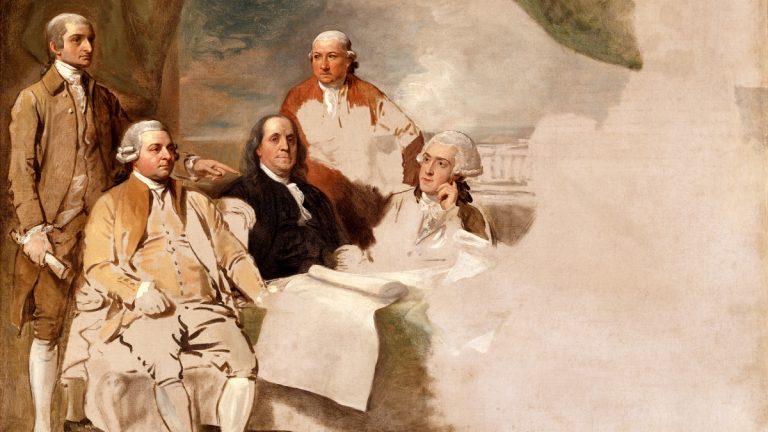
Image: Treaty of Paris by Benjamin West 1783.jpg, 1783-1784, from Benjamin West. Retrieved from: https://commons.wikimedia.org/wiki/File:Treaty_of_Paris_by_Benjamin_West_1783.jpg, used under Wikimedia Commons.

[1] John Lamberton Harper. American Machiavelli: Alexander Hamilton and the Origins of U.S. Foreign Policy. (Cambridge, UK; Cambridge University Press, 2004), 49.
[2] Harper, American Machiavelli, 32.
[3] Hansard, Parliamentary Debates, 1st series, xvii, col 161 (May 21, 1810).
[4] George C Herring, Years of Peril and Ambition, U.S. Foreign Relations, 1776-1921: The American Century and beyond, U.S. Foreign Relations, 1893-2015, (New York: Oxford University Press, 2017), 35.
[5] Jeremy Black, British Foreign Policy in an Age of Revolutions, 1783-1793, (Cambridge [England]; Cambridge University Press, 1994), 1.
[6] Harper, American Machiavelli, 59.
[7] Black, British Foreign Policy, 16.
[8] Harper, American Machiavelli, 31.
[9] Lawrence S Kaplan, Alexander Hamilton: Ambivalent Anglophile, (Wilmington, Del: SR Books, 2002), 51.
[10] Kaplan, Alexander Hamilton, 41.
[11] Boyd Hilton, A Mad, Bad, and Dangerous People?: England, 1783-1846, (Oxford: Oxford University Press, 2006), 32.
[12] Philip Harling, The Waning of ’Old Corruption’: The Politics of Economical Reform in Britain, 1779-1846, (New York: Oxford University Press, 1996), 33.
[13] Black, British Foreign Policy, 15.
[14] Harling, The Waning of ‘Old Corruption,’ 42.
[15] Arthur Burns, and Joanna Innes, Rethinking the Age of Reform: Britain 1780-1850, (Cambridge, UK; Cambridge University Press, 2003), 65.
[16] Christopher Wyvill, Political Papers, Chiefly Respecting the Attempt of the County of York and Other Considerable Districts, … to Effect a Reformation of the Parliament of Great Britain: Collected by the Rev. Christopher Wyvill, (York: printed by W. Blanchard: sold by J. Johnson, London and J. Todd, York, 1794) vol. ii, 336.
[17] Harper, American Machiavelli, 34.
[18] Harper, American Machiavelli, 45.
[19] Harper, American Machiavelli, 48; Walter Russell Mead, Special Providence: American Foreign Policy and How It Changed the World, (New York: Knopf, 2001), 117.
[20] Ritcheson, Aftermath of Revolution, 32.
[21] Ritcheson, Aftermath of Revolution, 61.
[22] Harling, The Waning of ‘Old Corruption,” 37.
[23] John Brewer, The Sinews of Power: War, Money, and the English State, 1688-1783, (Harvard University Cambridge, Mass: Harvard University Press, 1990), 114.
[24] Ritcheson, Aftermath of Revolution, 10.
[25] Ritcheson, Aftermath of Revolution, 31.
[26] Ritcheson, Aftermath of Revolution, 45.
[27] Ritcheson, Aftermath of Revolution, 42.
[28] Ritcheson, Aftermath of Revolution, 49.
[29] Harper, American Machiavelli, 36.
[30] Ritcheson, Aftermath of Revolution, 33.
[31] Duffy, The Younger Pitt, 166.
[32] Black, British Foreign Policy, 98.
[33] Black, British Foreign Policy, 16.
[34] Black, British Foreign Policy, 39, 41.
[35] Robert W. Smith, Keeping the Republic: Ideology and Early American Diplomacy, (DeKalb: Northern Illinois University Press, 2004), 39.
[36] Burton Spivak, Jefferson’s English Crisis: Commerce, Embargo, and the Republican Revolution, (Charlottesville: University Press of Virginia, 1978), 3.
[37] Harper, American Machiavelli, 32, 39
[38] Smith, Keeping the Republic, 54.
[39] Smith, Keeping the Republic, 38.
[40] Harling, The Waning of ‘Old Corruption,’ 16.
[41] Burns, Rethinking the Age of Reform, 98.
[42] Duffy, The Younger Pitt, 7.
[43] Spivak, Jefferson’s English Crisis, 4.
[44] Harper, American Machiavelli, 80.
[45] Smith, Keeping the Republic, 69.
[46] Ritcheson, Aftermath of Revolution, 29.
[47] Harper, American Machiavelli, 85.
[48] Black, British Foreign Policy, 54.
[49] Black, British Foreign Policy, 9.
[50] Black, British Foreign Policy, 30.
[51] Harper, American Machiavelli, 78.
[52] Harper, American Machiavelli, 76.
[53] Ritcheson, Aftermath of Revolution, 18.
[54] Ehrman, The Younger Pitt, 31.
[55] Ritcheson, Aftermath of Revolution, 15.
[56] Report of Committee of Lords of Privy Council on Trade of Great Britain with U.S., Jan. 1791 [Print of Unpublished Manuscript, with Data on Customs Duties, Trade, and Vessels by U.S. Port and Flag; with Reports of British Merchant Associations, and Legislation Introduced]. Congressional Document, 1888.
[57] Harper, American Machiavelli, 49.
[58] Harper, American Machiavelli, 47.
[59] Spivak, Jefferson’s English Crisis, 39.
[60] Jefferson, Thomas, William Peden, sponsoring body Institute of Early American History and Culture. Notes on the State of Virginia, (Chapel Hill: University of North Carolina Press, 1955), 41; Smith, Keeping the Republic, 21.
[61] Harper, American Machiavelli, 92.
[62] Smith, Keeping the Republic, 66.
[63] Smith, Keeping the Republic, 38.
[64] Harper, American Machiavelli, 48.
[65] Harper, American Machiavelli, 110.
[66] Harper, American Machiavelli, 185.
[67] Harper, American Machiavelli, 80.
[68] Meacham, Thomas Jefferson, 49.
[69] Harper, American Machiavelli, 125.
[70] Ehrman, The Younger Pitt, 179.
[71] The Commercial Treaty; or John Bull changing beef and pudding for frogs and soup maigre!. [England: Pub. by Wm. Holland, No. 66 Drury Lane, Novr. 25, 1786]
[72] Ritcheson, Aftermath of Revolution, 125.
[73] Ritcheson, Aftermath of Revolution, 16.
[74] Harper, American Machiavelli, 57.
[75] Smith, Keeping the Republic, 59.
[76] Alexander Hamilton, “Federalist 11” in The Federalist Papers, ed. Jacob Ernest Cooke (Middletown, Conn: Wesleyan University Press, 2014).
[77] Kaplan, Ambivalent Anglophile, 63.
[78] Herring, Years of Peril and Ambition, 46.
[79] Alexander Hamilton, Arthur Harrison Cole, Business Historical Society., and Business Historical Society. Industrial and Commercial Correspondence of Alexander Hamilton, Anticipating His Report on Manufactures. Edited by Arthur Harrison Cole, (Chicago: A.W. Shaw Company, 1928).
[80] Mead, Special Providence, 117.
[81] Samuel Flagg Bemis, Jay’s Treaty: A Study in Commerce and Diplomacy, (New York: Macmillan Company, 1923).
[82] Harper, American Machiavelli, 139.
[83] Harper, American Machiavelli, 133.
[84] Harper, American Machiavelli, 109.
[85] Spivak, Jefferson’s English Crisis, 6.
[86] Doron S. Ben-Atar, The Origins of Jeffersonian Commercial Policy and Diplomacy, (New York, N.Y: St. Martin’s Press, 1993).
[87] Herring, Years of Peril and Ambition, 44.
[88] Harper, American Machiavelli, 158.
[89] Duffy, Pitt the Younger, 179.
[90] Duffy, Pitt the Younger, 190.
[91] Duffy, Pitt the Younger, 192.
[92] Flagg Bemis, Jay’s Treaty, 89.
[93] Richard White, The Middle Ground: Indians, Empires, and Republics in the Great Lakes Region, 1650-1815, (New York: Cambridge University Press, 2011).
[94] John Bew, Castlereagh: A Life, (New York: Oxford University Press, 2012); Ehrman, The Younger Pitt, 345.
[95] Ritcheson, Aftermath of Revolution, 275.
[96] Harper, American Machiavelli, 173.
[97] Spivak, Jefferson’s English Crisis, 39.
[98] Spivak, Jefferson’s English Crisis, 49.
[99] Malone, Jefferson the President, 224.
[100] Spivak, Jefferson’s English Crisis, 9.
[101] Arthur Scherr, Thomas Jefferson’s Image of New England: Nationalism versus Sectionalism in the Young Republic, (Jefferson, North Carolina: McFarland & Company, Inc., Publishers, 2016).
[102] Spivak, Jefferson’s English Crisis, 65.
[103] Annals of Congress, 9th Congress, first session, p 554
[104] John Quincy Adams, edit. Robert Walsh. American Quarterly Review, (Philadelphia: Carey, Lea & Carey, 1827), vol I.
[105] Spivak, Jefferson’s English Crisis, 54.
[106] Spivak, Jefferson’s English Crisis, 27.
[107] Linda Colley, Britons: Forging the Nation, 1707-1837. Revised edition with new introductory essay, (New Haven, CT: Yale University Press, 1987), 312.
[108] Patrick K. O’Brien, “The Political Economy of British Taxation, 1660-1815.” The Economic History Review 41, no. 1 (1988): 1–32, 13.
[109] Harling, The Waning of ‘Old Corruption,’ 22.
[110] O’Brien, “The Political Economy,” 27.
[111] Cobbett, William. “COBBETT’S.” Cobbett’s Political Register, Aug. 24, 1819-July 14, 1821 14, no. 20 (1808): cccxciii–cccxciii.
[112] Spivak, Jefferson’s English Crisis, 55.
[113] Hilton, Mad, Bad, and Dangerous People, 55.
[114] Dumas Malone, Jefferson the President: Second Term, 1805-1809, (Boston: Little, Brown, 1974), 167.
[115] Malone, Jefferson the President, 169.
[116] Spivak, Jefferson’s English Crisis, 63.
[117] Spivak, Jefferson’s English Crisis, 61.
[118] Malone, Jefferson the President, 170.
[119] Spivak, Jefferson’s English Crisis, 64.
[120] Spivak, Jefferson’s English Crisis, 67.
[121] Robert Zoellick, “Whither China? From Membership to Responsibility.”National Committee on U.S.-China Relations, September 21, 2005. Accessed June 9, 2025 (https://www.ncuscr.org/wp-content/uploads/2020/04/migration_Zoellick_remarks_notes06_winter_spring.pdf).
[122] 2017 National Security Strategy: Issues for Congress (IN10842), 2.
[123] Rush Doshi, The Long Game : China’s Grand Strategy to Displace American Order, (Oxford University Press, 2021), 4.
[124] Anshu Siripurapu and Noah Berman, “The Contentious U.S.-China Trade Relationship,” in The Council on Foreign Relations, April 14, 2025. Accessed June 9, 2025 (https://www.cfr.org/backgrounder/contentious-us-china-trade-relationship).
[125] Doshi, The Long Game, 3, 297.