


Security and Strategy Journal
Amphibious Warships: The Joint Force’s Swiss Army Knife
Share On:
The United States faces warfighting capacity challenges across the joint force. With increased aggression from peer adversaries, China and Russia, and pronounced provocation from rogue states, such as Iran and North Korea, the United States faces a strategic challenge in how to build and maintain a force structure that is lethal and adaptable across theaters and a posture that offers flexibility from the moment crisis ensues to when conflict erupts. Across theaters, America’s naval and amphibious forces will be essential in supporting the joint force’s ability to extend control from the sea onto land. Given industrial base capacity constraints, procurement and building timelines, and anticipated defense budget figures, the fleet of today is the fleet with which the United States will likely enter its next large-scale kinetic conflict. While building the fleet of the future, the United States must adopt new methods of operating and embrace near-term requirements that will assist the United States in overcoming capability shortcomings while projecting the power necessary to deter adversaries and prevail should war arise.
In cooperation with the next generation of highly capable allies and partners, the United States must balance its military presence globally to deny adversaries the opportunity to attack or subvert. A strategy of deterrence by denial is the United States’ best approach for projecting the power needed to erode the confidence of an emboldened China. A state’s ability to deter rests in its capability to defend.1 The United States is already in possession of the best capability to deter and defend: its amphibious warships. Present amphibious capabilities meet the warfighting demands of today, providing U.S. forces with the capabilities needed to prevent or counter aggression vis-à-vis adversaries.
America’s amphibious warships offer the joint force necessary capabilities for the present and foreseeable battle space, namely the ability to project force in environments across the competition continuum. Amphibious warships have been referred to as the “Swiss Army Knives” of the fleet.2 Their design allows the vessels to operate at sea while enabling the joint force to operate on land, across theaters, and within weapon engagement zones.3 They function as miniature aircraft carriers and launchers for smaller watercraft while operating in harm’s way, freeing up carrier strike groups to execute other essential task orders. They are designed to rapidly transport thousands of personnel along with their vehicles and weapons globally. Amphibious warships have successfully deterred, defended, and protected U.S. and allied personnel, infrastructure, and vehicles in operations ranging from humanitarian missions to littoral campaigns.
These vessels allow the United States to bypass political and logistical burdens on host nations by operating from the sea and reducing the footprint ashore.4 They are well-positioned to serve as mothership vessels for autonomous and unmanned capabilities. Fundamentally, by enabling forward deployment, they extend and distribute a full spectrum range of U.S. capabilities that is essential for power projection and thereby, deterrence.
Strategic deployment of amphibious capabilities requires hand-in-glove cooperation between the United States Navy and Marine Corps. Hard choices and a sober assessment of operational concepts must be made to prepare a force structure that can deliver the joint force to the fight—one that will likely play out across multiple theaters and could involve multiple adversaries.
This assessment explores why amphibious warships are well suited for the current threat environment and why their role in executing a strategy of deterrence by denial should be reviewed and enhanced. Furthermore, this paper assesses how new operational concepts and near-term requirements using the existing amphibious fleet can ultimately assist the United States in winning the competition, not simply managing it.
State of Play: America’s Amphibious Fleet
Fundamentally Versatile
Amphibious warships are naval vessels designed to support offensive operations requiring the projection of ground, sea, and air power, most often onto a hostile landing beach. These vessels vary in their size, payload, speed, and designated specialized purpose. Beyond delivering troops and materiel ashore, these watercraft are configured to launch armaments ranging from traditional firepower to drones. Fundamentally, they are designed to support operational maneuvers from the sea, ship to objective maneuvers, and forward deployment of aircraft.5
Amphibious capabilities are at the heart of naval integration between the U.S. Navy and the Marine Corps. The Navy is responsible for purchasing and maintaining the nation’s amphibious fleet, while the Marine Corps plans its budget and operations around how many amphibious ready groups will be necessary to support Marine Expeditionary Units.6 Presently, there are 32 warships in the U.S. amphibious fleet, one more than the Navy is required by law to maintain.7 The 32 ships fall into four primary groupings: general purpose amphibious assault ships (LHAs), multi-purpose amphibious assault ships (LHDs), amphibious transport docks (LPDs), and dock landing ships (LSDs). Figure 1 offers an overview of the number, air and landing craft, and armament capabilities of the current amphibious fleet.
| Active | Aircraft & Landing Craft | Armament | |
| LHA (America-Class) | 2 | Aircraft: – F-35B Joint Strike Fighters (JSF) STOVL aircraft – MV-22 Osprey VTOL tiltrotors – CH-53E Sea Stallion helicopters – UH-1Y Huey helicopters – AH-1Z Super Cobra helicopters – MH-60S Sea Hawk helicopter | – Two RAM launchers – Two NATO Sea Sparrow launchers (with Evolved Sea Sparrow Missile (ESSM) – Two 20mm Phalanx CIWS mounts – Seven twin .50 caliber machine guns |
| LHD (Wasp-Class) | 7 | Aircraft: – 12 CH-46 Sea Knight helicopters – Four CH-53E Sea Stallion helicopters – Six AV-8B Harrier attack aircraft – Three UH-1N Huey helicopters – Four AH-1W Super Cobra helicopters (planned capability to embark MV-22 Osprey VTOL tiltrotors) – F-35B Joint Strike Fighters (JSF) STOVL aircraft | – Two RAM launchers – Two NATO Sea Sparrow launchers; three 20 mm Phalanx CIWS mounts (two on LHD 5-8) – Four .50 caliber machine guns – Four 25 mm Mk 38 machine guns (LHD 5-8 have three 25 mm Mk 38 machine guns) |
| LPD (San Antonio- Class) | 13 | Aircraft: – CH53E Super Stallion helicopters – MV-22 Osprey tiltrotor aircraft – Up to four CH-46 Sea Knight helicopters, AH-1 or UH-1 helicopters – MH-60S Sea Hawk helicopter Landing/Attack Craft: – Two LCACs or one LCU – 14 Expeditionary Fighting Vehicles/Amphibious Assault Vehicles | – Two Bushmaster II 30 mm Close in Guns – Two Rolling Airframe Missile launchers – Ten .50 caliber machine guns. |
| LSD (Harpers Ferry-Class & Whidbey Island-Class) | 10 | Aircraft: – MV-22 Osprey – CH-53E Super Stallion – UH-1Y Venom – AH-1Z Viper – AH-1W Cobra – MH-60S Knighthawk (Seahawk) Landing/Attack Craft–LSD 41 Class: – Four LCACs or 2 LCUs Landing/Attack Craft–LSD 49 Class: – 2 LCACs or 1 LCU | – Two 25mm MK 38 Machine Guns – Two 20mm Phalanx CIWS mounts – Six .50 caliber machine guns – Two Rolling Airframe Missile (RAM) mounts. |
Figure 1: Amphibious Fleet Overview 20258
Providing Historical Advantages: The Use of Amphibious Vessels in U.S. Naval Operations
Amphibious capabilities have been significant to U.S. naval operations for over a century. During the Second World War, amphibious warships were essential to landing operations where attacking U.S. forces came ashore in the face of significant opposition fire.9 Amphibious vessels with sizable well decks and cargo capacity delivered U.S. forces onto the beaches of Normandy, Tarawa, and Peleliu. By the time of Japan’s surrender in 1945, the United States had conducted 2,574 large-scale amphibious operations and nearly one thousand more small-scale ones.10 America’s amphibious strategy played a significant role in the successful defeat of Japanese forces. In the subsequent peacetime years, the Navy cut its amphibious forces down to 79 ships.11
By 1950, defense planners were faced with the vastness of the Soviet bloc and the destructive power of nuclear weapons. In pursuit of a way to conduct long-range operations while dispersing to avoid nuclear attacks, planners reinvigorated the use of amphibious warships to transport troops and materiel. As the Cold War progressed, the use of ship-based helicopters added an additional dimension to amphibious assaults by allowing landing forces to seize objectives inland and support beach landings.12 In the 1970s, full-length flight decks and hangars aboard Iwo Jima-class ships were combined with the docking well of Austin-class amphibious transport dock ships to produce the largest purpose-built amphibious vessel to date.13
The end of the Cold War saw the decline in amphibious ship numbers and capabilities. By 1994, the U.S. Navy decommissioned 23 of its amphibious ships.14 As the nation’s defense budget contracted, these vessels were replaced with larger amphibious warships in fewer numbers. In the years following the September 11 attacks, the Marine Corps, along with vast swathes of the joint force, pivoted to engagement in Iraq and Afghanistan.
The Marine Corps was instrumental to the United States’ ability to sustain dispersed operations during the Global War on Terror. Under Task Force 58, which was stood up in 1944 to enhance carrier-based naval warfare, the Marine Corps established amphibious squadrons 1 and 8 and the 15th and 26th Marine Expeditionary Units to conduct the longest-range assault from the sea in U.S. naval history.15 On November 25, 2001, these units executed multiple maneuver elements on the USS Peleliu and USS Bataan that projected 350 miles inland to seize an airstrip in Kandahar.16
Despite bearing little resemblance to the invasions of Normandy and Inchon, Task Force 58’s maneuvers constituted “forcible entry.”17 These operations underscore the adaptability of amphibious operations in circumstances both inside and outside of the theater of combat operations.18 As the United States became further entrenched in Afghanistan and Iraq, and with the increased demand on the Marine Corps for support to land-based counterinsurgency operations, the “amphibious fleet was, at best, an afterthought.”19
The Next Conflict: Why Amphibious Capabilities? Why Now?
As great power competition reemerges to define the present strategic security environment, U.S. defense planners should assess how amphibious capabilities can meet the moment by filling capability gaps and executing a strategy of denial against multiple adversaries. Recent strategic guidance has called for a flexible joint force capable of managing and sustaining multiple theaters of operation. The 2018 National Defense Strategy explicitly calls for the joint force to sustainably compete to deter aggression in three key regions: the Indo-Pacific, Europe, and Middle East.20 This task has become increasingly difficult as adversaries’ capabilities have expanded, leaving U.S. forces increasingly overstretched.
Deterrence across multiple theaters will require a ready fleet of multi-mission combatants capable of countering different adversaries in varied contested environments. The United States Navy does not presently and will not in the next decade have enough surface or subsurface vessels to fight a protracted conflict anywhere in the world. In a war with China, naval forces will be allocated quickly and positioned in critical in- theater locations. There will likely not be enough surface vessels to support operations in-theater, let alone enough vessels to deter further escalation of kinetics. Persistent engagement with the PLA Navy will outstrip U.S. naval capabilities quickly. China is likely to contest sea lines throughout the Pacific, and even possibly the Arabian Gulf, thereby making U.S. maneuvers into the region far more difficult. As the U.S. surface fleet moves into the region, amphibious vessels will be available for the necessary execution of other sea control missions in the Pacific and other theaters that could inevitably be dragged into the broader conflict.
Compared to carrier operations, amphibious operations are regarded as “less escalatory, more compatible with allied forces, and cheaper and more efficient for the presence and engagement missions called for in the National Defense Strategy.”21 Amphibious vessels have increasing mission utility for such deterrence-based operations. The expansive subcomponent systems aboard a carrier increase the cost of its loss and vulnerability to missile, drone, and cyber attacks.22 While amphibious vessels face vulnerability, equipping them with inexpensive, off-the-shelf unmanned systems and drones will make them more useful platforms in conflict.
From The Seabed to the Heavens: Enabling Power Projection & Presence
During Exercise Trident Juncture 2018, then-Major General David Coffman, U.S. Marine Corps, described amphibious ships’ usefulness to combatant commanders as a multiplication problem: “capacity times capability times readiness equals lethality.”23 At a later date, he elaborated: “It’s multiplication, not addition – so if you have a zero in any one of these categories, you end up with a big fat nothing.”24 While measures to improve capacity and readiness will bear results in the medium- to long-term future, the present force has the ability to emphasize and enhance current capabilities in support of the joint force. To deter China from advancing its claims in the Pacific, the United States must increase its presence and bolster its ability to project power by innovatively operating the current fleet and enhancing it with available and off-the-shelf kits.
Presence in the Campaigning Stage
The presence of amphibious warships supports engagement, theater-wide operations, and adversary deterrence. They maintain presence by “serving as the cornerstone of the amphibious ready group (ARG) or expeditionary strike group (ESG).”25 U.S. amphibious vessels transport and deliver elements of the Marine Expeditionary Unit (MEU) or Marine Expeditionary Brigade (MEB) with a combination of air and landing craft.26 The platform’s size, payload, launch, and fire capabilities make it well suited for campaigning, crisis response, and full-scale war.
As pre-positioned ready responders to support missions ashore, amphibious capabilities offer the United States the ability to respond quickly with relative ease. In time of emerging crisis or limited contingency operations, amphibious capabilities allow U.S. forces to protect American citizens and U.S. interests, strengthen alliances, conduct information operations, and expand influence. They stand ready as bases of operations ready to maneuver ashore when needed. In doing so, MEUs offer credible deterrence and decision time across various military operations.27 Furthermore, pre-positioned amphibious forces create assured access and freedom of the seas, thereby enabling the sustainment of sea-based operations, sometimes indefinitely, and without the burden or complications of in-theater host-government support.28 Credible demonstration of forced-entry capabilities will compel adversaries to distribute their defenses over broader swathes of territory at sea and on land.
In the Pacific theater, such forward presence is made complicated by China’s extensive anti-access area denial (A2AD) systems, which include anti-ship, anti-air, and anti-ballistic weapons, submarines, and other naval and aerial capabilities surrounding the South China Sea, the East China Sea, and the Strait of Taiwan. In a scenario in which the United States must escalate toward a major contingency posture, amphibious vessels can deliver critical components to the theater’s nexus of operations.
Power Projection
Amphibious vessels are poised to significantly enhance sea control and strike missions. By harnessing their ability to operate within weapon engagement zones, amphibious vessels can project power into contested environments. Providing a mobile and flexible platform for the deployment of aircraft, amphibious warships project air power. Their sensors and fires network coordinate and deliver diversified types of fire support that can support joint operations beyond the individual amphibious warship. Operating individually, in support of an Amphibious Ready Group, as a part of a Marine-Air-Ground Task Force, or by enabling Expeditionary Advanced Base Operations, amphibious vessels can collectively employ fires, information activities, and systems to create desired effects and to achieve objectives in the battlespace. In a single battle concept, Marine-Air-Ground Task Force fires and maneuvers shape the battlespace and set conditions for decisive action and mission execution. These fires are able to degrade, delay, or disrupt enemy forces or capabilities. By positioning in small numbers close to the enemy, these operations launched from amphibious warships can constrain the adversary’s freedom of movement.
China has developed a formidable and layered A2AD system of systems intended to prevent or delay U.S. intervention in the South China Sea. By positioning anti-air and anti-surface system missiles, ballistic missiles, and cruise missile along the coastline, China has established systems capable of engaging targets hundreds of miles away. By limiting U.S. access to the target space, China has created a regional imbalance without yet even firing a shot. The presence of and risk posed by anti-ship ballistic missiles will make it undoubtedly difficult for U.S. forces to engage along the coastline. The amphibious fleet, equipped with enhanced armaments, can withstand the threat of entering the A2AD territory and weapons engagement zone. Furthermore, with modified ISR capabilities, they can be made more difficult for Chinese radar to spot.
The Way Forward: Enhancement for Joint All-Domain Operations
To better support joint all-domain operations and to deliver presence and power projection, enhancements to amphibious warships can be made with already available equipment and the modification of basic operational plans. Amphibious warships outfitted with enhanced fire power, intelligence, surveillance, and reconnaissance capabilities, and air defense systems will be force multipliers for the joint force in preparing for battle with China.
Bolt-On Lethality
Conflict has always been a catalyst for innovation. During Operation Iraqi Freedom, “large-deck amphibious ships adapted to a new mission for which they had never trained, acting in an aircraft carrier role by conducting expeditionary strike warfare.”29 These LHDs became known as “Harrier carriers” and increased the Navy’s warfighting options by modifying and capitalizing on the ships’ multifaceted capabilities. The naval expertise on board large-deck amphibious platforms, combined with Marine Corps air assets, served as a powerful force multiplier for the operation.30 Despite operational challenges and operating under a short-notice surge deployment, the Harrier carrier concept allowed amphibious warships to maintain presence, create flexible maintenance options in the theater, and serve as another point from which to launch attacks. During a state of competition, the integration of a modernized Harrier carrier concept strategy will enhance readiness across the fleet. During war, it will allow U.S. forces to surge the necessary numbers of aircraft in needed in theater.
In the current geopolitical climate, using large-deck amphibious warships as strike platforms would relieve some burden borne by the Navy’s carrier fleet. Current design requirements for amphibious vessels in production have been adequately updated to equip amphibious ships with the air and fire power to support the carrier fleet. By normalizing and embracing the use of amphibious warships as strike platforms, the Marine Corps can more rapidly plug and play to provide presence and alleviate burden on the carrier fleet. Such considerations are currently underway for advancements that will increase expeditionary war fighting capabilities, but adoption is not projected to be in the near future.
Beyond traditional air capabilities, amphibious vessels can serve as motherships for unmanned technologies in the air, on the surface, and beneath the surface. Given their proximity to shore, amphibious vessels are well positioned to gather intelligence on a defended port or beach prior to an amphibious assault. By evaluating the operations environment with less risk to the individual Sailor or Marine, the pairing of unmanned systems and amphibious vehicles will be a force multiplier for expeditionary strike groups. Beyond the central role unmanned systems will play in ISR, these unmanned systems could play a potentially significant role in assault functions and loitering munitions.31
The United States will face adversaries fielding weapons and targeting capabilities designed to delay and reduce the effectiveness of U.S. or other forces that may attempt to intervene on behalf of allies, most notably Taiwan. These adversarial capabilities are less effective at targeting ground units composed of smaller and less concentrated capabilities than larger ships or aircraft. Herein lies a possible opportunity for U.S. forces to exploit the targeting gap and establish expeditionary advanced base operations in littoral areas near potential objectives.32
To persist in contested environments, these warships should be equipped with Vertical Launch System magazines that carry medium-range air defense surface-to-air missiles in large numbers and anti-ship strike weapons which would enable them to launch attacks at the same time as long-range raids by marines in MV-22s.33 Another proposed arming enhancement is the Army’s Indirect Fire Protection Capability Increment 2-1 paired with the employment of camouflage and electronic warfare systems to defeat enemy targeting sensors.34 Marines in littoral environments would benefit from systems, such as the Army’s Tactical Missile System, to persist within weapons engagement zones and to support cross domain operations.35
The addition of existing advanced missile systems abroad amphibious warships will increase capabilities and offer the joint force more options for offensive and defensive operations. Long range anti-ship missiles like the Naval Strike Missile and the High Mobility Artillery Rocket System will improve anti-air and anti-surface warfare capacities.
Arming amphibious warships for expeditionary advanced base operations will prepare Marines to fight protracted campaigns where they may need to deny the adversary access to imported or exported goods that support or fund the conflict. However, mounting a blockade will require more than sea control. Amphibious operations could be pivotal in assisting with the massive lift and personnel barriers to effectively executing a blockade. Mounting a blockade will require a greater emphasis on air control and aviation. Reviewing the composition of amphibious ready groups can be altered to meet this demand.
Operational Concepts
Updated operational concepts will be paired with short-term requirement updates to enable effectiveness. Debates over the Navy’s force design needs have led to a potentially more significant debate over how the Navy informs its own requirements. Resource-informed requirements stand in opposition to operational requirements. Requirements driven by resources assessments do adequately consider industrial building capability, maintenance schedules, and budgetary constraints, but fall short of alignment with the reality of amphibious vessels’ operational use. Effectively, resource-driven requirements act as budget submissions. Furthermore, the execution of deterrence by denial will need to be encompassed by a strategy-driven budget and force design built upon operational requirements. In order to support the joint force’s fight in the Indo-Pacific, the U.S. Navy, Marine Corps, and Army should look to amphibious vessels as platforms for achieving cross-service all-domain objectives.
If the Marine Corps were to move from a three-ship formation to a four-ship amphibious ready group formation, Marines would be able to field a force with between seventy and one hundred percent more strike aircraft while sacrificing little airlift capability.36 An evolution to a four-ship formation would refocus large deck amphibious vehicles on strike aviation and would include more small deck amphibious ships to enable a more distributed amphibious force while carrying rotary wing aircraft that are displaced by the addition of extra attack fighters on amphibious assault ships. Furthermore, the shift to a four-ship amphibious ready group would reduce the number of complete amphibious ready groups deployed at any one time, even if the total number of amphibious ships remains the same. This shift has the potential to yield massive solutions for maintenance issues facing the amphibious fleet. Furthermore, this formation would relieve intense stress placed on the carrier fleet which requires even more time for training and maintenance.
| Active | Aircraft, Landing Craft, & Unmanned Systems | Armament | |
| Four-Ship Amphibious Ready Group | 4 | Aircraft: – F-35B Joint Strike Fighters (JSF) STOVL aircraft – MV-22 Osprey VTOL tiltrotors – CH-53E Sea Stallion helicopters – UH-1Y Huey helicopters – AH-1Z Super Cobra helicopters – MH-60S Sea Hawk helicopter – Enlarged hangar deck, enhanced aviation maintenance facilities, increased aviation fuel capacity, additional aviation storerooms, removal of the well deck, and an electronically reconfigurable C4ISR suite Landing/Attack Craft: – Two LCACs or one LCU – 14 Expeditionary Fighting Vehicles/Amphibious Assault Vehicles – Army Tactical Missile System Unmanned: – Proteus large-diameter UUV – Metal Shark Long Range Unmanned Surface Vessel – GhostX Platform | – Two RAM launchers – Two NATO Sea Sparrow launchers; three 20 mm Phalanx CIWS mounts (two on LHD 5-8) – Four .50 caliber machine guns – Four 25 mm Mk 38 machine guns (LHD 5-8 have three 25 mm Mk 38 machine guns) – Two Bushmaster II 30 mm Close in Guns – Two Rolling Airframe Missile launchers – Ten .50 caliber machine guns – Mk 41 Vertical Launch System – Army Tactical Missile System – Two RAM launchers – Two NATO Sea Sparrow launchers (with Evolved Sea Sparrow Missile (ESSM)) – Two 20mm Phalanx CIWS mounts – Seven twin .50 caliber machine guns – Mk 41 Vertical Launch System – HIMARS |
Figure 2: Proposed Amphibious Fleet Capability Enhancements 2026-202837
Delivering the Joint Force to the Fight
Referencing China’s potential invasion of Taiwan, Admiral Samuel Paparo, USN, Commander of U.S. Indo-Pacific Command, stated, “The ability to deliver fast, accurate and lethal fires across domains is fundamental.”38 U.S. air and maritime superiority are not enough to deter an invasion. The joint force needs the capability to deny China access to the Strait of Tawain and must decisively establish multi-domain task forces with amphibious capabilities central to the mission.
Given fleet constraints, the amphibious fleet offers the United States a versatile asset that can be made more lethal and distributive through updated operational concepts. By leveraging the amphibious fleet’s ability to project power, the joint force can use amphibious warships to penetrate the most dangerous waterways. Arming these vessels adequately will be key. Operationalizing amphibious vessels as motherships for emerging, highly lethal drones and unmanned systems will revolutionize U.S. capability range. These enhancements reflect the operational use of the vessels and realistic procurement forecasting.
Without forward deployment and readiness to engage in contested environments, U.S. forces will be unable to exercise the presence necessary for executing a strategy of denial—the best strategy for deterring adversaries in multiple theaters. Taking stock of assets, arming them adequately, innovating rapidly and inexpensively, and working with allies and partners is how the United States will win the competition, not just manage it.
Gabrielle Moran is an Associate at Dataminr where she focuses on maritime strategy in support of U.S. Navy, U.S. Marine Corps, and Office of the Secretary of Defense clients. She graduated from American University with a bachelor’s degree in international studies. Gabrielle is an alumna of SSS Russia and Iran.
The views expressed in this publication are those of the author and do not reflect the official stance of Dataminr or the Department of Defense.
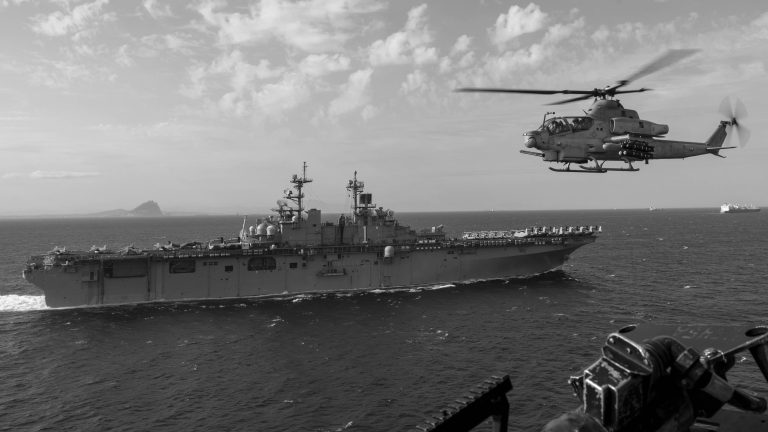
Image: Viper flies patrol for the USS Wasp (LHD 1) as it transits the Strait of Gibraltar, June 26, 2024, from U.S. Navy Mass Communication Specialist 2nd Class Sydney Milligan. Retrieved from: https://commons.wikimedia.org/wiki/File:VMM-365_AH-1Z_Viper_flies_patrol_for_the_USS_Wasp_%28LHD_1%29_as_it_transits_the_Strait_of_Gibraltar.jpg, used under Wikimedia Commons.
[1] Michael J. Mazarr, “Understanding Deterrence,” RAND Corporation, 2018, https://www.rand.org/content/dam/rand/pubs/perspectives/PE200/PE295/RAND_PE295.pdf.
[2] “Amphibious Warships,” Capabilities, HII, accessed September 15, 2024, https://hii.com/what-we-do/capabilities/amphibious-ships/.
[3] Joint Chiefs of Staff, Amphibious Operations (Washington, DC: Joint Chiefs of Staff, 2021), 6-11, https://www.jcs.mil/Portals/36/Documents/Doctrine/pubs/jp3_02.pdf.
[4] Joint Chiefs of Staff, Amphibious Operations, 6-11.
[5] U.S. Navy, Amphibious Assault Ships: LHD/LHA (R) (Washington, DC: U.S. Navy, 2021), https://www.navy.mil/Resources/Fact-Files/Display-FactFiles/Article/2169814/amphibious-assault-ships-lhdlhar/.
[6] Megan Eckstein, “Amphib ship requirements study could spell bad news for Marines, industry,” Defense News, January 18, 2022, https://www.defensenews.com/naval/2022/01/18/amphib-ship-requirements-study-could-spell-bad-news-for-marines-industry/.
[7] Government Accountability Office, Amphibious Warfare Fleet: Navy Needs to Complete Key Efforts to Better Ensure Ships Are Available for Marines (Washington, DC: Government Accountability Office, 2024), https://www.gao.gov/assets/gao-25-106728.pdf.
[8] U.S. Navy, Amphibious Assault Ships: LHD/LHA (R).
[9] Naval History and Heritage Command, Naval Amphibious Forces Shoulder Insignia (Washington, DC: Naval History and Heritage Command, 2020), https://www.history.navy.mil/our-collections/artifacts/uniforms-and-personal-equipment/pins–badges–and-insignia/patches/amphibious-forces-patch.html.
[10] Kyle Mizokami, “Amphibious Evolution,” Proceedings 146, no. 11 (2020), https://www.usni.org/magazines/proceedings/2020/november/amphibious-evolution.
[11] Mizokami, “Amphibious Evolution.”
[12] Mizokami, “Amphibious Evolution.”
[13] Mizokami, “Amphibious Evolution.”
[14] Mizokami, “Amphibious Evolution.”
[15] Task Force 58, “Task Force 58/38,” https://www.taskforce58.org/task-force-58-task-force-38/.
[16] George Galdorisi and Scott C. Truver, “The U.S. Navy’s Amphibious Assault Renaissance: It’s More Than Ships and Aircraft,” War on the Rocks, December 12, 2018, https://warontherocks.com/2018/12/the-u-s-navys-amphibious-assault-renaissance-its-more-than-ships-and-aircraft/.
[17] Galdorisi and Truver, “The U.S. Navy’s Amphibious Assault Renaissance: It’s More Than Ships and Aircraft.”
[18] Gregory Bereiter, “The U.S. Navy in Operation Enduring Freedom 2001-2002,” Naval History and Heritage Command, April 22, 2024, https://www.history.navy.mil/content/dam/nhhc/research/library/online-reading-room/war-and-conflict/us-navy-operation-enduring-freedom/Chrono-OEF%20%20.pdf.
[19] Galdorisi and Truver, “The U.S. Navy’s Amphibious Assault Renaissance: It’s More Than Ships and Aircraft.”
[20] U.S. Department of Defense, Summary of the 2018 National Defense Strategy of the United States (Washington, DC: U.S. Department of Defense), https://dod.defense.gov/portals/1/documents/pubs/2018-national-defense-strategy-summary.pdf.
[21] Noel Williams, “Samson the Carrier and Goliath the Amphib: Twin Giants of a Compromised Fleet Architecture,” War on the Rocks, March 7, 2019, https://warontherocks.com/2019/03/samson-the-carrier-and-goliath-the-amphib-twin-giants-of-a-compromised-fleet-architecture/.
[22] Williams, “Samson the Carrier and Goliath the Amphib.”
[23] Megan Eckstein, “Navy Pitching Amphibious Warship Overhaul to Boost Lethality, Survivability,” USNI News, November 13, 2018,https://news.usni.org/2018/11/13/amphibious-warship-upgrade-plan-to-outline-offensive-capabilities-for-lpds-lhd-midlife-overhauls?utm_source=USNI+News&utm_campaign=8028442daf-USNI_NEWS_WEEKLY&utm_medium=email&utm_term=0_0dd4a1450b-8028442daf-230408805&mc_cid=8028442daf&mc_eid=afeaead07e%5d.
[24] Eckstein, “Navy Pitching Amphibious Warship Overhaul to Boost Lethality, Survivability.”
[25] U.S. Navy, Amphibious Assault Ships: LHD/LHA (R).
[26] U.S. Navy, Amphibious Assault Ships: LHD/LHA (R).
[27] U.S. Marine Corps, “Amphibious Ready Group and Marine Expeditionary Units,” https://www.marines.mil/portals/1/Amphibious%20Ready%20Group%20And%20Marine%20Expeditionary%20Unit%20Overview.pdf.
[28] U.S. Marine Corps, “Amphibious Ready Group and Marine Expeditionary Units,” https://www.marines.mil/portals/1/Amphibious%20Ready%20Group%20And%20Marine%20Expeditionary%20Unit%20Overview.pdf.
[29] Cindy Rodriguez, “Harrier Carriers Perform in Iraqi Freedom,” Proceedings 130, no. 2, (2004), https://www.usni.org/magazines/proceedings/2004/february/harrier-carriers-perform-iraqi-freedom.
[30] Rodriguez, “Harrier Carriers Perform in Iraqi Freedom.”
[31] Williams, “Samson the Carrier and Goliath the Amphib.”
[32] Clarke and Sloman, “Amphibious Operations in a Brave New World.”
[33] Clarke and Sloman, “Amphibious Operations in a Brave New World.”
[34] Clarke and Sloman, “Amphibious Operations in a Brave New World.”
[35] Clarke and Sloman, “Amphibious Operations in a Brave New World.”
[36] Clarke and Sloman, “Amphibious Operations in a Brave New World.”
[37]U.S. Navy, Amphibious Assault Ships: LHD/LHA (R).
[38] Matthew Olay, “Indo-Pacom Commander Highlights Army’s Regional Contribution,” Department of Defense, May 2025, https://www.defense.gov/News/News-Stories/Article/Article/4186821/indo-pacom-commander-highlights-armys-regional-contribution.