
Hamiltonian Journal
Shared Burdens, Shared Futures: Rethinking U.S.-ROK Defense Cost-Sharing
Share On:
President Donald Trump has wasted no time setting new domestic and foreign priorities for the United States under his leadership as the forty-seventh president. On day one of his second term, he made an official statement that the U.S. Department of State will proceed with “America-first foreign policy.” [1] In the domain of U.S. foreign defense spending, the administration argues that the United States cannot afford to continue subsidizing other nations’ security at its own expense. Now more than ever, each U.S. ally must contribute its fair share for the U.S. security guarantee.
As the administration is reassessing U.S. commitments abroad, this is a pertinent time to reevaluate the virtues and pitfalls of the U.S. security alliance with the Republic of Korea (ROK). For the future fortitude and longevity of this alliance, U.S. policymakers should act now to renegotiate this alliance such that the ROK contributes at least $5 billion USD annually rather than the previously negotiated $1.13 billion USD. [2] This figure is rumored to be President Trump’s desired ROK contribution, according to ROK media and U.S. congressional aides. [3] A $5 billion USD commitment would underscore the ROK’s deep investment in the alliance, while also serving as a tangible achievement for politicians to showcase to their constituents. Policymakers can more successfully renegotiate by utilizing a contribution calculation method outlined below, in addition to leveraging the immense value of U.S.-backed nuclear and conventional deterrence to the region’s security.
A Brief History of the U.S. Security Guarantee in the ROK
The United States first became involved in the security of the ROK at the end of the Pacific War when it began to defend the land south of the 38th parallel north, overseeing the removal of the occupying Japanese forces who had been there since 1910. [4] Later on, during the 1950-1953 Korean War, the United States was the fiercest foreign defender of the ROK, sending 1,789,000 troops in total. Comparatively, the United Kingdom sent the second highest quantity of foreign troops with 81,084. [5] The U.S.-ROK defensive alliance became formalized with the signing of the Mutual Defense Treaty in 1953. The ROK granted the United States the right to station land, air, and sea forces in ROK territory, and in return, the United States pledged to provide assistance in case of an armed attack against the U.S.-recognized territory of the ROK. [6] This alliance and security guarantee has proven to be firm and effective, as it has successfully deterred conflict in the Korean Peninsula for over 70 years.
The United States remains strong in its commitment to the ROK today. For instance, the U.S. Forces Korea (USFK) currently contains about 28,500 U.S. service personnel who are stationed in the ROK and operate under the doctrine of being ready and willing to “fight tonight!” [7] The fourth Nuclear Consultative Group (NCG) meeting that took place in Washington, D.C. on January 10, 2025 saw the United States reaffirm that its “extended deterrence to the ROK is backed by the full range of U.S. capabilities, including nuclear.”[8] As the historical and present-day efforts demonstrate, the United States is a formidable and valuable ally to the ROK. It is time for the ROK’s financial contribution to the alliance to reflect this value.
Comparing Apples to Apples: Strategizing to Renegotiate Defense Cost-Sharing with the ROK
While the ROK may be reluctant to increase its defense spending, there are a few strategies U.S. policymakers can use to facilitate a successful renegotiation. One of the most important of these is to understand the numbers and present them in an even and fair way. A popular argument among those opposed to the $5 billion USD contribution pledge is that it would be a roughly 400 percent increase from the current contribution, which opponents would argue is unreasonable and absurd. [9] This argument is misleading and misconstrues the data. A more appropriate way to view the situation is to compare the requested increase in ROK contribution to the actual contribution of the United States. If the United States were demanding the ROK to contribute beyond what the United States is willing to put in, then this would indeed be unfair and unreasonable. But the reality is that the United States is merely requesting that the ROK equalize its defense spending as a percentage of its gross domestic product (GDP) with that of the United States.
As a percentage of its GDP, the United States spends roughly 3.013 percent of GDP on defense. This is calculated using the $961.6 billion USD budget request from the Department of Defense for fiscal year 2026 and the most recent current-dollar GDP estimate from the Department of Commerce of $31.92 trillion USD reported for the first quarter of 2025. [10-11] With the latest data from 2024 and 2025, the ROK spent approximately 2.456 percent of GDP on defense. This calculation is based off the $1.79 trillion USD estimate for the ROK’s GDP in 2025 as reported by the International Monetary Fund and the $43.96 billion USD defense budget request for 2025 published by the ROK Ministry of National Defense. [12-13] Using these numbers, an extra $5 billion USD added to ROK defense spending would raise their percentage to roughly 2.735 percent of GDP. Adding even $10 billion USD, as President Trump floated in October 2024, would bring the percentage to about 3.015 percent of GDP and equalize ROK defense spending with U.S. defense spending as percentages of their respective GDPs. [14] Suddenly, $5 billion does not seem so extreme.
Some may argue that this analysis is incomplete and note that supporting the U.S.-ROK alliance should be peripheral to the overall ROK defense budget, given the vast military and financial superiority the United States holds over the ROK, as well as concern for ROK defensive self-reliance, especially in light of perceived U.S. unreliability. But this argument does not properly appreciate the weight and value of the U.S. security guarantee. Indeed, it fails to acknowledge one crucial aspect: deterrence.
U.S.-Backed Deterrence: The True Value of a U.S. Security Alliance
U.S. negotiators should invite their counterparts in Seoul to consider the following question, “Without the United States, to whom can the ROK turn for protection against China and North Korea?” If Seoul decides to walk away from the U.S. security guarantee instead of sharing more of the costs, it will be forced to find a new source of deterrence. This would be a monumental challenge. To reinstate nuclear deterrence, which is important given the nuclear weapons held by the ROK’s hostile northern neighbor, the ROK would need to itself nuclearize or find a new nuclear umbrella. Given that the two other nuclear umbrellas it could theoretically shelter under are those of Russia and China, two authoritarian states allied with North Korea, the only viable option would be to nuclearize. If it did nuclearize, the ROK would ostracize itself from military alliances by violating the norms set by the Treaty on the Non- Proliferation of Nuclear Weapons (NPT), to which it has been a signatory since 1975; and even with nuclear weapons, the ROK would still not be able to compete with the might of the major power players of Russia and the People’s Republic of China (PRC). [15] Furthermore, if Seoul were to pursue a nuclear weapons program, it could risk severe sanctions from major global powers that are signatories to the NPT. For context, the only nations not currently signed on to the NPT are Israel, India, Pakistan, South Sudan, and the Democratic People’s Republic of Korea (DPRK). [16] All things considered, the ROK has more to lose than to gain from giving up U.S.-backed nuclear deterrence.
The ROK cannot ignore its surrounding threat environment. Peninsular tensions remain high following Supreme Leader Kim Jong Un’s declaration in January 2024 that the DPRK would no longer seek reunification, but rather enduring competition and even conflict with the ROK, the “invariable principal enemy” of the DPRK. [17] If the DPRK were to invade its southern neighbor, the ROK would be outgunned without U.S. support given the strength of North Korean allies, Russia and China. The relationship between North Korea and Russia – already grounded in a mutual defense pact – is deepening by the day, as Pyongyang supplies ammunition and even troops to support President Vladimir Putin’s war against Ukraine. [18] The PRC, an expansionist power with historical ties to the DPRK dating back to the Korean War, is an even bigger threat. Given Chinese claims on Taiwan and the Japanese Senkaku Islands, it is possible to imagine that the PRC might eventually target the ROK over historical Chinese involvement on the Korean Peninsula. A perhaps more realistic fear is that, without the U.S.-ROK alliance, the PRC could Finlandize the ROK in the event of a victorious conquest of Taiwan. The PRC could prevent the ROK from intervening to support Taiwan by threatening to support a DPRK invasion of the ROK in return. Without the backing of the United States to wage a (potentially nuclear) war against the DPRK, the ROK cannot afford the risk.
The growing aggression of the PRC and Russia in the great power competition with the United States presents more evidence as to why the ROK should seek to ally itself more closely with the United States rather than to challenge or abandon the alliance. As Russia and the PRC aim to revitalize and expand their empires geographically while also destabilizing the liberal world order to gain influence, they may encourage and militarily support a DPRK conquest of the ROK. While the threshold for a nation to launch a nuclear attack may be quite high, the ongoing Russia-Ukraine War demonstrates that the threshold for a great power to initiate a conventional war is much lower. The United States is the best choice for the ROK’s security guarantor, as no other nation can match the United States’ conventional deterrence capability and international authority. The United States also has a proven track record since the beginning of the ROK’s national existence of providing an effective deterrent against aggression. Without an ally as formidable as the United States, the ROK cannot adequately deter or defend itself against the northern threat.
The United States also wields distinguished authority in the Indo-Pacific region specifically. The San Francisco Peace Treaty of 1951 created a hub-and-spoke alliance network where the United States acts as the center point of multiple security alliances with Indo-Pacific partner nations to create U.S.-sustained regional stability. [19] The treaty has led to increased regional cooperation and “paved the way for notable confidence building measures (CBM’s) among neighboring states at both government and non-government levels in East Asia.” [20] Another example is the AUKUS partnership between the United States, Australia, and the United Kingdom, defined by the mission of supporting a “free and open Indo-Pacific that is peaceful, secure and stable.” [21] Seoul therefore receives the additional benefit of connection with the United States’ many other allies within and beyond the region who all share a dedication to maintaining peace and freedom for the Indo-Pacific.
It is also important to note the great value the U.S.-ROK alliance presents to the United States. The long-lasting, exceptionally steadfast, and comprehensive nature of the partnership indicates that the ROK is a reliable ally in an especially relevant theater. The ROK is uniquely situated to understand and respond to the threat of the DPRK given their shared history, language, culture, and geography. Furthermore, the ROK reflects and promotes American ideals and values, acting as an ambassador of these ideals to its regional neighbors. This augments U.S. “soft power,” making it easier for the United States to find and engage opportunities for international collaboration and cooperation to advance U.S. national interests. On the military front, it is highly advantageous for the United States to station the sizable USFK in the ROK where they can quickly mobilize to neutralize a U.S. national security threat from the DPRK or the PRC. As such, the alliance is not one way; there are reciprocal benefits to be reaped.
Conclusion
The importance of the U.S.-ROK defensive alliance, and especially U.S.-backed nuclear and conventional deterrence, to the future security of the ROK cannot be overstated. In an increasingly competitive international environment, the ROK defense budget must reflect a strong commitment to this alliance. U.S. policymakers should therefore renegotiate the ROK contribution to the U.S.-ROK security alliance to shore up the agreement and negate the idea that the ROK is a free rider. In negotiating increased ROK defense spending, policymakers should highlight the United States’ rich history of defending ROK security and how the USFK stationed in the ROK today demonstrates the United States’ continuing resolve to readily defend the peace and sovereignty of the ROK. Negotiators should explain the many benefits involved with having the United States as the ROK’s security guarantor and what the nation will lose out on if it walks away. Negotiators could use the above quantitative analysis to show fairness in their request.
To indicate the United States’ willingness to continue the alliance and commitment to helping Seoul meet an increased contribution, policymakers should buy ROK-made armaments. As of 2024, the ROK was the tenth largest exporter of major arms. [22] In 2023, the top buyer of ROK weapon exports was Poland, which bought $320 million USD worth of weapons, while the United States bought less than half of that — only $121 million USD. [23] For the same year, the ROK’s top source of weapon imports was the United States with $282 million USD worth of weapons purchased. [24] In the spirit of reciprocity, U.S. policymakers should turn the United States into the top buyer of ROK weapons. This would not only add to the military capability of the United States but would also deepen the U.S.-ROK relationship and help to make the increased financial contribution easier for the ROK to meet.
These recommendations can serve as a starting point from which further action ought to be taken to ensure the sustainability of the U.S.-ROK alliance. The ROK is an important and strategically valuable ally of the United States. The two nations are intertwined in a history of democratic kinship, including through and beyond periods of difficulty like the December 2024 martial law declaration by the now-impeached, former President of the ROK, Yoon Suk Yeol. The newly sworn-in President, Lee Jae Myung, referred to democracy in the ROK over ten times in his inaugural address, emphasizing the vital need to restore and protect it. [25] Though President Trump may find it challenging to connect with the new liberal-leaning ROK president, he will likely find more success by emphasizing their values-based alliance rooted deeply in democratic ideals. The United States should act now to renegotiate the alliance cost-sharing so that both countries can build upon this robust legacy in the years to come.
Samantha DeCosta ’25 served as the President of the AHS chapter at the University of California, Berkeley, where she majored in Political Science.
Notes:
[1] “President Trump’s America First Priorities,” The White House, January 20, 2025, https://www.whitehouse.gov/briefings-statements/2025/01/president-trumps-america-first-priorities/
[2] “U.S., South Korea agree on five-year plan to share defense costs,” Reuters, October 4, 2024, https://www.reuters.com/world/asia-pacific/us-south-korea-agree-five-year-plan-share-defence-costs-2024-10-04/
[3] Joon Ha Park, “US, ROK reach new defense cost-sharing deal for troops to counter North Korea,” NK News, October 7, 2024, https://www.nknews.org/2024/10/us-rok-reach-new-defense-cost-sharing-deal-for-troops-to-counter-north-korea/
[4] “US Enters the Korean Conflict,” National Archives, https://www.archives.gov/education/lessons/korean-conflict#background
[5] “Size of War Participation,” Republic of Korea Ministry of Patriots and Veterans Affairs, https://mpva.go.kr/english/contents.do?key=986
[6] “Mutual Defense Treaty Between the United States and the Republic of Korea,” Yale Law School, https://avalon.law.yale.edu/20th_century/kor001.asp
[7] “Defense Vision of the U.S.-ROK Alliance,” Department of Defense, November 13, 2023, https://www.defense.gov/News/Releases/Release/Article/3586528/defense-vision-of-the-us-rok-alliance/
[8] “Joint Press Statement on the Fourth Nuclear Consultative Group Meeting,” Department of Defense, January 10, 2025, https://www.defense.gov/News/Releases/Release/Article/4026575/joint-press-statement-on-the-fourth-nuclear-consultative-group-meeting/
[9] Nicole Gaouette, “Trump hikes price tag for US forces in Korea almost 400% as Seoul questions alliance,” CNN, November 15, 2019, https://www.cnn.com/2019/11/14/politics/trump-south-korea-troops-price-hike/index.html
[10] “Fiscal Year 2026 Discretionary Budget Request,” The White House, May 2, 2025, https://www.whitehouse.gov/wp-content/uploads/2025/05/Fiscal-Year-2026-Discretionary-Budget-Request.pdf
[11] “Gross Domestic Product, 1st Quarter 2025 (Advance Estimate),” Department of Commerce, April 30, 2025, https://www.bea.gov/news/2025/gross-domestic-product-1st-quarter-2025-advance-estimate
[12] “GDP, current prices,” International Monetary Fund, April 2025, https://www.imf.org/external/datamapper/NGDPD@WEO/WEOWORLD/KOR
[13] “2025 Defense Budget: 61.6 Trillion Won, Up 3.6% from Previous Year,” Republic of Korea Ministry of National Defense, August 27, 2024, https://www.mnd.go.kr/user/newsInUserRecord.action?command=view&newsld=l_669&siteld=mnd&page=1&id=mnd_02050000000&newsSeq=l_84026
[14] Taejun Kang, “Trump suggests $10 billion price tag for US troops in South Korea,” Radio Free Asia, October 16, 2024, https://www.rfa.org/english/news/korea/trump-usfk-sma-10162024034010.html
[15] Se Young Jang, “Bringing Seoul into the Non-Proliferation Regime,” Wilson Center, September 20, 2017, https://www.wilsoncenter.org/publication/bringing-seoul-into-the-non-proliferation-regime
[16] “Fact Sheet: Nuclear Non-Proliferation Treaty (NPT),” Center for Arms Control and Non-Proliferation, April 14, 2017, https://armscontrolcenter.org/fact-sheet-nuclear-non-proliferation-treaty-npt/
[17] “NK leader calls for defining S. Korea as ‘No. 1 hostile country’ in Constitution,” The Korea Times, January 16, 2024, https://www.koreatimes.co.kr/www/nation/2025/01/103_366981.html
[18] Victor Cha, “Crossing the Rubicon: DPRK Sends Troops to Russia,” Center for Strategic and International Studies, October 23, 2024, https://www.csis.org/analysis/crossing-rubicon-dprk-sends-troops-russia
[19] Youngshik Bong, “Past Is Still Present: The San Francisco System and a Multilateral Security Regime in East Asia,” Korea Observers 42, no. 3 (2010)
[20] Gavan McCormack, “The San Francisco System at sixty: The Okinawa angle,” in The San Francisco System and Its Legacies: Continuation, transformation and historical reconciliation in the Asia-Pacific 1, (Routledge, 2010), 144-161, https://researchportalplus.anu.edu.au/en/publications/the-san-francisco-system-at-sixty-the-okinawa-angle
[21] “AUKUS: The Trilateral Security Partnership Between Australia, U.K. and U.S.,” Department of Defense, https://www.defense.gov/Spotlights/AUKUS/America,” War on the Rocks, August 21, 2024, https://warontherocks.com/2024/08/south-koreas-growing-role-as-a-major-arms-exporter-future-prospects-in-latin-america/
[23] “Weapons in South Korea,” The Observatory of Economic Complexity, https://oec.world/en/profile/bilateral-product/weapons/reporter/kor
[24] “Weapons in South Korea,” The Observatory of Economic Complexity
[25] “Lee Jae-myung’s Inaugural Speech,” The Korea Times, June 4, 2025, https://www.koreatimes.co.kr/southkorea/politics/20250604/full-text-lee-jae-myungs-inaugural-speech
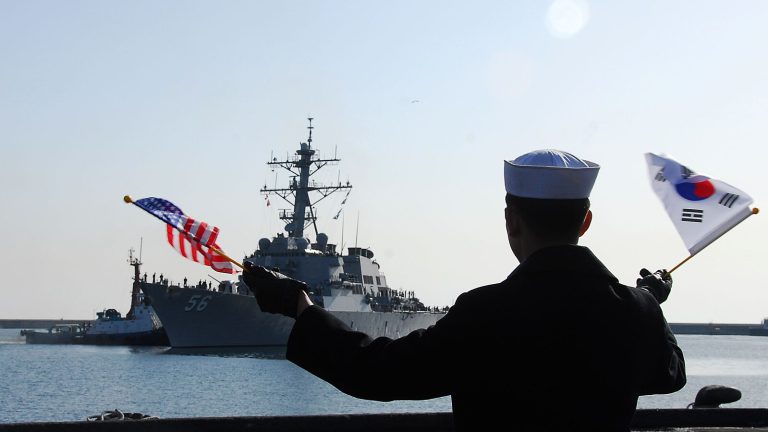
Image: “100319-N-9573A-005 DONGHAE, Republic of Korea (March 19, 2010) A Republic of Korea (ROK) Sailor waves the American flag and ROK flag as the USS John S. McCain (DDG 56) pulls into the port of Donghae. John S. McCain is scheduled to train with the ROK Navy as part of Foal Eagle 2010, which is a series of field exercises. John S. McCain is one of seven ships assigned to Destroyer Squadron (DESRON) 15 and is forward-deployed to Yokosuka, Japan,” by Mass Communication Specialist 1st Class Bobbie G. Attaway, retrieved from https://commons.wikimedia.org/wiki/ File:USFK_United_States_Forces_Korea_image_archive_(5449663989).jpg. This file is licensed under the Creative Commons Attribution 2.0 Generic license.