


Hamiltonian Journal
Guiding the Rising Sun: U.S. Strategy for Japan’s Conservative Resurgence
Share On:
In October 2025, Japan entered a new political era as Prime Minister Sanae Takaichi, a staunch conservative, assumed office as the first female Prime Minister of Japan. Her assumption of power, however, transcends the breaking of a gender barrier and into what her leadership can bring to the table, in both Japan’s domestic and international politics. Prime Minister Takaichi seeks a stronger and more prosperous relationship with the United States, aiming to “realize a new golden age of Japan–U.S. alliance,” especially amidst a worsening relationship with China, towards which Japan plans to take a more hawkish stance. [1] Pledging to raise defense spending to two percent of GDP two years earlier than originally planned suggests a Japan that is willing to act with greater resolve, and one that is a more capable ally for the United States in deterring aggression in the Indo-Pacific region. [2] At the same time, a more nationalist and hawkish Japan risks straining alliances and amplifying regional polarization. While Prime Minister Takaichi’s leadership will strengthen U.S.–Japan cooperation in the short term, her assertive nationalism holds the risk of complicating long-term stability in East Asia. Thus, the United States should embrace Japan’s new conservative assertiveness as a chance to deepen defense integration and share its burden, while urging Japan to exercise their power with restraint and diplomatic reassurance regarding its neighbors. By doing so, the United States can transform potential instability into long-term regional stability, denying China the regional foothold it would need to displace U.S. influence and upend the Indo-Pacific order the alliance has long sustained.
Postwar Pacifism & Abe’s Influence
After its defeat in WWII, Japan’s foreign policy has been one of postwar pacifism, greatly shaped by the Yoshida Doctrine and its emphasis on economic growth under U.S. protection. The Doctrine prioritized a tight alliance with the United States, building up limited armed forces necessary only for self-defense, and pursuing economic growth through international trade. [3] Japan’s prioritization of “contributing to global peace and security through non-military means” enabled it to become the world’s second largest economic power from 1968 to 2010. [4] Rather than converting its economic might into military power, Japan leveraged its strengths in providing foreign aid, especially in conflict-prone areas bordering on communist countries. [5] However, the early 2010s brought a multitude of pressures: the rising strength of Communist and authoritarian regimes, Japan’s declining economic power, deepening uncertainty about U.S. security commitments in the Indo-Pacific, and the alliance skepticism of the Trump era, all of which eroded the foundations of the Yoshida Doctrine. [6] In response, Prime Minister Shinzo Abe introduced the notion of “proactive pacifism,” reframing Japan’s role by coupling its economic influence with a stronger defense identity grounded in universal values and power–marking a decisive shift from a purely economic foreign policy focus toward one of power and principle. [7]
Prime Minister Abe’s introduction of the Free and Open Indo-Pacific (FOIP) initiative in 2016 and his proposal of the Quadrilateral Security Dialogue (Quad) with Japan, the United States, Australia, and India, placed Japan in a more proactive position for regional and global security and implicitly acted as a counterweight to China’s growing influence and coercive behavior in the South and East China Seas. [8] The Quad established a concrete multilateral security framework, signaling that Japan was no longer solely sheltering under U.S. protection, but instead actively shaping the architecture of Indo-Pacific security. This strategic reorientation was driven in large part by its deteriorating relationship with China as tensions escalated during the Senkaku Islands disputes of 2010 and 2012. [9]
In the first instance, China imposed a rare-earths export ban amid a maritime confrontation near the Senkaku Islands; later, in 2012, Japan’s purchase of three of the islands triggered widespread anti-Japanese demonstrations across China and prompted Beijing to significantly increase its naval presence in the East China Sea.[10] These developments, alongside North Korea’s growing resolve, contributed to rising domestic support for revision of Japan’s Constitution, particularly Article 9, and a more robust self-defense position. Article 9 is a pacifist clause stating that Japan forever renounces war and the use of threats or force to settle international disputes. [11] The formation of FOIP and the Quad marked a decisive break for Japan from postwar pacifism and into a more proactive security posture. For the U.S., this represents both an achievement and a new challenge of long-term alliance management. As Japan steps beyond the Yoshida Doctrine and embraces a “proactive contribution to peace,” its newfound strategic agency must be matched by restraint in practice: pairing defense investment with regional diplomacy, framing constitutional reform as defensive normalization instead of revisionism, and working within alliance structures (particularly with the United States) to ensure its growing autonomy reinforces the Indo-Pacific order that the alliance has sustained for decades. [12]
Takaichi’s Agenda
Prime Minister Sanae Takaichi represents both the continuity and change within Japan’s conservative tradition. A protégé of former Prime Minister Abe, Prime Minister Takaichi embraces many of his core tenets like economic revitalization, alliance, reinforcement, and a proactive regional role while bringing a sharper nationalist edge. Unlike Abe, who governed under the stable 26-year coalition led by the Liberal Democratic Party (LDP) and Komeito that balanced his ambitious security reforms with caution rooted in pacifist norms, Takaichi provokes a more emboldened and ideologically explicit nationalism. Takaichi’s assumption of power triggered Komeito’s withdrawal from the coalition, ending an arrangement that had existed since 1999 and had long acted as a brake on the LDP’s more conservative instincts. [13] In Komeito’s place, Takaichi reached a confidence-and-supply arrangement with the Japan Innovation Party (Ishin). As an informal coalition, Ishin holds no cabinet seats and retains full policy independence, backing Takaichi on budgets and key votes while preserving the freedom to walk away. [14] This implies that the LDP is left to broker support on an issue-by-issue basis, a governing posture that is more ideologically unconstrained but significantly more fragile than anything Abe navigated, and one that risks blurring Japan’s strategic resolve at precisely the moment Washington needs a reliable partner. [15]
Takaichi has long advocated for the revision of Japan’s pacifist constitution, tougher immigration policies, and the strengthening of Japan’s national military capabilities. [16] She argues that amending the constitution to formally recognize the Self-Defense Forces (SDF) as a national military would mark “…the first time in Japanese history that a constitution is created by the Japanese people, embodying the spirit of Japan and symbolizing the end of its deliberately chosen submission to a great power, the United States.”[17] Emphasizing the defense of democracy in Asia, Takaichi pledges to raise defense spending to two percent of GDP two years ahead of schedule, invest in counter-strike missile and cyber capabilities, and reduce Japan’s economic dependence on China through supply-chain diversification and technological partnerships with allies. [18] These capabilities would be developed through a combination of Japan’s domestic defense-industrial base, led by firms such as Mitsubishi Heavy Industries and co-development partnerships with allies like the United States and the United Kingdom. For the United States, this new agenda offers a more capable ally, but the nationalist framing risks undermining regional legitimacy, which is the perception among Indo-Pacific partners that Japan’s growing military power is defensive in nature. China and South Korea, in particular, view any change to Japan’s military policy through the lens of historical grievance, colored by ongoing controversies over Japan’s wartime legacy of aggression and imperialism. [19] In fact, many South Koreans would view Japan’s constitutional revision as a reversion to militarism. [20] Thus, it is possible that many Indo-Pacific states may view changes to Article 9 as a symbolic repositioning away from Japan’s postwar restraint, fragmenting the broader Indo-Pacific coalition that underpins U.S. strategy. Washington should therefore use diplomatic engagement and alliance talks through the Security Consultative Committee (“2+2”) meetings between U.S. and Japanese foreign and defense ministers, as well as trilateral dialogues with South Korea to help Tokyo build a regional assurance strategy: a sustained, coordinated effort through public messaging to frame these reforms as contributions to collective stability and not a repudiation of its postwar pacifist commitments. [21]
Despite her ambitious vision, Prime Minister Takaichi faces a significant domestic constraint— political vulnerability. Her government rests on a minority coalition with the Japan Innovation Party (Ishin), meaning that for the passage of major legislation, the Takaichi administration will have to coordinate carefully with its coalition partner and even cooperate with the opposition–a stark contrast to Abe’s majority-backed administration. [22] [23] This fragility has pushed Prime Minister Takaichi to align more closely with more conservative forces like the emerging Sanseito party. Sanseito, as a more extreme conservative party, supports anti-immigration, a protectionist economy, nationalistic foreign policy, and hard-right social values. While this would reinforce her standing among right-leaning voters, this also brings up concerns over an overall rightward shift that alienates centrist and liberal factions, which could deepen political polarization and complicate consensus on foreign and security policy. At the same time, the coalition partner, Ishin, may resist Prime Minister Takaichi’s more conservative security policies, risking the delay of implementation. [24] These internal divisions threaten to blur Japan’s strategic resolve, potentially raising doubts in Washington and other international partners about Japan’s long-term reliability. (As of this writing, the 2026 snap elections were held, and Takaichi consolidated her allyship with Ishin and Sanseito).
Furthermore, while Prime Minister Takaichi must pursue diplomatic realism in the national interest, her conciliatory posture towards the United States and stabilizing attitude towards South Korea could provoke dissatisfaction among hardline conservatives. The compromises required by governing as prime minister risk alienating the hardline base that elevated her. Diplomatic realism demands that she moderate the positions that define her political identity: her visits to the Yasukuni Shrine, controversial for honoring Japan’s war dead alongside 14 Class-A WWII war criminals, and maximalist demands in U.S. alliance negotiations. Takaichi faces pressure over whether she should continue these visits as prime minister, as doing so could trigger diplomatic crises with China, South Korea, and potentially Washington, as it did when Abe visited in 2013; but refraining would be read by hardline conservatives as capitulation to foreign pressure. [25] Such a perception could further fracture Takaichi’s coalition, as reduced legislative cooperation and even hardline defection would erode the thin parliamentary majority she depends on to advance her agenda. Similarly, any outreach to Seoul will require at minimum avoiding inflammatory statements on wartime history that the ascendant Sanseito party, who gained significant ground in the 2025 upper house election on a ‘Japan First’ platform, would interpret as weakness. [26] Therefore, there exists a structural, not ideological, tension: the same diplomatic restraint that makes Takaichi a credible partner for Washington and Seoul simultaneously exposes her to a conservative movement that views restraint as a betrayal of principle.
These domestic vulnerabilities suggest that the U.S. engagement with Japan should go beyond simple defense coordination. Through alliance reassurance, regular communication, and economic cooperation initiatives, the United States can help Japan sustain political legitimacy at home while maintaining Japan’s alignment with shared strategic values. Washington should actively and publicly validate Takaichi’s reforms as contributions to widespread Indo-Pacific security, giving her political cover against both domestic critics who may see her as too conciliatory and regional partners who view her as too hawkish. Such validation could take the form of joint statements, accelerated co-development agreements in missiles and cyber as mentioned earlier, expanded joint military exercises, and preferential supply-chain partnerships that reward Japan’s economic de-risking from China. Many Japanese citizens are concerned that President Trump may pursue partnerships with China that could undermine Japanese interests, so current economic cooperation initiatives must now serve a reassurance function as well as a strategic one. [27] This demonstrates to the Japanese public that the U.S.–Japan alliance delivers tangible benefits, which will sustain the domestic legitimacy Takaichi needs to pursue her security agenda without being outflanked by nationalist critics on her right.
Prime Minister Takaichi is poised to deepen strategic alignment with Washington, as indicated by her October meeting with President Donald Trump.The United States welcomes Japan’s more active defense disposition, and this convergence of interests will reinforce the alliance as a cornerstone of regional stability. [28] As Japan enhances its military capabilities and seeks a more equal command relationship, the U.S. and Japanese forces must carefully manage how to coordinate in a crisis. Currently, U.S. forces in Japan operate under a framework built around Japan’s military constraint, and with a more forward-leaning Japan on the rise, such roles and responsibilities will have to be renegotiated. [29] Washington should use this moment of close alignment to make the alliance more flexible and balanced through improving joint crisis planning, sharing advanced military technology, and coordinating military operations more effectively. By channeling Japan’s growing strategic confidence through cooperation, the United States can turn Japan’s expanding regional role into a stronger source of deterrence.
Takaichi’s foreign policy will have mixed implications for East Asian regional stability. Her tougher stance on China will most certainly heighten rhetorical and military tensions, especially around the Senkaku Islands and the East China Sea. If tensions escalate, Japan could pursue a variety of escalatory options for full rearmament, including strengthening forward defenses, deploying counter-strike missiles, revising Article 9 to reconstitute the SDF as a standing military, or, in the most extreme scenario, pursuing nuclear deterrence through a NATO-style sharing arrangement or a domestic capability. Each option would mark a profound departure from Japan’s postwar identity and carries the risk of accelerating the arms race in East Asia that Takaichi’s deterrence strategy seeks to prevent.
On Taiwan, Takaichi’s open support for U.S. deterrence initiatives will strengthen Japan’s role as a key partner in crisis planning, but at the same time will also deepen Japan’s exposure to being directly involved in a U.S.–China confrontation. Her recent statement that an attack on Taiwan could threaten Japan’s survival has strained Japan–China relations and departed from the traditional strategic ambiguity, leaving the door open for Japan to respond with force under the 2015 legislation. [30] However, her remarks did not alter Japan’s longstanding position on Taiwan or signal a formal policy change. [31]
Japan’s relationships with its regional partners under Takaichi present a similarly mixed picture. With South Korea, the early signs appear to be optimistic: Takaichi and South Korean President Lee Jae Myung have held multiple summits, both acknowledging their mutual intent to deepen strategic cooperation across security, economic security, and regional diplomacy, while sidelining historical grievances in favor of pragmatic alignment. [32] However, Takaichi’s nationalist tendencies and her history of visits to the Yasukuni Shrine risk creating tensions with South Korea and setting back the progress made on cooperation, particularly if domestic pressures push her toward more inflammatory rhetoric on wartime history [33][34] In Southeast Asia, Japan’s growing hard power profile has been broadly welcomed as a defense partner in the region, with strong cooperation with the Philippines, Vietnam, Indonesia, and Malaysia through exercises, port calls, and strategic dialogues. [35] However, this is complicated by China’s active efforts to drive a wedge between Tokyo and ASEAN nations. Following Takaichi’s controversial Taiwan remarks, Beijing convened a rare meeting with Southeast Asian envoys to urge support for its position against Japan, though the effort appeared to have had little impact on ASEAN countries’ interactions with Japan. [36] At the same time, while the Philippines and Vietnam would likely favor Japan’s growing assertiveness towards China, other countries might view it as a contributor to regional polarization. The net effect is unclear: it may increase deterrence in the short term but can also add complexity to the delicate balance of power in East Asia.
As Japan’s tougher stance heightens tensions with China and reshapes Southeast Asian perceptions, the United States should leverage its diplomatic influence to encourage Japan to pair deterrence with reassurance. Through trilateral dialogues with Japan and South Korea and expanded cooperation with ASEAN, Washington can ensure that Japan’s growing military power is complemented by regional trust-building, whether through security partnerships or coordinated economic initiatives that signal collective rather than unilateral intent. Encouraging Takaichi to maintain pragmatic diplomacy, particularly towards South Korea and the Philippines, will prevent her nationalist instincts from undermining coalition cohesion.
Japan should take a proactive realist strategy and strengthen deterrence in response to growing threats, but do so with restraint to avoid destabilizing alliances or escalating regional tensions. Power and principle must reinforce each other, or else a Japan that grows militarily stronger while alienating its neighbors will undermine the order it seeks to defend. Japan must develop a diplomatic strategy that overcomes its domestic political vulnerabilities, maintains international trust, and balances its power with caution. [37] To do this, Japan should pair its military buildup with regional reassurance and historical sensitivity, maintain transparency in defense policy to build trust, and seek to pursue constitutional reform responsibly. Japan must strengthen cooperation with ASEAN countries by providing high-quality infrastructure investment and human resource development, while diversifying Japanese firms’ production bases in Asia. [38] Domestically, a framework for discussing major diplomatic issues should be established between the ruling and opposition parties to communicate a unified Japanese view to the international community. [39] Washington should focus on continuous engagement with Prime Minister Takaichi’s government to set clear alliance parameters and support Japan’s defense normalization while encouraging diplomatic outreach to South Korea and members of ASEAN.
Conclusion
Japan’s new leadership marks a decisive shift from what scholar Michael Green once termed “reluctant realism.” Japan has transcended its reluctance to embrace a more forward-leaning strategic identity. [40] Whether her new leadership leads to a more balanced regional order or greater polarization depends on how skillfully Japan aligns power with wisdom as it plays a more central role in world politics. This presents both an opportunity and a test for U.S. strategy in East Asia.
Washington should welcome Japan’s new resolve, acting as both partner and moderator by supporting Japan’s defense normalization while ensuring its evolving strategic role strengthens, rather than destabilizes, the Indo-Pacific balance. Judging by how well American leadership can guide Japan’s growing strength into a force of regional balance, this new golden age of the alliance can help mark a new era of shared stability in the Indo-Pacific. H
Ada Shu ‘28 is a member of the AHS chapter at the University of Michigan, where she is majoring in Philosophy, Politics, and Economics.
NOTES:
[1] Justin McCurry, “Japanese PM promises golden age in relations with US during Trump visit,” The Guardian, effective October 28, 2025, https://www.theguardian.com/world/2025/oct/28/donald-trump-sanae-takaichi-japan-prime-minister-rare-earths-agreement.
[2] Makiko Yamazaki, “Japan’s new premier pledges early boost to defence spending, ‘proactive’ fiscal policy,” Reuters, October 24, 2025, https://www.reuters.com/world/asia-pacific/japans-new-premier-pledges-early-boost-defence-spending-proactive-fiscal-moves-2025-10-24/.
[3] Ayako Kusunoki, “Has Japan’s Foreign Policy Gone Beyond the Yoshida Doctrine?” The Diplomat, effective March 10, 2020, https://thediplomat.com/2020/03/has-japans-foreign-policy-gone-beyond-the-yoshida-doctrine/.
[4] Kusunoki, “Has Japan’s Foreign Policy.”
[5] Kusunoki, “Has Japan’s Foreign Policy.”
[6] Adam P. Liff, “Japan’s Security Policy in the ‘Abe Era’: Radical Transformation or Evolutionary Shift?” Texas National Security Review 1, no. 3 (May 2018): 8–35, https://doi.org/10.15781/T29S1M35C.
[7] Murata Koji, “Kishida’s ‘Realism’ Diplomacy: From the Yoshida Doctrine to Values-Based Diplomacy?” CSIS, June 8, 2023, https://www.csis.org/analysis/kishidas-realism-diplomacy-yoshida-doctrine-values-based-diplomacy#:~:text=With%20the%20Yoshida%20Doctrine%2C%20Japan,obviously%20violated%20the %20UN%20Charter.
[8] Koji, “Kishida’s ‘Realism’ Diplomacy.”
[9] Suk Kyoon Kim, “The Senkaku Islands Dispute Between Japan and China: A Note on Recent Trends.” Ocean Development & International Law 52, no.3 (2021): 260–73, https://doi.org/10.1080/00908320.2021.1957242.
[10] Kim, “The Senkaku Islands Dispute Between Japan and China.”
[11] “Article 9 and the U.S.-Japan Security Treaty,” Columbia University, accessed March 3, 2026, https://afe.easia.columbia.edu/special/japan_1950_usjapan.htm.
[12] “Japan’s Proactive Contribution to Peace,” The Government of Japan, accessed November 20, 2025, https://www.japan.go.jp/tomodachi/2014/spring-summer2014/japans_roactive_contribution_to_peace.htm.
[13] Alan Siaroff, “Moving to the Right: The New Government in Japan,” Open Canada, effective December 5, 2025, https://opencanada.org/moving-to-the-right-the-new-government-in-japan/.
[14] Chad de Guzman, “How Sanae Takaichi Remade Japan’s Ruling Coalition to Become the Country’s First Female PM,” Time, October 2, 2025, https://time.com/7327260/japan-prime-minister-sanae-takaichi-ldp-coalition-komeito-ishin-analysis/.
[15] Charles Crabtree and Sona N Golder, “Takaichi’s Japan Enters an Era of Fragile Coalitions,” East Asia Forum, November 27, 2025, https://eastasiaforum.org/2025/11/27/takaichis-japan-enters-an-era-of-fragile-coalitions/.
[16] Bart Gaens, “With Sanae Takaichi, Japan Gets Its First-ever Female Prime Minister—What to Expect?” International Centre for Defence and Security, effective October 27, 2025, https://icds.ee/en/with-sanae-takaichi-japan-gets-its-first-ever-female-prime-minister-what-to-expect/#:~:text=As%20Japan%20sees%20itself%20surrounded,in%20a%20nation%2Dwide%20referendum.
[17] Gaens, “Japan Gets Its First-ever Female Prime Minister.”
[18] Tom Corben, “With Sanae Takaichi, ‘Japan is back’ is back,” Lowy Institute The Interpreter, November 4, 2025, https://www.lowyinstitute.org/the-interpreter/sanae-takaichi-japan-back-back.
[19] “Amending Japan’s Pacifist Constitution,” Institute for Security & Development Policy, April 2018, https://www.isdp.eu/publication/amending-japans-pacifist-constitution/.
[20] “A Korean View: Japan’s Constitutional Revision Debate,” Council on Foreign Relations, May 12, 2017, https://www.cfr.org/articles/korean-view-japans-constitutional-revision-debate.
[21] “Joint Statement of the Security Consultative Committee (“2+2”),” U.S. Department of War, July 28, 2024, https://www.war.gov/News/Releases/Release/Article/3852169/joint-statement-of-the-security-consultative-committee-22/.
[22] “Japan’s LDP, Ishin agree to form coalition government, Kyodo says,” Reuters, October 19, 2025, https://www.reuters.com/world/asia-pacific/japans-ldp-ishin-agree-form-coalition-government-kyodo-says-2025-10-19/.
[23] Daiju Wada, “The New Takaichi Administration: Confronting Harsh Realities on the International Stage,” Policy Brief No. 256, Toda Peace Institute, effective November 14, 2025, https://toda.org/publications/policy-briefs-and-reports/the-new-takaichi-administration-confronting-harsh-realities-on-the-international-stage/.
[24] Wada, “New Takaichi Administration.”
[25] Takahashi Kosuke, “Takaichi Sanae and the Rise of Conservative Populism in
Japan,” The Diplomat, October 6, 2025, https://thediplomat.com/2025/10/takaichi-sanae-and-the-rise-of-conservative-populism-in-japan/.
[26] Peter Chai and Willy Jou, “Japan’s Political Paradox: Why Young Liberals Backed a Conservative Landslide,” The Diplomat, March 13, 2026, https://thediplomat.com/2026/03/japans-political-paradox-why-young-liberals-backed-a-conservative-landslide/.
[27] “U.S.–Japan Relations,” Congressional Research Service, effective February 5, 2026, https://www.congress.gov/crs_external_products/IF/PDF/IF10199/IF10199.45.pdf.
[28] “Trump and Takaichi swap praise for ‘new golden age of ties’ between Japan and the US,” Le Monde, October 28, 2025,
https://www.lemonde.fr/en/international/article/2025/10/28/trump-and-takaichi-swap-praise-for new-golden-age-of-ties-between-japan-and-the-us_6746842_4.html.
[29] Kristi Govella and Nicholas Szechenyi, “Deepening Strategic Alignment: Priorities for the U.S.-Japan Alliance,” Center for Strategic & International Studies, April 3, 2026, https://www.csis.org/analysis/deepening-strategic-alignment-priorities-us-japan-alliance#h2-u-s-japan-alliance-cooperation-progress-challenges-opportunities.
[30] Miranda Jeyaretnam, “What to Know About Japan and China’s Spat Over Taiwan,” Time, November 17, 2025, https://time.com/7334371/china-japan-taiwan-takaichi-explainer/.
[31] Jeyaretnam, “What to Know.”
[32] Takahashi Kosuke, “Japan-South Korea Summit: Why Middle Power Cooperation Matters More Than Ever in an Imperializing World,” The Diplomat, January 14, 2026, https://thediplomat.com/2026/01/japan-south-korea-summit-why-middle-power-cooperation-mat ters-more-than-ever-in-an-imperializing-world/.
[33] Kanishkh Kanodia, “Securing the future of US–Japan–South Korea cooperation,” Chatham House, December 10, 2025,
https://www.chathamhouse.org/2025/12/securing-future-us-japan-south-korea-cooperation/what are-obstacles-further-progress.
[34] Kenji Yoshida, “Yasukuni Shrine Returns to Spotlight as Takaichi Government Takes Off,” Japan Forward, October 23, 2025, https://japan-forward.com/yasukuni-shrine-returns-to-spotlight-as-takaichi-government-takes-off/.
[35] Hoang Thi Ha and Eugene Tan, “Japan’s Growing Hard-Power Profile: Implications for Southeast Asia,” ISEAS Perspective 2026, no. 8 (February 6, 2026), https://www.iseas.edu.sg/articles-commentaries/iseas-perspective/2026-8-japans-growing-hard-power-profile-implications-for-southeast-asia-by-hoang-thi-ha-and-eugene-tan/.
[36] Henrick Tsjeng, “Southeast Asia amid China-Japan Tensions: A Difficult Path
Ahead,” RSIS Commentary, no. 045 (Singapore: S. Rajaratnam School of International Studies, March 17, 2026).
[37] Wada, “New Takaichi Administration.”
[38] Wada, “New Takaichi Administration.”
[39] Wada, “New Takaichi Administration.”
[40] Michael J. Greene, “Japan’s Reluctant Realism: Foreign Policy Challenges in an Era of Uncertain Power,” Council on Foreign Relations, April 2001, https://www.cfr.org/books/japans-reluctant-realism.
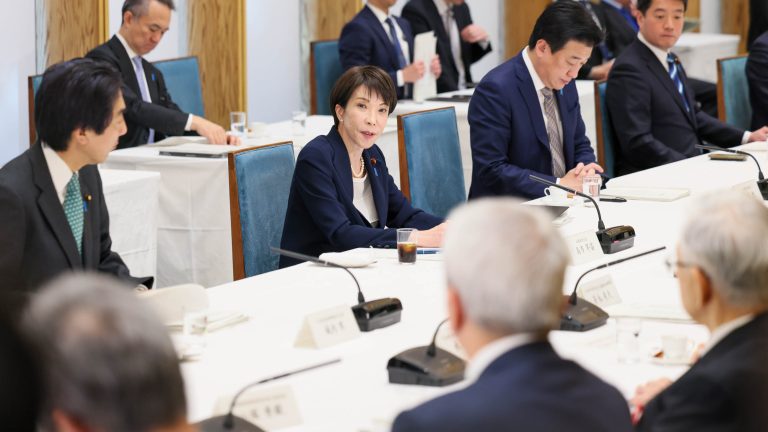
Image: “Sanae Takaichi meets the Japan Business Federation” by 内閣広報室 / Cabinet Public Affairs Office, retrieved from https://commons.wikimedia.org/wiki/File:Sanae_Takaichi_meets_the_Japan_Business_Federation_January_2026_04.jpg This work is licensed under the Public Data License (Ver.1.0). The Terms of Use are compatible with the Creative Commons Attribution License 4.0 International.