

Hamiltonian Journal
Making the Monroe Doctrine Great Again: How the Monroe Doctrine Frames Trump’s Shift to Hemisphere-First Foreign Policy
Share On:
U .S. President Donald Trump significantly escalated tensions with Venezuela from September 2025 to January 2026, carrying out more than 20 military strikes on Venezuelan drug-trafficking boats and ultimately capturing Venezuela’s President Nicolás Maduro in the covert “Operation Absolute Resolve.” [1] This series of military operations strained Venezuela’s authoritarian regime and highlighted the increasing U.S. foreign policy focus on the Western Hemisphere as well as a broader shift in American strategic outlook. More specifically, this shift suggests a re-grounding of U.S. policy in the Monroe Doctrine. A dominant force in U.S. foreign policy for a century following its inception in 1823, the doctrine originally aimed to prevent European colonial powers from interfering with Western Hemisphere affairs and later established the United States as the region’s police power. [2] The history of the Monroe Doctrine is crucial to understanding Trump’s present foreign policy shift, and its history is essential when considering how the administration should pursue its policy going forward.
Trump’s New Shift to The Western Hemisphere
By explicitly shifting the focus of U.S. foreign policy from the Indo-Pacific to the Western Hemisphere, the second Trump administration has departed from recent presidential administrations. This includes the first Trump administration, which primarily worked to counter the United States’ main “strategic competitor” in China. [3] The Biden administration did the same, establishing China as the U.S. military’s “pacing challenge.” [4] However, in the first year of the second Trump administration, Trump focused much of his foreign policy strategy on the Western Hemisphere, distracting from the competition with China. [5] The 2025 National Security Strategy (NSS), for its part, prioritizes the hemisphere first among global regions. [6] It views the Western Hemisphere as containing the most immediate U.S. national security concerns and needing increased U.S. investment in long-term strategic competition compared to that made by recent presidential administrations. The 2025 NSS characterizes China as a near-peer competitor but not the driving force behind U.S. foreign policy. The strategy is primarily concerned with balancing the two countries’ trade relations and, notably, outlining steps to counter Chinese influence in the Western Hemisphere. Accordingly, Trump has carried out a plethora of actions to secure the hemisphere and reassert U.S. preeminence. In addition to the 21 strikes on Venezuelan boats and the capture of Venezuela’s President Maduro, Trump has also pressured Mexico and Canada in trade negotiations, placed 100 percent tariffs on leftist Nicaragua, sanctioned Brazil and Colombia, given Argentina’s government a $20 billion bailout, and pushed for U.S. control of Greenland. [7]
In part, the United States aims to strengthen its position in the Western Hemisphere because of China’s growing economic influence in the region since 2000. The United States stands to shore up its waning dominance in Latin America’s “lucrative markets” and its access to their natural resources, where China has been fast encroaching on U.S. preeminence. [8] To be sure, these concerns are valid. In 2000, China made up “less than 2 percent of Latin America’s exports,” but in 2024, China made up 13 percent of the region’s exports. [9] Over the same time period, the share of Latin American exports going to the United States fell from approximately 60 to 40 percent. [10] China’s massive increase in economic power in Latin America unambiguously threatens U.S. “soft power in its traditional sphere of influence” because it presents arguably the greatest non-American influence in the region since the fall of the Spanish Empire. Despite this challenge to U.S. preeminence, the first Trump administration and the Biden administration made underwhelming efforts to counter China’s growing influence in the region. In contrast, the second Trump administration has embraced a more assertive approach, through tariffs, threats to retake control of the Panama Canal, and slashing China’s supply of discounted Venezuelan oil. [11]
The United States is also motivated to increase its role in the Western Hemisphere for more overt security reasons. Over the past decade, China has increased its military influence in the region via arms sales, military exchanges, and training programs. [12] Through these efforts, China has fostered closer security relationships mainly with Cuba and Venezuela, while also selling military equipment such as aircraft, ground vehicles, and radar systems to Argentina, Bolivia, and Ecuador. [13] Russia has engaged in similar but smaller-scale efforts. Accordingly, the 2026 National Defense Strategy focuses on securing the United States and the Western Hemisphere. [14] This focus is driven by the administration’s perspective that “U.S. security is inseparable from the stability of its own hemisphere,” because there, U.S. “interests are densest and threats most immediate.” [15]
Historical Role of The U.S. In the Western Hemisphere
In re-prioritizing the Western Hemisphere, the Trump administration has invoked the Monroe Doctrine. Iterations of the Monroe Doctrine have defined the U.S. role in the Western Hemisphere for two centuries. Spelled out in President James Monroe’s annual message to Congress in 1823, the doctrine asserted that the United States would oppose foreign powers meddling in the Western Hemisphere, namely European powers looking to reestablish a colonial presence in Latin America at the time. [16]
At its outset, the Monroe Doctrine was enforced in practice by the British Navy instead of the United States, because the U.S. military was weak relative to European powers. Britain and the United States reached a “common understanding” to support newfound Latin American independence. The British were driven by their commercial interests in the region, because “recolonization [by other European powers] threatened British trade and finance.” Thus, the British Navy would enforce the Monroe Doctrine by preventing other European powers, with much weaker navies, from recolonizing Latin America. This partnership let the United States present itself as the preeminent nation protecting an independent Western Hemisphere. This status granted the United States favor and influence in Latin America, where the Monroe Doctrine was “praised by [Simon] Bolivar and other Latin American liberators.” [17]
In the early 20th century, President Theodore Roosevelt amended the Monroe Doctrine with the Roosevelt Corollary of 1904, taking on Britain’s former role of preventing foreign powers from interfering in the Western Hemisphere. [18] He further expanded the Monroe Doctrine, transforming it from a defensive policy into a proactive one. Concerned that Latin American instability at the time could invite European intervention, he declared the United States “had a right to reshape hemispheric nations guilty of ‘chronic wrongdoing.’” [19] This “right” served as the justification for numerous American military interventions over the next 15 years, including in the Dominican Republic, Cuba, Nicaragua, Haiti, and Mexico. [20] The Roosevelt Corollary effectively changed the Monroe Doctrine from an “anti-interventionist message [to] a call for unilateral intervention” in unstable hemispheric nations. [21] Roosevelt aggressively built upon the United States’ previous special position in the Western Hemisphere, establishing it as the regional police power.
The history of the Monroe Doctrine since the Roosevelt Corollary is more sporadic. The United States has invoked its historic special position in the Western Hemisphere without having a consistently applied policy. After World War I, the United States ended the interventionist policy of the Roosevelt Corollary and implemented “Good Neighbor” policies, with no interventions in the Western Hemisphere from 1933 to 1954. This period featured a significantly diminished role for the U.S. in the region. But this was short-lived.
In 1954, the CIA-backed coup in Guatemala, codenamed “Operation PBSUCCESS,” saw the first implicit adaptation of the Monroe Doctrine to the Cold War. [22] Later in the Cold War, Presidents John F. Kennedy and Ronald Reagan invoked the Monroe Doctrine by name as a basis for pursuing the strategy of “containment” in the Western Hemisphere. They called upon the doctrine when opposing Soviet influence in the region during the Cuban Missile Crisis and the Nicaraguan rebellion against the Sandinistas respectively. [23] Also during the Cold War, the United States intervened against “leftist guerrilla movements and communist or socialist governments” in Chile, the Dominican Republic, El Salvador, and Guatemala to prevent the rise of new Soviet footholds. [24] These interventions reaffirmed the U.S. right asserted by the Roosevelt Corollary to “reshape hemispheric nations guilty of ‘chronic wrongdoing.’” [25] It is worth noting that Cold War U.S. interventions in the Western Hemisphere drew upon the Monroe Doctrine for justification largely because it was situationally convenient, rather than because the doctrine was driving U.S. policy.
Lessons for Implementing The Trump Corollary
Today, Latin America largely remembers the Monroe Doctrine as representative of unilateral U.S. intervention with little regard for their sovereignty. [26] Therefore, the second Trump administration must tread carefully as it implements the Trump Corollary, especially if a guiding component of the strategy is to persuade Latin Americans to prefer the United States to China. Several of the administration’s policies thus far have received poor receptions in Latin America, hindering the potential for a successful reassertion of U.S. preeminence in the Western Hemisphere. These negative Latin American reactions will make the lives of U.S. policymakers difficult, rendering the Trump Corollary a repeat of the past abrasiveness of the Monroe Doctrine. Policymakers should instead favor Trump Corollary policies that will cultivate a cooperative, rather than contentious, relationship with the hemisphere. Such a good-willed environment will facilitate U.S. efforts to thwart foreign influence in the region, especially China’s.
Crucially, the second Trump administration should rhetorically align Trump Corollary policies with Latin American interests to avoid perpetuating the region’s view of the Monroe Doctrine as solely benefiting the United States. The removal of Venezuela’s President Maduro had the potential to build broad Latin American support behind Venezuelan regime change and on the side of the Trump Corollary, but the administration blundered this opportunity. Early on, the United States suggested the possibility of regime change to create a democratic Venezuela, which a majority of Latin America supported given their negative perception of the Maduro regime. [27] Instead, much of the public messaging has centered on boosting the flow of Venezuelan oil to world markets, including the United States. [28] Since removing Maduro, U.S. oversight of Venezuelan oil exports and how their revenue is spent has strongly asserted U.S. influence in Venezuela, which was previously close to China. [29] However, the U.S. also moved away from the prospect of regime change in both rhetoric and policy, leaving behind Latin American interests. Notably, Trump’s speech immediately following “Operation Absolute Resolve” made no mention of democracy. [30] Likewise, the United States allowed the structure and many veterans of the Maduro regime to remain in power. This decision signaled to Latin America that the United States was satisfied by a compliant but still authoritarian regime, which benefited itself but not the region. [31] The Trump Corollary intervention in Venezuela helped secure the hemisphere and boost U.S. influence, but Trump squandered the opportunity to build broader support and good will in Latin America when he discarded the region’s interest in regime change. Even if the Trump administration did not want to pursue a policy of Venezuelan regime change in practice, it could have rhetorically supported it, symbolically aligning with Latin American interests instead of overtly abandoning them. Ultimately, the United States reaffirmed its old Monroe Doctrine reputation in the region: self-interested and ignorant of Latin American interests.
The second Trump administration should, where possible, prioritize soft power over hard power as it implements the Trump Corollary, avoiding the sour history of Monroe Doctrine military interventions in Latin America. Since December 2025, Trump has increasingly threatened direct U.S. military action in Mexico to combat drug cartels and thus secure the hemisphere. [32] Mexico, in turn, has repeatedly rejected the idea of such an intervention, emphasizing the need for the United States to respect Mexican sovereignty. Similarly, Trump has made military threats against Cuba, Colombia, and even Greenland. [33] This dynamic harkens back to the many 20th-century U.S. interventions in Latin America motivated to protect U.S. interests. Latin America is not interested in repeating that history. [34] Trump must exercise U.S. hard power very carefully. Reserving it for use against widely opposed regimes like Maduro’s or for use in collaboration with other governments like Ecuador’s, when its military conducted joint operations with the United States against Ecuadorian drug cartels. [35] This prudence with hard power should help prevent the Trump Corollary from backfiring by creating an adversarial Latin America driven away from the United States and closer to China. Trump should instead take advantage of U.S. soft power to build a positive reputation for his adaptation of the Monroe Doctrine. For example, increased U.S. intelligence sharing with Mexico has led the way in generating “unprecedented cooperation and visible enforcement gains” against drug cartels. [36] Furthermore, U.S. soft power was exercised in Argentina, when the Trump administration provided the country with a $20 billion bailout to stabilize its economy. [37] Argentina has since repaid the $20 billion. [38] The bailout simultaneously demonstrated U.S. good will and built up its economic influence in Latin America. These uses of soft power have successfully advanced the Trump Corollary’s priorities in ways friendly to the region. Trump should make soft power the primary tool for implementing the Trump Corollary, crafting a positive reputation of his version of the Monroe Doctrine.
Conclusion
The Monroe Doctrine and its history in U.S. foreign policy is essential to understanding the second Trump administration’s foreign policy shift to the Western Hemisphere. It signals a reinvigoration of the U.S. special position in the region. The Monroe Doctrine and the Trump Corollary present a new frame for many of Trump’s existing foreign policy priorities. However, the Trump administration should be careful to implement its new policy in a way that cultivates goodwill for the United States in the Western Hemisphere, rather than pushing its countries away. H
Zane Holley ’28 serves as a Campus Officer of the AHS chapter at Duke University, where he is majoring in Public Policy and History.
NOTES:
[1] Julian E. Barnes, Tyler Pager, and Eric Schmitt, “Inside ‘Operation Absolute Resolve,’ the U.S. Effort to Capture Maduro,” The New York Times, January 3, 2026, https://www.nytimes.com/2026/01/03/us/politics/trump-capture-maduro-venezuela.html; Ben Finley, et al, “A timeline of U.S. military escalation against Venezuela leading to Maduro’s capture,” PBS News, January 3, 2026, https://www.pbs.org/newshour/world/a-timeline-of-u-s-military-escalation-against-venezuela-leading-to-maduros-capture.
[2] Thomas E. McNamara, “The Monroe Doctrine After 200 Years: A Strategic Hinge Period in American History,” American Diplomacy (2023), Gale Academic OneFile (accessed November 28, 2025), https://link-gale-com.proxy.lib.duke.edu/apps/doc/A760330822/AONE?u=duke_perkins&sid=summon&xid=93b8666c.
[3] Peter Feaver, “Trump’s Year of Living Dangerously,” Foreign Affairs, November 12, 2025, https://www.foreignaffairs.com/americas/trumps-year-living-dangerously; Mark F. Cancian and Chris H. Park, “The 2026 National Defense Strategy by the Numbers: Radical Changes, Moderate Changes, and Some Continuities,” Center for Strategic and International Studies, January 27, 2026, https://www.csis.org/analysis/2026-national-defense-strategy-numbers-radical-changes-moderate-changes-and-some.
[4] Anthony J. Blinken, “The Administration’s Approach to the People’s Republic of China,” U.S. Department of State, May 26, 2022, https://2021-2025.state.gov/the-administrations-approach-to-the-peoples-republic-of-china/.
[5] Feaver, “Trump’s Year.”
[6] The White House, National Security Strategy of the United States of America, November 2025, https://www.whitehouse.gov/wp-content/uploads/2025/12/2025-National-Security-Strategy.pdf.
[7] Jack Nicas, “The ‘Donroe Doctrine’: Trump’s Bid to Control the Western Hemisphere,” The New York Times, November 17, 2025, https://www.nytimes.com/2025/11/17/world/americas/trump-latin-america-monroe-doctrine.html; Andreas Østhagen, “Trump & Greenland: Is There Logic in the Chaos?” The Arctic Institute, January 8, 2026, https://www.thearcticinstitute.org/trump-greenland-logic-chaos/.
[8] Daniel Erikson, “Requiem for the Monroe Doctrine,” Current History 107, no.
706 (February 2008): 58-64, Accessed December 8, 2025, https://doi.org/10.1525/curh.2008.107.706.58.
[9] Rebecca Ray and Enrique Dussel Peters, “China-Latin America and the Caribbean Economic Bulletin, 2025 Edition,” Boston University Global Development Policy Center, November 2025, https://www.bu.edu/gdp/files/2025/12/GCI-China-LAC-Bulletin-2025-EN-FIN.pdf.
[10] “Latin America & Caribbean Trade Summary 2000,” World Integrated Trade Solution, Accessed April 13, 2026, https://wits.worldbank.org/CountryProfile/en/Country/LCN/Year/2000/Summarytext; “Economics: The Americas,” Council on Foreign Relations, May 7, 2025, https://education.cfr.org/learn/learning-journey/americas-essentials/economics-the-americas
11] Diana Roy, “China’s Growing Influence in Latin America,” Council on Foreign Relations, June 6, 2025, https://www.cfr.org/backgrounder/china-influence-latin-america-argentina-brazil-venezuela-security-energy-bri; Siyi Liu, “China’s teapots buy Iranian oil to replace Venezuelan supply, sources say,” Reuters, February 2, 2026, https://www.reuters.com/business/energy/chinas-teapots-buy-iranian-oil-replace-venezuelan-supply-sources-say-2026-02-02/.
[12] Roy, “China’s Growing Influence.”
[13] Roy, “China’s Growing Influence.”
[14] Cancian, “Radical Changes.”
[15] Jeffrey Reeves, “Securing the Core: The Case for a Hemisphere-First U.S. National Defense Strategy,” The Institute for Peace & Diplomacy, September 15, 2025, https://peacediplomacy.org/2025/09/15/securing-the-core-the-case-for-a-hemisphere-first-u-s-national-defense-strategy/#:~:text=The%20Trump%20administration%27s%20National%20Defense%20Strategy%20%28NDS%29,security%20travels%20most%20effectively%20over%20shorter%20distances.
[16] Jay Sexton, “The Monroe Doctrine in an Age of Global History,” Diplomatic History, 47, no. 5 (November 2023): 845–870, https://doi-org.proxy.lib.duke.edu/10.1093/dh/dhad043.
[17] McNamara, “The Monroe Doctrine After 200 Years.”
[18] McNamara, “The Monroe Doctrine After 200 Years.”
[19] Erikson, “Requiem.”
[20] Thomas E. McNamara, Eric Foner, Kathleen DuVal, and Lisa McGirr, “An Era of Intervention,” in Give Me Liberty!: An American History, Seventh Edition, Volume 2, W. W. Norton & Company, 2022), https://nerd.wwnorton.com/ebooks/epub/givemeliberty7seagullv2/EPUB/content/19.1-chapter19.xhtml.
[21] Sexton, “The Monroe Doctrine in an Age of Global History.”
[22] Thomas E. McNamara, et al, “CIA and Assassinations: The Guatemala 1954 Documents,” National Security Archive, Accessed May 31, 2026, https://nsarchive2.gwu.edu/NSAEBB/NSAEBB4/.
[23] Erikson, “ Requiem.”
[24] R. Evan Ellis, “The Monroe Doctrine – Then And Now,” R. Evan Ellis, PhD, December 5, 2023, https://revanellis.com/the-monroe-doctrine-then-and-now.
[25] Erikson, “Requiem.”
[26] Britta Crandall and Russell Crandall, “The Monroe Doctrine Turns 200. Why Won’t It Go Away?” Americas Quarterly, July 25, 2023, https://americasquarterly.org/article/the-monroe-doctrine-turns-200-why-wont-it-go-away/#:~:text=The%20United%20States%20will%20always,U.S.%20relations%20with%20the%20region.
[27] “Latin American Reactions to Maduro’s Capture,” Geopolitical Futures, January 12, 2026, https://geopoliticalfutures.com/latin-american-reactions-to-maduros-capture/#:~:text=Reactions%20in%20Latin%20America%20to,so%20for%20their%20own%20reasons.
[28] Landon Derentz, “Venezuelan oil was the enabler, not the prize,” Atlantic Council, January 4, 2026, https://www.atlanticcouncil.org/dispatches/venezuelan-oil-was-the-enabler-not-the-prize/.
[29] Bram Ebus, and Alexandra Fuenmayor Starr, “U.S. Snaps up Venezuela’s Oil and Rare Minerals in Race for Supplies,” International Crisis Group, March 6, 2026, https://www.crisisgroup.org/qna/latin-america-caribbean/venezuela/us-snaps-venezuelas-oil-and-rare-minerals-race-supplies#:~:text=For%20now%2C%20the%20Trump%20administration,involving%20Venezuelan%2Dorigin%20oil.
[30] Tim Pires Alves, “Regime change in Venezuela – but is it?” The Loop, March 31, 2026, https://theloop.ecpr.eu/regime-change-in-venezuela-but-is-it/#:~:text=In%20January%202026%2C%20many%20believed,the%20word%20’democracy’%20once.
[31] Ebus, “U.S. Snaps up Venezuela’s Oil.”
[32] Diego Marroquín Bitar, et al., “Why U.S.-Mexico Security Cooperation Is Still Falling Short for Washington,” Center for Strategic and International Studies, January 28, 2026, https://www.csis.org/analysis/why-us-mexico-security-cooperation-still-falling-short-washington.
[33] Diana Roy and Jonathan Masters, “The Trump Administration’s Push for Greenland: What to Know,” Council on Foreign Relations, January 22, 2026, https://www.cfr.org/articles/greenlands-independence-what-would-mean-us-interests.
[34] Crandall, “The Monroe Doctrine Turns 200.”
[35] “Ecuadorian and U.S. Military Forces Launch Operations Against Narco-terrorists,” U.S. Southern Command, March 3, 2026, https://www.southcom.mil/News/PressRe
leases/Article/4420523/ecuadorian-and-us-military-forces-launch-operations-against-narco-terrorists/.
[36] Bitar, “Why U.S.-Mexico Security Cooperation Is Still Falling Short.”
[37] James Kirchick, “Trump Has a Good Reason to Bail Out Argentina,” Politico, October 24, 2025, https://www.politico.com/news/magazine/2025/10/24/argentina-deserves-its-bailout-00620337.
[38] The Associated Press, “Argentina has repaid its $20 billion credit line from Trump administration, Scott Bessent says,” Fortune Magazine, January 9, 2026, https://fortune.com/2026/01/09/argentina-has-repaid-its-20-billion-credit-line-from-trump-administration-scott-bessent-says/.
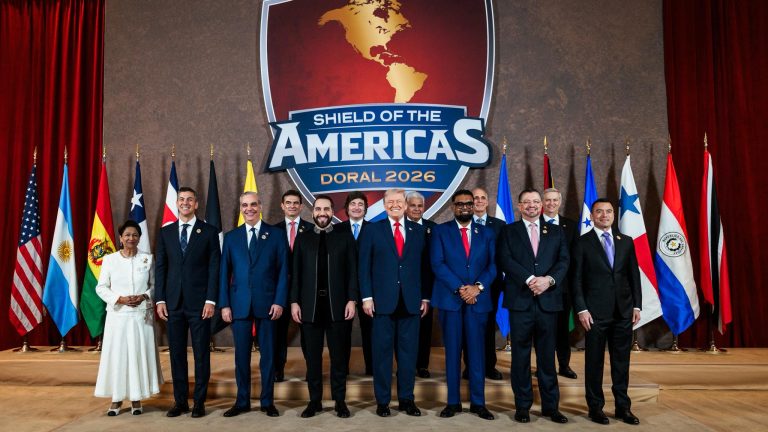
Image: “Leaders on the Shield of the Americas summit” by Daniel Torok, retrived from https://commons.wikimedia.org/wiki/File:Leaders_on_the_Shield_of_the_Americas_summit_2026.jpg. This file is a work of an employee of the Executive Office of the President of the United States, taken or made as part of that person’s official duties. As a work of the U.S. federal government, it is in the public domain.