
Hamiltonian Journal
Memorializing the Fallen in World War I
Share On:
The cataclysm of the Great War traumatized populations around the globe. The sheer number of dead and wounded shocked society; the war killed twenty million and left a further twenty-one million wounded or missing. As a result, families sought various avenues of relief to mourn their loved ones. In Sites of Memory, Sites of Mourning, Jay Winter explored the Great War by focusing on the bereavement of lamenting families, opening a new area of historical discussion in the cultural history of the Great War. Winter examined this social history, demonstrating how the immense losses of the Great War made grief a shared experience across Europe, affecting nearly every family.
Winter emphasized Europe’s elevation of the importance of the soldier and every life lost in the First World War. Winter’s cultural account demonstrated that anti-war sentiment still shapes European politics, driving a clear aversion to costly military entanglements. Such aversion endures, as the Great War instilled a moral and cultural emphasis on individual loss and mourning that makes large-scale sacrifice for ill-defined geopolitical goals a challenge to justify in contemporary European societies. Europe’s nations have thus generally prioritized diplomacy and multilateralism over the use of force. However, as great power conflict returns, Europe’s commitment to avoiding military intervention appears increasingly inadequate for the continent’s collective security. Ultimately, this work offers a poignant account of how mass casualties shaped and still dominate Europe’s collective conscience.
Winter’s Contribution
Winter’s piece underscored the importance that Europe placed on remembrance of its deceased. He challenged the then-prevailing idea that the war represented a cultural break from the past, as Princeton professor of literature Samuel Hynes and literary historian Paul Fussell introduced in their groundbreaking studies of Great War literature. [1] Hynes and Fussell represented a line of thinking that believed mourning in the aftermath of World War I hastened a new culture of fatigue that rejected earlier ideals of sacrifice and bravery. [2] Instead, Winter posited that the “enduring appeal of many traditional motifs” meant that World War I looked backwards more than forwards. [3] Winter argued that French and German families who lost loved ones found solace through outpourings of traditional remembrance, such as public commemoration ceremonies and the construction of war memorials. This expression became the principal avenue for society to mourn its loss. This harkening to remembrance was not limited to popular expression but was also important among the elite, as the wartime losses were so universal that distinctions between the high and low strata of society were “much more difficult to uphold.” [4]
The Scale of the Fallen
Firstly, Winter emphasized the belief that families who lost loved ones wanted the bodies back. The “sheer chaos of the devastated areas” meant that many soldiers were hastily buried. [5] The fact that “half of the men killed had no known grave” made the process of verifying deaths difficult. [6] Winter argued that the family’s desire to bury their own was an integral traditional practice. For example, many in France wanted to return the bodies to the parish church. Such burial in the parish church reflected Catholic traditions of consecrated ground and shared remembrance that connected the dead to family and faith. Christian beliefs surrounding the dignity of the body and the promise of resurrection further strengthened this desire. Burial further echoed the classical emphasis on the body as central to funerary rites, such as Priam’s pleas to Achilles to let the Trojans properly bury Hektor in the Iliad.
While some French leaders argued against disinterring bodies as they did not want to “separate those whom death has united,” much of the populace wanted to bring loved ones home. In the years following the Great War, “hundreds of people, prominent and obscure” united in a campaign to bring the dead back. [8] In response, the French government established the right of families to bring the bodies of their loved ones home at state expense in 1920. [9] By 1922, French officials transported around 300,000 bodies back from the front lines at family request, which represented around 40 percent of identified French dead. [10] Consequently, Winter established that proper burial rites shaped by culture and well-established Christian beliefs that honored each life lost were central to the West’s response to the Great War.
Winter continued that such corporeal commemoration was not always possible. For example, families of the approximately 60,000 Australian soldiers killed in the Gallipoli campaign often received limited information at an “interval of about 10 to 14 days after the event.” [11] The news of a death was communicated by a brief official communiqué from the state and, typically, a standard note from an officer in the dead man’s unit. These messages were “not always true and always incomplete.” [12] What the bereaved desired was more “detailed and in most cases less anodyne or strictly formal than the standard messages expressing official regret and noble thoughts.” [13] To fill this void, consolation groups such as the Australian Red Cross Information Bureau worked with soldiers within a dead man’s unit to supplement the story around a soldier’s death. [14] Red Cross agents acted as the families’ eyes and ears, searching hospitals, depots, battlefields, and prisoner of war camps for news of the missing.
Winter highlighted that families turning to such support organizations represented a way for ordinary people “to face together…the loss in war.” [15] In addition to these relief groups, soldiers and families placed increased trust in others whom they had never met or worked with before. For widows, ex-soldiers in the husband’s unit coalesced to support their comrade’s wife and children. [16] Groups such as Legacy, an association of Australian veterans, emerged dedicated to continuing the spirit of mutual assistance that helped widows and children in the name of ‘fictive kinship.’ [17] In an example of ‘fictive adoption,’ Mr. and Mrs. Semple cared with “unremitting kindness” for their nineteen-year-old parentless neighbor, Charles Berg, for seventeen years after he sustained a shrapnel injury to his spine. [18] These forms of consolation and adoptive kinship reflected a culture that leaned upon and expanded earlier forms of support and bereavement.
Spiritualism
Winter furthered that the colossal loss of the Great War also sparked increased interest in pre-war spiritualism. As established religion could not cope with the scale of the slaughter, European families sought private solace in an already-established spiritualism to cope with bereavement and mourning. The belief and practice of spiritualism features séances and other mystic practices to connect and speak with the dead. The pre-war prominence of spiritualism was so great that it led to its denunciation by the Holy See in 1898. Such upheaval of war “deepened well-established Victorian sentiments and conjectures concerning the nature of the spiritual world.” [20] As one French observer noted, “After a murderous war, who would doubt that the living would try to communicate with the fallen.” [21] These assumptions and the desire to communicate with the fallen elevated interest in the paranormal and the afterlife during and after the Great War. [22] Sir Arthur Conan Doyle, the famous writer of the hyper-rational Sherlock Holmes, ironically turned to spiritualism to cope with the loss of his brother, Innes, who died in the last months of the war, and his son, Kingsly, who died of pneumonia after being wounded at the Somme. [23] In a séance, Doyle recalled that his brother Innes appeared and said that he “regretted not the fact of his death, but rather that he had died before seeing the Allied victory at the end of the war,” which further suggested the blending of traditional visions of patriotism with the supernatural. [24] Spiritualism also overlapped with conventional religious modes for the soldiers fighting on the front lines. [25] Winter’s analysis highlighted the extreme measures families took in response to the war’s toll, including their turn to spiritualism to process grief in the wake of unprecedented loss.
Memorials
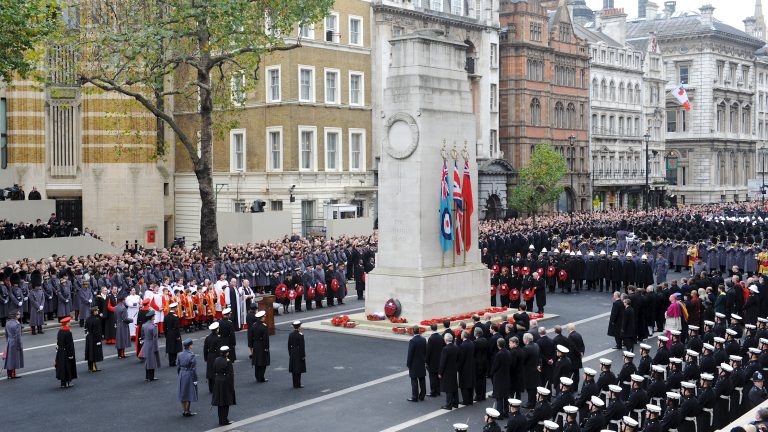
Winter concluded his study by examining public expressions of loss within Europe’s broader process of bereavement. Winter argued that the memorials across Europe were intended to remember the dead and to console the survivors, not to valorize heroism or ideology. [26] In 1920, the British government unveiled Sir Edwin Lutyens’ Cenotaph in Whitehall as Britain’s national memorial to the dead of the Great War. Grieving families understood it as the tomb for their own dead, establishing its presence as “the tomb of no one, this one became the tomb of all who had died in the war.” [27] The Cenotaph was originally a temporary exhibition, but its popularity convinced the government to make it permanent. Winter noted the Cenotaph is a work of genius due to its simplicity, writing that the Cenotaph is a form that allows any mourner to “inscribe his or her own thoughts, reveries, or sadnesses.” [28] [29] Accordingly, the Cenotaph transformed the “commemorative landscape by making… London into an imagined cemetery.” [30] Half a century later, when designing the Vietnam Memorial, Maya Lin drew inspiration from Edward Lutyens’s Monument to the Missing at Verdun by inscribing the names of every serviceman killed in the war. The Vietnam Memorial fostered a personal bond with the dead, as Lutyens envisioned, with its reflective granite panels only showing “names, and our own reflection.”
Rituals and processions surrounding these monuments were instrumental for coping families. For example, in Germany, a “24-part ceremony…was outlined for school and other civic use” to accompany the small-scale “iron nail” memorials. [32] These ceremonies featured hymns and poems where the “[g]lorification of sacrifice was expressed in a deliberately archaic language, the cadences of knights and valour.” [33] Winter found that these German war rituals glorified the dead through ancient language as a further example that the Great War did not break with tradition. These and other rituals represented the “public recognition, and mediation through ritual, of bereavement; and the appeal to the living to remember the dead. [34] The war memorials allowed grieving individuals to find solace in a distinctly dark moment of history.
Lasting Impact
In concluding Sites of Memory, Sites of Mourning, Winter noted that a European “bond of bereavement” ultimately endured from the Great War. [35] The inconceivable loss of life had taken its toll on social expression. What emerged from the penumbras of World War I was a continent stained by a “universal problem of grief.” [36] This shared experience of mass mourning reshaped how Europeans understood conflict. War was no longer a distant policy tool, but rather an immediately personal and shared tragedy. Winter highlighted that recognition of the individual lies at the forefront of Europe’s concern. The presence of loss in families and communities made the cost of conflict enduring. The persistence of such grief left a cultural legacy of skepticism for future conflicts. Postwar remembrance not only commemorated the past but fostered a clearer aversion to violence. For Europe’s conscience, the human consequences from war were not forgotten. Winter ended his work with a suggestion that World War II reflected a more complete “caesura in European cultural life.” [37] The aftermath of a second cataclysm, with the even darker undertones of the Holocaust and nuclear weapons, reinforced the profound trauma sustained by grieving families. Though Europe entered another conflict so soon after World War I, the commitment of leaders such as Chamberlain and Daladier to appeasement best reflects a broader desire to avoid another tragedy. While ultimately futile, such intentions revealed how sincerely the memory of the Great War shaped European desires to ensure peace.
Sites of Memory, Sites of Mourning clarified the picture of Europe’s universal experience with bereavement. Communities relied on traditional symbolism to better understand the scale of tragedy induced by the Great War. The resurgence of memorials and practices of spiritualism reflected a continent embattled with the reality of mass death and fallen kin. A society shaped by bereavement and remembrance understands war through its human cost rather than potential for glory. Such a context underscores how Europe’s culture of mourning stands in tension with contemporary calls to arms.
In the aftermath of World War II, Europe embraced international diplomacy undergirded by the institutions it helped create. The rise of international institutions and economic integration fostered a Pax Europaea that remained largely unchallenged for the remainder of the twentieth century. Yet this emphasis on international collaboration is now reaching its limits. International guarantees were powerless to prevent Russia’s invasion of Ukraine in February 2022. Great power conflict continues to unfold on Europe’s doorstep. In a similar vein, the American hegemony which once anchored Europe’s collective security has seen its resources increasingly stretched. If Winter helps explain why Europe remains wary of war, the present moment suggests that memory alone must not serve as strategy. A continent molded by trauma must now reconcile its culture of remembrance with the demands of contemporary security. Winter’s contention of the “backward gaze” provides guidance. [38] As Winter affirmed, a balanced approach to defense in Europe needs a cultural affixation that remembers the devastation after 1914. However, rather than rejecting military readiness entirely, Europe should build its capabilities mindful of its cultural conscience. A ‘backward gaze’ framework ensures that security policy preserves life, articulates objectives, and avoids vague geopolitical aims. Remembrance thus guides responsible defense without paralyzing action. H
Charles Schell ’27 serves as Chapter President of the AHS chapter at Cornell University, where he is majoring in Government and Spanish.
NOTES:
[1] Paul Fussell, The Great War and Modern Memory (Oxford: Oxford University Press, 1975), 8.
[2] Samuel Hynes, A War Imagined: The First World War and English Culture (New York: Atheneum, 1991).
[3] Jay Winter, Sites of Memory, Sites of Mourning (Cambridge: Cambridge University Press, 1995), 5.
[4] Winter, Sites of Memory, 227.
[5] Winter, Sites of Memory, 22.
[6] Winter, Sites of Memory, 31.
[7] Winter, Sites of Memory, 26.
[8] Winter, Sites of Memory, 24.
[9] Winter, Sites of Memory, 26.
[10] Winter, Sites of Memory, 26.
[11] Winter, Sites of Memory, 35.
[12] Winter, Sites of Memory, 35.
[13] Winter, Sites of Memory, 35.
[14] Winter, Sites of Memory, 36.
[15] Winter, Sites of Memory, 53.
[16] Winter, Sites of Memory, 49.
[17] Winter, Sites of Memory, 48.
[18] Winter, Sites of Memory, 45.
[19] Winter, Sites of Memory, 55.
[20] Winter, Sites of Memory, 76.
[21] Winter, Sites of Memory, 58.
[22] Winter, Sites of Memory, 58.
[23] Winter, Sites of Memory, 58.
[24] Winter, Sites of Memory, 58.
[25] Winter, Sites of Memory, 65.
[26] Winter, Sites of Memory, 78.
[27] Winter, Sites of Memory, 104.
[28] Winter, Sites of Memory, 104.
[29] Winter, Sites of Memory, 104.
[30] Winter, Sites of Memory, 104.
[31] Winter, Sites of Memory, 104.
[32] Winter, Sites of Memory, 84.
[33] Winter, Sites of Memory, 85.
[34] Winter, Sites of Memory, 97.
[35] Winter, Sites of Memory, 228.
[36] Winter, Sites of Memory, 224.
[37] Winter, Sites of Memory, 228. See Kim Munholland, Review of Sites of Memory, Sites of Mourning: The Great War in European Cultural History by Jay Winter, American Historical Review 102, no. 5 (1997): 1471, https://doi.org/10.1086/ahr/102.5.1470.
[38] Winter, Sites of Memory, 223.
Image: “English: Wreaths are pictured being laid by Members of Parliament during the Remembrance Sunday service at the Cenotaph in Whitehall, London.” by Sgt Dan Harmer, RLC/MOD, retrieved from https://commons.wikimedia.org/wiki/File:Wreaths_Are_Laid_at_the_Cenotaph,_London_During_Remembrance_Sunday_Service_MOD_45152052.jpg. This file is licensed under the Open Government Licence version 1.0 (OGL v1.0).