



Security and Strategy Journal
A Strategy of Technology for the Age of Techno-Economic Warfare
Share On:
In November 2025, members of the Chinese Communist Party’s (CCP) powerful Central Committee gathered in Beijing to discuss the upcoming release of China’s 15th Five-Year Plan. Their message: technology has become the primary currency of national power, and China must harness it to defeat its adversaries. “The great power game is ultimately a competition of productive forces,” wrote Vice Premier He Lifeng in an article summarizing the event.1 “We must act proactively and without delay to accelerate the formation of more landmark, original, and disruptive scientific and technological and industrial innovations, thereby gaining strategic initiative in the great power game.”2
In Washington, meanwhile, technology has eaten national security policy. Emerging technologies from artificial intelligence to biotechnology now take center stage at intelligence briefings, think-tank events, and negotiating tables. Yet Washington still speaks of the technological contest between the United States and China as a form of strategic competition—a term which has come to imply managerial caution and incremental response. This framing fails to capture the stakes of the struggle between great powers to capture the “commanding heights” of advanced industries.3 Instead, policymakers would do well to reach back more than half a century to The Strategy of Technology: Winning the Decisive War, an out-of-print 1970 book by Cold War thinkers Stefan Possony, Jerry Pournelle, and Francis X. Kane. Once used as a textbook at service academies and military colleges, The Strategy of Technology offers a framework for understanding competition in emerging technologies as a form of warfare.4
The three authors brought complementary backgrounds to their project. Possony was a Viennese-born political scientist and Sovietologist who fled Europe ahead of the Nazi advance, eventually landing at the Hoover Institution at Stanford, where he spent decades studying Soviet strategy and the relationship between technology and power. Pournelle was a polymath who defied easy categorization: a political scientist, science fiction author, and technologist, he wrote the first book-length work produced using a personal computer.5 Kane, known as “Duke,” was a career Air Force officer and engineer who designed the Global Positioning System. Together, these three men helped shape the Reagan administration’s Strategic Defense Initiative.6
Their work remains strikingly relevant today. Possony, Pournelle, and Kane framed the contest between the United States and the Soviet Union as fundamentally technological in nature, arguing that this new mode of competition deserved to be classified as a form of warfare. The authors then identified a series of strategic principles for successfully waging technological warfare. These principles—the psychological aspects of technological rivalry, the infinite nature of innovation, the centrality of resource allocation, and the need for technological ‘generalship’—apply equally to today’s contest between the United States and China.
Yet their framework also carries blind spots. Possony and his coauthors wrote during an era when the most consequential innovations emerged from government research and development (R&D) programs, national laboratories, and defense contractors operating under direct public direction. In the twenty-first century, however, private firms, not governments, control the most potent forms of technological power. This key difference, above all others, will determine how the United States competes in the twenty-first century. This paper proposes that the United States adopt a strategy of techno-economic warfare grounded in Possony, Pournelle, and Kane’s classical framework, updated for the central reality they could not foresee: that aligning firm behavior with strategic ends is now the primary task of American statecraft.
Cold War, Tech War
Possony, Pournelle, and Kane believed that the centrality of technology in strategic competition predated the Cold War. The success of the Manhattan Project brought about a fundamental shift in the nature of national power, they argued, such that power now “grows largely—sometimes exclusively—from products based on applied science.”7 Scientific breakthroughs at university, government, and corporate labs now translated directly into advantages on the battlefield. As a result, the processes of discovery, invention, application, and diffusion in high technology had taken on new significance as a form of warfare.
Based on this conclusion, Possony and his coauthors framed the contest between the United States and Soviet Union as not merely ideological or diplomatic in nature, but as “a conflict for technological dominance”—a “Technological War.”8 Like all forms of warfare, they argued, the ultimate aim of technological war is to enforce the national will on adversaries and compel them to modify their goals and operations. It involves a deadly conflict with an intelligent opponent that actively conspires to surprise and divert the other side.
For Possony, Pournelle, and Kane, the “key battle” in the technological war was the race to improve, anticipate, and defend against nuclear delivery systems.9 They attacked the consensus held by advocates of détente and arms control, who argued that the United States must prioritize the pursuit of strategic stability by negotiating reductions in both sides’ nuclear arsenal, and called instead for a strategy of technological overmatch.10 Like Herman Kahn and other nuclear strategists who rejected the absolute weapon thesis, Possony and his coauthors argued that technological breakthroughs could fundamentally alter the strategic balance, making nuclear war winnable for the side that achieved decisive advantages in delivery systems, defenses, or targeting capabilities.11 Other developments they believed could have outsized impact on the military balance included inertial guidance systems for precision strike, ballistic missile defense, space-based orbital weapons, and the commoditization of computing power driven by the development of the integrated circuit.12
While Possony, Pournelle, and Kane are little remembered today, their work had a profound influence on U.S. policy during the Cold War’s final decade. The three men played a key role in shaping the Reagan administration’s Strategic Defense Initiative, or SDI, a high-tech missile defense system that proposed the use of space-based interceptors and direct-energy weapons to shoot down incoming Soviet warheads.13 (Democratic Senator Ted Kennedy gave the program the derisive nickname Star Wars). An organization chaired by Pournelle, the Citizens’ Advisory Council on National Space Policy, formed in 1980 to write transition papers on space policy and high technology for the Reagan administration.14 Other members included Possony, Kane, several astronauts, including Buzz Aldrin, and retired military officials, including Air Force Lt. Gen. Daniel O. Graham. The organization wrote several reports for President Reagan and even drafted portions of his 1983 speech announcing the Strategic Defense Initiative.15
Principles for Techno-Economic Warfare
Although today’s contest between the United States and China differs in a host of ways from the Cold War, Possony, Pournelle, and Kane’s framework carries enduring lessons. This is because it derives largely from classical strategic theory. The authors include epigraphs from French General d’Armee Andre Beaufré, a twentieth century disciple of Clausewitz, in roughly one-third of their chapters.16 That classical foundation provides their work its durability. The following four principles—threads which run throughout The Strategy of Technology—are especially relevant for today’s technological contest between the United States and China:
- Technological warfare is psychological.
- Technological development is an infinite game.
- Technological strategy revolves around resource allocation.
- Technological warfare requires generalship.
Technological Warfare Is Psychological
Following Clausewitz and his disciples, Possony and his coauthors argue that all warfare, including technological war, consists of a “clash between two opposing wills.”17 Thus, its primary target is the adversary’s “will to resist.”18 As in all forms of warfare, they wrote, the clearest path to demoralize the adversary is to achieve surprise:
A major goal of strategy should always be to achieve surprise, regardless of whether the strategy is offensive or defensive. Weapons systems and scientific research programs should be designed…to create maximum uncertainty in the mind of the opponent. Surprise may result from the proper use of technology, but its main impact is upon the enemy’s mind.19
The authors describe a range of stratagems by which a nation can shape enemy perceptions. These include concealing true technological capabilities, publicizing rejected or inferior systems to misdirect attention, and feeding misleading data into an adversary’s intelligence apparatus.20 The cumulative purpose of all these techniques is the same: “to generate uncertainty in the mind of the opponent.”21 When uncertainty is successfully maintained, the adversary’s will is weakened even absent direct confrontation. Equally important, Possony and his coauthors reject the assumption that surprise belongs exclusively to the aggressor. “The defender also can employ the technique of surprise,” they argue, “and perhaps more effectively than the attacker.”22 By keeping the adversary in doubt about the performance, disposition, or very existence of key capabilities, they explain, the defending power forces the attacker into planning paralysis.23
Technological Development is an Infinite Game
Borrowing from game theory, Possony and his coauthors open the book’s first chapter with an epigraph from game theorist and philosopher James P. Carse: “A finite game is played for the purpose of winning, an infinite game for the purpose of continuing the game.”24 Carse distinguished between contests that end with victory (finite games) and those that persist through continuous adaptation (infinite games). While finite players compete within fixed boundaries to achieve definite outcomes, infinite players play with the boundaries themselves, constantly changing rules to keep all participants engaged and prevent final resolution.25
Possony, Pournelle, and Kane applied this insight first to nuclear strategy. Since the Soviets might be willing to play a finite game by launching a first strike, they reasoned, Washington’s imperative was to ensure the game remained infinite.26 They then generalized this principle. Since new breakthroughs tend to build off previous innovations, all modern technological development is an infinite game:
Although the technological stream can to some extent be directed, it is impossible to dam it; the stream flows on endlessly. This leaves only three choices. You may swim with the stream, exploiting every aspect of technology to its fullest; you may attempt to crawl out on the bank and watch the rest of the world go past; or you can attempt to swim against the stream and ‘put the genii back in the bottle.’27
In his work The Nature of Technology: What It Is and How It Evolves, economist W. Brian Arthur captures a similar insight. Technology, he writes, “creates itself out of itself.”28 Early technologies form from primitive components, which become building blocks for newer ones. This enables combinations that themselves seed still more advanced systems, opening domains that did not previously exist.29 Arthur terms this technology’s “combinatorial character.”30 For the strategist, this creates a dizzying environment: scarce resources must be allocated across a proliferating field of technologies of growing complexity. Not all paths can be pursued equally, and some cannot be pursued at all. Yet in an infinite game, choosing to abstain is the only sure path to automatic defeat.
Technological Strategy is Resource Allocation
Whether in business strategy or national security, the heart of all strategy involves making choices about how to spend limited resources.31 Technological strategy takes this principle to the extreme.32 Possony, Pournelle, and Kane write:
In the place of battles, the Technological War general disposes his own resources so as to maximize the power he holds and at the same time compel the enemy to make maximum dispersal of his. To make the enemy counter each move you make, and dance to your tune, is the aim of a Technological War strategy. In the ideal, if the enemy were required continually to build purely defensive weapons which might protect him from your weapons but could not possibly harm you, you could be said to have won a major engagement in the Technological War.33
The ultimate goal of technological strategy is to influence the adversary’s spending decisions in ways that divert resources away from decisive capabilities. This approach lives on in the concept of “competitive strategies” developed by the Pentagon’s Office of Net Assessment and its longtime director, Dr. Andrew Marshall.34
For Possony and his coauthors, President Reagan’s 1983 announcement of SDI exemplified this principle. Pursuing SDI, they argued, would “force the U.S.S.R. to invest heavily in weapons to counter our advantages” and compel the adversary to “use resources in ways that cannot harm us.”35 Baiting the Soviets into an expensive technological megaproject would force them to make trade-offs with their massive R&D investment in strategic nuclear forces, diverting resources from offensive capabilities. In advocating for SDI, they noted, Air Force Lt. Gen. Daniel O. Graham characterized space-based missile defense as a “strategic side step”—a deliberate pivot to a domain where American advantages were most pronounced and Soviet strengths least applicable.36
Technological Warfare Requires Generalship
As in military strategy, technological superiority cannot adequately substitute for the judgment, creativity, and adaptability that characterize effective strategic leadership—qualities that military theorists from Sun Tzu to Napoleon recognized as the essence of command. As Possony, Pournelle, and Kane write:
A good general identifies opportunities to paralyze the will of his opponent and exploits them…Here the general must be the man who can get the maximum performance out of the systems he actually possesses. He must have an inventive mind, to carry out modifications that become desirable. If he cannot overcome a technological lead by the opponent he must be able to devise tactics or stratagems to carry out his mission despite technological inferiority…He must have full knowledge of his weapons systems and those of the opponents.37
Here Possony and his coauthors again transfer the lessons of Clausewitz and Beaufré. Clausewitz famously distinguished between material factors and moral forces in war, arguing that the latter prove decisive.38 Drawing on this insight, the authors argue that the general’s role is to marshal technological capabilities in service of psychological and political ends: convincing adversaries that resistance is futile, that their technological investments will fail, or that the costs of competition exceed any conceivable benefit.
These leaders need not have technical training, Possony and his coauthors argue, though they must of course acquire a deep working knowledge of the technologies and industries for which they are responsible. “The generals of the Technological War need not be scientists any more than the generals of the past needed to be good riflemen or railroad engineers,” they state.39 Rather, technological strategists “must have one main attribute—the ability to apply common sense to complex relationships,” Possony wrote in an earlier work.40 These leaders must be “integrators,” working with scientists and industry experts to apply the logic of strategy causally given the salient features of key technologies and industries.41
Don’t Forget the Firm
For all its utility, The Strategy of Technology offers a framework that is almost entirely state-centric. To Possony, Pournelle, and Kane, firms are merely part of a state’s “technological base,” a pool of latent capability that policymakers draw from to achieve their desired ends.42 Yet private firms, not governments, now drive innovation to a far greater degree than during the Cold War.43 This observation is supported by data on R&D spending. In 1980, U.S. government R&D spending was roughly on par with private sector R&D.44 Today, the U.S. government’s share of R&D spending has fallen to less than 20 percent of total U.S. spending.45
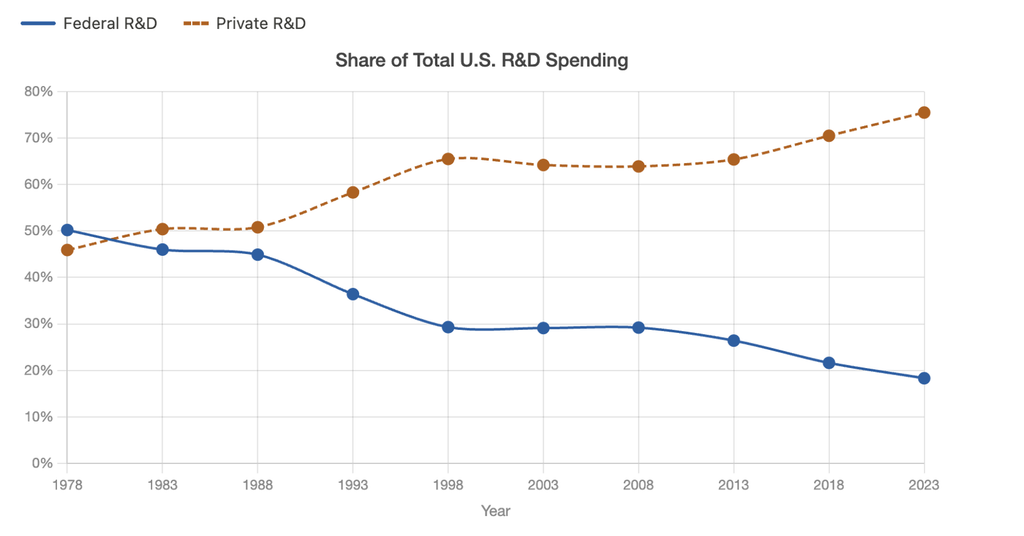
Figure I: Share of Total U.S. R&D Spending46
Decades of scholarship on economic statecraft have largely glossed over the vital role played by firms. Consider Henry Farrell and Abraham Newman’s concept of “weaponized interdependence.”47 Their framework, which offers a useful interpretation of how states exploit asymmetric dependencies in global networks to coerce adversaries, has emerged as the dominant conceptual lens through which policymakers and scholars consider economic statecraft.48 But because Farrell and Newman adopt the same state-centric tack as Possony, Pournelle, and Kane, they offer an imperfect framework for understanding the weaponization of supply chains and corresponding efforts by both governments and commercial actors to break dependence on adversaries.49 Farrell and Newman themselves acknowledge that their work does not “provide any real independent agency to businesses, treating them as the passive transmitters of state policy.”50
A more useful alternative comes from scholar William J. Norris, who proposes a new framework that highlights the central role of the firm in technological competition. Norris introduces the concept of “security externalities,” or the security consequences that arise from commercial actors’ economic activities.51 In economics, externalities are the “spillover effects” of economic activity that affect those not immediately involved in the transaction.52 Norris organizes these externalities into two channels: those that carry an economic impact and those that carry a military impact.53
Economic security externalities that Norris identifies include transactional leverage, interest transformation, corrosion, and bolstering.54 Military externalities, meanwhile, include disarming and arming.55 Critically, a single transaction might trigger multiple externalities at the same time. These effects may even conflict with one another. To take one current example, selling advanced AI chips to Chinese firms in an effort to generate transactional leverage might simultaneously help to arm China’s military.56
| Externality | Description |
| Transactional leverage | Using economic dependence to coerce behavioral change |
| Interest transformation | Fostering integration that realigns a target’s strategic preferences |
| Corrosion | Weakening a target’s economy |
| Bolstering | Strengthening a target’s economy |
| Disarming | Eroding a target’s military-industrial capacity |
| Arming | Enhancing war-fighting capabilities through technology or resource transfer |
Figure II: Categories of National Security Externalities57
Using this framework, the role of the state comes into clearer focus. While states enjoy varying degrees of control over domestic and multinational firms, regulation creates incentive structures that make certain kinds of economic transactions more or less likely. The task for states, then, is to realign commercial incentives, encouraging firms to make transactions that achieve the desired effect. This realignment takes the form of industrial policy: the use of government funding, tax and regulatory frameworks, and other tools to bolster strategic high-technology industries.58
A Strategy of Technology for the 21st Century
Over the past decade, U.S. policymakers have built a considerable techno-economic toolkit, from export controls and investment screening to financing instruments and strategic stockpiles. But these tools have not always followed a coherent strategic logic connecting them to political ends. Policies built around acquiring specific technologies or denying them to adversaries are incomplete unless subordinated to a clear theory of how technological advantage translates into political and psychological effect. As Possony and his coauthors write, “technology should be the servant of the strategist,” not the other way around.59 The principles laid out in The Strategy of Technology provide a starting point for recalibrating U.S. techno-economic strategy.
First, the United States must regain the initiative. During the final two years of President Trump’s first term, a flurry of restrictions on Chinese tech firms like Huawei, ZTE, and SMIC caught Beijing flat-footed.60 Under the Biden administration, however, rounds of export controls on advanced AI chips were implemented slowly, often after warnings were communicated to firms or leaked to the press.61 These delays allowed Chinese semiconductor foundries to stockpile massive amounts of semiconductor manufacturing equipment, high-bandwidth memory, and leading-edge logic dies—equipment and components needed for high-end chipmaking—from firms based in the United States and allied nations.62
While achieving surprise can be difficult due to the need to consult with industry and coordinate with allies, forewarning allows adversaries to prepare countermeasures. U.S. policymakers must move away from carefully telegraphing future moves and perpetually moderating policy actions for fear of escalation. Instead, Washington can keep Beijing off-balance by prioritizing the use of surprise and staking out maximalist positions, then recalibrating as necessary. This approach also keeps the character of the Chinese Communist Party in mind. As a Leninist party, it reads competitive pauses as weakness and intensified pressure as strength.63
Second, policymakers must keep in mind that, in an infinite game, there are no permanent technological chokepoints. A competitor that falls behind in a given technology retains the option to pursue substitutes, invest in ‘leapfrog’ technologies, or accelerate allied cooperation. The only unrecoverable position is voluntary exit.
Consider the energy storage sector. For most of the past decade, domestic battery policy was viewed primarily through the lens of EV policy—a question of consumer subsidies, content requirements, and auto industry jobs. The Trump administration has deprioritized that frame, and the investment structure built around it is contracting. But high-capacity cells are equally foundational to autonomous drones, robotics, and the grid-scale storage installations that data center projects increasingly require. Choosing to abstain from competition in the sector would have ripple effects through critical downstream industries.
Third, the United States must spend not only to build capability but to shape how Beijing spends. The aim is not to outspend China—given fiscal realities, that is neither feasible nor wise—but to press asymmetric advantages in ways that impose disproportionate costs and multiply American leverage. The CCP’s nationalistic pride and sensitivity to rhetoric and symbolism help here. A rival so susceptible to provocation can be steered, at least in part, into reactive and wasteful expenditure.
The United States today possesses an asymmetric advantage in the commercial space sector that could serve as the basis of such a strategy. Thanks to the success of SpaceX, the United States holds a dominant position in space launch. SpaceX alone accounts for nearly 70 percent of all satellites currently in orbit, and the firm’s progress in reusable launch vehicles means the United States leads global space launch capacity by roughly an order of magnitude.64 This dominance in commercial launch and satellite deployment presents precisely the kind of advantage that Possony, Pournelle, and Kane’s framework suggests exploiting. By making anti-satellite capabilities a central mission for the U.S. Space Force while simultaneously accelerating satellite deployment, space-based sensing, in-space servicing, assembly, and manufacturing, and cislunar operations, Washington could compel Beijing to disperse its resources across multiple space-related programs where American advantages are pronounced.
Fourth, effective technological generalship requires financing mechanisms that operate outside the annual appropriations cycle. As industrial policy scholar Rob Atkinson writes, “maintaining redundant capacity, subsidizing strategic industries, and accepting higher consumer prices are necessary costs of not losing the techno-economic war.”65 Government-backed investments in manufacturing capacity, critical materials, and foundational technologies are necessary to crowd in additional private capital, and they require patient, flexible capital that normal budget channels struggle to supply. The proper role of Congress in these instances is that of a limited partner: providing capital, setting guardrails, and holding institutions accountable through transparent reporting and commercial-grade due diligence requirements.66
Several promising mechanisms already exist. The Department of War’s Office of Strategic Capital has positioned itself as a proto-industrial bank, announcing investments across a range of defense-related industries. The Development Finance Corporation and Export-Import Bank have built out domestic programs focused on investment in U.S. manufacturing industries. These agencies and offices employ direct-hire loan specialists with genuine project finance experience who can conduct the kind of rigorous, sector-specific due diligence necessary to properly safeguard taxpayer funds. Today, however, these and other departments and agencies share overlapping authorities and frequently target the same industries without a clear strategic framework governing who does what. Without clear lines of responsibility and strong interagency coordination, due diligence standards may become too permissive and government capital could risk crowding out private investment.
Conclusion
Years into its technological contest with China, Washington finds itself on the back foot. Possony, Pournelle, and Kane’s insights—that technological rivalry is fundamentally psychological, infinite in nature, a contest of resource allocation, and ultimately dependent on strategic leadership—remain as relevant today as during the Cold War. What has changed is the terrain. The locus of innovation has migrated from government R&D programs to commercial firms, and American advantage now depends on how effectively Washington can mobilize private capital and industrial capacity. In its technological contest with the CCP, the United States does not lack resources, alliances, or ingenuity. What it has lacked is the willingness to call technological competition what it is: warfare conducted by other means, demanding the same unity of purpose, ruthlessness of prioritization, and clarity about winning and losing.
Brady Helwig is an associate at Garnaut Global, where he focuses on advanced manufacturing and critical supply chains. He graduated from Hillsdale College with a bachelor’s degree in politics. Brady is an alumnus of SSS China and Defense.
Image: SpaceX CRS-14 Falcon 9 rocket lifts off (KSC-20180402-PH AWG01 0023).jpg, April 2, 2018, from NASA/Tony Gray, Tim Powers, Tim Terry. Retrieved from: https://commons.wikimedia.org/wiki/File:SpaceX_CRS-14_Falcon_9_rocket_lifts_off_%28KSC-20180402-PH_AWG01_0023%29.jpg
[1] He Lifeng, “学习贯彻党鎏鴥鋮届痼齌闀会瀎蜺 | 孻礜薴錥发霠蜪质蛺产’,” 侺产党员网, https://www.12371.cn/2025/11/11/ARTI1762822439590264.shtml.
[2] He Lifeng, “学习贯彻党鎏鴥鋮届痼齌闀会瀎蜺 | 孻礜薴錥发霠蜪质蛺产’.”
[3] Xi Jinping, “吤攠呤设峞唑阰国 实现‘漵讔峞唑簏堙簏阰,” Qiushi, April 30, 2022, https://www.qstheory.cn/dukan/qs/2022-04/30/c_1128607366.htm.
[4] United States Space Force, “Space and Missile Pioneers,” accessed March 23, 2026, https://www.spaceforce.mil/About-Us/Space-and-Missile-Pioneers/.
[5] Andrew Liptak, “Jerry Pournelle, Science Fiction Author Who Wrote on Computers, Dies,” The Verge, September 9, 2017, https://www.theverge.com/2017/9/9/16279582/jerry-pournelle-science-fiction-author-writing-computers-obituary.
[6] Jerry Pournelle, “A Disquisition on the Strategy of Technology,” Chaos Manor (blog), January 9, 1999, https://www.jerrypournelle.com/jerrypournelle.c/sot/disquis.html.
[7] Stefan Possony, Jerry Pournelle, and Francis X. Kane, The Strategy of Technology: Winning the Decisive War, updated online ed. (1997), chap. 1, https://www.jerrypournelle.com/sot/sot_1.htm.
[8] Possony et al., The Strategy of Technology, chap. 1.
[9] Possony et al., The Strategy of Technology, chap. 1.
[10] Francis X. Kane, in The Strategy of Technology, notes to chap. 7, https://www.jerrypournelle.com/sot/sot_7note.htm.
[11] Herman Kahn, On Thermonuclear War (Princeton, NJ: Princeton University Press, 1960); Herman Kahn, Thinking About the Unthinkable (New York: Horizon Press, 1962); Possony et al., The Strategy of Technology, chap. 1.
[12] See Robert Strausz-Hupé, William R. Kintner, and Stefan T. Possony, A Forward Strategy for America (New York: Harper & Brothers, 1961), 71–85.
[13]Possony et al., The Strategy of Technology, chap. 2, https://www.jerrypournelle.com/sot/sot_2.htm.
[14] Pournelle, “A Disquisition on the Strategy of Technology.”
[15] Danny Lewis, “Reagan and Gorbachev Agreed to Pause the Cold War in Case of an Alien Invasion,” Smithsonian Magazine, November 25, 2015, https://www.smithsonianmag.com/smart-news/reagan-and-gorbachev-agreed-pause-cold-war-case-alien-invasion-180957402/.
[16] Stefan T. Possony and Jerry E. Pournelle, The Strategy of Technology: Winning the Decisive War (Cambridge, MA: University Press of Cambridge, 1970).
[17] Andre Beaufré, An Introduction to Strategy: With Particular Reference to Problems of Defence, Politics, Economics, and Diplomacy in the Nuclear Age (New York: Praeger, 1965), 22; Possony et al., The Strategy of Technology, chap. 1.
[18] Possony et al., The Strategy of Technology, chap. 1.
[19] Possony et al., The Strategy of Technology, chap. 1.
[20] Possony et al., The Strategy of Technology, chap. 5, https://www.jerrypournelle.com/sot/sot_5.htm.
[21] Possony et al., The Strategy of Technology, chap. 5.
[22] Possony et al., The Strategy of Technology, chap. 5.
[23] Possony et al., The Strategy of Technology, chap. 5.
[24] James P. Carse, Finite and Infinite Games: A Vision of Life as Play and Possibility (New York: The Free Press, 1986), 3; Possony, et al., The Strategy of Technology, chap. 1.
[25] Carse, Finite and Infinite Games, 3–14.
[26] Possony et al., The Strategy of Technology, chap. 1.
[27] Possony et al., The Strategy of Technology, chap. 1.
[28] W. Brian Arthur, The Nature of Technology: What It Is and How It Evolves (New York: Free Press, 2009), 21.
[29] Arthur, The Nature of Technology, 107–165.
[30] Arthur, The Nature of Technology, 107–165.
[31] John Lewis Gaddis, On Grand Strategy (New York: Penguin Press, 2018), 21.
[32] Strausz-Hupé et al., A Forward Strategy for America, 80.
[33] Possony et al., The Strategy of Technology, chap. 1.
[34] Thomas G. Mahnken, ed., Competitive Strategies for the 21st Century: Theory, History, and Practice (Stanford: Stanford University Press, 2012).
[35] Possony et al., The Strategy of Technology, chap. 7, https://www.jerrypournelle.com/sot/sot_7.htm.
[36] Possony et al., The Strategy of Technology, chap. 2, https://www.jerrypournelle.com/sot/sot_2.htm.
[37] Possony et al., The Strategy of Technology, chap. 1.
[38] Carl von Clausewitz, On War, ed. and trans. Michael Howard and Peter Paret (Princeton: Princeton University Press, 1976), 184–185.
[39] Possony et al., The Strategy of Technology, chap. 1.
[40] Strausz-Hupé et al., A Forward Strategy for America, 87.
[41] Strausz-Hupé et al., A Forward Strategy for America, 87.
[42] Possony et al., The Strategy of Technology, chap. 1.
[43] Raj M. Shah and Christopher Kirchhoff, Unit X: How the Pentagon and Silicon Valley Are Transforming the Future of War (New York: Simon & Schuster, 2024).
[44] William C. Greenwalt, “It’s All About the R&D: Implications of Post-World War II Spending,” AEIdeas (blog), American Enterprise Institute, June 20, 2025, https://www.aei.org/foreign-and-defense-policy/its-all-about-the-rd-implications-of-post-world-war-spending/.
[45] Greenwalt, “It’s All About the R&D.”
[46] National Center for Science and Engineering Statistics, Long-Term Trends Show Decline in Federally Funded R&D as a Share of GDP while Business-Funded R&D Share Increases, NSF 25-334 (Alexandria, VA: U.S. National Science Foundation, 2025), https://ncses.nsf.gov/pubs/nsf25334.
[47] Henry Farrell and Abraham Newman, “Weaponized Interdependence: How Global Economic Networks Shape State Coercion,” International Security 44, no. 1 (Summer 2019): 42–79.
[48] Farrell and Newman, “Weaponized Interdependence,” 42–79.
[49] Ling S. Chen and Miles M. Evers, “‘Wars Without Gun Smoke’: Global Supply Chains, Power Transitions, and Economic Statecraft,” International Security 48, no. 2: 169–170.
[50] Farrell and Newman, “Weaponized Interdependence,” 45; Henry Farrell and Abraham L. Newman, “Weaponized Interdependence and Networked Coercion: A Research Agenda,” in ed. Daniel W. Drezner, Henry Farrell, and Abraham Newman, The Uses and Abuses of Weaponized Interdependence (Washington, DC: Brookings Institution Press, 2021), 315.
[51] William J. Norris, “Security Externalities: A Firm-Centric Theoretical Framework for Economic Statecraft,” Law & Geoeconomics I (2025): 175–213.
[52] N. Gregory Mankiw, Principles of Economics, 9th ed. (Mason, OH: Cengage Learning, 2020), 196–197.
[53] Norris, “Security Externalities,” 180–181.
[54] Norris, “Security Externalities,” 185–196.
[55] Norris, “Security Externalities,” 196–201.
[56] Ben Buchanan and Matt Pottinger, “Trump Is Doubling Down on His Disastrous AI Chip Policy,” The New York Times, December 17, 2025, https://www.nytimes.com/2025/12/17/opinion/trump-ai-chips-nvidia-china.html.
[57] Norris, “Security Externalities,” 175–213.
[58] Robert D. Atkinson, “Marshaling National Power Industries to Preserve America’s Strength and Thwart China’s Bid for Global Dominance,” Information Technology and Innovation Foundation, November 17, 2025, https://itif.org/publications/2025/11/17/marshaling-national-power-industries-to-preserve-us-strength-and-thwart-china/.
[59] Possony et al., The Strategy of Technology, chap. 3, https://www.jerrypournelle.com/sot/sot_3.htm.
[60] Chris Miller, Chip War: The Fight for the World’s Most Critical Technology (New York: Scribner, 2022), 295–325.
[61] Gregory C. Allen, “Understanding the Biden Administration’s Updated Export Controls,” Center for Strategic and International Studies, December 16, 2024, https://www.csis.org/analysis/understanding-biden-administrations-updated-export-controls.
[62] Dylan Patel, AJ Kourabi, and Myron Xie, “Huawei Ascend Production Ramp: Die Banks, TSMC Continued Production, HBM Is the Bottleneck,” SemiAnalysis, September 8, 2025, https://newsletter.semianalysis.com/p/huawei-ascend-production-ramp.
[63] Matt Pottinger and Mike Gallagher, “No Substitute for Victory: America’s Competition with China Must Be Won, Not Managed,” Foreign Affairs 103, no. 3 (May/June 2024): 25–39.
[64] Todd Harrison, “Building an Enduring Advantage in the Third Space Age,” American Enterprise Institute, May 8, 2024, https://www.aei.org/research-products/report/building-an-enduring-advantage-in-the-third-space-age/.
[65] Atkinson, “Marshaling National Power Industries.”
[66] Brady Helwig, “When the Government Owned Factories: The Defense Plant Corporation and Its Lessons for Today,” American Affairs X, no. 1 (Spring 2026), https://americanaffairsjournal.org/2026/02/when-the-government-owned-factories-the-defense-plant-corporation-and-its-lessons-for-today/.