



Security and Strategy Journal
China’s Copper Advantage: Salami Slicing and Supply Chain Competition
Share On:
The U.S.–China strategic competition is often framed through high-visibility arenas such as advanced technology, semiconductors, military modernization, and ideological rivalry. This framing captures important dimensions of the rivalry, but it also obscures lower-visibility resource supply chains that increasingly shape the material foundations of strategic power.
Rare earth elements—such as neodymium, dysprosium, and terbium—have already become high-visibility strategic minerals. This is because China controls roughly 60 percent of global production and approximately 85 percent of separation and refining capacity, and it has shown a willingness to use export controls as leverage in strategic competition with adversaries.1 Copper, by contrast, has long remained a lower-visibility bulk industrial metal. Despite its importance to electricity, electronics, construction, and related sectors, copper was generally treated as a mature and diversified commodity market and was not included in U.S. critical minerals lists until 2025.2
While Washington concentrated on high-profile resources such as rare earths, China gradually secured control over critical nodes of the global copper supply chain through a salami-slicing approach. Economist Thomas Schelling’s Arms and Influence describes the strategic logic of advancing through incremental moves calibrated to remain below the threshold that would provoke a decisive counter-response. Three features distinguish its application to supply chains: each move is framed as commercially rational, technically routine, or developmentally beneficial; moves are sequenced across multiple value-chain segments so that no single regulatory regime captures the cumulative pattern; and strategic intent becomes visible only once structural lock-in is difficult to reverse.3 The strategic distinctiveness lies not in the methods themselves, which are often indistinguishable from ordinary commercial practice, but in their aggregation across time and value-chain segments. The more recent, conspicuous moves of the Belt and Road Initiative (BRI) do not falsify this logic but confirm its expected trajectory: salami slicing typically yields to fait accompli once structural advantage has been consolidated.
Through domestic refining buildout, overseas mine acquisitions, and project-linked financing, this incremental process gave China dominance over the most critical segments of the global copper supply chain, particularly smelting and refining. Yet Washington did not seriously reconsider copper’s strategic significance until after 2024, when AI infrastructure and power-grid expansion sharply increased copper demand. Data centers are copper-intensive facilities: their power-distribution systems, transformers, cooling loops, and internal wiring all require large volumes of copper. In 2023, global data centers consumed an estimated 300–380 terawatt-hours (TWh) of electricity, roughly equivalent to the entire annual electricity demand of the United Kingdom.4 The United States and China together accounted for nearly two-thirds of that total.5 Because such power demand requires sustained grid expansion, copper now sits at the center of a strategic chain linking AI infrastructure, electricity systems, and national security.6

Figure 1. Copper Demand Will Surge as the Grid Expansion Demand Increases7
China’s rise in the global copper supply chain is best understood as a form of salami slicing—using small, inconspicuous actions to slowly accomplish an overarching goal—in supply chain competition, whereby incremental gains in refining, upstream mining, and downstream power equipment collectively produced a structural shift in market power. Adapting this concept from territorial strategy to supply chain competition, and distinguishing it from ordinary industrial policy, this article traces how that logic deepened U.S. dependence across key segments of the copper value chain, underscoring the need for policies that rebuild resilience where vulnerabilities are greatest.
China’s rise in the global copper supply chain exemplifies salami slicing in supply chain competition: each policy, investment, or industrial initiative appeared too incremental to warrant alarm, but together they produced a structural shift. China’s rise in the global copper supply chain is best understood as a form of salami slicing the supply chain competition, whereby incremental gains in refining, upstream mining, and downstream power equipment collectively produced a structural shift in market power. This pattern has increased U.S. dependence across key segments of the copper value chain, resulting in the need for policies that rebuild resilience where vulnerabilities are greatest.
China’s Salami-Slicing Strategy in the Global Copper Supply Chain
Mid-Stream: Constructing Overwhelming Refining and Smelting Capacity
China’s state-led buildout of copper smelting capacity began in the early reform era, shortly after Deng Xiaoping launched the reform and opening-up drive in the late 1970s. Dividing the copper value chain into three segments: upstream mining, midstream smelting and processing (including refining and cycling), and downstream end-use consumption, it becomes clear that China, lacking significant domestic copper ore reserves, could not immediately pursue control of upstream extraction. And although China was the world’s most populous country with aspirations to become the global manufacturing hub, it was also not yet able to dominate global copper consumption downstream. That left only the midstream segment—ore smelting and processing—as the area where policy-driven efforts could yield meaningful results. Moreover, it is precisely this midstream segment, which links mining to end use, that formed a critical chokepoint for China in the copper supply chain.
In 1979, China announced the establishment of Jiangxi Copper Corporation, the country’s first modern copper smelting enterprise.8 Its development marked China’s transition from small-scale copper production toward industrialized smelting. During this period, although China had already launched a top-down expansion of copper smelting capacity, progress remained slow due to its underdeveloped industrial base and lack of infrastructure.
The real takeoff in capacity soon followed. By 1990, China’s refined copper output had already reached 559,000 tons.9 A decade later in 2000, production climbed to 1.33 million tons, and by 2003, it had leapt to 1.84 million tons.10 These capacity figures were not just increasing in absolute terms; China’s share of global copper refining also began to surge after 2000. By 2025, China accounted for more than half of the world’s total refining capacity (See figure 2).
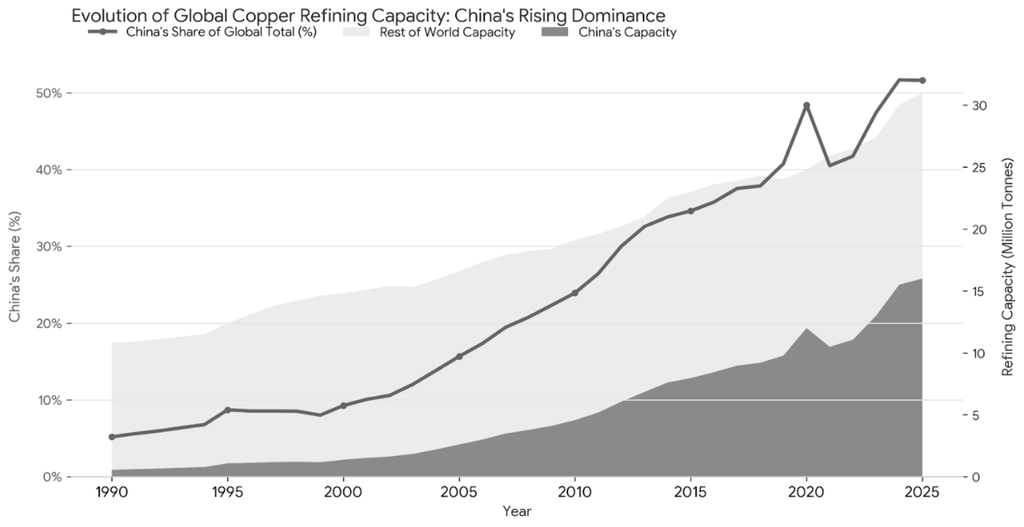
Figure 2. Global Total Refining Capacity, China’s Total Refining Capacity, and China’s Share of Global Refining Capacity11
To support this capacity growth, Beijing expanded its direct investment into copper smelting. This support extended beyond financial input: by the mid-2000s, copper smelting was under formal industrial-policy guidance through state planning tools such as the Industrial Structure Adjustment Catalogue.12 In the early 2000s, the Chinese government introduced a series of policy directives aimed at optimizing the spatial distribution of smelting capacity and cultivating high-performing companies that could compete at top international levels in this sector.13 These policies channeled capital, tax credits, and land access toward large-scale, technologically advanced state-owned copper firms.
Crucially, none of these measures resembled heavy-handed state intervention: there were no outright takeovers of private refineries, no mandatory mergers by decree, no public designation of copper as a strategic priority. Instead, they followed a gradual, low-visibility trajectory in which each step appeared to refine resource allocation at the margins while in practice consolidating the midstream smelting segment under state direction. Once China surpassed half of the global share of refining capacity, Beijing gained substantial structural leverage over the world’s copper-processing chokepoint.
This policy environment ultimately reinforced an increasingly concentrated industry structure centered on a handful of major state-backed copper groups. For analytical purposes, this may be understood as a ‘4+1’ configuration centered on five companies: Jiangxi Copper, Tongling Nonferrous Metals, Yunnan Copper, Jinchuan Group, and China Copper Corporation. This configuration emerged not through an abrupt market disruption, but through salami-sliced initiatives—mergers of mid-sized smelters, phasing out outdated facilities, and the expansion of captive concentrate supplies. Each step was framed as either technological upgrades or environmental compliance, which was domestically uncontroversial and externally unthreatening.
By itself, the midstream consolidation does not prove strategic intent. At the time, Western observers reasonably read it as industrial improvement consistent with broader Chinese development, and on the available evidence, that reading was not unreasonable.14 What made the strategic interpretation more compelling was the broader pattern that emerged when midstream dominance was considered alongside systematic upstream acquisition and downstream demand capture, which together were more difficult to explain as sector-specific advancement alone.
Upstream: Fragmented but Persistent Equity Expansion in Overseas Mines
Mirroring the pattern by which China built its domestic copper-smelting capacity, Beijing’s upstream expansion into overseas copper mines has likewise followed a classic salami-slicing trajectory. Since the 2000s, Chinese firms entering major copper-producing countries, such as Chile, Peru, Zambia, and the Democratic Republic of the Congo (DRC), have typically adopted a commercial, low-visibility approach centered on small minority equity stakes, consortium-based acquisitions, and long-term offtake agreements.
According to one Chinese industry study, the most common entry strategy for Chinese companies is to obtain a minority share in a project, often paired with joint development arrangements or project-linked financing, rather than seeking controlling stakes at the outset.15 Viewed individually, these incremental, minority-equity investments are commercially rational (and consistent with the practices of major Western mining companies), and they do not cross national-security sensitivity thresholds for host governments. Yet as these dispersed equity positions accumulated over time and extended across multiple resource-rich jurisdictions, China’s attributable share of high-quality global copper production expanded quietly but substantially. Research by S&P Global indicates that China’s overseas attributable copper mine production reached approximately 2.6 million metric tons by 2024, reflecting significant growth. Combining this figure with China’s domestic copper mine production, China’s attributable copper production reaches 18.9 percent of global output.16
A representative example of this strategy is the Las Bambas project in Peru. In 2014, a consortium led by China Minmetals, together with CITIC Resources and Guoxin International, acquired the project from Glencore for $5.85 billion USD.17 Executed through a multi-firm consortium rather than a single state-owned buyer, the transaction appeared commercial while securing a major long-term feedstock source for China’s copper smelting system, with Las Bambas producing 350,000–400,000 tons of copper concentrate annually.18 Moreover, the acquisition was not an isolated event. It was preceded by more than a decade of Chinese equity participation in several Peruvian copper projects, such as Toromocho, Galeno, and Río Blanco.19 In this sense, the Las Bambas acquisition was not a standalone gambit but a strategic move within a long-running pattern of fragmented, consortium-based Chinese investment in upstream copper.
While long-term offtake rights, project-linked finance, and influence over export logistics are standard tools of any minority investor, the Chinese deployment differs in aggregation. Held in coordination by a small set of state-backed entities, these positions allowed Beijing to secure its supply without the political cost of full ownership.20
A further component strengthening China’s control over upstream copper resources is its extensive use of equity-for-loans arrangements. Under this model, Chinese policy banks provide infrastructure financing in exchange for mining equity or long-term supply and revenue-repayment mechanisms.21 The most representative example is the Sicomines project in the Democratic Republic of Congo. In 2008, China Eximbank and other state-backed lenders extended roughly $6 billion in infrastructure loans to the DRC, through which Chinese enterprises obtained approximately 68 percent of the project’s equity, with loan repayment tied to future copper and cobalt revenues.22 Framed as development infrastructure, the arrangement carried the appearance of development assistance while producing durable and difficult-to-reverse resource lock-in.23 Like earlier minority-equity investments, each individual equity-for-loans transaction is economically rational on its own terms, yet the cumulative effect compounds—each new loan deepens China’s structural position at the mining stage.
Taken as a whole, these incremental, commercially framed investments have allowed China to assemble a resilient structural position across the upstream copper mining sector. The alternative would have been visible and politically costly: a single state-owned majority acquisition of a top tier mine would have invited investment screening or political pushback in producer countries. By distributing the same influence across consortia, minority stakes, and resource-backed loans, China secured comparable structural reach at a far lower political cost. Whether this pattern reflected deliberate strategy or accumulated commercial logic, the practical outcome is identical: a durable upstream position assembled through individually unremarkable transactions.
Downstream: Extending Influence on Copper Through Power Equipment Industrial Expansion
In terms of demand structure within China, copper’s single largest use lies in power and electricity-related applications. One policy-focused study notes that approximately 65 percent of copper consumption in China ultimately goes to power uses, primarily cables and wires.24 A securities industry analysis based on official planning estimates that in 2023, the power sector accounted for 56.6 percent of China’s total copper consumption.25 Related analyses referencing China’s official document “State Power Investment Corporation’s 14th Five-Year Plan and 2035 Long-Term Outlook” indicate that, driven by carbon-neutrality and renewable-energy goals, China plans to invest nearly 6 trillion RMB in grids and associated industries, much of which will translate into long-term demand for power cables and grid equipment.26
From an industry-organization perspective, China’s consolidation of the downstream wire-and-cable segment likewise exhibits a classic salami slicing pattern. According to the latest assessment by Huang Chongqi, a member of the Chinese Academy of Engineering, China’s wire-and-cable sector consumed approximately 7.54 million tons of copper in 2022, equivalent to over 60 percent of national refined-copper output and roughly one-third of global wire-and-cable copper usage.27 The country hosts at least 7,000 wire-and-cable enterprises, with total annual industry output reaching 1.64 trillion RMB, making it the second-largest supporting sector within China’s machinery industry.28 Over time, local manufacturers and small producers were consolidated into a low-sensitivity industrial cluster that became the world’s largest and most diversified wire-and-cable production and export regime.
In overseas markets, Chinese power-equipment expansion follows a similarly low-visibility, incremental logic. At the policy level, official documents explicitly define electricity cooperation as a core component of the BRI, and academic analyses identify power-grid interconnection and energy cooperation as priority areas in BRI infrastructure partnerships.29 At the operational level, securities and industry research commonly observe that Chinese electrical-equipment firms typically begin their international expansion by securing engineering, procurement, and construction (EPC) contracts for transmission and transformation projects, followed by turnkey equipment exports. These initial projects then drive the batch supply of transmission, distribution, and substation equipment, gradually forming an increasingly complete export ecosystem for power-grid equipment.30 Each project appeared as ordinary infrastructure cooperation or a modest EPC contract, unlikely to trigger strategic alarm. Yet as large numbers of such projects accumulate across regions, China’s share in global power-equipment supply has increased steadily, and overseas grid construction becomes increasingly reliant on Chinese transmission and distribution equipment. Although no single dataset captures China’s total share of global power-transmission-equipment sales, China was the world’s largest exporter of electrical transformers in 2024, accounting for 34.1 percent of global exports, underscoring China’s substantial role in grid equipment exports.31
Taken as a whole, China’s expansion in downstream power-equipment industries did not result from a single, highly visible strategic initiative like the state-owned China National Offshore Oil Corporation’s (CNOOC) failed 2005 bid for the American energy firm Unocal.32 Rather, it proceeded through incremental domestic capacity enlargement in wires, cables, and electrical equipment, policy-guided investment in domestic grid construction, and the gradual proliferation of overseas EPC projects. Over time, these steps have produced a form of dominance in the end-use copper market—particularly in the Global South. The sustained demand generated by these high copper density products has effectively created a powerful copper-consumption gravity center, with global smelters and mining companies increasingly orienting capacity and trade flows toward China.
In short, through salami-sliced expansion of its downstream power-equipment industries, China has not only locked in substantial copper demand at the consumption level, but has also further strengthened its bargaining position and absorptive pull in the midstream and upstream segments, thereby generating a form of structural control across the whole global copper supply chain.
Policy Options for the United States
By the mid-2020s, the salami-slicing phase outlined above had given way to fait accompli. China’s accumulated positions in refining, overseas mining, and downstream power equipment are no longer merely emerging advantages; they have become entrenched structural realities that would be costly to unwind. As a result, the United States is responding to a strategy that has already entered its consolidation phase. Each additional year of inaction widens the gap between observable reality and recoverable position.
The Trump administration’s Section 232 action has imposed a 50 percent tariff on imported copper products, such as pipes, cables, and electrical components. Raw materials are exempt.33 The idea is that taxing finished goods while leaving raw inputs untouched would protect domestic manufacturers. However, tariffs only address the symptoms. They will raise the cost of Chinese power equipment without building a domestic refining capacity to replace it, and the scraps will continue to flow to Chinese smelters. Tariffs can provide some time, but they cannot rebuild a value chain. The U.S. response should focus on the segments where dependence is most acute and where federal policy can move fastest: domestic smelting and refining, secondary copper processing, and downstream demand for copper-intensive power infrastructure. Washington should rebuild the industrial base that allows copper to be processed, recycled, and consumed within a supply chain ecosystem that is independent of China. The Trump administration should make domestic copper refining and recycling a national industrial priority, shifting policy from incremental compliance management toward accelerated approvals, targeted production incentives, and demand-side localization. Specifically, the following measures should be implemented.
Implement America First Permitting Reform
Building on the Trump administration’s mineral-production executive order, federal environmental reviews for copper smelters and secondary copper-processing facilities should be significantly streamlined, with categorical or procedural exemptions used only where legally permissible.34 Furthermore, the administration should encourage states to establish Strategic Resource Special Zones by tying them to federal infrastructure grants, tax incentives, and local job-creation commitments. Within these zones, state-level approval cycles for investment in smelting and recycling plants should be compressed to under one year, a substantial reduction from the multi-year timelines that often characterize major industrial permitting in the United States, with provisions allowing production to begin before the final completion of secondary compliance milestones.35 This is essential to ensure the United States can rapidly fill the strategic vacuum left by the attrition of domestic capacity since the 1990s.
Authority for this reform rests on extending the existing FAST-41 framework—a system that accelerates environmental reviews for large-scale infrastructure projects that is administered by the Federal Permitting Improvement Steering Council—to copper smelters and secondary copper processing facilities.36 Because the framework already covers critical minerals projects, this extension could potentially be pursued through an executive order under the 2025 critical minerals national security designation, without immediately requiring new legislation.37 The political significance of this pathway is considerable: it avoids the legislative gauntlet in Congress, where Democratic legislators committed to environmental review and procedural protections would have strong grounds to delay or block any new permitting carve-out.
Anticipated pushback from environmental advocacy groups, career EPA staff, and tribal governments adjacent to legacy smelter sites can be addressed by making clear that the measure would only change the sequencing of compliance, not its substance. The provisions would allow limited production to begin before non-core secondary compliance milestones are finalized. Furthermore, if acceleration alone proves insufficient and a full National Environmental Policy Act (NEPO) exemption becomes necessary, the legislative template for such carve-outs already exists in the Building Chips in America Act of 2023.38
Establish a Copper Revitalization Act for Direct Incentives
Emulating the model of the CHIPS and Science Act, which used targeted federal support to expand domestic production in strategic sectors, the federal government should prioritize Production Tax Credits (PTCs) over investment credits for domestic copper refiners to directly offset China’s cost advantages. For foreign firms from non-adversary countries willing to invest in the United States, Washington should use its own phased approach: accelerated depreciation, capped Capital Expenditure (CAPEX) credits, and production-based bonuses that lower entry barriers without granting blanket upfront subsidies.
This measure would require congressional legislation, but its political path is well established. The 2022 CHIPS and Science Act already demonstrated that targeted federal support for a strategic industry can pass with bipartisan backing when framed around national security, and copper’s 2025 designation as a critical mineral places it squarely in that same category.
Three objections are likely. Fiscal conservatives worried about cost can be reassured by the design itself. Because credits are paid only when copper is actually produced, rather than on money spent building facilities, the government pays for results, not promises, which is a more disciplined structure than under the CHIPS Act. Libertarians opposed to industrial policy on principle can be answered by copper’s national security status, which takes it out of the ordinary government-picking-winners debate. The hardest objection comes from economic nationalists who oppose any subsidy to foreign firms, even allies. That tension cannot be fully resolved: the measure deliberately trades some foreign ownership for faster construction of copper capacity on American soil. This is the same trade-off the Trump administration has repeatedly accepted in welcoming foreign-built semiconductor and battery plants in Arizona, Ohio, and Georgia.
Repurpose the Residual Framework of the Inflation Reduction Act (IRA)
Existing IRA incentives should be reweighted toward critical energy infrastructure where copper supply chain resilience is most directly at stake. Enhanced domestic content credits should be granted to transformers, high-voltage cables, and data center power distribution systems that utilize 100 percent domestically refined copper. These localization rewards would stimulate domestic smelting demand while preventing U.S. grid and data-center buildouts from becoming locked into Chinese-made power equipment.
This redirection can be pursued along two tracks. The first is administrative: the executive branch already has the authority to tighten the eligibility rules for existing IRA tax credits so that they reward equipment built with domestically refined copper, and the U.S. Department of Energy can steer its existing financing and grid-modernization programs in the same direction, all without new legislation. The second track, formally rerouting appropriated IRA funds away from electric vehicles and renewables, would require an act of Congress and would face steep procedural and political obstacles. The administrative track, therefore, is the realistic near-term route, though pushback will be intense. Democratic legislators and climate groups will cast this as an attack on the IRA, but this track should be reframed in a way that shows how it rescues the law’s own goals: the IRA’s electrification and clean-energy targets are impossible to meet without a secure copper supply, so strengthening domestic copper serves those goals. Solar, wind, and battery special interest groups will worry about losing access to subsidies, but no IRA funding is being cut; eligibility is simply being tightened to favor American-made inputs, a direction the IRA itself already takes through its existing domestic-content bonus. Career staff at Treasury and the IRS may resist reinterpreting settled rules, though grounding the changes in copper’s critical minerals status and moving through proper rulemaking channels would reduce that friction.
Establish a Phased Copper Scrap Export Control Regime to Rebuild Domestic Recycling Capacity
The United States is currently a major net exporter of copper scrap. In 2024, the United States exported nearly 957,000 metric tons of copper scrap, with more than 40 percent destined for China.39 This flow effectively subsidizes Chinese refining capacity at the expense of U.S. domestic recycling. Industry analysts estimate that existing U.S. secondary smelters operated at only about 21 percent of installed capacity in mid-2025, even as new multi-metal recycling facilities like Aurubis’s $800 million Richmond, Georgia plant are entering commissioning and ramp-up phases.40 To redirect this flow, the federal government should phase in export controls in step with domestic capacity. In the first year, the U.S. Department of Commerce would require licenses for scrap exports to non-market economies. Over the following two years, Copper Revitalization Act subsidies would raise output at existing recyclers and speed new plants into operation. Only after domestic buyers are in place, beyond the three-year mark, would the government tighten controls further through quotas or targeted export bans, structured as limits on quantity rather than as export taxes, which the Constitution forbids. The sequencing is deliberate: domestic capacity must come first, so that restricting exports does not strand the scrap industry before American buyers exist to absorb the material. Each phase draws on existing executive branch authorities.
The U.S. Department of Commerce can require export licenses under existing export control law, though making copper scrap subject to those rules would require it to first go through a formal rulemaking process, achievable without new legislation but not instantaneous. The later, tighter phases could be implemented by expanding the same licensing system or, in a genuine supply emergency, by invoking the president’s emergency economic powers. The main pushback would come from the scrap recycling industry. The Institute of Scrap Recycling Industries (ISRI) would likely argue that domestic refining capacity is insufficient to absorb existing scrap volumes and that restrictions will damage their export markets. The phased sequencing built into the measure directly addresses this by deferring Phase 3 restrictions until Phase 2 domestic capacity buildup is meaningfully operational. This is supplemented by the fact that existing secondary U.S. smelters currently operate at only about 21 percent of installed capacity, leaving substantial near-term headroom to absorb diverted scrap volumes without new greenfield construction.
Together, these measures would not immediately replicate China’s decades-long accumulation of copper supply chain advantages, but they would begin to rebuild the missing U.S. capacity at the points where dependence is most acute: refining, recycling, and copper-intensive power infrastructure.
Conclusion
Copper is no longer a mundane industrial commodity, but a strategic resource increasingly central to U.S.–China competition in the age of AI, grid expansion, and electrification. China’s dominance in the global copper supply chain was built incrementally through upstream equity acquisition, midstream smelting expansion, and downstream demand creation in power equipment and infrastructure. Each step appeared commercially rational and individually non-threatening, yet together they produced a structural advantage that is now difficult to reverse. The central implication is that the United States is not merely competing with China over access to a strategic mineral, but confronting a China-centered copper ecosystem that Beijing has spent decades constructing. Restoring U.S. resilience, therefore, requires more than new mining: it requires rebuilding the capacity to refine, recycle, and absorb copper within a China-resilient industrial ecosystem. If Washington fails to act at these processing and demand-side chokepoints, copper may become both a material constraint on U.S. industrial revival and a structural vulnerability in the broader strategic competition to come.
Shijie Wang is a deputy editor at the Jamestown Foundation where he focuses on Chinese critical mineral and industrial policy. He graduated from Shanghai Normal University with a bachelor’s degree in journalism and a master’s degree from Georgetown University in public policy. Shijie is an alumnus of SSS China.
Image: Labyrinthine circuit board lines – Flickr – quapan, April 20, 2008, from Labyrinthine Circut Board Lines. Retrieved from: https://commons.wikimedia.org/wiki/File:Labyrinthine_circuit_board_lines_-_Flickr_-_quapan.jpg.
[1] Vina Nadjibulla and Xiaoting (Maya) Liu, “How Escalating U.S.-China Competition Over Critical Minerals Impacts Canada,” Asia Pacific Foundation of Canada, March 19, 2025, https://www.asiapacific.ca/publication/how-escalating-us-china-competition-over-critical-minerals;; Nik Martin, “How China Wields Rare Earths as a Strategic Weapon,” Deutsche Welle, October 9, 2025, https://www.dw.com/en/how-china-wields-rare-earths-as-a-strategic-weapon/a-72868760.
[2] U.S. Geological Survey, “2025 List of Critical Minerals,” https://www.usgs.gov/media/images/2025-list-critical-minerals.
[3] Thomas C. Schelling, Arms and Influence (New Haven, CT: Yale University Press, 1966), 66–69.
[4] UK Department for Energy Security and Net Zero, “Chapter 5: Electricity,” in Digest of UK Energy Statistics (DUKES) 2024 (London: Department for Energy Security and Net Zero, 2024), https://assets.publishing.service.gov.uk/media/66a7da1bce1fd0da7b592f0a/DUKES_2024_Chapter_5.pdf.
[5] George Kamiya and Vlad C. Coroamă, Data Centre Energy Use: Critical Review of Models and Results (IEA 4E, 2025), https://www.iea-4e.org/wp-content/uploads/2025/05/Data-Centre-Energy-Use-Critical-Review-of-Models-and-Results.pdf.
[6] Harry Krejsa and Audrey Kurth Cronin, “AI and National Security: Harden the Grid To Win the Race,” Carnegie Mellon University, accessed March 23, 2026, https://www.cmu.edu/work-that-matters/energy-innovation/ai-and-national-security-harden-grid-win-race.
[7] “AI’s Power Binge,” McKinsey & Company, November 6, 2024, https://www.mckinsey.com/featured-insights/week-in-charts/ais-power-binge;; Daniel Yergin, Carlos Pascual, Eleonor Kramarz, Aurian De La Noue, Miguel Acosta, Gray Bender, Mohsen Bonakdarpour, Tabitha Bailey, and Keerti Rajan, Copper in the Age of AI (S&P Global, 2025), https://www.spglobal.com/en/research-insights/special-reports/copper-in-the-age-of-ai; “AI Could Add 1 Million Tons to Copper Demand by 2030, Says Trafigura,” Trafigura, April 8, 2024, https://www.trafigura.com/news-and-insights/in-the-news/2024/ai-could-add-1-million-tons-to-copper-demand-by-2030-says-trafigura/.
[8] Jiangxi Copper Group Co., Ltd., “Company Profile” (Gongsi Jianjie; 公司简介), https://www.jxcc.com/aboutus.html..
[9] Yu Lirong, “The Long Road from Bull to Bear: Outlook for the 2005 Copper Market” (Niuxiong Zhuanhuan Lu Manman—2005 Nian Tongshi Zhanwang; 牛熊转换路漫漫——2005年铜市展望), Shanghai Futures Exchange, 2005, https://www.shfe.com.cn/jrysp/20/12.pdf.
[10] Yu, “The Long Road from Bull to Bear.”
[11] U.S. Geological Survey, “Mineral Commodity Summaries,” accessed March 23, 2026, https://www.usgs.gov/centers/national-minerals-information-center/mineral-commodity-summaries; International Copper Study Group, The World Copper Factbook 2025 (Lisbon: International Copper Study Group, 2025), https://icsg.org/download/2025-10-the-world-copper-factbook/.
[12] National Development and Reform Commission, “Industrial Structure Adjustment Catalogue (2007 Edition)” (Chanye Jiegou Tiaozheng Zhidao Mulu (2007 Nian Ben); 产业结构调整指导目录 (2007年本)), December 2, 2007, https://www.ndrc.gov.cn/xxgk/zcfb/tz/200712/W020190905521022663075.pdf.
[13] State Economic and Trade Commission, “Outline of the Tenth Five-Year Plan for Industrial Structural Adjustment” (“Shiwu” Gongye Jiegou Tiaozheng Guihua Gangyao; “十五”工业结构调整规划纲要), October 2001, https://www.ndrc.gov.cn/fggz/fzzlgh/gjjzxgh/200506/W020191104623896525331.pdf;; State Council of the People’s Republic of China, “Outline of the Eleventh Five-Year Plan for National Economic and Social Development of the People’s Republic of China” (Zhonghua Renmin Gongheguo Guomin Jingji He Shehui Fazhan Di Shiyi Ge Wunian Guihua Gangyao; 中华人民共和国国民经济和社会发展第十一个五年规划纲要), March 14, 2006, https://www.gov.cn/gongbao/content/2006/content_268766.htm.
[14] U.S. Geological Survey, “The Mineral Industry of China,” in 2010 Minerals Yearbook, Vol. III, Area Reports: International (Reston, VA: U.S. Geological Survey, 2012), https://d9-wret.s3.us-west-2.amazonaws.com/assets/palladium/production/mineral-pubs/country/2010/myb3-2010-ch.pdf.
[15] Chen Xiufa et al., “Distribution Characteristics of Global Copper Resources, the Exploration and Development Pattern, and Future Prospects” (Quanqiu Tongkuang Ziyuan Fenbu Tezheng, Kancha Kaifa Geju Yu Zhanwang; 全球铜矿资源分布特征打勘查开发格局与展望), China Mining Magazine 34, no. 2 (2025): 314–23, http://www.chinaminingmagazine.com/cn/article/pdf/preview/10.12075/j.issn.1004-4051.20242271.pdf.
[16] Shunyu Yao, “China Overseas Mining 2025: Gold and Energy Transition Metals,” S&P Global Market Intelligence, September 29, 2025, https://www.spglobal.com/market-intelligence/en/news-insights/research/2025/10/china-overseas-mining-2025-gold-and-energy-transition-metals.
[17] Glencore Xstrata plc, “Sale of Las Bambas Copper Mine Project,” April 13, 2014, https://www.glencore.com/dam/jcr%3Aab02d77a-c760-478f-b649-6283af9f8266/201404131900-Sale-of-Las-Bambas-Copper-Mine-Project-CHI-E.pdf.
[18] MMG Limited, 2020 Annual Report (Hong Kong: MMG Limited, April 19, 2021), https://www.mmg.com/wp-content/uploads/2021/03/e_2021-04-19_2020-Annual-Report.pdf.
[19] “China’s Chinalco Starts $1.3 Billion Expansion of Peru Copper Mine,” Reuters, June 3, 2018, https://www.reuters.com/article/markets/currencies/chinas-chinalco-starts-13-billion-expansion-of-peru-copper-mine-idUSKCN1J00CH/; AidData, “CDB Pledges to Finance Galeno Copper Mine Project,” https://china.aiddata.org/projects/36127/; “Rio Blanco Copper Mine, Peru,” Mining Technology, https://www.mining-technology.com/projects/rio-blanco.
[20] Brooke Escobar et al., Ammar A. Malik, Sheng Zhang, Katherine Walsh, Alexandra Joosse, Bradley C. Parks, Jacqueline Zimmerman, and Rory Fedorochko, Power Playbook: Beijing’s Bid to Secure Overseas Transition Minerals (Williamsburg, VA: AidData at William & Mary, January 28, 2025), https://docs.aiddata.org/reports/china-transition-minerals-2025/FULL_REPORT_Power_Playbook.pdf.
[21] David Landry, “Sicomines Deal Offers Four Clear Resource-for-Infrastructure Lessons,” Natural Resource Governance Institute, March 9, 2017, https://resourcegovernance.org/articles/sicomines-deal-offers-four-clear-resource-infrastructure-lessons.
[22] Landry, “Sicomines Deal.”
[23] Aaron Ross, “China’s ‘Infrastructure for Minerals’ Deal Gets Reality-Check in Congo,” Reuters, July 8, 2015, https://www.reuters.com/article/markets/currencies/chinas-infrastructure-for-minerals-deal-gets-reality-check-in-congo-idUSKCN0PI1UA.
[24] Jason Potts, Fushan Shang, Bo Zhao, Shaofu Duan, Zunbo Zhou, Martin Streicher-Porte, and John Atherton, “Policy Recommendations for a Sustainable Copper Supply Chain: A Chinese Perspective” (Zhongguo Shijiao Xia Kechixu Tong Gongying Lian Zhengce Jianyi; 中国视角下可持续铜供应链政策建议), International Institute for Sustainable Development, 2010, https://www.iisd.org/system/files/publications/policy_recommendations_china_copper_zh.pdf.
[25] Zhang Tianfeng, “In-Depth Report on the Copper Industry (II): The Resilience and Elasticity of Copper Consumption—A Forward-Looking Analysis of Copper Demand in China’s Four Major End-Use Sectors” (Tong Hangye Shendu Baogao (II): Tong Xiaofei de Renxing Ji Tanxing—Zhongguo Sida Yongtong Hangye Yuanqi Tong Xiaoliang Fenxi Zhanwang; 铜行业深度报告(II): 铜消费的韧性及弹性: 中国四大用铜行业远期铜消耗量分析展望), Dongxing Securities, August 16, 2024, https://pdf.dfcfw.com/pdf/H3_AP202408211639369891_1.pdf.
[26] Zhang, “In-Depth Report on the Copper Industry (II).”
[27] Huang Chongqi, Xu Xiaofeng, Liu Jingping, Li Fu, and Gao Huan, “Technical Status and Development Trend of Cable Industry in China” (Zhongguo Dianlan Gongye de Jishu Xianzhuang Jiqi Fazhan Qushi; 中国电缆工业的技术现状及其发展趋势), Wire & Cable (电线电缆) 67, no. 6 (2024): 1–8, https://jwc.cwc.net.cn/cn/article/pdf/preview/10.16105/j.dxdl.1672-6901.202406001.pdf.
[28] Huang et al., “Technical Status and Development Trend of Cable Industry in China.”
[29] State Council Information Office of the People’s Republic of China, “Energy in China’s New Era” (Xin Shidai de Zhongguo Nengyuan Fazhan; 新时代的中国能源发展), December 21, 2020, https://www.gov.cn/zhengce/2020-12/21/content_5571916.htm; Liu Zhe, Gao Yi, Wang Yusheng, Li Jun, and Huang Weihe, “Analysis of Power Interconnection under the Belt and Road Initiative” (“Yidai Yilu” Dianli Hulian Hutong Qianxi”; (一带一路”电力互联互通浅析), Strategic Study of CAE (中国工程科学) 21, no. 4 (2019): 76–81, https://www.engineering.org.cn/sscae/CN/10.15302/J-SSCAE-2019.04.007.
[30] Zhang, “In-Depth Report on the Copper Industry (II).”
[31] “Electrical Transformers in China Trade,” Observatory of Economic Complexity, https://oec.world/en/profile/bilateral-product/electrical-transformers/reporter/chn.
[32] Dick K. Nanto, James K. Jackson, Wayne M. Morrison, and Lawrence Kumins, “China and the CNOOC Bid for Unocal: Issues for Congress,” CRS Report RL33093 (Washington, DC: Congressional Research Service, February 27, 2006), https://www.everycrsreport.com/reports/RL33093.html.
[33] Proclamation No. 10962, “Adjusting Imports of Copper into the United States,” 90 Fed. Reg. 37,727 (August 5, 2025), https://www.federalregister.gov/documents/2025/08/05/2025-14893/adjusting-imports-of-copper-into-the-united-states.
[34] Donald J. Trump, “Immediate Measures to Increase American Mineral Production,” The White House, executive order, March 20, 2025, https://www.whitehouse.gov/presidential-actions/2025/03/immediate-measures-to-increase-american-mineral-production/.
[35] Federal Permitting Improvement Steering Council, FAST-41 Performance Schedules (November 2023, revised January 2024), https://www.permits.performance.gov/sites/permits.dot.gov/files/2024-02/FPS%20Final%20January%202024%20Revision.pdf.
[36] Fixing America’s Surface Transportation Act, Pub. L. No. 114-94, Title XLI, 129 Stat. 1312 (December 4, 2015), codified at 42 U.S.C. §§ 4370m–4370m-12, https://uscode.house.gov/view.xhtml?path=/prelim@title42/chapter55/subchapter4&edition=prelim.
[37] Federal Permitting Improvement Steering Council, “Addition of Mining as a Sector Eligible for Coverage under Title 41 of the Fixing America’s Surface Transportation Act (FAST-41),” 86 Fed. Reg. 5,084 (January 19, 2021); see also Federal Permitting Improvement Steering Council, “Title 41 of the Fixing America’s Surface Transportation Act (FAST-41),” accessed May 12, 2026, https://www.permitting.gov/projects/title-41-fixing-americas-surface-transportation-act-fast-41; The White House, “Fact Sheet: President Donald J. Trump Takes Immediate Action to Increase American Mineral Production,” March 20, 2025, https://www.whitehouse.gov/fact-sheets/2025/03/fact-sheet-president-donald-j-trump-takes-immediate-action-to-increase-american-mineral-production/; U.S. Department of the Interior, “Interior Department Releases Final 2025 List of Critical Minerals,” press release, November 25, 2025, https://www.doi.gov/pressreleases/interior-department-releases-final-2025-list-critical-minerals.
[38] Building Chips in America Act of 2023, Public Law 118-86, October 2, 2024, https://www.congress.gov/bill/118th-congress/senate-bill/2228.
[39] Pratima Desai, “Explainer: What Impact Will US Plans to Restrict Copper Scrap Exports Have?” Reuters, July 31, 2025, https://www.reuters.com/business/what-impact-will-us-plans-restrict-copper-scrap-exports-have-2025-07-31.
[40] Fastmarkets. “US Copper Tariff Impact Over the Next Decade.” July 28, 2025. https://www.fastmarkets.com/insights/us-copper-tariff-impact/; Aurubis AG, “Aurubis Richmond: First US Multimetal Recycling Plant Starts Production of Strategic Metals,” September 24, 2025, https://www.aurubis.com/en/media/press-releases/press-releases-2025/aurubis-richmond-first-usmultimetal-recycling-plant-starts-production-of-strategic-metals.