
Security and Strategy Journal
Establishing a Perimeter of Freedom: Lessons from Korea to Ukraine
Share On:
Stabilizing America’s early Cold War position was difficult. While policymakers coalesced around a strategy to contain Soviet aggression by “creating situations of strength in the free world,” they struggled with initial execution.1 Soviet aggression was met with haphazard responses in Iran, Greece, occupied Europe, and divided Berlin. North Korea’s Soviet-backed invasion of South Korea in June 1950 was the first overt kinetic shot of the Cold War. The attack stunned American policymakers but served as the first definitive test of realizing containment.
Several perilous moments would test America’s containment strategy over the course of the Cold War, but the United States’ firm response in Korea established a defined containment line that deterred immediate Soviet adventurism in other theaters. Over the long term, the U.S. response in Korea clearly delineated that the countries under U.S. protection existed in an area of freedom that was not to be challenged by the Soviets. Containment allowed America and its allies to marshal their strength over the ensuing decades, setting favorable conditions for the United States to embrace rollback and win the Cold War peacefully.
Like 1950, the war in Ukraine is the shocking kinetic opening salvo in today’s confrontation between the United States and its allies, and a new array of authoritarian challengers—China, Russia, Iran, and North Korea. Winning and making the world safe for freedom to flourish is a desirable end state. But realizing such an end state first requires establishing a strategic baseline. This means containing the worst of authoritarian aggression and integrating new partners within a perimeter of freedom. This baseline provides the stability and tight political, economic, and military integration between the United States and its allies to confront a more powerful and comprehensive collection of adversaries compared to the Soviet Union.
The conduct, outcome, and aftermath of the Korean War is a useful case study for establishing a similar containment line in Ukraine today, and it offers instructive first steps toward establishing a stable baseline to realize a contemporary “we win, they lose” strategy against the axis of evil over the long term.
Failed deterrence
The outbreak of the Korean War in 1950 and the war in Ukraine in 2022 bear remarkable similarities. In both instances, the United States presided over an era of lost deterrence that culminated in shocking acts of aggression.
In response to communist encroachment in the Balkans in 1947, President Truman pledged, “it must be the policy of the United States to support free peoples who are resisting attempted subjugation by armed minorities or outside pressures.”2 Truman deserves high marks for articulating and executing a containment strategy in post-World War II Europe. But ensuing efforts at containment and providing the military means to do so fell short. The Chinese Communist Party’s victory in the Chinese Civil War overshadowed previous containment success stories in Greece and Berlin, while between the end of World War II in 1945 and the outbreak of the Korean War in 1950, the U.S. military “was coming apart.”3 Within three years of defeating the Axis powers, the U.S. Army shrank from 8.2 million to 554,000 personnel.4 As historian Brian McAllister Linn wrote, “[t]his postwar ghost force of skeleton formations” was equipped with aging weapons and manned by “an unhappy collection of draftees, veterans, and misfits” tasked with global occupation duty, deterring a superior Red Army in Europe, and monitoring civil war in China and the dissolution of colonialism in Asia and Africa.5
American officials quickly recognized Korea’s importance to America’s Cold War posture in Asia. One U.S. diplomat said Korea was “where a test will be made of whether a democratic competitive system can be adopted to meet the challenge of defeated feudalism, or whether…Communism, will be stronger.”6 However, U.S. policy decisions sent a different message. In 1949, the United States withdrew its last occupation troops from South Korea, and responded indifferently to pleas from Taiwan, the Philippines, and South Korea to create a “Pacific Pact” styled after NATO.7 Further, Congress voted down a security assistance package bound for South Korea.8 In addition to policy shortcomings, top administration officials delivered mixed messages. Secretary of State Dean Acheson excluded South Korea from the U.S. defense perimeter in Asia in a January 1950 address, while President Truman compared providing economic assistance to South Korea to the economic assistance sent to Western Europe, which was a precursor to U.S. security guarantees.9 Acheson’s speech was not solely responsible for the communist invasion; rather, it was a fair assessment of the Truman administration’s Korea policy and posture throughout Asia. However, Stalin analyzed Acheson’s speech carefully. Looking to probe the United States outside Europe—the primary theater of the Cold War—he approved Kim Il-Sung’s decision to invade.10 A combination of shortsighted policy, erratic signaling, and insufficient hard power convinced Stalin that the United States was unlikely to intervene on South Korea’s behalf in the event of a communist invasion.
As the Ukraine crisis unfolded in 2021 and 2022, American policymakers repeated similar mistakes made by officials preceding the Korean War. One of President Biden’s first moves after entering office was waiving sanctions on the Nord Stream 2 pipeline, a unilateral concession just a month before a Biden-Putin summit in Geneva.11 Securing approval for the pipeline was a major geopolitical prize for the Kremlin since the project threatened to increase Europe’s already dangerous reliance on Russian energy. Moreover, Nord Stream 2 would bypass existing pipelines in Ukraine, removing a valuable source of revenue and exposing Ukraine to increased Russian coercion.12
Events outside of Europe also influenced Putin’s calculus. As Putin built up military strength around Ukraine’s borders in fall 2021, the Biden administration completed its withdrawal from Afghanistan. Scenes of dead American troops at Abbey Gate and desperate Afghans hanging off U.S. transport planes undoubtedly strengthened Putin’s conviction that if the United States was unwilling to support its ally in Afghanistan, it certainly would not defend Ukraine. By December, Biden indicated that the 100,000 Russian troops massed near Ukraine would have a free hand.13 He said “the idea that the United States is going to unilaterally use force to confront Russia invading Ukraine is not in the cards right now.”14 A month before the invasion, Biden went a step further, saying the United States was even willing to tolerate “a minor incursion” into Ukraine.15 Even if Biden struck a more forceful tone, deterrence was not credible. Leading up to the invasion, U.S. European Command troop levels remained near post-Cold War lows. Meanwhile, Biden self-deterred, pre-emptively signaling that a symbolic 2,000-man reinforcement brigade deployed to Europe would not fight in Ukraine.16
In both 1950 and 2021, a combination of policy missteps, mixed public messaging, and insufficient combat power failed to deter authoritarian aggressors from invading a U.S. partner. In both cases, the United States was caught woefully unprepared and initially struggled to support its partners. Larger challenges concerning war termination, defining victory, and negotiating from strength plagued both Truman and Eisenhower in Korea, and the Trump administration is navigating similar questions in Ukraine today.
Limited war: defining victory and preserving an area of freedom
On June 25, 1950, North Korean forces flooded south across the 38th parallel that had divided the two Koreas since the end of World War II. Within two months, North Korea controlled over 90 percent of the peninsula, and South Korean forces clung to a 140-mile perimeter around the port of Busan. The invasion surprised Truman, but he quickly recognized that Korea was now a focal point of the nascent Cold War and a litmus test for American credibility in strategically vital areas like Japan and Western Europe. When Truman addressed the nation to explain U.S. intervention in Korea, he said, “the attack upon Korea makes it plain beyond all doubt that communism has passed beyond the use of subversion to conquer independent nations and will now use armed invasion and war.”17 Three months earlier, Truman had issued NSC-68, which provided the blueprint for increased military, economic, and political measures to contain communism across the globe. NSC-68 called for “retraction” of Soviet “power and influence from the present perimeter areas around traditional Russian boundaries.”18 For Truman, Korea was now the first opportunity for the United States to take the offensive in the Cold War, roll back communist aggression, and establish a definitive containment line in Asia.
In fall 1950, a daring amphibious invasion on the inhospitable Incheon beach, combined with a buildup and breakout of United Nations (UN) forces from the Busan perimeter, sent North Korean forces into a chaotic retreat across the 38th parallel.19 Truman faced a choice: UN forces could halt at the border, or advance across the 38th parallel to destroy the remnants of the North Korean Army and unify the peninsula. In October, Truman sided with his military advisors, viewing operations in North Korea as an opportunity to unify Korea politically and end the communist threat on the peninsula permanently.20 UN troops advanced quickly, nearly reaching the Chinese border at the Yalu River by the end of the month. The United States dismissed warnings and intelligence reports that Mao was certain to intervene under such circumstances. By early 1951, over 200,000 Chinese troops had pushed UN forces south of the 38th parallel and seized Seoul.21 After the UN regrouped and refit, they recaptured Seoul in March. China’s Fifth Phase Offensive—its final major offensive of the war—was repulsed in May 1951, and battle lines remained largely static until the end of the war in 1953.22
The UN incursion into North Korea revealed a fundamental misunderstanding and mismanagement of the nature of the Korean War. Encouraged by success at Incheon and the Busan breakout, Truman sought total victory and the destruction of Korean communism. After Chinese intervention and battlefield setbacks, he realized the prudent political and military goal was the preservation of a free South Korea.23 Policymakers should reach a similar conclusion in Ukraine today. After absorbing the initial shock of the Russian invasion, defiant Ukrainian forces repulsed Russian troops from the Kyiv area by the end of March.24 A lightning counteroffensive around Kharkiv liberated the city and 5,000 miles of occupied territory in fall 2022, and Kherson—the only regional capital captured by Russia—was liberated in November.25 Buoyed by battlefield successes, Zelensky declared it was “impossible” to negotiate with Russia until Putin was removed from power and promised to “return the Ukrainian flag to our entire territory.”26 Since Ukraine’s highly anticipated spring 2023 offensive failed, the frontlines have largely calcified. Ukraine and Russia have waged wars of attrition, relying on swarming armies of drones to stymy large-scale advances and exhaust their opponent.27
After UN troops were driven out of North Korea, Truman concluded the United States needed to contain the conflict and revised his political aims and military strategy accordingly. The United States would fight a limited war confined only to the Korean peninsula to achieve a negotiated settlement that restored South Korea’s June 1950 borders.28 New political goals required a new military strategy. Instead of waging maneuver warfare that sought to destroy communist units, the United States employed an attritional strategy that leveraged superior firepower from the air, sea, and land to wear down communist forces and consolidate localized gains around the 38th parallel.29 Attrition, combined with even greater commitments of available American military resources, slowed communist advances.
By July 1951, the attritional strategy prompted the communists to agree to UN-requested ceasefire talks for the first time in the war. Instead of negotiating in good faith, the communists used the ceasefire and month-long negotiation to bolster their defensive positions, digging in and bringing up three armored divisions to push UN troops below the 38th parallel.30 Attritional strategies in Korea and Ukraine are effective tools for limiting major territorial losses and even achieving localized gains, but attritional strategies are unlikely to produce sufficient battlefield pressure to induce the adversary to engage in sincere negotiations. In both 1951–1952 and 2023–2024, public frustration mounted as U.S. resources were committed to strategies that fell short of producing demonstrable battlefield victories. In February 1952, 50 percent of Americans viewed entering the Korean War as a mistake, while 45 percent of Americans thought support for Ukraine was not worth the cost by late 2023.31
UN and communist interlocutors met 158 times over the course of two years before the armistice was signed, the longest armed negotiation in history.32 Like Russia today, the communists viewed negotiations as war by other means—a tool to solidify their battlefield position while simultaneously making their opponent’s position untenable. What changed in Korea and forced the communists to agree to a lasting armistice? In 1952, a new American president—Dwight Eisenhower—promised to bring the Korean War to an “early and honorable end.”33 Additionally, Joseph Stalin’s death in March 1953 removed the war’s main instigator and created fresh momentum for an end to the fighting. After negotiations stalled early in Eisenhower’s term, he indicated the United States would not tolerate any further delays.34 Eisenhower personally threatened to expand the war beyond Korea, allowing Nationalist Chinese attacks from Taiwan to resume against the mainland. He followed with commitments to build up the South Korean military, resumed bombing against North Korean irrigation dams, and even threatened nuclear escalation, using tactical nuclear weapons to advance through North Korea and into China unless the communists agreed to an armistice.35
Korea exemplifies the risks associated with waging open-ended limited war, reliant on favorable attrition exchange ratios. But it also offers a hopeful model for bringing a stalemated conflict to a favorable resolution. Like Truman, the Biden administration deserves credit for working to rectify its initial policy missteps. From providing $124 billion in security assistance, training Ukrainian forces, building an international coalition of willing partners, and isolating Russia, Ukraine owes its survival in part to the actions taken by Biden from 2022–2024.36 However, the other side of Biden’s Ukraine policy often treated escalation—not Russia—as the enemy. Biden’s pledge to support Ukraine “as long as it takes” was reflective of an administration determined to prevent a Russian—and Ukrainian—victory.37 Wary of threats of Russian escalation, the administration hesitated to provide Abrams tanks, F-16 aircraft, permission to fire inside Russia, and other “escalatory” capabilities to Ukraine.38 At each turn, escalatory Russian threats were empty. Even if Ukraine received the requested equipment in sufficient numbers and in a timely fashion, it would not overcome the Biden team’s fundamental flaw: a lack of strategic vision for a winning strategy in Ukraine. Paradoxically, Biden’s approach prolonged the war and, by the start of 2025, placed Ukraine in a less favorable position than it had been after the Kherson offensive a year into the war.
Such are the conditions when a new American president inherited an unpopular, deadlocked war and entered office pledging to “stop the killing.”39 President Trump has exercised remarkable patience negotiating with Putin. At every turn, Putin has rebuffed Trump’s overtures and has used the negotiating process to exact maximalist demands while seizing more territory.40 The two essential questions before the Trump administration are the same ones that were before Eisenhower: what are the minimum acceptable conditions for a ceasefire, and how long should the United States undertake negotiations before turning to alternative measures?
Both the United States and Ukraine have agreed that their minimal conditions for a ceasefire are freezing the battle lines in their current position in most areas, while accepting some withdrawals and establishing localized demilitarized zones, particularly in Donetsk.41 This position recognizes Ukraine is unlikely to wholly eject Russian forces and restore boundaries resembling the pre-2022 or pre-2014 borders.42
After leaving office Eisenhower advised his successor, John F. Kennedy, that “when you commit [the American] flag, you commit it to win.”43 Just like Eisenhower in Korea, the war in Ukraine did not start on President Trump’s watch, but it is now his responsibility to finish it. Eisenhower’s strategy was multipronged: threatening to remove combat restrictions on Nationalist Chinese forces, promising a renewed UN offensive credibly backstopped by tactical nuclear weapons, and targeting North Korean irrigation dams maximized battlefield dominance. Each leveraged different, yet overlapping, axes of pressure in the military, economic, and political domains to make the continuation of the war unbearable for the communists.
The conditions to realize a similar strategy and reach a negotiated settlement in Ukraine may be materializing. Spring 2026 marked an “inflection point in the war.”44 Russia has suffered several months of net territorial losses, while Ukraine’s deep strike drone program expanded its scale and reach. In March, Ukraine surpassed Russia in the number of long-range drone attacks launched and inflicted significant damage to economic and military targets up to 2,000 kilometers inside Russia.45 These battlefield and economic setbacks were the first indicators that Russia’s options are shrinking, and tradeoffs between maintaining the war effort, supporting the civilian economy, and stifling increasing domestic discontent are becoming more difficult for Moscow to manage.46 Ukraine is not just hanging in the fight: events in early 2026 indicate Ukraine is winning. The United States has important tactical military, economic, and political tools—particularly the rhetorical power of the president—at its disposal to bolster Ukraine’s position and accelerate the compounding axes of pressure that make continuation of the war untenable for Russia.
Recognizing the Ukrainian asset
The conduct of and strategy to end the Korean War bears remarkable resemblance to Ukraine today. But when it comes to economic, political, and military potential, South Korea in 1953 pales in comparison to Ukraine in 2026.
Both Ukraine and Korea occupy strategic positions in Europe and East Asia respectively. The Korean peninsula cuts into the heart of the Japanese home islands, while Ukraine is the largest country in Europe, stretching over 800 miles from its border with Russia in the east to its Polish frontier in the west.47 Fundamentally, the United States went to war in Korea and has gone to great lengths to defend Ukraine because of the strategic territory they occupy. Korea unified under communist rule would have posed an unacceptable threat to a democratic Japan in the Cold War, while a Russian-controlled Ukraine would constitute an existential threat to Poland and the Baltic allies.
Such concerns prompted the United States to quickly conclude a mutual defense pact with South Korea shortly after the armistice. For the first 30 years of the U.S.-Korea alliance, the returns were wanting. While a bastion against communism in northeast Asia, South Korea lurched between authoritarian leaders with a struggling economy, while protected at enormous cost to American blood and treasure. 37,000 Americans died fighting in Korea and 100,000 were wounded.48 In 2024 dollars, the Korean War cost $476 billion.49 Meanwhile, Ukrainians bravely repulsed Russia’s initial attack on Kyiv, recaptured swathes of territory from Kharkiv to Kherson, and ground the Russian war machine to a halt, inflicting one million casualties on Russian forces.50 Zero American soldiers have died fighting in Ukraine, no U.S. forces rushed to secure the equivalent of the Busan perimeter or man trenches on a stalemated frontline. U.S. military assistance to Ukraine has totaled $67 billion since 2022, and it is now Ukrainians helping defend U.S. soldiers from Iranian drones in the Middle East.51
South Korea transitioned into a thriving democracy with a dynamic market economy in the 1980s, quickly emerging as one of America’s most valued trading partners and a shining example of American leadership acting as a force for good in the world. President Reagan recognized as much. During his visit to South Korea in 1983, he said, “The United States knows what you’ve accomplished here. In the 25 years following the war, America provided almost $5.5 billion in economic aid. Today that amounts to less than 6 months’ trade between us.”52 It has only expanded since then. South Korea is America’s sixth-largest trading partner and a source of high-end electronics, cars, phones, and other commodities. South Korea is also an important destination for American agricultural products, financial services, and high technology equipment.53
While the U.S.-Korea economic relationship took decades to materialize, American defense technology firms already operate inside Ukraine.54 The United States is eager to integrate Ukrainian drone technology into the U.S. military and is exploring multiple long-term technology-sharing agreements.55 Moreover, while South Korea’s path to democracy was arduous, Ukraine is already a democracy, and summer 2025’s protests demonstrate it has a robust civil society committed to joining the Western democratic community.56
The United States should recognize the Ukrainian asset. Moreover, the United States must learn from 1953, when protracted discussions concerning a U.S.-Korea mutual defense pact nearly derailed armistice negotiations.57 A security guarantee for all Ukrainian territory behind the final settlement line of contact is not only the essential guarantor of the peace, but also strategically prudent. Failing to integrate a democratic partner with cutting-edge defense technology that just so happens to have the most powerful military in Europe into Western economic and security architectures would be nothing short of strategic malpractice.
1953 versus 2026
While the causes, conduct, and outcome of the Korean War serve as a useful model to understand the war in Ukraine and the outcome U.S. policymakers should strive for, there are important differences between Korea and Ukraine, and the world of 1953 and 2026 more broadly.
Truman and Eisenhower recognized that their strategy existed in an environment of limited resources and understood that the Korean War took place in the secondary theater of the Cold War. Both recognized that they could not prioritize units for a wartime buildup in Korea before reinforcing West Germany with four additional Army divisions.58 Moreover, strategic priorities necessitated fighting a limited war. Field commanders could not escalate the war outside the bounds of existing political constraints, which ultimately aimed to preserve a free South Korea. Applying a multi-pronged pressure approach today exists under similar limitations. Such a strategy cannot place an undue burden on U.S. assets and capabilities that are also needed in Asia or result in a misalignment between tactical measures to realize pressure and the larger political aim of a negotiated ceasefire. In addition to geostrategic prioritization requirements, the United States is limited by other considerations. 1950s American nuclear superiority ensured the United States possessed escalation dominance over the Soviet Union and communist forces. Nuclear superiority allowed the United States to hold the Soviet homeland at risk and wage the war largely unencumbered. The U.S. homeland and allied capitals were never at serious risk of Soviet nuclear retaliation regarding fighting in Korea. Despite their bluster thus far, Russia can credibly threaten unacceptable costs that necessitate a more restrained approach than employed in Korea.
A critical difference today is the character of the Western democracies. When communist forces invaded South Korea, it was only 11 years after appeasement failed to deter the Nazis and five years after the end of World War II. American and European officials understood the consequences of failing to check authoritarian aggression and readily sent combat forces to defend South Korea. A combination of receding historical lessons and logical strategic prioritization makes the deployment of NATO troops to fight in Ukraine an impossibility today. Moreover, Ukraine’s success resisting Russian aggression independently of Western intervention paradoxically lowered the stakes of Ukraine’s survival in the United States. Eisenhower was determined to secure an honorable peace in Korea in large part because of the immense sacrifice of American and allied blood and treasure on South Korea’s behalf. No such consensus exists today when United States and allied assistance to Ukraine lacks the same emotive impact.
Moreover, American assistance to Ukraine is not an open-ended commitment. In Korea, the United States bore the brunt of the fighting because it was the only nation capable of projecting meaningful power into Korea and waging a high-intensity war. Today, the principle should remain the same. European military assistance should consist of capabilities they excel at producing like armored vehicles and aircraft. The United States should contribute the unique capabilities only it possesses—advanced long-range fires, air defenses, and intelligence gathering.
When considering the end state, the Truman and Eisenhower administrations concluded the minimum preferable outcome for the United States was the preservation of a free South Korea largely along the 38th parallel—a dividing line previously negotiated and agreed with the communists. As negotiations commenced, American forces were largely entrenched along the 38th parallel and were well positioned to negotiate from a position of strength. Negotiations are exponentially more difficult in Ukraine because the only path to get Russia to negotiate in good faith is if Ukraine accumulates more net territory that threatens Putin’s hard-fought gains. Even then, the only demarcated dividing line is the pre-2022 border, and Ukraine is unlikely to threaten those areas anytime soon.
Establishing a baseline
The outbreak of the Korean War shocked not only the United States, but allied capitals across the globe. NATO—not even a year old—which expressed initial “elation” at American protection of South Korea quickly shifted to “petrified fright” when they realized the U.S. commitment of tens of thousands of troops in South Korea struggled to repulse the North Korean Army.59 This raised concerns that 12 uncoordinated and poorly equipped U.S. and NATO divisions could never deter the 27 Soviet divisions in East Germany alone.60
What followed was a substantial U.S. military buildup to meet America’s commitments abroad.61 Truman immediately requested $10 billion in supplemental defense appropriations on top of the $14 billion defense budget for the coming fiscal year.62 Defense spending as a percent of GDP doubled overnight, going from 5 to 10 percent.63 Defense spending would peak at 13 percent in 1953, and hover around 10 percent for the next 15 years of the Cold War.64 Within five months of the outbreak of the war, the Army doubled in size and would reach 1.5 million personnel two years later. Instead of forward deployments geared toward occupation duty, the Army tripled its size in Europe, permanently deploying four additional divisions to West Germany and eight divisions to the Far East to credibly deter further communist aggression.65 A vast network of supply, training, and administrative facilities was constructed to sustain a permanent U.S. military presence abroad.66
A second step was consolidation of the Western alliance. The Truman and Eisenhower administrations recognized that deterring communist aggression in Europe and Asia required early rearmament for and complete integration of West Germany and Japan. In 1951, U.S. occupation of Japan ended, and the U.S.-Japan mutual defense pact enshrined the permanent deployment of U.S. forces in Japan.67 The same year, the ANZUS treaty with Australia and New Zealand was signed.68 In 1955, allied occupation of West Germany concluded, and a sovereign West Germany rearmed and joined NATO.69 However, the military buildup and tightening alliances with existing U.S. partners were not enough. After the armistice in Korea, the Eisenhower administration recognized the United States had to embrace countries it was unfamiliar and often uncomfortable with into America’s area of freedom. Announcing the end of hostilities in Korea, Eisenhower cautioned “we have won an armistice on a single battleground—not peace in the world. We may not now relax our guard nor cease our quest.”70 Eisenhower would conclude the U.S.-Korea mutual defense treaty in October 1953 and the U.S.-Taiwan mutual defense pact in 1954.71 These agreements—in addition to billions in economic and security assistance—enlarged and cemented America’s containment lines, putting U.S. Cold War posture on stable ground for decades to come.
The display of American strength and resolve in Korea did more than reassure allies; it deterred the Soviets from engaging in similar overt expansionist aggression in Europe, the primary theater of the Cold War. After the Soviet-Yugoslav split in 1948, Stalin considered ordering a proxy-led invasion of Yugoslavia, envisioning a similar “quick victory” promised by Kim Il-sung.72 American intervention in Korea stymied that victory and “undoubtedly discouraged” Stalin from attacking Yugoslavia.73 By 1953, “the Soviet Union was far less likely than before to initiate or encourage the use of force across established boundaries into areas outside its sphere of influence.”74 Checking the worst of Soviet expansionism at the first opportunity had an immediate and long-lasting deterrent impact on the Cold War. The principle remains the same today: firm containment of blatant axis of evil expansionism in Ukraine can have a powerful deterrent effect against Chinese machinations in Asia and other theaters.
Ultimately, the Korean War was the impetus to design and define what is acknowledged today as the military posture and alliance structure that won the Cold War over 30 years later. While in America’s strategic interest, embracing war-weary, economically devastated countries in Europe took courage, even more so embracing unsavory authoritarian countries with little economic prospects in Asia. In the 1950s, North Korea was richer than South Korea.75 But sunlight is the best disinfectant. Close security partnerships gave way to vibrant economic relationships, interacting with the United States helped transform these countries into prosperous transparent democracies that derive their true power from their legitimacy.
Truman and Eisenhower’s statesmanship solidified America’s baseline in the Cold War struggle against communism. From that baseline, America’s allies grew in economic, political, and military strength through the ups and downs of the Cold War. By the time Reagan entered office in 1981 and dared to envision winning the Cold War, the democratic coalition had gathered enough military and economic strength, along with political and ideological legitimacy, to actualize his rollback strategy.
The only legitimate end state the United States and its democratic allies should accept is a world that is safe for freedom to flourish. Realizing that end state requires establishing a new baseline of containment, beginning in Ukraine. Like Korea in 1953, preserving and embracing a free Ukraine into the western alliance is the essential first step that positions the United States to realize “we win, they lose” today.
Michael Stanton is a research and policy assistant at the Ronald Reagan Institute, where he focuses on the Reagan military buildup and application of peace through strength. He graduated from the College of the Holy Cross with a bachelor’s degree in political science and a master’s degree from George Washington University’s Elliott School of International Affairs. Michael is an alumnus of SSS China and Russia.
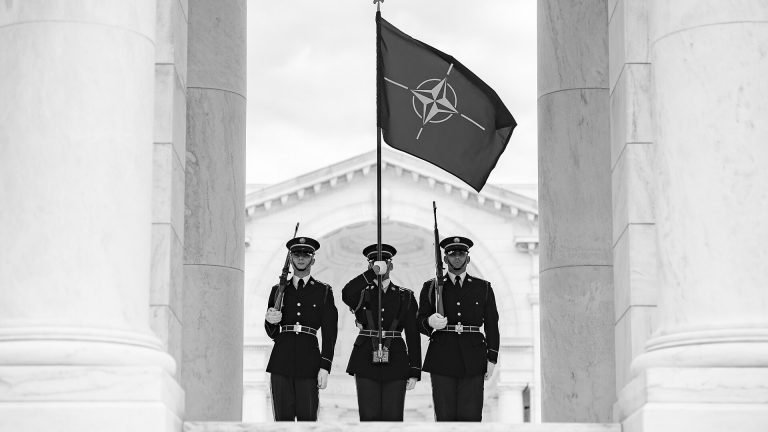
Image: Students and Senior Leaders From the North Atlantic Treaty Organization (NATO) Defense College Visit ANC, April 17, 2023, from Flickr.com. Retrieved from: https://commons.wikimedia.org/wiki/File:Students_and_Senior_Leaders_From_the_North_Atlantic_Treaty_Organization_(NATO)_Defense_College_Visit_ANC.jpg.
[1] A. Wess Mitchell, Great Power Diplomacy: The Skill of Statecraft from Attila the Hun to Kissinger (Princeton, NJ: Princeton University Press, 2025), 210.
[2] Harry Truman, “Special Message to the Congress on Greece and Turkey: The Truman Doctrine, March 12, 1947,” in Public Papers of the Presidents of the United States: Harry Truman, 1945-1953 (Washington DC: Government Printing Office, 1966), https://www.trumanlibrary.gov/library/public-papers/56/special-message-congress-greece-and-turkey-truman-doctrine.
[3] Brian McAllister Linn, Elvis’s Army: Cold War GIs and the Atomic Battlefield (Cambridge, MA: Harvard University Press, 2016), 9.
[4] Linn, Elvis’s Army: Cold War GIs and the Atomic Battlefield, 11.
[5] Linn, Elvis’s Army: Cold War GIs and the Atomic Battlefield, 11.
[6] William Stueck, The Korean War: An International History (Princeton, NJ: Princeton University Press, 1995), 25.
[7] Stueck, The Korean War: An International History, 35.
[8] Stueck, The Korean War: An International History, 35.
[9] Stueck, The Korean War: An International History, 35.
[10] Stueck, The Korean War: An International History, 31.
[11] Brett Forrest and Jessica Donati, “U.S. Declines to Impose Sanctions on Nord Stream Pipeline,” The Wall Street Journal, 19 May 2021, https://www.wsj.com/politics/policy/biden-administration-declines-to-impose-sanctions-on-nord-stream-2-pipeline-11621453630.
[12] Samantha Gross and Constanze Stelzenmuller, “Europe’s Russian gas divorce,” Brookings Institution, June 18, 2024, https://www.brookings.edu/articles/europes-messy-russian-gas-divorce/.
[13] Lauren Egan, “Biden says U.S. will not unilaterally send troops to defend Ukraine,” NBC News, December 8, 2021, https://www.nbcnews.com/politics/white-house/biden-says-u-s-will-not-unilaterally-send-troops-defend-n1285619.
[14] Egan, “Biden says U.S. will not unilaterally send troops to defend Ukraine.”
[15] Joseph R. Biden, Jr., “The President’s News Conference,” The American Presidency Project, January 19, 2022, https://www.presidency.ucsb.edu/node/354148.
[16] “Ukraine tensions: Russia condemns destructive US troop increase in Europe,” BBC, February 3, 2022, https://www.bbc.com/news/world-europe-60238869.
[17] Harry Truman, “Statement by the President on the Situation in Korea, June 27, 1950” in Public Papers of the Presidents of the United States: Harry Truman, 1945-1953 (Washington DC: Government Printing Office, 1966), https://www.trumanlibrary.gov/library/public-papers/173/statement-president-situation-korea.
[18] Secretaries of State and Defense, “NSC-68: A Report to the National Security Council,” Naval War College Review 28: no. 3, article 7, (1975), https://digital-commons.usnwc.edu/cgi/viewcontent.cgi?article=5901&context=nwc-review; Stueck, The Korean War: An International History, 42.
[19] Stueck, The Korean War: An International History, 85–87.
[20] Daniel Marston, “Limited War in the Nuclear Age: American Strategy in Korea,” in The New Makers of Modern Strategy: From the Ancient World to the Digital Age, ed. Hal Brands (Princeton, NJ: Princeton University Press, 2023), 724.
[21] Stueck, The Korean War: An International History, 128–130.
[22] Stueck, The Korean War: An International History, 168–70.
[23] Marston, “Limited War in the Nuclear Age: American Strategy in Korea,” 729–731.
[24] Paul Sonne et al., “Battle for Kyiv: Ukrainian valor, Russian blunders combined to save the capital,” The Washington Post, August, 24 2022, https://www.washingtonpost.com/national-security/interactive/2022/kyiv-battle-ukraine-survival/.
[25] Seth Jones et al., Ukrainian Innovation in a War of Attrition (Washington, DC: CSIS, 2023), 5, https://www.csis.org/analysis/ukrainian-innovation-war-attrition.
[26] Missy Ryan et al., “U.S. privately asks Ukraine to show it’s open to negotiate with Russia,” The Washington Post, November, 5 2022, https://www.washingtonpost.com/national-security/2022/11/05/ukraine-russia-peace-negotiations/; “Zelenskyy vows Ukraine will win as Russia redoubles effort,” Politico, September 21, 2022, https://www.politico.com/news/2022/09/21/zelenskyy-ukraine-russia-ap-00058201. .
[27] Ian Lovett and Marcus Walker, “Russia Gains the Upper Hand in the Drone Battle, Once Ukraine’s Forte,” The Wall Street Journal, November 29, 2025, https://www.wsj.com/world/russia-gains-the-upper-hand-in-the-drone-battle-once-ukraines-forte-803d242e.
[28] Marston, “Limited War in the Nuclear Age: American Strategy in Korea,” 729.
[29] Marston, “Limited War in the Nuclear Age: American Strategy in Korea,” 731.
[30] William Stueck, The Korean War: An International History, 231–32.
[31] Steve Crabtree, “The Gallup Brain: Americans and the Korean War,” Gallup, February 4, 2003, https://news.gallup.com/poll/7741/gallup-brain-americans-korean-war.aspx; Dina Smeltz and Lama El Baz, American Public Support for Assistance to Ukraine Has Waned, But Still Considerable (Chicago, IL: The Chicago Council on Global Affairs, 2023), 2, https://globalaffairs.org/research/public-opinion-survey/american-public-support-assistance-ukraine-has-waned-still.
[32] U.S. Department of Defense, “United Nations Command: Armistice Negotiations” (Washington, DC), https://www.unc.mil/History/1951-1953-Armistice-Negotiations/.
[33] Gen. Dwight Eisenhower, “Text of the Address by Dwight D. Eisenhower, Republican Nominee for President, at Detroit, Michigan, October 21, 1952,” Dwight D. Eisenhower Presidential Library, https://www.eisenhowerlibrary.gov/sites/default/files/research/online-documents/korean-war/i-shall-go-to-korea-1952-10-24.pdf.
[34] Stueck, The Korean War: An International History, 328–29; Marston, “Limited War in the Nuclear Age: American Strategy in Korea,” 736–37.
[35] Stueck, The Korean War: An International History, 328–29; Marston, “Limited War in the Nuclear Age: American Strategy in Korea,” 736–37.
[36] “How much money has the U.S. given Ukraine since Russia’s invasion?,” USA Facts, March 14, 2025, https://usafacts.org/articles/how-much-money-has-the-us-given-ukraine-since-russias-invasion/.
[37] Joesph R. Biden, jr., “Remarks by President Biden and President Zelenskyy of Ukraine in Joint Press Conference, December 21, 2022,” Public Papers of President Joe Biden, https://bidenwhitehouse.archives.gov/briefing-room/speeches-remarks/2022/12/21/remarks-by-president-biden-and-president-zelenskyy-of-ukraine-in-joint-press-conference/.
[38] Elliott Ackerman, “The Biden Administration’s Slow Yes Has Doomed Ukraine,” TIME Magazine, December 18, 2023, https://time.com/6548816/ukraine-biden-administration-military-aid/.
[39]Diana Nerozzi, “Trump wants peace in Ukraine, no matter what a deal looks like,” Politico, November 25, 2025, https://www.politico.com/news/2025/11/25/trump-wants-peace-in-ukraine-no-matter-what-a-deal-looks-like-00668136.
[40] Peter Dickinson, “While Trump talks peace, Putin is escalating efforts to erase Ukraine,” Atlantic Council, November 27, 2025, https://www.atlanticcouncil.org/blogs/ukrainealert/while-trump-talks-peace-putin-is-escalating-efforts-to-erase-ukraine/.
[41] Constant Meheut, “The Status of the 20-Point Peace Plan for Ukraine,” The New York Times, December 29, 2025, https://www.nytimes.com/2025/12/24/world/europe/what-is-in-the-20-point-ukraine-peace-plan.html.
[42] Max Bergmann and Maria Snegovaya, Russia’s War in Ukraine: The Next Chapter (Washington, DC: CSIS, 2025), 7, https://www.csis.org/analysis/russias-war-ukraine-next-chapter.
[43] Richard Reeves, President Kennedy: Profile of Power (New York, NY: Simon & Schuster, 1993), 71.
[44] “Russia is stumbling on the battlefield,” The Economist, May 10, 2026.
[45] “Russia is stumbling on the battlefield.”
[46] Amy Knight, “The U.S. Could Make 2026 Even Worse for Putin Than 2025,” The Wall Street Journal, January 11, 2026, https://www.wsj.com/opinion/the-u-s-could-make-2026-even-worse-for-putin-than-2025-611f9b8f.
[47] Yuliya Talmazan, “Poland moves troops to Belarus border as Wagner fighters fuel NATO tensions,” NBC News, August 12, 2023, https://www.nbcnews.com/news/world/poland-troops-belarus-border-wagner-fighters-nato-tensions-rcna98974.
[48] U.S. Department of Defense, “U.S. Military Casualties – Korean War” (Washington, DC: 2026), https://dcas.dmdc.osd.mil/dcas/app/conflictCasualties/korea/koreaSum.
[49] Hiranmayi Srinvasan, “U.S. Military Spending by War Since WWI,” Investopedia, October 31, 2024, https://www.investopedia.com/united-states-military-spending-by-war-8696931.
[50] Seth Jones and Riley McCabe, Russia’s Battlefield Woes in Ukraine, (Washington, DC: CSIS, 2025), 2, https://www.csis.org/analysis/russias-battlefield-woes-ukraine#h2-russia-s-battlefield-performance.
[51] U.S. Department of State, U.S. Security Cooperation with Ukraine, (Washington, DC: 2025), https://www.state.gov/bureau-of-political-military-affairs/releases/2025/01/u-s-security-cooperation-with-ukraine.
[52] Ronald Reagan, “Address Before the Korean National Assembly in Seoul, November 12, 1983,” Public Papers of President Ronald W. Reagan, Ronald Reagan Library, https://www.reaganlibrary.gov/archives/speech/address-korean-national-assembly-seoul.
[53] Office of the United States Trade Representative, US-Korea Free Trade Agreement (Washington, DC: 2025), https://ustr.gov/trade-agreements/free-trade-agreements/korus-fta.
[54] Victor Jack, “Ukraine’s push to sell arms to Europe runs up against export ban,” Politico, September 12, 2025, https://www.politico.eu/article/ukraine-push-sell-arms-europe-runs-up-against-export-ban/.
[55] Aidan Stretch, “Ukraine and U.S. move toward landmark drone defense deal as Iran war highlights capabilities, necessities,” CBS News, May 13, 2026, https://www.cbsnews.com/news/ukraine-us-drone-defense-deal-draft-iran-war-capabilities-necessities/.
[56] Peter Dickinson, “Wartime protests prove Ukraine’s democratic instincts are still strong,” Atlantic Council, July 24, 2025, https://www.atlanticcouncil.org/blogs/ukrainealert/wartime-protests-prove-ukraines-democratic-instincts-are-still-strong/.
[57] Stueck, The Korean War: An International History, 331.
[58] Stueck, The Korean War: An International History, 349–50.
[59] Stueck, The Korean War: An International History, 54.
[60] Stueck, The Korean War: An International History, 54.
[61] Stueck, The Korean War: An International History, 54.
[62] Stueck, The Korean War: An International History, 54.
[63] S. Galan, “Total annual United States military expenditure in gross terms and as a percentage of GDP during the Korean War from 1950 to 1953,” Statista, November 28, 2025, https://www.statista.com/statistics/1344315/us-military-expenditure-korean-war/.
[64] S. Galan, “Total annual United States military expenditure in gross terms and as a percentage of GDP during the Korean War from 1950 to 1953,” Statista, November 28, 2025, https://www.statista.com/statistics/1344315/us-military-expenditure-korean-war/; U.S. Department of Defense, “Defense Budget Overview: United States Department of Defense Fiscal Year 2025 Budget Request” (Washington DC: 2024), 1–5, https://comptroller.war.gov/Portals/45/Documents/defbudget/FY2025/FY2025_Budget_Request_Overview_Book.pdf.
[65] Linn, Elvis’s Army: Cold War GIs and the Atomic Battlefield, 49.
[66] Linn, Elvis’s Army: Cold War GIs and the Atomic Battlefield, 49.
[67] Christopher Johnstone et. al., “The Evolution of the U.S.-Japan Security Partnership,” CSIS, July 11, 2024, https://features.csis.org/evolution-of-the-us-japan-security-partnership/.
[68] Foreign Relations of the United States, Milestones 1954–1952, The Australia, New Zealand and United States Security Treaty (ANZUS Treaty), 1951, https://history.state.gov/milestones/1945-1952/anzus.
[69] Rear Admiral Howard E. Orem, “West Germany, A Candidate for Membership in NATO,” U.S. Naval Institute, May 1955, https://www.usni.org/magazines/proceedings/1955/may/west-germany-candidate-membership-nato.
[70] Dwight D. Eisenhower, “Radio and Television Address to the American People Announcing the Signing of the Korean Armistice,” The American Presidency Project, July 26, 1953, https://www.presidency.ucsb.edu/node/231814.
[71] Stueck, The Korean War: An International History, 5.
[72] Stueck, The Korean War: An International History, 352.
[73] Stueck, The Korean War: An International History, 352.
[74] Stueck, The Korean War: An International History, 352.
[75] Michael J. Seth, “An Unpromising Recovery: South Korea’s Post-Korean War Development 1953–61,” Association for Asian Studies, 2013, https://www.asianstudies.org/publications/eaa/archives/an-unpromising-recovery-south-koreas-post-korean-war-economic-development-1953-1961/.