
Featured Videos
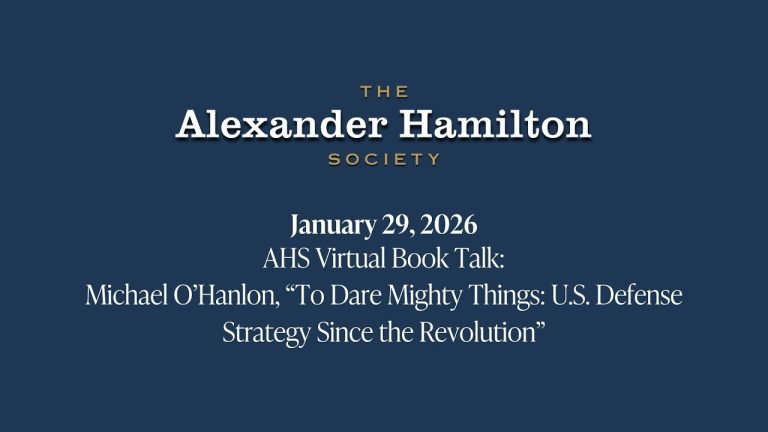
Michael O’Hanlon “To Dare Mighty Things” | AHS Virtual Book Talk
January 30, 2026
Much of the history of U.S. defense over the course of 250 years has been a story of success. Insulated by two oceans and mostly friendly neighbors, but constantly ambitious at home and abroad, America has dared mighty things…
Much of the history of U.S. defense over the course of 250 years has been a story of success. Insulated by two oceans and mostly friendly neighbors, but constantly ambitious at home and abroad, America has dared mighty things and often achieved them, argues defense analyst and strategist Michael O’Hanlon. After growing into a continental power, largely through force of arms, during the first half of its history, it then led the way to coalition victories in two world wars, pursued peace in the Cold War, and has contributed foundationally to the most democratic period in human history. But as historian Robert Kagan has argued, it is a more “dangerous nation” than most citizens appreciate, given that its leaders, as well as its people, are highly self-confident and activist. O’Hanlon claims that only by understanding this “national DNA” or American strategic culture and character can we hope to steer safely through the twenty-first century. He further argues that, in contrast to its consistently assertive grand strategy, there has been no single defining American “way of war” since 1775—a good thing, since security challenges of the future may not always resemble those of the past.

Quick Questions with Mike Watson | 1776: The Beginnings of American Exceptionalism Abroad
November 26, 2025
Get a candid look at Mike Watson’s essay “I am Large, I Contain Multitudes: Defining and Defending This Exceptional Nation” in the Alexander Hamilton Society’s publication “1776: The Beginnings of American Exceptionalism Abroad.”
Video Feed

Gen. David Petraeus “Conflict” | AHS Virtual Book Talk
October 26, 2023
Two leading authorities—an acclaimed historian and the outstanding battlefield commander and strategist of our time—collaborate on a landmark examination of war since 1945. ‘Conflict’ is both a sweeping history of the evolution of warfare up…
Two leading authorities—an acclaimed historian and the outstanding battlefield commander and strategist of our time—collaborate on a landmark examination of war since 1945. ‘Conflict’ is both a sweeping history of the evolution of warfare up to Putin’s invasion of the Ukraine, and a penetrating analysis of what we must learn from the past—and anticipate in the future—in order to navigate an increasingly perilous world.

Evan Thomas’ ‘Road to Surrender’ | AHS Virtual Book Talk
September 18, 2023
“At 9:20 a.m. on the morning of May 30, General Groves receives a message to report to the office of the secretary of war ‘at once.’ Stimson is waiting for him. He wants…
“At 9:20 a.m. on the morning of May 30, General Groves receives a message to report to the office of the secretary of war ‘at once.’ Stimson is waiting for him. He wants to know: has Groves selected the targets yet?” So begins this suspenseful, impeccably researched history that draws on new access to diaries to tell the story of three men who were intimately involved with America’s decision to drop the atomic bomb—and Japan’s decision to surrender. They are Henry Stimson, the American Secretary of War, who oversaw J. Robert Oppenheimer under the Manhattan Project; Gen. Carl “Tooey” Spaatz, head of strategic bombing in the Pacific, who supervised the planes that dropped the bombs; and Japanese Foreign Minister Shigenori Togo, the only one in Emperor Hirohito’s Supreme War Council who believed even before the bombs were dropped that Japan should surrender.
Bestselling author Evan Thomas draws on the diaries of Stimson, Togo and Spaatz, contemplating the immense weight of their historic decision to bring this critical event to life. In “Road to Surrender”, an immersive, surprising, moving account, Thomas lays out the behind-the-scenes thoughts, feelings, motivations, and decision-making of three people who changed history.